Will Car Run Without Catalytic Converter? Effects and Legal Risks
Yes, most gasoline cars can physically start and run with the catalytic converter missing because the converter is part of the exhaust-emissions system rather than a component required to create combustion. The car may become extremely loud, set a check-engine light, produce far more harmful exhaust, and develop drivability or safety problems depending on how the exhaust was left.
A vehicle with a stolen converter is different from one with a complete, properly sealed exhaust system. Theft often leaves an open gap underneath the passenger compartment. Exhaust gases, noise, hot exhaust flow, and damaged oxygen-sensor wiring can then create problems beyond emissions.
Removing a clogged converter can sometimes make an engine that was severely restricted seem stronger because exhaust flow is no longer blocked. That does not make converter removal a proper repair. A healthy converter is designed to flow enough exhaust for the engine while treating pollutants.
EPA states that catalytic converters are among the major emissions components covered by the federal emissions warranty for 8 years or 80,000 miles on qualifying light-duty vehicles. If a converter fails within that period because of a covered defect, checking warranty eligibility can save the cost of replacement.
The search question will car run without catalytic converter therefore has two answers: mechanically, many cars will still run; legally and practically, a road vehicle originally equipped with a converter should have the required converter restored. EPA considers removing or bypassing required emissions equipment to be tampering under federal law.
I’d treat a missing converter after theft as an exhaust repair that needs prompt attention, especially if the exhaust now ends under the vehicle. CDC warns that even a small exhaust-system leak can allow carbon monoxide to build up inside a car.
The sections below explain how the engine can keep running, what happens to power and fuel economy, why the check-engine light usually appears, the risks of an open exhaust, what happens after converter theft, and the correct repair path.
Why a Car Can Run Without a Catalytic Converter
The engine does not use the catalytic converter to ignite the air-fuel mixture.
Combustion happens inside the cylinders. The converter sits downstream in the exhaust and treats gases after they leave the engine.
The Converter Works After Combustion
A gasoline engine burns air and fuel inside its cylinders.
The resulting exhaust contains pollutants such as carbon monoxide, hydrocarbons, and oxides of nitrogen. The catalytic converter promotes chemical reactions that change much of those pollutants into less harmful exhaust compounds before gases leave the tailpipe.
EPA describes catalytic converters as major emissions-control components and notes that they have been fitted to most U.S. cars and light trucks since 1975.
The converter does not supply spark, fuel, compression, or engine timing. Those functions can continue if the converter is physically absent.
The Engine Still Needs a Proper Exhaust Path
Being able to run does not mean the engine should operate with a large open gap in the exhaust.
The exhaust system also routes hot gases toward the rear of the vehicle, reduces sound, supports oxygen-sensor monitoring, and keeps exhaust away from areas where it could enter the cabin.
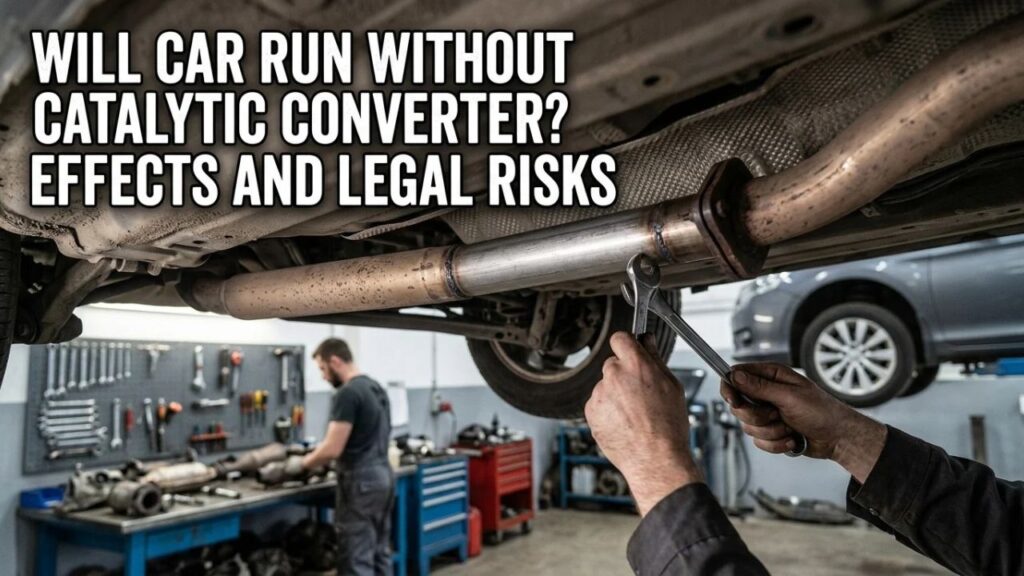
If thieves cut the converter out, the engine may dump exhaust underneath the floor instead of through the tailpipe.
That can make the vehicle dramatically louder and expose nearby parts to hot exhaust gases.
Modern Cars Monitor Catalyst Operation
Most OBD-II gasoline vehicles have an oxygen sensor before the converter and another after it.
Bosch explains that the downstream oxygen sensor monitors catalytic-converter efficiency and reports converter operation to the engine-control system.
If the converter disappears, the downstream sensor can see an exhaust signal that no longer resembles normal catalyst operation.
The computer can then set a catalyst-efficiency fault such as P0420 or P0430 and illuminate the check-engine light.
Key Takeaway: The engine can create combustion without a converter, but the converter, exhaust piping, and oxygen sensors remain part of the vehicle’s certified exhaust and emissions system.
What Happens When You Drive Without a Catalytic Converter?
The exact result changes with vehicle design and how the converter was removed.
A car with a stolen converter and cut wiring may behave differently from one with an emissions fault but an otherwise intact exhaust.
The Exhaust Becomes Much Louder
A catalytic converter provides some sound attenuation even though its main purpose is emissions control.
Removing it creates a less restricted and often much shorter exhaust path.
If theft leaves a pipe open near the engine, startup can sound harsh, deep, and dramatically louder than normal.
AutoZone lists a major increase in exhaust noise as one of the common results of operating without the converter.
The Check-Engine Light May Turn On
On modern vehicles, converter performance is monitored by oxygen sensors and the OBD system.
Without a functioning catalyst, upstream and downstream sensor signals may become too similar.
The computer may store:
- P0420 — Catalyst System Efficiency Below Threshold, Bank 1
- P0430 — Catalyst System Efficiency Below Threshold, Bank 2
- Oxygen-sensor circuit codes if wiring was damaged
- Heater-circuit codes if a sensor was cut during theft
Clearing the light does not restore the converter. The code may return after the catalyst monitor runs again.
Exhaust Emissions Rise Sharply
The engine continues producing pollutants that the converter was designed to treat.
Without the catalyst, more hydrocarbons, carbon monoxide, and nitrogen oxides can leave the exhaust untreated.
That is the main reason removal is prohibited on vehicles originally certified with catalytic converters.
Fuel Economy May Change
Simply removing a healthy converter does not guarantee better fuel economy.
Modern engine controls are calibrated around a complete emissions and exhaust system. Problems created by sensor faults, exhaust leaks, wiring damage, or altered exhaust behavior can contribute to poor operation.
AutoZone notes that removing or bypassing the converter may cause reduced fuel economy or poor engine behavior on some vehicles.
Exhaust Fumes Can Enter the Cabin
This risk is especially relevant after converter theft.
If the exhaust pipe ends underneath the passenger compartment, gases are no longer carried safely toward the rear of the vehicle.
CDC states that carbon monoxide is colorless and odorless and warns that even a small automotive exhaust leak can allow CO to build up inside the vehicle.
Do not rely on smell alone to judge whether exhaust gases are entering the cabin.
Key Takeaway: Expect louder exhaust, emissions faults, much higher pollutant output, and possible exhaust-fume exposure. A theft-damaged exhaust can create more immediate concerns than the missing catalyst itself.
Will Removing a Catalytic Converter Increase Horsepower?
Removing a healthy converter from a normal street car is not a sensible horsepower modification.
A properly selected factory converter is engineered to provide adequate exhaust flow for the original engine while meeting emissions requirements.
A Healthy Converter Is Not the Same as a Clogged Converter
A converter that has melted or collapsed internally can create severe exhaust backpressure.
In that condition, the engine may:
- Accelerate poorly
- Lose power at higher RPM
- Stall
- Struggle on hills
- Become difficult to start
Removing the restriction may make power return.
The gain comes from removing a faulty blockage, not from proving that a healthy converter was hurting engine output.
Replacing the failed converter with the correct new unit restores both exhaust flow and emissions treatment.
A Missing Converter Can Create Other Problems
Altered oxygen-sensor data, exhaust leaks, poor fabrication, and sensor wiring faults can offset any theoretical reduction in exhaust resistance.
AutoZone notes that modern engine-control systems are designed around the converter being present and that bypassing it can produce poor operation on some vehicles.
For a street vehicle, restoring the correct converter is the better approach than treating removal as a performance modification.
Key Takeaway: Removing a clogged converter can restore power lost to exhaust restriction. Removing a healthy converter is not the same thing and is not a proper street-performance repair.
Will a Car Run After the Catalytic Converter Is Stolen?
In many cases, yes.
The engine may start immediately after the theft, but the vehicle can sound radically different.
The Engine May Start Normally
The catalytic converter is downstream of the combustion process, so its sudden absence does not normally remove spark, fuel, or compression.
The engine may start and idle.
Drivers often discover converter theft because the car suddenly sounds extremely loud when started.
Damaged Sensors Can Change the Situation
Thieves may cut through oxygen-sensor wires or remove sections of exhaust containing sensors.
That can add electrical fault codes to the catalyst problem.
A hanging wiring harness can also contact hot exhaust parts or the road.
Inspect the underside before assuming the only missing part is the converter.
Driving After Theft Is a Poor Choice
An open exhaust can discharge gases underneath the cabin.
AutoZone recommends parking or towing a vehicle with a stolen converter rather than continuing to drive it because exhaust gases can enter the passenger compartment.
CDC’s carbon-monoxide guidance supports the same concern: automotive exhaust leaks can allow CO to accumulate inside a vehicle.
I would use towing if the exhaust ends under the cabin, wiring is hanging, parts are dragging, or fumes are noticeable inside.
Key Takeaway: A car can often start after converter theft, but the open exhaust and possible sensor damage make continued driving a poor plan. Inspect and repair the system promptly.
Can Driving Without a Converter Damage the Engine?
The answer depends on what happened to the exhaust and engine-control system.
The simple absence of a converter does not automatically destroy the engine.
An Open Exhaust Can Affect Nearby Components
Hot exhaust leaving from a cut pipe under the vehicle can blow onto wiring, heat shields, floor insulation, hoses, or nearby components.
That situation is very different from exhaust flowing normally through the full system.
Repairing the missing section restores the intended gas path.
Sensor Faults Can Affect Operation
The downstream oxygen sensor’s main job is catalyst monitoring, while upstream sensors have a larger role in mixture control on most gasoline vehicles.
Vehicle strategies differ, so a damaged sensor circuit should not be ignored.
Bosch states that downstream sensors monitor converter operation, while faulty oxygen sensors can be associated with poor engine behavior and reduced fuel economy.
The Cause of Converter Failure May Be the Bigger Engine Threat
If the converter was not stolen but failed internally, look for the cause.
Misfires, oil burning, coolant entering the cylinders, rich fuel mixtures, and other engine faults can damage the catalyst.
AutoZone notes that converter faults often begin with another engine problem rather than the converter failing without a cause.
Replacing or removing the converter without fixing that fault leaves the real engine problem in place.
Key Takeaway: Missing catalyst material alone does not guarantee engine damage. Open exhaust, damaged wiring, sensor faults, and the engine problem that destroyed the converter can create larger risks.
Is It Legal to Drive Without a Catalytic Converter in the U.S.?
A vehicle originally certified with a catalytic converter is required to retain its emissions equipment.
EPA treats deliberate removal, bypassing, or rendering the required converter inoperative as emissions tampering.
Federal Law Prohibits Converter Removal
EPA guidance states that replacing a required catalytic converter with a straight pipe is prohibited under federal anti-tampering rules.
The prohibition applies to private owners as well as businesses that install defeat or bypass parts.
A converter can be removed temporarily when necessary for legitimate repair work, provided the vehicle is returned to its proper emissions configuration afterward.
A Stolen Converter Is Different From Deliberate Removal
A vehicle owner whose converter was stolen did not intentionally tamper with the system.
The vehicle still needs to be repaired, though.
State inspection, registration, emissions, and road-use requirements can affect what happens next.
The Car May Fail an Emissions Inspection
A missing converter can be detected visually and through OBD diagnostics.
Catalyst-efficiency monitoring will also fail on many modern vehicles once the computer completes its tests.
Replacing the converter with the correct legal unit restores the vehicle to its intended emissions configuration.
Key Takeaway: A car may mechanically run without the converter, but deliberate removal or bypass of required emissions equipment is prohibited under U.S. federal law.
Can You Replace the Catalytic Converter With a Straight Pipe?
A straight pipe is not a legal substitute for a required converter on a U.S. road vehicle.
EPA specifically identifies converter replacement pipes as emissions defeat devices in its anti-tampering guidance.
Installing a pipe may restore a continuous exhaust path and reduce the extreme noise of an open system, but it still bypasses the emissions device the car was certified to use.
It may also leave catalyst-monitor codes active.
The correct repair is a legal converter that matches the vehicle’s emissions application.
Some states, including California, impose their own requirements on which aftermarket converter can be installed. Check the emissions label, VIN, engine family, and local replacement rules before ordering a part.
What Should You Do If Your Catalytic Converter Is Missing?
Start by determining why it is missing.
If it was stolen, inspect the rest of the exhaust system for damage.
Look for:
- Cut oxygen-sensor wires
- Hanging connectors
- Damaged exhaust pipes
- Missing shields
- Loose sections
- Scraped fuel or brake lines
- Exhaust ending below the cabin
Do not crawl underneath a vehicle supported only by a jack.
If the converter failed and was previously removed, diagnose the cause before fitting another one. Misfires, rich operation, oil consumption, and coolant leaks can shorten the life of the replacement.
Check Federal Warranty Coverage
EPA says catalytic converters are among the specified major emissions components covered for 8 years or 80,000 miles, whichever occurs first, for qualifying vehicles under federal emissions warranty provisions.
Check the warranty booklet and contact the manufacturer if the vehicle is still inside the applicable period.
The warranty does not normally cover theft.
Install the Correct Converter
Match the replacement to:
- Year
- Make
- Model
- Engine
- Converter position
- Federal or California emissions certification
- Vehicle emissions family where required
A converter that physically fits the pipe is not automatically the correct emissions part.
Repair Sensor and Exhaust Damage
Replace or repair damaged oxygen sensors, wiring, flanges, gaskets, and exhaust pipe sections.
After repairs, scan the vehicle for fault codes and confirm there are no exhaust leaks.
The OBD catalyst monitor may need normal driving before it completes its self-test.
Key Takeaway: Restore the full exhaust and emissions system rather than replacing only the missing canister. Theft can damage pipes, sensors, wiring, and mounting hardware at the same time.
How Long Can You Drive Without a Catalytic Converter?
There is no mileage figure that makes an open or converter-less exhaust a sound long-term setup.
If the converter was stolen and the exhaust is open beneath the car, I would avoid routine driving.
The immediate issues are not just emissions. Exhaust gases may enter the cabin, the exhaust may be extremely loud, and cut wiring or pipes may be unsafe.
If the car is already at home and a repair shop is some distance away, towing removes those concerns.
A vehicle with a properly sealed but illegally bypassed converter may physically travel much farther, but that does not make the configuration legal or suitable for road use.
The goal should be restoring the required converter, not determining the maximum distance the engine can tolerate without it.
Conclusion
The answer to will car run without catalytic converter is usually yes from a purely mechanical standpoint. Most gasoline engines can start and produce power without the catalyst because combustion occurs before exhaust reaches the converter.
That does not make the missing converter harmless. Expect much higher emissions, a possible check-engine light, louder exhaust, and added risk if the exhaust has been cut open beneath the passenger area. A stolen converter can also leave oxygen-sensor wiring and exhaust components damaged.
I would restore the correct converter and complete exhaust path rather than drive around the problem. If the converter failed rather than being stolen, diagnose the misfire, fuel, oil-consumption, or coolant problem that may have damaged it before installing the replacement.
FAQs About Running a Car Without a Catalytic Converter
Will a Car Start if the Catalytic Converter Is Missing?
Yes, most gasoline cars can still start because the converter does not create spark, compression, or fuel delivery.
A stolen converter often makes itself obvious through extremely loud exhaust. Sensor damage or other faults caused during removal may create extra warning lights or drivability problems.
Will a Car Run Better Without a Catalytic Converter?
A healthy car normally should not need converter removal to run well.
If a converter is badly clogged, removing the blockage can make the engine feel stronger because exhaust can escape again. The proper repair is to diagnose why the converter became restricted and install a correct replacement.
Will the Check-Engine Light Come On Without a Catalytic Converter?
On many OBD-II vehicles, yes.
The downstream oxygen sensor monitors converter behavior. Without a functioning catalyst, the computer may detect poor catalyst efficiency and store P0420 or P0430.
Damaged oxygen-sensor wiring can create additional codes.
Can a Missing Catalytic Converter Cause a Car to Stall?
The simple absence of a converter does not commonly cause stalling by itself.
A car may stall if sensor wiring was damaged, another engine problem exists, or the exhaust modification created other faults. A clogged converter is more commonly associated with stalling because it restricts exhaust flow.
Is It Safe to Drive After the Catalytic Converter Is Stolen?
Driving is a poor choice if the theft left the exhaust open beneath the passenger compartment.
CDC warns that exhaust leaks can allow carbon monoxide to accumulate inside a vehicle. Towing is safer when the exhaust has been cut open, sensor wires are damaged, or parts are hanging underneath.
Can I Replace a Catalytic Converter With a Straight Pipe?
Not legally on a U.S. road vehicle that was originally equipped with a required converter.
EPA considers installing a converter replacement pipe to be emissions tampering because it bypasses the certified emissions-control device.
Will a Car Pass Emissions Without a Catalytic Converter?
A modern vehicle required to have a converter is very unlikely to pass a proper emissions inspection without one.
The missing converter may be found during visual inspection, the check-engine light may be on, catalyst readiness may fail, or tailpipe emissions may exceed the applicable limits.
Does Insurance Cover a Stolen Catalytic Converter?
Catalytic-converter theft may be covered under comprehensive auto insurance when the policy includes that coverage, subject to the deductible and policy terms.
Document the theft, photograph the damage, follow the insurer’s claim process, and get a repair estimate before authorizing major exhaust work.