Why Does My Catalytic Converter Keep Going Bad? Causes and Fixes
Repeated catalytic-converter failure usually means another engine or exhaust problem has not been repaired. Misfires, an overly rich fuel mixture, burning oil, coolant entering the cylinders, exhaust restrictions, or the wrong replacement converter can damage the new unit again. Replacing the converter alone may only reset the problem temporarily.
This pattern can become expensive because the converter is often the damaged part rather than the original cause. Raw fuel can overheat and melt its internal ceramic structure, while oil or coolant can coat the catalyst surface until it can no longer treat exhaust gases properly.
Finding the upstream fault before installing another converter protects the replacement and can also correct rough running, poor fuel economy, misfires, oil consumption, overheating, or power loss that may have been present alongside the catalyst fault.
For U.S. vehicles, catalytic converters are among the major emission-control components covered by the federal 8-year/80,000-mile emissions warranty, whichever comes first, under applicable warranty conditions. Checking coverage before paying for another replacement can save a large repair bill.
If you are asking why does my catalytic converter keep going bad, start by assuming there may be an unresolved cause upstream of the converter. A replacement unit should not repeatedly fail after a short period on an engine that is running correctly and is not sending excess fuel, oil, coolant, or damaging heat into the exhaust.
I would pay special attention to any flashing check engine light, P0300-series misfire code, unusual oil consumption, unexplained coolant loss, or rich fuel-trim readings. EPA guidance warns that severe misfire can damage the catalytic converter in a short period.
The sections below cover the most common repeat-failure causes, signs that point toward each one, checks to perform before buying another converter, replacement-part mistakes, and ways to prevent the next converter from failing for the same reason.
Why Does My Catalytic Converter Keep Going Bad After Replacement?
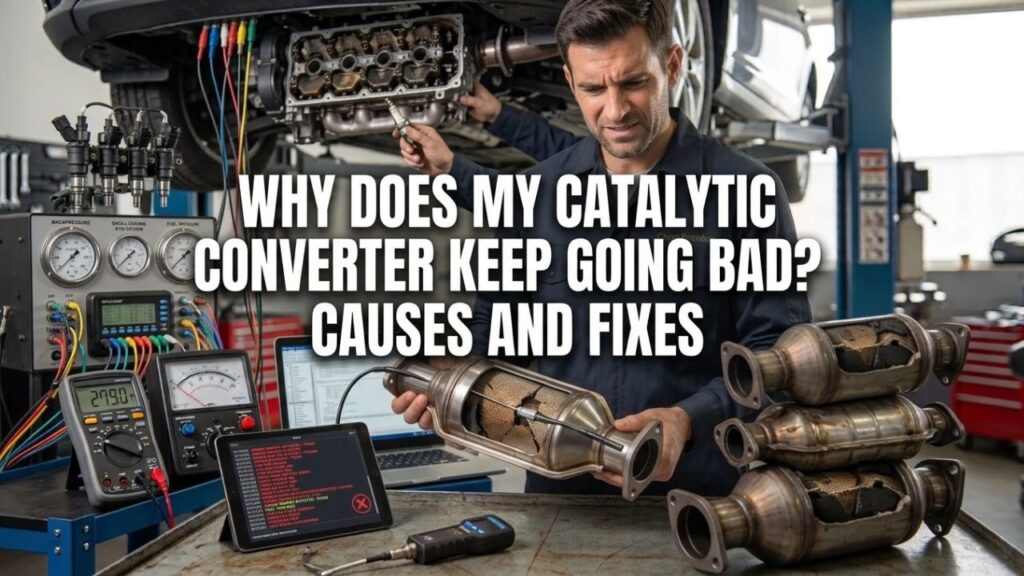
A catalytic converter has no moving parts that wear in the same way as a pump or bearing. Its internal substrate carries catalyst materials that process pollutants in the exhaust stream.
Repeated failure often means the converter is being exposed to conditions outside the environment it was built to handle.
Engine Misfires Are a Major Cause
A misfire occurs when a cylinder fails to burn its air-fuel charge correctly.
The unburned fuel can travel into the exhaust and reach the catalytic converter. Once inside the hot converter, that fuel can burn and create much more heat than normal.
Sustained overheating can damage, melt, or collapse the ceramic substrate. EPA technical material has long identified misfire and overly rich operation as causes of destructive converter temperatures.
Possible sources of a misfire include:
- Worn spark plugs
- Weak ignition coils
- Damaged plug wires on vehicles that use them
- Fuel-injector problems
- Low compression
- Vacuum or intake faults
- Mechanical engine problems
A flashing check engine light deserves immediate attention because it commonly indicates a severe misfire.
The Engine Is Running Too Rich
A rich air-fuel mixture means the engine is receiving more fuel than it can burn correctly.
That excess fuel can reach the converter and increase internal temperature.
Possible causes include a leaking injector, faulty airflow measurement, incorrect fuel pressure, sensor faults, or another problem that causes the engine computer to command too much fuel.
A rich-running engine may also show:
- Black exhaust smoke
- Strong fuel smell
- Poor fuel economy
- Soot around the tailpipe
- Negative long-term fuel-trim values
- Rough running
A converter installed before the rich condition is corrected can suffer the same damage as the previous one.
The Engine Is Burning Oil
Oil that enters the combustion chamber can pass through the exhaust after it burns.
Oil ash and additives can build deposits on the catalyst surface. That contamination blocks areas that need direct contact with exhaust gases.
Common sources include:
- Worn piston rings
- Worn cylinder walls
- Valve-stem seal problems
- Valve-guide wear
- PCV-system faults
- Turbocharger oil leaks on turbocharged engines
Blue or blue-gray exhaust smoke is a common clue, though an engine can consume oil without creating obvious smoke all the time.
Check the dipstick regularly. If the engine loses oil between changes without an external leak, investigate the consumption before installing another converter.
Coolant Is Entering the Combustion Chambers
Coolant can contaminate a catalytic converter in a similar way.
A leaking head gasket, cracked cylinder head, or another internal cooling-system fault may allow coolant into a cylinder. After combustion, coolant-related deposits travel through the exhaust and can coat the catalyst.
Possible clues include:
- Unexplained coolant loss
- Persistent white exhaust after warm-up
- Sweet-smelling exhaust
- Cooling-system pressure problems
- Overheating
- Misfire during startup
- Contaminated spark plugs
Replacing the converter does nothing to stop coolant from entering the engine.
Key Takeaway: Repeat converter failure commonly comes from misfires, excess fuel, oil consumption, or coolant contamination, so those faults need repair before another converter is installed.
How Misfires Destroy a Catalytic Converter
Raw Fuel Creates Excessive Heat
The catalytic converter normally operates at high temperature, but it is not meant to act as an engine combustion chamber.
When large amounts of unburned fuel enter the exhaust, oxidation inside the converter releases substantial heat.
The internal ceramic structure can begin to deteriorate, melt, or collapse under severe overheating.
Once melted material blocks the passages, exhaust cannot move through the converter normally.
A New Converter Can Fail Quickly
This is why a vehicle can destroy more than one converter in a relatively short time.
Imagine replacing a converter while leaving a weak ignition coil that occasionally causes a severe misfire. The new converter begins receiving the same raw fuel that destroyed the original part.
The replacement may work properly at first and then return with P0420, P0430, rattling, or restricted-exhaust symptoms later.
Flashing Check Engine Light Is a Warning
A flashing check engine light should not be treated like an ordinary steady warning lamp.
EPA guidance states that a flashing malfunction indicator can signal a severe misfire capable of seriously damaging emission-control components, especially the catalytic converter.
Reduce driving and diagnose the misfire rather than continuing until the vehicle becomes difficult to drive.
Key Takeaway: A severe misfire can send raw fuel into the converter and generate enough heat to destroy a replacement unit, so the misfire must be repaired first.
How Rich Fuel Mixtures Cause Repeat Converter Failure
Leaking Fuel Injectors
An injector that does not close properly can supply too much fuel to one cylinder.
That cylinder may still fire, so the problem may not always feel like an obvious dead-cylinder misfire.
Check fuel trims, spark-plug appearance, injector operation, and fuel pressure according to the vehicle’s diagnostic procedure.
Incorrect Sensor Information
The engine computer calculates fueling from several inputs.
Problems involving the mass airflow sensor, manifold-pressure sensor, coolant-temperature data, oxygen or air-fuel sensors, and related circuits can contribute to incorrect fueling.
Do not replace sensors simply because a converter code is present. Live data should support the diagnosis.
Excessive Fuel Pressure
Too much fuel pressure can push more fuel through the injectors than expected.
The computer may compensate within a limited range, but severe pressure problems can still produce rich operation.
Fuel-pressure specifications are vehicle-specific.
Stuck-Open Purge Valve
An evaporative-emissions purge valve that flows when it should be closed can introduce extra fuel vapor into the intake.
This may cause rich starting, rough idle, or fuel-trim problems under certain conditions.
Key Takeaway: A converter repeatedly exposed to excess fuel can overheat again, so injector operation, sensor data, fuel pressure, and mixture control deserve attention before replacement.
Oil and Coolant Contamination Can Poison the Converter
Oil Leaves Deposits on the Catalyst
Burned engine oil produces deposits that can cover the active catalyst surface.
A converter does not have a practical way to repair heavily contaminated catalyst material.
Installing another converter while the engine continues consuming oil can repeat the failure.
AutoZone and Cars.com both list oil or coolant contamination among common converter-failure causes.
Coolant Can Create Similar Damage
Coolant entering the combustion process can leave deposits in the converter.
Do not assume every head-gasket problem will create dramatic white smoke. Small leaks may first show up as slow coolant loss, intermittent misfires, or one unusually clean spark plug.
A cooling-system pressure test, combustion-gas test, leak-down test, or other vehicle-appropriate diagnostic method may be needed.
Cleaning the Converter Does Not Repair Severe Contamination
A chemical poured into the fuel tank cannot rebuild melted ceramic or restore catalyst material that has been badly poisoned.
Some deposits may change under normal driving conditions, but a physically damaged or heavily contaminated converter usually requires replacement after the root cause has been corrected.
Key Takeaway: Oil and coolant can coat the catalyst surface, so abnormal oil consumption or unexplained coolant loss should be diagnosed before another converter is fitted.
Could the Replacement Catalytic Converter Be the Problem?
Yes. The engine is not always responsible for repeat catalyst trouble.
The Wrong Converter May Have Been Installed
Catalytic converters are application-specific.
The replacement has to match factors such as:
- Vehicle year
- Engine size
- Engine family
- Exhaust configuration
- Number of converters
- OBD system
- Emissions certification
EPA material on aftermarket converters states that catalog application should be checked because certain aftermarket products may not operate correctly with some OBD systems.
A part that physically bolts into the exhaust is not automatically the correct emissions component.
Low-Quality Parts Can Create Early Efficiency Codes
Aftermarket converters vary in construction, catalyst loading, durability, certification, and application coverage.
A poorly matched unit may trigger P0420 or P0430 sooner than a proper OE or high-quality direct-fit converter, even after major engine faults have been corrected.
If the code returned shortly after replacement and all engine data looks normal, verify the exact converter part number and required emissions certification.
Installation Problems Can Affect the Result
An exhaust leak near an oxygen sensor can change the sensor signal and interfere with catalyst monitoring.
Check:
- Flange gaskets
- Welds
- Flex pipes
- Oxygen-sensor threads
- Exhaust-manifold connections
- Clamps
- Cracked tubing
A replacement converter should also be mounted without severe stress in the exhaust system.
Key Takeaway: A wrong, poorly matched, or badly installed converter can create repeat trouble even when the engine itself is healthy.
P0420 or P0430 Does Not Always Mean the New Converter Failed
Catalyst Codes Describe Efficiency
P0420 means catalyst-system efficiency is below the programmed threshold on Bank 1.
P0430 refers to the equivalent condition on Bank 2.
The computer typically reaches that conclusion by examining oxygen-sensor behavior before and after the converter.
The code does not contain a statement that says, “The converter itself is definitely defective.”
Oxygen-Sensor Problems Can Confuse Diagnosis
A biased, slow, damaged, or incorrectly installed oxygen sensor can alter catalyst-monitor data.
Wiring damage can create similar trouble.
Check sensor performance and related codes before replacing the converter again.
Exhaust Leaks Matter
Outside air entering the exhaust near a sensor can alter oxygen readings.
A small leak can produce a catalyst-related diagnostic path even though the converter is not the original cause.
Clear Codes Only After Repairs
Clearing P0420 or P0430 resets diagnostic information and may reset readiness monitors.
If the underlying fault remains, the code can return after the catalyst monitor runs again.
Do not use code clearing as proof that the repair worked.
Key Takeaway: P0420 and P0430 identify catalyst-monitor failure, but oxygen sensors, exhaust leaks, engine faults, and incorrect replacement parts need to be ruled out before another converter is condemned.
Can a Clogged Exhaust Destroy a Catalytic Converter?
A restriction elsewhere in the exhaust can contribute to excessive heat and poor engine operation.
A damaged muffler, crushed exhaust pipe, collapsed converter farther downstream, or debris from another catalyst can reduce exhaust flow.
Cars.com notes that a restricted muffler or tailpipe can increase backpressure and converter temperature.
Possible restriction symptoms include:
- Weak acceleration
- Power dropping as RPM rises
- Poor hill-climbing ability
- Excessive exhaust heat
- Engine struggling under load
- Converter glowing in severe cases
Backpressure testing or another manufacturer-approved restriction test may be needed.
Do not assume the newest converter is clogged merely because the vehicle lacks power. Fuel delivery, ignition, turbocharger, transmission, and airflow faults can create similar symptoms.
Physical Damage and Thermal Shock Can Break a Converter
Catalytic converters sit low enough under many vehicles to be exposed to road impacts.
A hard strike from debris, a curb, or rough terrain can crack the ceramic substrate or deform the shell.
Loose internal material may begin rattling and can later shift enough to obstruct exhaust flow.
Rapid temperature changes can also stress ceramic material. A very hot converter exposed to unusual cooling conditions can suffer thermal damage.
Inspect the exhaust for:
- Deep dents
- Impact marks
- Crushed tubing
- Loose heat shields
- Internal rattling
- Broken mounts
- Exhaust components contacting the body
Physical damage is less common than engine-related overheating, but replacing the converter without correcting poor exhaust support or ground-clearance problems can result in another damaged unit.
What to Check Before Replacing the Catalytic Converter Again
1. Scan All Codes
Read stored, pending, and permanent codes where supported.
Do not focus only on P0420 or P0430.
Misfire, fuel-trim, oxygen-sensor, injector, temperature, and airflow codes may reveal the fault responsible for damaging the catalyst.
2. Review Freeze-Frame Data
Freeze-frame data records operating conditions when a code was detected.
Look at:
- Engine RPM
- Load
- Coolant temperature
- Fuel trims
- Vehicle speed
- Related sensor information
This can show if the fault appeared during idle, cruise, heavy load, or another operating condition.
3. Check Misfire Data
Look for P0300 or cylinder-specific P0301-P0312 codes as applicable.
Some scan tools can also display live misfire counters.
A converter should not be installed while a severe active misfire remains.
4. Check Fuel Trims
Short-term and long-term fuel trims provide clues about mixture correction.
Large corrections deserve diagnosis.
Do not rely on one universal fuel-trim cutoff because vehicle strategies and operating conditions differ.
5. Check Oil Consumption
Record the oil level accurately and monitor it over mileage.
If oil repeatedly disappears without an external leak, determine where it is going.
6. Check Coolant Level
Monitor coolant only when the engine is cold and according to the owner’s manual.
Unexplained loss deserves investigation.
7. Inspect the Exhaust for Leaks
Inspect connections before and after the converter, especially near oxygen sensors.
Soot marks around a joint can indicate leakage.
8. Evaluate Oxygen-Sensor Data
Compare sensor behavior using vehicle-specific service information.
Wideband air-fuel sensors do not behave exactly like older narrowband oxygen sensors, so generic voltage rules can lead to poor diagnosis.
9. Test for Exhaust Restriction
If acceleration falls sharply under load, test for excessive backpressure using an approved diagnostic procedure.
A melted converter may be both inefficient and physically restricted.
10. Confirm the Replacement Part
Verify that the installed converter matches the vehicle’s engine and emissions application.
If the vehicle was repaired recently, locate the invoice and part number.
Key Takeaway: Before buying another converter, scan the complete system, check misfires and fuel trims, monitor oil and coolant, inspect for leaks, test restriction when symptoms fit, and verify the installed part number.
How to Prevent Another Catalytic Converter Failure
Fix the cause before replacing the converter.
Do not drive for extended periods with an active severe misfire, especially when the check engine light is flashing.
Repair rich-running conditions, leaking injectors, ignition faults, and fuel-control problems promptly.
Monitor oil and coolant levels. An engine that consumes either fluid internally can damage a replacement converter even if it still feels reasonably normal from the driver’s seat.
Use the correct converter for the exact emissions application and install new gaskets or required hardware where specified.
Keep oxygen sensors and exhaust connections in good condition.
If the vehicle is still inside applicable federal emissions coverage, check the warranty terms before paying for the repair. The EPA states that specified major emission-control components, including catalytic converters, receive federal coverage for 8 years or 80,000 miles under qualifying conditions.
When You Should Stop Driving
A steady catalyst-efficiency code does not always require an immediate roadside stop, but some symptoms deserve faster action.
Avoid continued normal driving if you have:
- A flashing check engine light
- Severe continuous misfire
- Major loss of engine power
- A glowing-red converter
- Strong overheating smell
- Smoke from under the vehicle
- Engine stalling from suspected exhaust restriction
- Extreme heat near the floor or exhaust system
A severely overheated converter can damage nearby components, while a melted substrate can restrict exhaust flow enough to affect engine operation.
If those symptoms are present, have the vehicle inspected rather than repeatedly clearing codes and continuing to drive.
Conclusion
If you are asking why does my catalytic converter keep going bad, the most likely explanation is that the original cause was never fully repaired or the replacement converter was not correct for the vehicle. Misfires, rich fueling, burning oil, coolant contamination, excessive heat, and exhaust problems can all destroy another converter.
Start with the engine rather than ordering another exhaust part. Scan all codes, inspect fuel-control data, verify there is no active misfire, track oil and coolant use, check oxygen-sensor operation, and look for exhaust leaks or restrictions.
I would not install a third converter until the reason the previous two failed is clear. Correcting the upstream fault first gives the replacement converter the conditions it needs to survive and prevents the same repair bill from returning.
FAQs About Repeated Catalytic Converter Failure
Can a Bad Spark Plug Ruin a Catalytic Converter?
Yes. A spark plug that causes repeated misfires can leave unburned fuel in the exhaust. That fuel may burn inside the catalytic converter and create damaging heat. Replace the failed ignition component and confirm the misfire is gone before installing another converter.
Can a Bad Ignition Coil Damage a New Catalytic Converter?
Yes. A weak or failed coil can cause one cylinder to misfire and send unburned fuel downstream. A flashing check engine light or P0300-series code deserves attention before the vehicle is driven extensively with a new converter.
Can Burning Oil Keep Ruining Catalytic Converters?
Yes. Oil entering the combustion chambers can leave deposits on the catalyst surface. Worn piston rings, valve seals, PCV faults, and turbocharger problems are possible causes. If oil consumption continues, another replacement converter may become contaminated too.
Can a Blown Head Gasket Damage the Catalytic Converter?
Yes. A head-gasket leak can allow coolant into a combustion chamber. Coolant-related deposits can contaminate the catalyst, while associated misfires may raise converter temperature. Repair the engine fault before fitting another converter.
Can a Bad O2 Sensor Ruin a Catalytic Converter?
An oxygen-sensor fault can contribute to incorrect fuel control on some vehicles, which may create conditions that harm the converter. It can also produce misleading diagnostic data. Test the sensor and fuel-control system rather than replacing it solely because a catalyst code is present.
Why Did My New Catalytic Converter Fail After a Few Months?
A short-lived replacement often points to an unresolved misfire, rich mixture, oil or coolant contamination, exhaust problem, incorrect converter application, or poor-quality replacement part. Check the failed converter and engine data for evidence of overheating or contamination before installing another unit.
Can a Cheap Catalytic Converter Cause P0420?
Yes, an incorrect or poorly matched aftermarket converter may fail to satisfy the vehicle’s catalyst monitor even if it physically fits the exhaust. Confirm the part number, emissions application, and certification required for the vehicle before replacing it again.
Will Fixing the Engine Make a Damaged Catalytic Converter Work Again?
Usually not if the converter’s ceramic substrate has melted, broken, or become heavily contaminated. Repairing the engine stops further damage, but a converter that has already lost enough catalyst efficiency or become physically restricted may still require replacement.