Can a Clogged Catalytic Converter Cause Rough Idle? Signs & Fixes
Yes, a severely restricted catalytic converter can make an engine idle roughly because trapped exhaust raises backpressure and interferes with normal cylinder breathing. The symptom is more common when the restriction becomes severe. A mildly restricted converter may idle normally yet cause major power loss during acceleration or at higher RPM.
Rough idle alone is not strong proof of a blocked converter. Spark plugs, ignition coils, vacuum leaks, dirty injectors, low compression, a faulty MAF sensor, and fuel-mixture problems are usually more direct causes of unstable combustion at idle.
The benefit of checking the symptoms in the right order is avoiding an expensive converter replacement that does not fix the engine. A restriction test can separate an exhaust problem from ignition, fuel, air, and mechanical faults.
For U.S. owners, the EPA identifies the catalytic converter as a specified major emissions component covered under applicable federal emissions warranties for 8 years or 80,000 miles, whichever comes first. Coverage conditions apply, so checking the warranty booklet may save a substantial repair bill if the converter itself has failed.
For can a clogged catalytic converter cause rough idle, the key detail is the degree of blockage. A converter that is partly restricted may create little trouble at idle because exhaust volume is low. As the passages become more blocked, backpressure can rise enough to affect cylinder filling and make the engine shake, stumble, or stall.
I’d pay close attention to what happens when you press the accelerator. Rough idle paired with weak acceleration, limited RPM, hard starting, excessive exhaust heat, or stalling makes an exhaust restriction more suspicious than rough idle by itself.
The sections below explain why a blocked converter can disturb idle, which symptoms point toward exhaust restriction, how it differs from a normal misfire, what codes may appear, how backpressure is tested, and what should be repaired before replacing the converter.
Can a Clogged Catalytic Converter Cause Rough Idle?
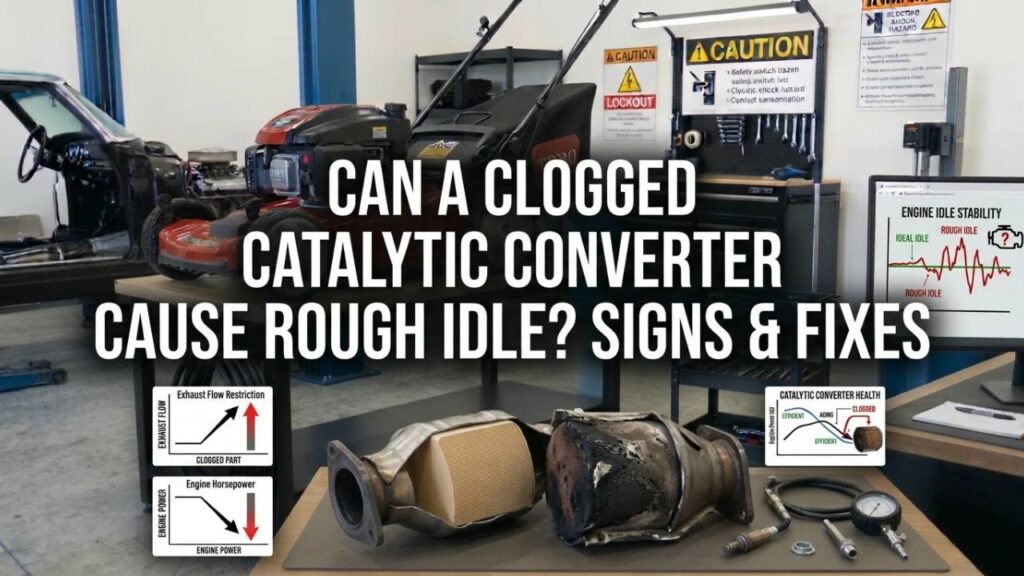
Yes. A badly clogged catalytic converter can cause rough idle when the exhaust restriction becomes severe enough to interfere with the engine’s ability to move exhaust gases out of the cylinders.
The effect comes from exhaust backpressure. The engine must push burned gases through the converter before fresh air and fuel can fill the cylinders for the next combustion cycle.
How Exhaust Backpressure Affects Idle
A healthy exhaust system lets burned gases leave with relatively little restriction.
A clogged converter narrows the available exhaust passages. Pressure builds between the engine and the blockage.
When enough exhaust remains trapped in a cylinder, there is less room for a fresh air-fuel charge during the next intake stroke. Combustion can become unstable, which may cause shaking, stumbling, or irregular idle speed.
Why the Problem May Be Worse Under Acceleration
The engine produces much less exhaust while idling than it does at 2,500 RPM or under heavy acceleration.
A partially clogged converter may therefore pass enough exhaust for a fairly smooth idle but become a major restriction as engine speed rises.
AutoZone describes clogged converters as creating excessive backpressure, with common effects that include starting trouble, poor acceleration, reduced engine output, misfires, and poor fuel economy.
This is why sluggish acceleration is often a stronger converter clue than rough idle alone.
Severe Restriction Can Cause Stalling
If the converter becomes nearly blocked, exhaust pressure may become high enough that the engine struggles even at low speed.
The engine may start and idle roughly for a short period, then stall as heat and exhaust pressure build.
A heavily damaged converter can become restrictive enough to cause both rough running and difficulty starting.
Key Takeaway: A clogged converter can disturb idle through excessive exhaust backpressure, but partial restrictions often show up first as poor acceleration and loss of higher-RPM power.
How a Clogged Converter Changes Engine Breathing
An internal-combustion engine acts partly like an air pump. It must draw fresh air in and push burned gases out during every operating cycle.
The exhaust stroke becomes harder when the converter cannot pass enough gas.
Exhaust Gas Remains in the Cylinder
Excessive backpressure reduces how completely the cylinder clears during the exhaust stroke.
Residual exhaust gas then mixes with the incoming air-fuel charge.
A small amount of residual exhaust is normal, but too much can weaken combustion and reduce the amount of oxygen available for the next firing event.
Cylinder Filling Becomes Less Consistent
Idle already operates with relatively small amounts of air and fuel.
If exhaust flow varies from one cycle to the next, cylinder filling can become inconsistent. The result may feel like a mild misfire or uneven shake through the seat and steering wheel.
The Engine Computer May Try to Compensate
The PCM adjusts fueling and idle control based on sensor information.
If exhaust restriction changes airflow through the engine, fuel trims and calculated engine load can shift.
The computer may compensate to a point, but it cannot physically clear a converter whose passages have melted, collapsed, or become heavily contaminated.
Key Takeaway: Converter restriction can leave excess burned gas in the cylinders and reduce fresh charge volume, creating unstable combustion when the blockage becomes severe.
Signs the Rough Idle May Come From a Clogged Converter
The strongest diagnosis comes from combining symptoms rather than focusing on idle quality alone.
Rough Idle Plus Weak Acceleration
This combination deserves attention.
A vehicle may shake while stopped, then feel unusually slow when pulling away. Acceleration can become worse as RPM rises because greater exhaust flow creates more pressure behind the restriction.
AutoZone describes a clogged catalytic converter as a source of engine backpressure that can choke power during acceleration.
Engine Will Not Rev Freely
A severe restriction can make the engine feel as though it reaches a ceiling.
You may press the accelerator farther, yet RPM climbs slowly or stops increasing normally.
This behavior is more characteristic of restricted exhaust flow than many ordinary idle problems.
Rough Idle Gets Worse as the Engine Warms
A vehicle may run better shortly after a cold start and become rougher once hot.
Heat can change the position of broken converter material, increase exhaust volume, or worsen a marginal restriction.
This pattern is not unique to converter problems, so testing is still needed.
Hard Starting or Stalling
Heavy blockage can trap enough exhaust to make starting difficult.
The vehicle may crank longer, start and stumble, or stall after running briefly.
AutoZone lists both hard starting and stalling among symptoms associated with severe converter restriction.
Converter Rattling
A broken internal substrate can rattle inside the converter shell.
Loose pieces may also shift and partially block the outlet.
Rattling plus rough running and poor acceleration makes internal converter damage more plausible.
Excessive Heat Under the Vehicle
A failing converter can become extremely hot, especially if a misfire or rich fuel mixture is feeding unburned fuel into the exhaust.
A converter that glows red needs immediate attention.
Do not touch a catalytic converter or exhaust pipe after driving. These parts can cause serious burns.
Sulfur or Rotten-Egg Smell
A sulfur-like odor sometimes appears with converter or fuel-mixture problems.
The smell is not proof of blockage, but it becomes more useful when paired with poor acceleration, high exhaust heat, or catalyst-related codes.
Key Takeaway: Rough idle becomes more suspicious for a clogged converter when it appears with weak acceleration, limited RPM, hard starting, stalling, rattling, or excessive exhaust heat.
Rough Idle From a Converter vs a Normal Engine Misfire
A rough idle often feels like a misfire, and the two problems can overlap.
In fact, the misfire may have damaged the converter before the converter began restricting exhaust flow.
Single-Cylinder Misfire
A consistent P0301, P0302, P0303, or similar cylinder-specific code usually points first toward that cylinder.
Common causes include:
- Spark plug failure
- Ignition coil failure
- Fuel injector trouble
- Low compression
- Vacuum leak near one intake runner
- Valve damage
A converter restriction generally affects several cylinders that share the same exhaust path rather than one isolated cylinder.
Random or Multiple-Cylinder Misfires
P0300 means random or multiple-cylinder misfire.
A severe exhaust restriction can contribute to this pattern because several cylinders may struggle to clear exhaust correctly.
P0300 has many other causes, so a converter should not be replaced without restriction testing.
Misfire Can Damage the Converter First
This failure direction is very common.
A misfiring cylinder can send unburned fuel into the exhaust. That fuel may burn inside the converter and raise its temperature enough to melt or damage the substrate.
Cars.com notes that misfires can produce rough idle and can damage the catalytic converter by allowing unburned fuel into the exhaust.
The sequence can become:
- A plug, coil, injector, or compression problem creates a misfire.
- Unburned fuel enters the converter.
- Converter temperature rises.
- The substrate melts or breaks down.
- Exhaust flow becomes restricted.
- Backpressure creates additional running problems.
That cycle is why the original misfire must be repaired before installing a new converter.
Key Takeaway: A clogged converter can contribute to multiple-cylinder rough running, but an isolated cylinder misfire usually points toward ignition, fuel, air, or compression first.
Other Common Causes of Rough Idle to Check First
Rough idle has many causes that are more common than converter restriction.
Vacuum Leak
A cracked vacuum hose, intake gasket leak, or PCV-system leak can allow unmetered air into the engine.
The problem often becomes most obvious at idle because manifold vacuum is high.
A lean mixture may cause shaking, surging, or misfire codes.
Bad Spark Plugs or Ignition Coils
Weak ignition can prevent a cylinder from burning its mixture completely.
A failing coil may produce a rough idle, hesitation, flashing Check Engine Light, or cylinder-specific P0300-series code.
Dirty or Faulty Fuel Injectors
An injector that delivers too little fuel can make one cylinder run lean.
A leaking injector can make the mixture too rich.
Either condition can make idle rough and can eventually damage the catalytic converter if combustion remains poor.
Dirty or Faulty MAF Sensor
The mass airflow sensor helps the PCM calculate how much fuel the engine needs.
Incorrect airflow information can create a rich or lean mixture.
Firestone lists rough idle, loss of power, and other drivability problems among possible MAF-related symptoms.
Faulty Oxygen Sensor
An upstream oxygen or air-fuel sensor can affect fuel control on many vehicles.
Bad information may push the mixture rich or lean and create rough running.
The downstream sensor has a different job and is used largely to monitor catalyst activity on many OBD-II systems.
Low Compression
Worn rings, burned valves, a leaking head gasket, or valve-timing problems can produce rough idle that no converter replacement will fix.
Compression or leak-down testing may be needed if ignition and fuel checks do not explain the problem.
Does P0420 Mean the Converter Is Causing Rough Idle?
No.
P0420 means the catalyst system on Bank 1 is operating below the expected efficiency threshold. P0430 indicates a similar problem on Bank 2.
These codes do not prove that the converter is physically clogged.
A converter can lose chemical efficiency while exhaust still moves through it freely. In that case, the Check Engine Light may be on while the engine idles and accelerates normally.
If you have P0420 plus rough idle, check for other codes before blaming the converter.
A P0300-series misfire code, lean or rich fuel-trim code, MAF code, or oxygen-sensor code may point toward the problem that caused both symptoms.
Cars.com notes that converter failure is often a result of abnormal combustion or rough engine operation rather than the original cause.
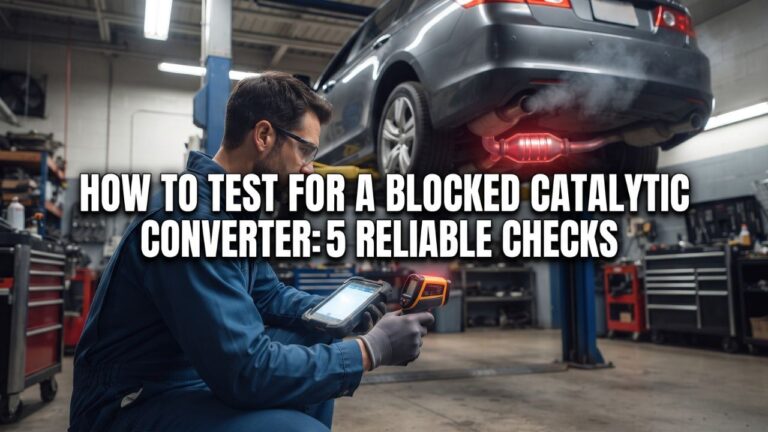
How to Test a Clogged Catalytic Converter
Testing is much more reliable than replacing parts from symptoms alone.
Scan for Codes and Live Data
Start with an OBD-II scanner.
Look for:
- P0420 or P0430
- P0300 through P0308
- Rich or lean codes
- MAF or MAP codes
- Oxygen-sensor codes
- Fuel-system faults
Review fuel trims and misfire counters if your scan tool provides them.
A cylinder-specific misfire should usually be diagnosed before exhaust restriction.
Perform an Exhaust Backpressure Test
A backpressure gauge provides a direct way to check exhaust restriction.
The gauge can be connected at an appropriate test point, commonly through an oxygen-sensor port using the correct adapter.
Walker gives general reference figures of no more than about 1 psi at idle and 3 psi at 2,500 RPM on most vehicles. Vehicle-specific service data should take priority.
If pressure is high before the converter, the restriction may be in the converter or farther downstream.
Testing at more than one location can help identify which component is blocked.
Use a Vacuum Gauge
A manifold-vacuum test can provide another clue.
With the engine held above idle, vacuum that gradually falls rather than stabilizing may indicate increasing exhaust restriction.
Valve timing and other mechanical problems can also affect vacuum readings, so this test should support other evidence rather than stand alone.
Compare Exhaust Temperature Carefully
An infrared thermometer can reveal abnormal temperature patterns.
Temperature by itself cannot prove that a converter is clogged.
A converter may run hot because unburned fuel is entering it, while a chemically inactive converter may run cooler without being physically blocked.
Check for Internal Damage
A broken substrate may create a rattle.
Visible impact damage, severe heat discoloration, or a loose internal core strengthens the case for converter failure.
Key Takeaway: OBD data, backpressure testing, vacuum behavior, temperature checks, and physical inspection give a much stronger diagnosis than rough idle or P0420 alone.
Can a Clogged Converter Cause Rough Idle Only When Hot?
Yes, it can.
A marginal restriction may allow the engine to behave normally while cold and produce stronger symptoms after the exhaust system heats up.
Heat can expand damaged materials, increase exhaust volume, and change how broken substrate pieces sit inside the converter.
A heat-related rough idle can also come from ignition coils, sensors, injectors, vacuum leaks, or mechanical engine problems.
Record when the roughness begins:
- Immediately after a cold start
- Only after several minutes
- Only at stoplights
- Only after highway driving
- Only with the air conditioner on
- Only under heavy load
That pattern can make diagnosis faster.
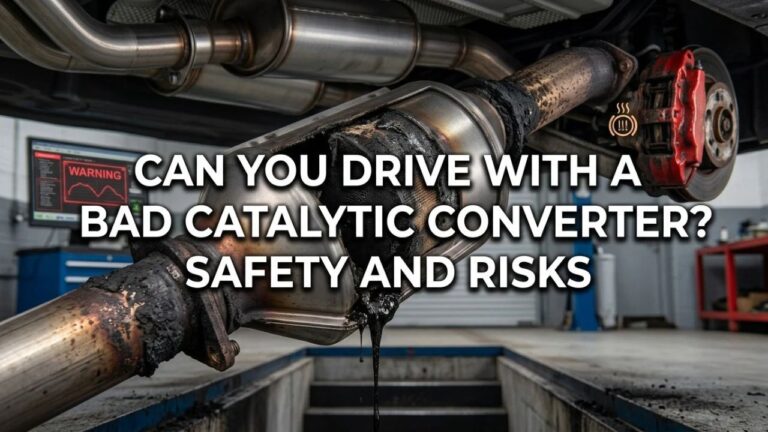
Can You Drive With a Clogged Converter and Rough Idle?
A lightly rough idle with normal acceleration still needs diagnosis, but it may not mean the car must be parked immediately.
Severe symptoms change the situation.
Stop driving and arrange inspection or towing if you notice:
- Major loss of acceleration
- Engine cannot maintain road speed
- Repeated stalling
- Converter glowing red
- Smoke beneath the vehicle
- Severe shaking
- Flashing Check Engine Light
- Strong burning smell
- Extreme exhaust heat
A flashing Check Engine Light often indicates a severe misfire that can quickly overheat the converter.
Driving harder will not clear a physically melted converter. Heavy throttle can increase exhaust flow and heat against the restriction.
What Should You Fix First?
If the converter is clogged because another engine problem damaged it, repair the original problem first.
Replacing the converter before correcting a misfire, rich mixture, oil-burning condition, or coolant leak can ruin the new part.
A sensible diagnostic order is:
- Scan all stored and pending codes.
- Diagnose active misfires.
- Check fuel trims.
- Inspect for vacuum leaks.
- Test suspect coils and spark plugs.
- Check injector operation.
- Check compression if needed.
- Inspect for oil or coolant consumption.
- Test exhaust backpressure.
- Replace the converter only after restriction or internal failure is confirmed.
I’d avoid replacing a converter solely because rough idle and P0420 happen at the same time. Confirm the restriction first.
Conclusion
Yes, can a clogged catalytic converter cause rough idle has a clear answer: severe converter restriction can create enough exhaust backpressure to disturb cylinder breathing and produce unstable idle, shaking, misfires, or stalling.
A partially clogged converter may still idle smoothly. Its first obvious signs may instead be weak acceleration, limited RPM, excessive heat, or loss of power under load. That makes rough idle alone a weak basis for replacing the converter.
Check more common causes such as plugs, coils, vacuum leaks, injectors, MAF readings, fuel mixture, and compression. Then use an exhaust backpressure test if the symptoms still point toward restriction.
I would repair any engine fault that damaged the converter before installing a replacement. If the converter is still within applicable federal emissions-warranty limits, check the vehicle’s warranty information before paying for the repair.
FAQs About Clogged Catalytic Converters and Rough Idle
Can a Clogged Catalytic Converter Make the Engine Shake at Idle?
Yes. A severe exhaust restriction can leave excess exhaust gas in the cylinders and interfere with fresh air entering the engine.
That can create unstable combustion and shaking. Spark, fuel, vacuum, and compression faults are also common causes, so shaking alone does not prove the converter is clogged.
Can a Bad Catalytic Converter Cause RPM to Fluctuate at Idle?
It can if the converter is restricted enough to disturb airflow through the engine.
Idle RPM fluctuation can also come from vacuum leaks, throttle-body deposits, MAF faults, fuel-control problems, ignition misfires, or idle-control issues. Scan data and backpressure testing can narrow the cause.
Can a Clogged Catalytic Converter Cause Stalling at Idle?
Yes. A severe blockage can create enough backpressure that the engine struggles to clear exhaust gases and eventually stalls.
Stalling has many other possible causes, including fuel-pressure loss, crankshaft-sensor faults, vacuum leaks, dirty throttle components, and ignition problems.
Does P0420 Cause Rough Idle?
P0420 itself does not cause rough idle. It is a diagnostic code indicating low catalyst efficiency on Bank 1.
The problem behind P0420 may exist alongside rough idle. Check for misfire, fuel-trim, sensor, and exhaust-leak codes before assuming the converter is physically blocked.
Will a Clogged Catalytic Converter Cause a Misfire at Idle?
It can when the restriction becomes severe.
Excess backpressure may reduce fresh cylinder filling and cause unstable combustion across multiple cylinders. A single-cylinder misfire is more likely to come from that cylinder’s plug, coil, injector, compression, or nearby air leak.
Why Does My Car Idle Rough but Drive Fine?
If the car drives normally once RPM rises, a clogged converter becomes less likely.
Vacuum leaks, dirty throttle components, weak ignition, injector imbalance, or idle-control problems deserve attention first. Converter restrictions often become more obvious as exhaust volume increases during acceleration.
Can a Clogged Catalytic Converter Cause Rough Idle Only After Warming Up?
Yes. Heat can make a marginal restriction more noticeable, and damaged converter material may shift as the exhaust system expands.
Heat-related ignition, sensor, injector, and vacuum problems can create the same pattern, so backpressure testing is useful before replacing the converter.
How Do I Confirm the Catalytic Converter Is Clogged?
Measure exhaust backpressure rather than relying on symptoms alone.
A technician may test through an oxygen-sensor port, compare readings at idle and higher RPM, and use additional test points to locate the restriction. High upstream pressure combined with poor acceleration and rough running provides stronger evidence of a clogged converter.