Hole in Catalytic Converter Symptoms: Signs, Risks, and Fixes
A hole in a catalytic converter usually causes a louder exhaust, hissing or ticking from underneath the vehicle, visible soot around the damaged area, and a stronger exhaust smell. A large leak can also trigger a check engine light, affect emissions readings, and allow dangerous exhaust gases to collect near or inside the passenger compartment.
A hole does not always mean the catalyst material inside has stopped working. The outer shell can rust, crack, or be damaged while part of the internal honeycomb remains intact. The leak itself still needs attention because exhaust is escaping before reaching its intended exit point.
Location matters too. A leak ahead of or close to an oxygen sensor can introduce outside air and alter sensor readings. A hole farther downstream may mainly produce noise and fumes without causing major engine-performance changes. Walker notes that even small exhaust leaks can affect oxygen-sensor information and fuel-control diagnosis.
The most common hole in catalytic converter symptoms are excessive exhaust noise, exhaust odor, black soot, rattling or vibration, an illuminated check engine light, and failed emissions inspection. You may also notice unusual heat marks or visible corrosion around the converter housing.
There is also a safety concern. CDC guidance warns that even a small vehicle exhaust leak can allow carbon monoxide to build up inside a car. Carbon monoxide is colorless and odorless, so the smell of exhaust should never be used as the only warning that fumes are entering the cabin.
A damaged converter should be inspected before deciding on repair. The sections below explain the main symptoms, why holes develop, how they differ from an internally clogged converter, how technicians find leaks, and when replacement is the safer repair.
What Are the Main Symptoms of a Hole in a Catalytic Converter?
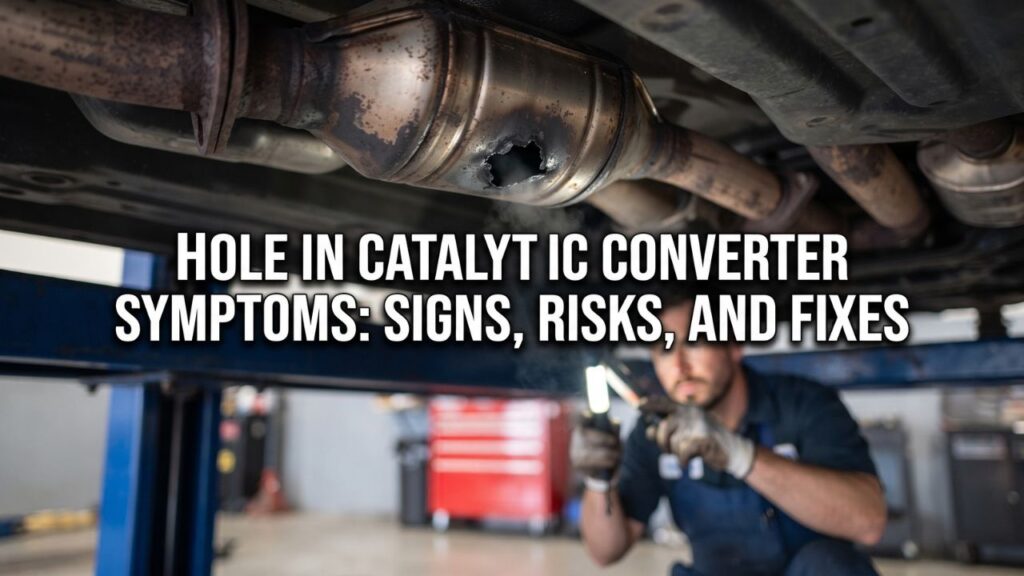
A perforated converter acts partly like an exhaust leak.
The symptoms depend on the size of the opening, its position, and the condition of the catalyst inside.
Louder Exhaust Noise
A sudden increase in exhaust volume is one of the easiest symptoms to notice.
Exhaust normally stays sealed inside the system until it exits at the tailpipe. A hole in the converter housing gives pressurized exhaust another route out.
The sound may be:
- Deep and booming
- Raspy
- Hissing
- Ticking
- Popping during acceleration
Small cracks often sound sharper.
Large openings can make the vehicle sound as though part of the exhaust pipe has been removed.
Noise usually becomes louder as RPM rises because exhaust flow increases.
Ticking or Hissing Under the Vehicle
A pinhole or narrow crack can create a distinct ticking or hissing sound.
Cold-start ticking may be easier to hear because exhaust pressure is high and surrounding metal has not expanded yet.
As the converter warms up, thermal expansion can slightly change the size of the opening and alter the sound.
This does not mean the problem has repaired itself.
Strong Exhaust Smell
Escaping exhaust may produce a noticeable odor around the vehicle.
The smell may be strongest:
- At idle
- During slow traffic
- After parking
- Near the damaged side of the exhaust
- With windows open
- When the climate-control system draws outside air
A sulfur-like odor can occur with catalyst or fuel-mixture problems, but a plain exhaust smell can simply come from the leak.
Black Soot Around the Hole
Exhaust leaks often leave dark deposits around the damaged area.
Look for dry black or gray soot near:
- Cracks
- Rust holes
- Weld seams
- Converter inlet
- Converter outlet
- Oxygen-sensor ports
Ford service guidance has used soot and moisture witness marks as evidence when checking exhaust systems for leaks.
Fresh soot around a crack strongly supports an exhaust-leak diagnosis.
Check Engine Light
A hole may trigger the check engine light, especially if the leak affects oxygen-sensor readings.
Codes may involve:
- Catalyst efficiency
- Oxygen-sensor response
- Fuel mixture
- Exhaust sensor readings
P0420 or P0430 may appear in some cases, but neither code proves that a hole exists.
A scanner should be used as part of the diagnosis rather than as a replacement for physical inspection.
Failed Emissions Inspection
A damaged converter housing can contribute to an emissions-test failure.
Problems may include:
- Exhaust escaping before proper treatment
- Incorrect sensor readings
- Reduced catalyst operation
- Visible exhaust-system damage
- Catalyst-monitor codes
Inspection requirements differ by state.
Rattling From the Converter
A hole caused by heavy corrosion or impact may occur alongside internal catalyst damage.
Broken pieces of the ceramic substrate can rattle inside the housing.
Rattling is more likely during:
- Startup
- Acceleration
- Deceleration
- Driving over bumps
A loose heat shield can make a similar sound, so rattling alone does not prove the honeycomb has broken.
Key Takeaway: The strongest signs of a converter hole are louder exhaust, ticking or hissing, visible soot, exhaust smell, and visible housing damage. Warning lights or rattling may appear when the leak also affects sensors or internal catalyst parts.
Can a Hole in the Catalytic Converter Cause Exhaust Fumes Inside the Car?
Yes.
Any opening in the exhaust system creates a possible route for gases to escape beneath the vehicle instead of behind it.
Air movement around the body can then carry exhaust toward openings in the cabin.
Carbon Monoxide Is the Main Safety Concern
Vehicle exhaust can contain carbon monoxide.
Carbon monoxide cannot be reliably detected by smell, sight, or taste.
Possible exposure symptoms include:
- Headache
- Dizziness
- Nausea
- Drowsiness
- Weakness
- Confusion
NIOSH identifies carbon monoxide as a poisonous gas found in engine exhaust and notes that exposure can cause headache, dizziness, drowsiness, and nausea.
If occupants develop those symptoms while riding in the vehicle, get into fresh air and seek appropriate medical assistance.
Cabin Odor May Be Worse While Idling
A moving vehicle has airflow underneath it that can disperse some exhaust.
At idle, gases may linger around the underside.
That is why exhaust odor can seem stronger:
- At traffic lights
- In drive-through lines
- While warming the car
- Inside enclosed parking structures
Do not leave a vehicle with a known exhaust leak running in an enclosed garage.
Open Windows Do Not Make the Leak Safe
Opening a window may reduce the concentration of fumes in some situations, but it does not repair the exhaust.
Airflow around moving vehicles can behave unpredictably.
The correct fix is sealing or replacing the damaged exhaust component.
Key Takeaway: A hole in the converter can release exhaust beneath the passenger compartment, creating a carbon-monoxide risk even if no strong smell is present.
Can a Hole in a Catalytic Converter Cause a Check Engine Light?
Yes, though it depends on the location of the leak.
Modern engine-management systems use oxygen or air-fuel sensors before and after the catalyst.
Leaks Can Disturb Oxygen-Sensor Readings
Exhaust flow is made up of pressure pulses.
A leak can allow outside air to enter the system between pulses.
That extra oxygen may affect sensor readings.
Walker specifically recommends checking for leaks near converter connections and oxygen-sensor ports when diagnosing catalyst concerns.
The engine computer may then interpret the exhaust differently from what is actually happening inside the cylinders or converter.
Catalyst Codes May Appear
Possible converter-related codes include:
- P0420 — Catalyst System Efficiency Below Threshold, Bank 1
- P0430 — Catalyst System Efficiency Below Threshold, Bank 2
A hole near the monitored section of exhaust can complicate catalyst evaluation.
Do not replace the converter from a code alone without inspecting the exhaust for leaks.
Other Sensor Codes Are Possible
A leak may also contribute to oxygen-sensor or air-fuel-ratio sensor codes.
Exact codes depend on:
- Leak location
- Engine design
- Sensor type
- Vehicle programming
Key Takeaway: A converter hole can trigger a check engine light if escaping exhaust or incoming outside air changes the readings used by the engine computer.
Can a Hole in a Catalytic Converter Cause Loss of Power?
A simple external hole usually does not restrict exhaust enough to cause major power loss.
In fact, the opening reduces exhaust pressure at that location rather than blocking flow.
Large power loss points toward another problem.
Internal Damage Can Occur at the Same Time
The event that created the hole may also have damaged the substrate.
For example, a strong impact can:
- Dent or crack the housing.
- Break the ceramic honeycomb.
- Allow broken pieces to move.
- Partially block the converter outlet.
The resulting restriction can cause:
- Weak acceleration
- Poor high-RPM power
- Stalling
- Rough idle
- Limited engine speed
In that situation, the loss of power comes from the internal blockage rather than from the hole itself.
Severe Fuel-Control Problems Can Produce Both Symptoms
A converter that has overheated badly may develop:
- Cracked housing
- Melted substrate
- Heat discoloration
- Restricted exhaust
An underlying misfire or rich-running engine may be responsible for both the converter damage and poor performance.
Key Takeaway: A hole alone normally causes leakage and noise rather than major power loss. Strong performance problems suggest internal converter damage or another engine fault.
Does a Hole in the Catalytic Converter Cause Poor Gas Mileage?
It can in some situations, though a hole is not guaranteed to reduce fuel economy.
The effect depends largely on sensor position.
A Leak Near an Upstream Sensor Can Affect Fuel Control
The engine computer relies on upstream exhaust sensors to adjust fuel mixture.
If a leak alters the sensed oxygen level, fuel corrections may shift.
That can contribute to:
- Rich running
- Lean-running corrections
- Hesitation
- Increased fuel use
Walker states that even small exhaust leaks can affect the accuracy of MAF, oxygen-sensor, and air-fuel-sensor diagnosis.
A Downstream Leak May Have Little Effect on Fueling
The downstream oxygen sensor primarily monitors catalyst operation on many gasoline vehicles.
A leak behind the main fuel-control sensor may trigger monitoring problems without changing fuel delivery enough to cause obvious fuel-economy loss.
A sudden mileage drop should therefore be investigated rather than automatically blamed on the hole.
What Causes a Hole in a Catalytic Converter?
Converter housings are built to survive high temperatures and road exposure, but they are not immune to damage.
Rust and Corrosion
Corrosion is a common cause on older exhaust systems.
Moisture, road salt, dirt, and repeated heating cycles can attack:
- Weld seams
- Flanges
- Pipe connections
- Converter shell
Eventually, thin metal can perforate.
A tiny rust spot may grow into a larger opening once surrounding metal becomes weak.
Road Impact
The converter is positioned underneath many vehicles.
It can be struck by:
- Rocks
- Road debris
- Curbs
- Speed bumps
- Off-road obstacles
A hard impact may dent or tear the outer shell.
Excessive Heat
Converter temperatures rise sharply when excess fuel enters the exhaust.
Common causes include:
- Engine misfire
- Leaking injector
- Rich fuel mixture
- Ignition failure
Extreme temperature can weaken metal and damage welds while melting the internal substrate.
Thermal Stress
The exhaust repeatedly heats and cools every time the vehicle is driven.
Over many years, expansion and contraction can contribute to metal fatigue around already weak areas.
Previous Repair or Welding
An old weld can crack if:
- The surrounding metal is thin
- Exhaust hangers are damaged
- The system moves excessively
- Welding quality was poor
Inspect the mounting system whenever a repaired converter cracks again.
Theft Damage
Catalytic-converter theft often involves cutting through exhaust pipes quickly.
If an attempted theft is interrupted, the converter or adjacent pipes may be left partially cut or punctured.
Key Takeaway: Corrosion, road impact, excessive heat, thermal cycling, damaged mounts, old repairs, and attempted theft can create holes or cracks in a converter housing.
Hole in Catalytic Converter vs. Clogged Catalytic Converter
These problems can occur together, but they usually produce different symptom patterns.
| Symptom | Hole or crack | Clogged converter |
| Loud exhaust | Very common | Not typical |
| Hissing or ticking | Common | Not typical |
| Visible soot | Common | Not typical |
| Exhaust fumes underneath | Common | Possible |
| High-RPM power loss | Less common | Common |
| Restricted acceleration | Less common | Common |
| Rattling | Possible | Possible |
| Check engine light | Possible | Possible |
| Exhaust backpressure | Usually not increased by hole | Often increased |
| Visible housing damage | Common | May look normal externally |
A vehicle can have both if the converter has suffered severe heat or impact damage.
How Do You Check for a Hole in a Catalytic Converter?
Inspecting an exhaust leak requires care because the system becomes extremely hot.
Start With a Cold Exhaust
Let the vehicle cool fully.
Do not touch a recently operated catalytic converter.
The housing can remain hot well after the engine has been switched off.
Look for Visible Damage
Inspect the converter and nearby exhaust for:
- Holes
- Cracks
- Rust flakes
- Dents
- Broken welds
- Soot marks
- Damaged flanges
- Cut marks
- Loose heat shields
A flashlight makes small cracks easier to see.
Never crawl underneath a vehicle supported only by a jack.
Use properly rated jack stands or a professional lift.
Listen for the Source
A leak often produces a ticking, hissing, or blowing sound.
Have the exhaust checked while cold and again after warm-up because metal expansion can change the sound of a small leak.
Walker recommends inspecting exhaust systems under both cold and normal operating-temperature conditions when tracking down leaks.
Smoke Testing Can Find Small Leaks
Repair shops often use a smoke machine to find leaks that are difficult to locate visually.
Smoke introduced into the exhaust exits through cracks, pinholes, or leaking connections.
This avoids guessing based only on noise.
Scan the Vehicle
If the check engine light is on, read the diagnostic trouble codes before clearing them.
Codes can give clues about:
- Catalyst monitoring
- Oxygen sensors
- Fuel mixture
- Misfires
They should be combined with physical inspection.
Key Takeaway: Visual inspection, soot marks, sound checks, smoke testing, and scan data can identify a converter leak without guessing from symptoms alone.
Can You Repair a Hole in a Catalytic Converter?
The answer depends on the location and extent of damage.
Small Damage to Adjacent Pipe May Be Repairable
If the leak is in a short piece of exhaust pipe next to the converter, a qualified exhaust shop may be able to repair or replace that pipe section.
That does not necessarily require replacing a healthy converter.
A Rusted Converter Shell Often Needs Replacement
If corrosion has eaten through the actual converter housing, surrounding metal may already be thin.
Welding one small spot may simply move the next failure to another weak area.
Replacement is often the more durable repair.
Internal Damage Changes the Decision
A converter should generally be replaced if inspection shows:
- Broken substrate
- Melted honeycomb
- Heavy internal rattling
- Severe restriction
- Catalyst-efficiency failure
- Extensive structural corrosion
Repairing the outer shell does not restore a damaged catalyst.
Do Not Drill or Punch the Converter
Creating holes intentionally is not a repair method.
It can:
- Increase exhaust noise
- Release untreated exhaust
- Affect sensor readings
- Create fumes beneath the vehicle
- Violate emissions requirements
A damaged emissions component should be restored using a legal repair or compatible replacement.
Key Takeaway: A nearby pipe leak may be repairable, but a perforated converter shell with severe corrosion or internal damage usually calls for replacement.
Is It Safe to Drive With a Hole in the Catalytic Converter?
Driving should be limited until the leak is inspected.
The primary concern is exhaust escaping underneath the vehicle.
Do not keep driving if you notice:
- Exhaust fumes inside the cabin
- Headache or dizziness while driving
- Heavy smoke
- Severe exhaust noise
- Loose exhaust parts
- Converter glowing or overheating
- Strong power loss
- A flashing check engine light
If fumes enter the cabin, open the doors after stopping, move into fresh air, and have the vehicle repaired before routine use.
Do not idle a leaking vehicle inside a garage.
Conclusion
The most common hole in catalytic converter symptoms are louder exhaust, hissing or ticking, exhaust odor, black soot, visible rust or cracks, and possible check engine warnings. Rattling may appear if the internal ceramic structure has also been damaged.
A hole by itself usually acts like an exhaust leak rather than a blockage. Major acceleration loss or an engine that cannot reach normal RPM points more strongly toward a clogged converter or another engine problem.
Cabin fumes deserve immediate attention because vehicle exhaust can contain carbon monoxide. The gas cannot be reliably detected by smell, making a leaking exhaust system a safety issue even when occupants notice little odor.
Have the converter inspected for corrosion, impact damage, substrate failure, and nearby pipe leaks. If the actual converter shell is badly perforated or its catalyst is damaged, replacement is generally a better repair than repeatedly patching weakened metal.
FAQs About Hole in Catalytic Converter Symptoms
What does a hole in a catalytic converter sound like?
A small hole often produces ticking, hissing, or blowing sounds. A larger opening may create a loud, raspy exhaust note. The sound usually increases with engine RPM because more exhaust gas is passing through the system.
Will a hole in the catalytic converter turn on the check engine light?
It can. A leak near an oxygen sensor may change the exhaust readings used by the engine computer. Catalyst-efficiency or oxygen-sensor codes may appear. A small hole farther downstream may produce noise without immediately triggering a warning light.
Can a hole in the catalytic converter cause exhaust smell inside the car?
Yes. Exhaust escaping beneath the vehicle can move toward the cabin through ventilation openings or body gaps. Because exhaust may contain carbon monoxide, cabin fumes should be treated as a safety concern and repaired promptly.
Can a hole in a catalytic converter cause loss of power?
A simple hole usually does not cause major power loss because it does not block exhaust flow. If the converter was damaged internally at the same time, broken or melted catalyst material may restrict flow and reduce acceleration.
Can you weld a hole in a catalytic converter?
Some localized structural repairs may be possible when the surrounding metal and converter remain sound. A badly rusted housing, broken catalyst, or melted substrate generally requires replacement. An exhaust specialist should inspect the converter before deciding.
Will a hole in the catalytic converter cause bad gas mileage?
It can if the leak affects exhaust-sensor readings and fuel control. A hole farther downstream may have little effect on fuel consumption. Poor mileage has many other causes, so scan data and exhaust inspection are useful before blaming the converter.
Is a small catalytic converter hole dangerous?
It can be. Even a small exhaust leak may release fumes beneath the vehicle and potentially allow carbon monoxide into the cabin. Small holes also tend to grow when corrosion is present, so they should not be ignored.
Can a rust hole in the catalytic converter be patched?
A temporary patch may not last if surrounding metal is already thin from corrosion. If the actual converter housing has extensive rust, replacement is usually the more reliable option. Nearby exhaust-pipe damage may sometimes be repaired separately.