Broken Catalytic Converter Symptoms: 9 Signs and What They Mean
A physically damaged catalytic converter can cause a metallic rattle, loss of acceleration, limited engine speed, rough running, excessive exhaust heat, sulfur odors, poor fuel economy, hard starting, or a Check Engine Light. The exact symptoms depend on whether the internal honeycomb has cracked, melted, shifted, or become restricted.
Ignoring internal converter damage can turn a noisy exhaust problem into a severe flow restriction. Broken ceramic pieces may shift inside the housing, partly block the outlet, and create enough exhaust backpressure to reduce engine power or make the vehicle stall.
Identifying the type of failure before replacing parts reduces wasted repair costs. A converter that has lost catalyst efficiency behaves differently from one with a shattered or melted core, and P0420 or P0430 alone cannot tell you that the substrate has physically broken.
For U.S. owners, the EPA lists catalytic converters among specified major emissions-control components covered under applicable federal warranty provisions for 8 years or 80,000 miles, whichever comes first. Warranty conditions apply, so checking the vehicle’s warranty booklet is worthwhile before paying for a replacement.
The most useful broken catalytic converter symptoms are the ones that point toward physical substrate damage: rattling from the converter housing, worsening power as RPM rises, abnormal heat, and signs of exhaust restriction. I would give those symptoms more weight than a catalyst-efficiency code by itself.
The sections below explain nine common warning signs, the difference between a broken, clogged, and chemically failed converter, the faults that break the internal core, diagnostic tests, and when driving should stop.
What Does a Broken Catalytic Converter Mean?
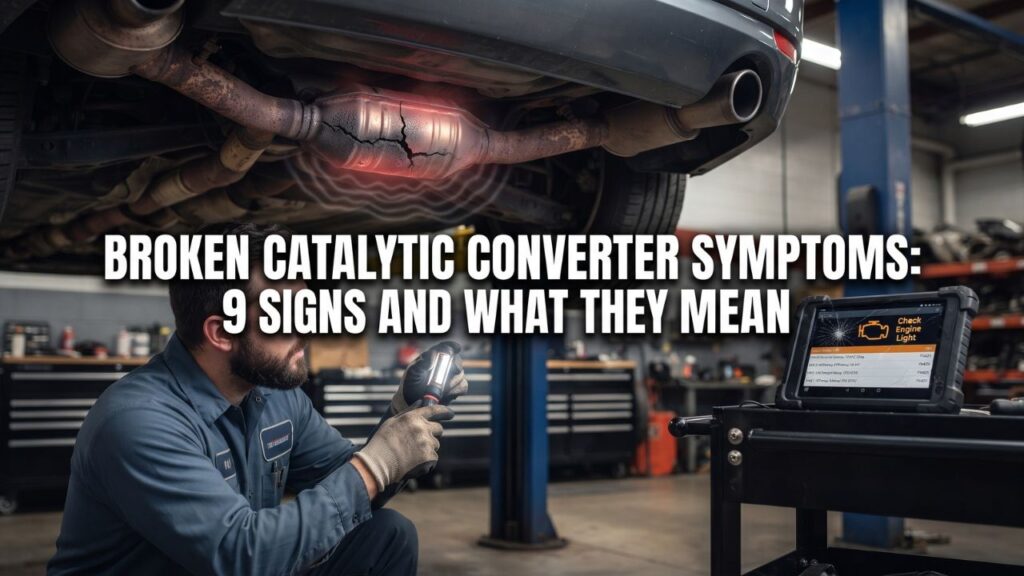
A catalytic converter contains a ceramic or metallic substrate formed into many small passages. Exhaust travels through those passages while catalyst-coated surfaces treat harmful gases.
A converter becomes physically broken when that internal structure cracks, melts, shifts, or separates from the material holding it inside the metal shell.
Cracked or Shattered Substrate
The internal ceramic core can fracture after impact, severe heat, corrosion-related stress, or repeated thermal cycling.
Loose pieces may remain inside the housing and rattle as the engine starts, accelerates, or changes speed.
If those pieces stay clear of the exhaust outlet, the car may still drive fairly normally. If they shift across the outlet, power can drop quickly.
Melted or Collapsed Substrate
Excessive converter temperature can soften or melt the honeycomb.
Walker states that converter temperatures above roughly 1,600°F may damage catalyst material and that severe temperatures can destroy the matting or substrate. Engine misfires and abnormal air-fuel conditions are among the faults linked with this heat damage.
A melted core is more likely to cause exhaust restriction than a simple crack.
Loose Internal Matting
The substrate is supported inside the converter housing by special matting.
If that support fails, the catalyst brick can move out of position. Walker notes that a shifted brick can block exhaust flow and create loss of power.
Key Takeaway: A broken converter may have a cracked, melted, or displaced internal core; the most serious drivability problems appear when that damage begins restricting exhaust flow.
Broken Catalytic Converter Symptoms You Should Watch For
A broken converter does not produce one universal symptom. Some failures mainly create noise, while others affect emissions or exhaust flow.
1. Metallic Rattling Under the Vehicle
A loose ceramic substrate can sound like small stones or pieces of metal shaking inside a container.
The noise may be easiest to hear:
- During startup
- At idle
- During light acceleration
- When engine speed drops
- While driving over bumps
A loose heat shield, exhaust hanger, clamp, or pipe can make a similar sound, so the location of the rattle should be confirmed before condemning the converter.
Rattling from the converter housing is one of the stronger clues that the internal substrate has physically fractured.
2. Check Engine Light
A damaged converter may trigger the Check Engine Light when the engine computer detects poor catalyst operation.
Common codes include:
P0420 — Catalyst System Efficiency Below Threshold, Bank 1
P0430 — Catalyst System Efficiency Below Threshold, Bank 2
These codes do not prove the converter is physically broken. Exhaust leaks, sensor faults, mixture problems, and engine faults can affect catalyst-monitor readings.
Walker recommends resolving other engine codes and exhaust leaks before treating a catalyst code as confirmation of converter failure.
3. Loss of Engine Power
If broken material blocks part of the converter, exhaust gases cannot leave the engine freely.
The engine then has to work against increased backpressure.
You may notice:
- Weak acceleration
- Poor hill-climbing ability
- Reduced passing power
- Engine speed that rises slowly
- A vehicle that feels unusually heavy
A badly restricted converter often feels worse as throttle and RPM increase because exhaust volume rises with engine load.
Walker identifies a melted or shifted converter core as a cause of sluggish performance and power loss.
4. Engine Will Not Rev Normally
A severely blocked converter can make the engine feel as if it reaches an RPM ceiling.
You may press the accelerator farther while the engine refuses to build speed normally.
This pattern is a useful distinction because a chemically weak converter may set P0420 while the car still accelerates normally. A physical restriction affects flow, so symptoms become stronger as the engine tries to move more exhaust.
5. Rough Idle, Misfire, or Stalling
A heavily restricted converter can interfere with cylinder breathing.
Excessive backpressure may leave more exhaust gas in the cylinders, reducing the space available for fresh air and fuel.
The engine may:
- Shake at idle
- Develop random misfires
- Stall after warming up
- Start and then die
- Run better cold than hot
A misfire can also be the cause of converter damage rather than the result. Unburned fuel from a misfiring cylinder can enter the converter, raise its temperature, and melt the substrate. Walker lists misfire as a major cause of converter thermal failure.
6. Excessive Heat or Converter Discoloration
A failing converter may run abnormally hot.
Excessive heat can discolor the metal shell or create a bronze, blue, or rainbow appearance. Walker lists this type of discoloration as a clue that the converter has experienced elevated temperature.
A converter that glows red is a much more serious warning.
Stop driving if you see glowing exhaust components, smoke, or severe heat beneath the vehicle. Do not touch the converter after operation; exhaust components can remain hot enough to cause severe burns.
7. Rotten-Egg or Sulfur Odor
A sulfur-like smell can appear when the converter or fuel-control system is not processing exhaust correctly.
MagnaFlow lists a rotten-egg odor among common signs of catalyst trouble.
This smell alone is not proof of a broken core.
A rich air-fuel mixture, fuel quality, or another combustion problem can create similar odors and may also be the condition damaging the converter.
8. Poor Fuel Economy
A restricted exhaust can force the engine to work harder.
The driver may press the accelerator farther to compensate for lost power, causing fuel consumption to increase.
Fuel economy can also fall because of the same engine fault that damaged the converter, such as a rich mixture or repeated misfire.
Treat poor mileage as supporting evidence rather than a stand-alone converter diagnosis.
9. Failed Emissions Test
A converter with a fractured, contaminated, or chemically damaged substrate may no longer reduce exhaust pollutants enough to meet emissions requirements.
The vehicle may fail because of:
- Catalyst-efficiency codes
- Excess tailpipe emissions
- An illuminated Check Engine Light
- A damaged or incorrect converter found during inspection
A vehicle can fail an emissions test without having a physically broken converter, so test results should be combined with scan data and physical inspection.
Key Takeaway: Rattling, power loss, limited RPM, abnormal heat, and exhaust restriction are stronger clues of physical converter damage than a Check Engine Light or emissions failure alone.
Broken vs Clogged vs Inefficient Catalytic Converter
These terms are often used as if they mean the same thing, but they describe different conditions.
| Converter Condition | What Is Happening | Typical Clues |
| Broken | Internal core is cracked, loose, or shifted | Rattle, possible restriction |
| Clogged | Exhaust passages are partly or fully blocked | Power loss, high backpressure |
| Melted | Heat has collapsed or fused the substrate | Severe restriction, heat |
| Contaminated | Oil, coolant, carbon, or chemicals coat the catalyst | Codes, emissions failure |
| Inefficient | Catalyst no longer treats exhaust at the required rate | P0420/P0430, often normal driving |
A Broken Converter May Not Be Clogged Yet
A cracked substrate can rattle while still allowing exhaust to pass.
The problem becomes more serious if pieces shift and block the outlet.
This explains why a vehicle may begin with only a rattle and later develop severe acceleration loss.
A Clogged Converter May Not Rattle
A melted substrate can form a solid restriction without leaving loose pieces.
The driver may experience major power loss without any obvious rattle.
An Inefficient Converter May Drive Normally
A converter can lose chemical activity while remaining physically intact and open.
In that case, P0420 or P0430 may be the main symptom.
The car may still idle, accelerate, and reach highway speed normally.
Key Takeaway: Broken describes physical damage, clogged describes restricted flow, and inefficient describes weak emissions conversion; one converter can have more than one of these faults at the same time.
What Causes a Catalytic Converter to Break?
Converters are built to tolerate normal exhaust heat and vibration, so physical failure often points toward another problem.
Engine Misfires and Excess Fuel
A severe misfire sends unburned air and fuel into the exhaust.
That mixture can burn inside the converter and raise internal temperature sharply.
Walker identifies misfire, low compression, poor spark, fuel problems, and air-fuel imbalance as conditions associated with overheated or melted converters.
Common upstream faults include:
- Worn spark plugs
- Weak ignition coils
- Leaking fuel injectors
- Excessive fuel pressure
- Low compression
- Incorrect engine timing
Oil or Coolant Contamination
An engine that burns oil can send ash and residue into the converter.
An internal coolant leak can coat the catalyst as well.
Walker lists excessive oil consumption and internal coolant leaks among major causes of converter contamination.
Contamination may first reduce catalyst activity, then contribute to overheating and further damage.
Road Impact and Structural Damage
The converter is mounted beneath the vehicle on many models.
A hard impact from road debris, a curb, or an object can dent the housing or fracture the ceramic core.
Walker lists road-debris impact, corrosion, thermal shock, and metal fatigue among possible structural causes.
Thermal Shock
A very hot converter exposed suddenly to cold water or deep snow can experience rapid temperature change.
Repeated thermal stress can contribute to cracking.
Corrosion and Age
Exterior corrosion can weaken converter shells, welds, pipes, and mounting areas.
Age also exposes the substrate to thousands of heating and cooling cycles.
Age alone does not prove a converter has failed, but older components have had more opportunities to experience damaging engine faults and physical stress.
Key Takeaway: Misfires, rich operation, oil or coolant contamination, road impacts, thermal shock, and long-term stress are common reasons a converter core cracks, melts, or moves out of position.
How to Diagnose a Broken Catalytic Converter
Do not replace an expensive converter based on one symptom.
A good diagnosis checks the engine, exhaust, and converter together.
Scan for Trouble Codes
Start with an OBD-II scanner.
Look for:
- P0420 or P0430
- P0300-series misfire codes
- Rich or lean mixture codes
- Oxygen-sensor codes
- MAF or MAP sensor faults
- Fuel-control codes
Other engine codes should be addressed because a converter may be the victim of an upstream problem.
Locate the Rattle
A loose heat shield can sound very similar to broken converter material.
Listen carefully around the converter area with the vehicle safely parked.
Do not crawl beneath a vehicle supported only by a jack.
A technician may inspect the converter after it has cooled and check for loose internal material. Walker describes light tapping of the converter housing with an appropriate rubber tool as one diagnostic method for detecting a cracked substrate or damaged matting.
Measure Exhaust Backpressure
Backpressure testing is one of the stronger ways to confirm a restriction.
A technician can measure exhaust pressure through an oxygen-sensor port or another approved test location.
Walker gives general reference values of less than about 1.5 psi at idle and 3 psi at 2,000 RPM, while noting that specifications vary by application.
High pressure ahead of the converter points toward converter restriction or another blockage farther downstream.
Inspect Converter Temperature
An infrared thermometer can identify unusual temperature patterns.
Temperature alone cannot prove the converter is broken because mixture problems and misfires can also produce abnormal heat.
Use temperature as one piece of evidence rather than a replacement for backpressure testing.
Check the Engine Before Installing a New Converter
Look for the fault that may have destroyed the old converter.
That may require:
- Spark and ignition testing
- Fuel-pressure testing
- Injector checks
- Fuel-trim analysis
- Compression testing
- Cooling-system pressure testing
- Oil-consumption diagnosis
- Exhaust-leak inspection
Walker specifically advises finding and correcting the root cause before installing another converter.
Key Takeaway: Scan codes, locate the noise, test exhaust backpressure, inspect temperature, and diagnose the engine fault that may have caused the converter failure before replacing parts.
Can You Drive With a Broken Catalytic Converter?
A vehicle may still run with a cracked converter core, but the risk depends on what the broken material is doing.
A light rattle with normal power is different from a converter whose loose substrate has shifted and blocked exhaust flow.
Stop normal driving if you notice:
- Severe loss of acceleration
- Engine cannot reach normal road speed
- Repeated stalling
- A glowing converter
- Smoke beneath the vehicle
- Strong burning odor
- Severe engine shaking
- A flashing Check Engine Light
Loose substrate pieces can change position, so a converter that only rattles today may become restrictive later.
I would schedule inspection once internal converter breakage is suspected rather than waiting for power loss to appear.
Can a Broken Catalytic Converter Damage the Engine?
A broken converter usually does not damage internal engine parts simply because its catalyst material has cracked.
The risk rises when the converter becomes restricted.
Excessive exhaust backpressure can reduce engine breathing, lower power, raise exhaust temperature, and create poor running.
The larger concern is often the reverse relationship: an engine problem damages the converter.
Misfires, rich fuel mixtures, oil burning, and coolant leaks should be corrected before the replacement converter is installed.
Should You Replace a Broken Catalytic Converter?
A physically cracked, melted, or displaced substrate generally cannot be repaired with a cleaner.
If internal pieces are loose or the passages have collapsed, the normal repair is replacement after the underlying cause has been corrected.
Do not assume an additive can repair:
- Broken ceramic
- Melted honeycomb
- Shifted catalyst bricks
- Impact-damaged housing
- Severe internal restriction
Choose a replacement approved for the exact vehicle and emissions configuration.
U.S. owners should also check federal warranty coverage before authorizing the repair if the vehicle may still be within the applicable 8-year/80,000-mile period.
Conclusion
The main broken catalytic converter symptoms are internal rattling, weak acceleration, restricted RPM, rough running, excessive heat, sulfur odor, poor fuel economy, hard starting or stalling, catalyst codes, and emissions-test failure.
The strongest clues of physical breakage are a rattle from the converter housing and evidence that exhaust flow is becoming restricted. P0420 or P0430 alone points to catalyst-efficiency trouble but does not prove the honeycomb is cracked or clogged.
Diagnosis should include scan data, exhaust inspection, backpressure testing, and checks for the engine problem that may have damaged the converter. Misfires, rich operation, oil consumption, and coolant leaks can destroy a replacement if left unresolved.
I would repair the root cause before fitting another converter and avoid extended driving if the vehicle has severe power loss, extreme exhaust heat, repeated stalling, or a glowing converter.
FAQs About Broken Catalytic Converter Symptoms
What Does a Broken Catalytic Converter Sound Like?
A broken internal substrate often produces a metallic rattle that sounds like small stones moving inside a metal housing.
The noise may be strongest during startup, acceleration, deceleration, or bumps. Heat shields and exhaust hangers can make similar noises, so confirm where the sound originates.
Can a Broken Catalytic Converter Cause Loss of Power?
Yes. If pieces of the internal substrate shift and block the exhaust path, backpressure rises and engine power can drop.
The problem may become much more noticeable at higher RPM because the engine is trying to move a larger volume of exhaust through the restriction.
Can a Broken Catalytic Converter Cause Rough Idle?
Yes, if internal damage creates severe exhaust restriction.
Excess backpressure can interfere with cylinder breathing and contribute to rough idle, misfires, or stalling. Rough idle has many other causes, so test the exhaust before replacing the converter.
Does P0420 Mean the Catalytic Converter Is Broken?
No. P0420 means the catalyst system on Bank 1 is operating below its expected efficiency threshold.
A worn catalyst, exhaust leak, oxygen-sensor issue, fuel-mixture problem, or engine fault may be involved. The code does not confirm that the internal substrate is physically cracked.
Can a Broken Catalytic Converter Cause a Rattle?
Yes. A cracked ceramic honeycomb or loose catalyst brick can move inside the converter shell and produce a rattle.
This is one of the more direct signs of physical internal damage, though loose heat shields should be ruled out first.
Can a Broken Catalytic Converter Cause Hard Starting?
A severely restricted converter can make the engine harder to start because exhaust gases cannot leave freely.
A converter that is broken but still flows normally may not affect starting. Fuel, ignition, battery, sensor, and compression problems should also be checked.
Can You Fix a Broken Catalytic Converter Without Replacing It?
A physically shattered, melted, or displaced substrate generally cannot be restored with cleaning products.
If the internal core is damaged, replacement is normally required. The engine problem that caused the failure should be repaired first.
How Do I Know if the Converter Is Broken or Just Clogged?
A rattle points more strongly toward a broken or loose substrate, while major power loss and high backpressure point toward a restriction.
The two conditions can happen together if broken pieces shift and block the outlet. Backpressure testing and physical inspection provide a stronger answer than symptoms alone.