Will a Clogged Catalytic Converter Cause a Car to Stall or Die?
A severely restricted catalytic converter can make an engine stall because exhaust gases cannot leave the cylinders fast enough. Backpressure rises, the engine struggles to move air through the combustion cycle, and RPM may fall until the engine shuts off. Severe blockage may cause stalling at idle, under acceleration, or after the engine gets hot.
The problem often begins before the car actually stalls. You may notice sluggish acceleration, loss of power at higher RPM, hard starting, jerking under load, poor fuel economy, or an engine that feels increasingly restricted as you press the accelerator.
Finding the cause early matters because a converter usually does not become badly restricted for no reason. Misfires, excessive fuel, oil burning, coolant contamination, physical damage, or extreme converter temperature can damage the internal honeycomb and eventually reduce exhaust flow.
For U.S. vehicles, EPA states that catalytic converters are among the specified major emissions components covered under the federal emissions warranty for 8 years or 80,000 miles, subject to the applicable warranty conditions. Checking coverage before paying for a replacement may save a large repair expense.
For drivers asking will a clogged catalytic converter cause a car to stall, the answer is yes once restriction becomes severe enough. O’Reilly specifically lists engine stalling as a possible result of extreme converter blockage because exhaust pressure builds until the engine can no longer operate normally.
One useful clue is when the engine runs reasonably well at first but becomes weaker as RPM, throttle opening, or engine temperature rises. Exhaust volume increases with engine load, so a partially blocked converter often becomes more noticeable during acceleration, uphill driving, or highway merging.
The sections below explain why restriction causes stalling, what symptoms usually appear first, how to test for excessive backpressure, how to separate converter trouble from fuel or ignition faults, and what to do if the car begins stalling.
Will a Clogged Catalytic Converter Cause a Car to Stall While Driving?
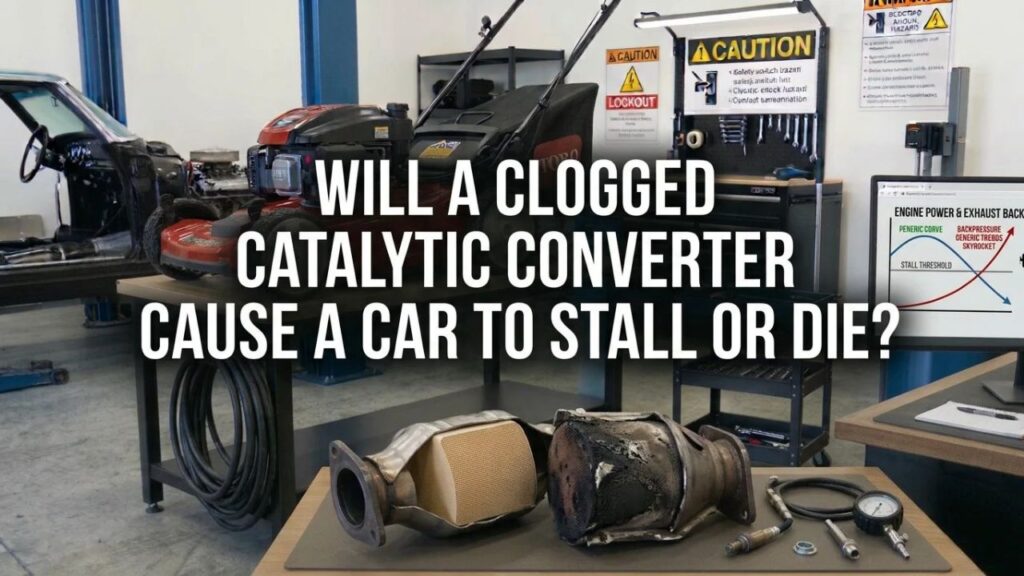
Yes. A converter that becomes badly restricted can stall an engine while the vehicle is moving.
The internal catalyst contains many small passages that exhaust gases must pass through. If those passages melt, collapse, break apart, or become plugged, pressure rises ahead of the converter.
Why Exhaust Backpressure Can Stall the Engine
An internal-combustion engine must move exhaust gas out before the next combustion cycle can work normally.
With a severe restriction, the pistons have to push against trapped exhaust pressure during the exhaust stroke. Cylinder clearing becomes poor, fresh intake charge is reduced, and engine output falls.
As restriction worsens, the engine may no longer make enough torque to maintain idle or pull the vehicle under load.
O’Reilly notes that an extremely clogged converter can build enough exhaust pressure to cause the engine to stall while driving.
Why Stalling May Be Worse Under Acceleration
A partially restricted converter may pass enough exhaust for the engine to idle.
Pressing the accelerator changes the situation. More fuel and air enter the cylinders, so the engine produces much more exhaust gas.
If the converter cannot pass that extra volume, backpressure rises rapidly.
The driver may notice:
- Slow acceleration
- Engine power fading as RPM climbs
- Hesitation
- Jerking
- Engine bogging
- Stalling under heavy throttle
AutoZone also lists hard starting and stalling among symptoms of severe catalyst restriction.
Why the Car May Stall After It Gets Hot
A damaged converter can sometimes become more restrictive as the exhaust system heats.
Loose or partially collapsed catalyst material may shift as components expand. A substrate that has suffered severe overheating can also have melted passages inside even when the ends appear less damaged.
Walker notes that catalyst substrates can be damaged by excessive temperatures and may melt internally.
That can create a pattern where the engine starts and drives better cold, then loses power or stalls after several minutes.
Key Takeaway: Severe converter restriction raises exhaust backpressure, and the engine may stall once it can no longer move enough exhaust through the blocked catalyst.
Symptoms That Often Appear Before a Clogged Converter Causes Stalling
Stalling is usually a later-stage symptom. Other signs often appear first.
Loss of Power at Higher RPM
A restricted converter commonly creates a car that feels acceptable at light throttle but weak when the engine is asked to work harder.
You may press the accelerator and hear the engine labor without getting the expected increase in speed.
Walker lists loss of power and stalling among drivability problems associated with bad or clogged converters.
Power loss that becomes stronger as RPM rises is an especially useful restriction clue.
Hard Starting or Starting Then Dying
A severely blocked exhaust can make starting difficult because the engine cannot clear exhaust from previous combustion cycles.
The engine may:
- Crank longer than usual
- Start and immediately die
- Start only with added throttle
- Run briefly and then stall
- Restart after sitting for a while
AutoZone lists difficulty starting as a common clogged-converter symptom when backpressure becomes excessive.
Poor Acceleration
A blocked converter may create a strong delay between pressing the pedal and gaining speed.
The problem can be most obvious while:
- Entering a highway
- Passing another vehicle
- Climbing a hill
- Carrying a heavy load
- Accelerating above moderate RPM
The same symptom can come from low fuel pressure, ignition faults, transmission trouble, or airflow problems, so testing is still needed.
Check Engine Light
P0420 and P0430 are common catalyst-related trouble codes.
P0420 usually refers to catalyst efficiency below threshold on Bank 1, while P0430 refers to Bank 2 on engines with two banks.
These codes do not prove that the converter is physically clogged. They mainly indicate that catalyst performance is below the level expected by the engine computer.
A converter can flow freely and still set an efficiency code.
Rattling From the Converter
The catalyst substrate can crack or break into pieces.
Loose material may create a metallic rattle from beneath the vehicle, especially during startup or changing engine speed.
O’Reilly notes that broken honeycomb material may rattle and can move into positions that restrict exhaust flow.
A rattle combined with major power loss raises suspicion of physical internal damage.
Excessive Heat
A converter damaged by misfire or rich operation can run extremely hot.
Walker states that temperatures above about 1,600°F can damage catalyst material, while higher temperatures can damage the substrate or its support mat.
If the converter glows red, stop operating the vehicle when it is safe to do so.
A glowing converter is not normal and may create a fire risk around dry grass, leaves, fuel, or other combustible material.
Key Takeaway: Power loss, difficult starting, poor acceleration, rattling, catalyst codes, and extreme heat often appear before restriction becomes severe enough to stall the engine.
How to Confirm a Clogged Catalytic Converter Is Causing the Stall
Stalling has many possible causes, so replacement should not be based on symptoms alone.
Test Exhaust Backpressure
A backpressure test is one of the strongest ways to confirm exhaust restriction.
A low-pressure gauge can be fitted to an oxygen-sensor port or another suitable test point.
Walker gives general reference values of:
- Around 1 psi or less at idle
- Around 3 psi or less at 2,500 RPM
Vehicle-specific service specifications should take priority.
If pressure is high ahead of the converter and normal behind it, the converter is likely the restriction.
If pressure remains high behind the converter, the muffler or another downstream exhaust component may be blocked.
Perform an Engine Vacuum Test
A vacuum gauge can also indicate exhaust restriction.
Connect it to a suitable intake-manifold vacuum source and record the reading at idle.
Then hold the engine around 2,500 RPM.
Walker states that vacuum should initially change and then return close to the idle reading. A large continuing drop can indicate an exhaust restriction.
This test can reveal a blocked exhaust but may not identify the exact component causing it.
Scan All Stored Codes
Use an OBD-II scanner before removing parts.
Do not look only for P0420 or P0430.
Also check for:
- P0300-series misfire codes
- Fuel-trim codes
- Oxygen-sensor faults
- Mass-airflow sensor faults
- Throttle-related codes
- Fuel-pressure faults
- Coolant-temperature sensor problems
An active misfire may be both the cause of the stall and the reason the converter became damaged.
Check Converter Temperature
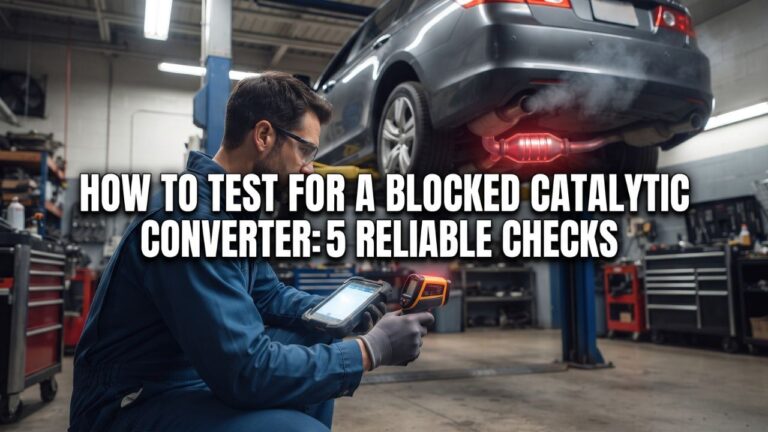
An infrared thermometer can compare temperatures before and after the converter.
Temperature can reveal unusual catalyst activity or severe heat, but it is not the strongest test for a physical blockage.
Backpressure directly measures the condition that creates most restriction-related stalling.
Inspect for Internal Damage
A technician may inspect for rattling catalyst material, impact damage, shell discoloration, or evidence of overheating.
Walker notes that melted substrate can exist deeper inside the converter even when the visible ends do not immediately reveal the damage.
Key Takeaway: Backpressure testing gives the strongest evidence of converter restriction, while scan data, vacuum readings, temperature, and physical inspection support the diagnosis.
Clogged Converter vs Other Causes of Engine Stalling
A converter is only one possible cause.
| Possible fault | Typical clues |
| Clogged catalytic converter | Power falls under load, high exhaust backpressure |
| Weak fuel pump | Low fuel pressure, lean running, stall under acceleration |
| Bad crankshaft sensor | Sudden stall, possible no-start when hot |
| Ignition misfire | Shaking, P0300-series codes, flashing check engine light |
| Dirty throttle body | Unstable idle, low-speed stalling |
| Vacuum leak | Rough idle, lean fuel trims |
| Faulty MAF sensor | Poor response, incorrect airflow data |
| EGR fault | Rough idle or stall on some vehicles |
| Transmission load problem | Stall when shifting into gear on some vehicles |
| Charging-system fault | Electrical symptoms before engine shuts off |
A correct diagnosis comes from matching the stall pattern with test results.
Can a Clogged Catalytic Converter Cause Stalling at Idle?
Yes, but idle stalling usually means the restriction has become severe.
At idle, the engine produces relatively little exhaust gas. A mildly restricted converter may therefore allow the engine to idle without much trouble.
If the converter becomes almost completely blocked, even idle exhaust flow may be too much.
Possible symptoms include:
- Low idle speed
- Rough running
- Engine shaking
- Starting then dying
- Stalling when coming to a stop
- Engine unable to remain running without throttle
Do not assume idle stalling automatically means the converter.
Vacuum leaks, throttle-body deposits, idle-control problems, EGR faults, fuel problems, and ignition faults are also common causes.
Can a Clogged Catalytic Converter Make the Car Stall When Stopping?
It can.
When you release the accelerator and stop at a traffic light, engine speed drops rapidly toward idle.
If exhaust backpressure is already high, the engine may not stabilize at the lower RPM and may shut off.
A severely clogged converter can therefore create a pattern where the vehicle drives poorly and then dies as you slow down.
Another possibility is a torque-converter, throttle, EGR, or idle-control problem, so the symptom should not be used alone to diagnose the catalyst.
Can the Car Restart After Stalling From a Clogged Converter?
Yes.
Some vehicles restart immediately. Others may need to sit for a short period.
A restart does not rule out exhaust restriction.
If loose catalyst material moves inside the converter, the amount of blockage can change. Cooling may also change clearances within damaged exhaust components.
The vehicle might restart and seem better briefly, then lose power again once exhaust flow and temperature rise.
That repeated pattern deserves prompt diagnosis rather than repeated driving.
Will P0420 or P0430 Cause the Car to Stall?
The codes themselves do not cause stalling.
P0420 and P0430 describe catalyst-efficiency problems detected by the engine-management system.
A converter can trigger either code without being clogged enough to affect engine operation.
If a vehicle has P0420 plus severe loss of power or stalling, test for restriction rather than assuming the code alone proves the cause.
The opposite is also possible: a converter can become physically restricted without immediately setting a catalyst-efficiency code.
What Causes a Catalytic Converter to Become Clogged Enough to Stall?
Converters commonly fail because another problem damages the catalyst.
Persistent Engine Misfire
A misfire sends unburned fuel and oxygen into the exhaust.
That mixture can react inside the hot converter and raise catalyst temperature dramatically.
Walker lists misfires, weak spark, low compression, fuel-delivery problems, and air-fuel-ratio imbalance among causes that can overheat a converter.
Rich Air-Fuel Mixture
Too much fuel can increase converter temperature and create deposits.
Possible causes include:
- Leaking injector
- Excessive fuel pressure
- Faulty sensor input
- Ignition faults
- Incorrect fuel control
A replacement converter can fail again if the rich condition remains.
Oil Burning
Engine oil entering the combustion chamber can leave ash and other deposits in the catalyst.
High oil consumption may come from worn piston rings, valve seals, turbocharger problems, or other engine faults.
Coolant Entering the Exhaust
Internal coolant leaks can contaminate catalyst material.
Unexplained coolant loss should be diagnosed before blaming or replacing the converter.
Physical Damage
Road debris or bottoming out can damage the converter housing and internal substrate.
Broken catalyst material can shift inside the shell and create a partial or near-total blockage.
Key Takeaway: Severe converter restriction is often the result of misfires, excessive fuel, oil or coolant contamination, or physical catalyst damage.
What Should You Do if a Clogged Converter Is Making the Car Stall?
Do not continue normal driving if the engine repeatedly stalls from suspected exhaust restriction.
A stalled engine can leave you without normal acceleration in traffic and may reduce power-assist functions depending on the vehicle.
Stop Driving if the Symptoms Are Severe
Arrange diagnosis if you have:
- Repeated stalling
- Major acceleration loss
- Converter glowing red
- Flashing check engine light
- Strong burning smell
- Smoke beneath the vehicle
- Severe rattling
- Engine unable to stay running
A flashing check engine light deserves special attention because an active misfire can rapidly overheat the converter.
Repair the Root Cause
If the converter failed because of a bad ignition coil, injector, oil-burning problem, or rich mixture, repair that fault first.
Walker stresses that converters generally fail as the result of another problem rather than failing independently.
Installing a new converter without correcting the original engine fault can damage the replacement.
Replace a Physically Blocked Converter
Light deposits may sometimes improve after the engine problem is repaired, but a melted or collapsed substrate cannot be restored by a fuel additive.
A converter with verified severe backpressure and physical internal damage normally needs replacement.
Do not hollow out or remove emissions equipment as a road-going repair. Use a legal replacement approved for the vehicle and applicable emissions requirements.
Check Warranty Coverage
If the vehicle is still within the federal 8-year/80,000-mile major-emissions-component warranty period, contact the manufacturer or dealer before buying the converter yourself.
Have the VIN, mileage, codes, and diagnostic information available.
Key Takeaway: Repeated stalling calls for prompt diagnosis; confirm restriction, repair the engine fault that damaged the catalyst, and replace the converter if the substrate is physically blocked.
Conclusion
The answer to will a clogged catalytic converter cause a car to stall is yes. Once blockage becomes severe, exhaust backpressure can prevent the engine from clearing its cylinders normally, causing weak acceleration, rough running, hard starting, and eventually stalling.
The strongest evidence comes from an exhaust-backpressure test rather than from P0420, P0430, temperature readings, or smell alone. High pressure ahead of the converter, combined with load-related power loss, makes a physical restriction much more likely.
I would not keep driving a vehicle that repeatedly stalls, loses major power, develops a flashing check engine light, or shows severe converter heat. Diagnose the root engine problem first, then replace the converter if testing confirms that its internal passages have melted, collapsed, or become permanently blocked.
FAQs About Clogged Catalytic Converters and Stalling
Can a clogged catalytic converter make a car shut off while driving?
Yes. A severely clogged converter can build enough exhaust backpressure to make the engine lose power and stall while the vehicle is moving. The risk becomes greater as the blockage worsens and exhaust volume rises under acceleration.
Can a bad catalytic converter cause stalling at idle?
Yes, but the restriction normally has to be severe before idle is affected. Mild blockage is more likely to show up as poor acceleration or high-RPM power loss first. If the engine stalls mainly at idle, throttle, vacuum, fuel, ignition, and EGR faults should also be checked.
Can a clogged converter make a car start and then die?
Yes. A near-total exhaust blockage can let the engine fire initially, then stall as pressure builds in the exhaust. Fuel-pressure problems, immobilizer faults, crank-sensor failures, and airflow problems can create a similar start-then-die pattern, so backpressure testing is useful.
Can P0420 cause a car to stall?
P0420 itself does not cause stalling. It indicates that catalyst efficiency on Bank 1 is below the programmed threshold. A converter with P0420 may still flow exhaust normally. Stalling becomes more likely when the converter is physically restricted.
How do I know if the converter is clogged or the fuel pump is bad?
A clogged converter usually shows excessive exhaust backpressure and often loses more power as RPM rises. A weak fuel pump produces low fuel pressure or low fuel volume under load. Testing exhaust pressure and fuel pressure separates the two more reliably than symptoms alone.
Will a clogged catalytic converter eventually stop the car from running?
A severe enough blockage can make the engine extremely difficult to start or prevent it from remaining running. A partial restriction may only cause sluggish acceleration at first, then progress to hard starting and stalling as the internal blockage worsens.
Can I keep driving if the catalytic converter is causing stalling?
Repeated stalling, major power loss, severe overheating, or a flashing check engine light are reasons to stop normal driving and arrange diagnosis. A physically restricted converter can worsen, and the engine problem that damaged it may continue overheating the catalyst.