How to Test for a Blocked Catalytic Converter: 5 Reliable Checks
The most direct way to check a suspected clogged converter is an exhaust backpressure test performed ahead of the converter. High pressure that rises as engine speed increases points toward a restriction. A vacuum-gauge test, scan data, temperature checks, and physical inspection provide supporting evidence before the converter is replaced.
A blocked catalyst can make an engine feel starved for power, especially during hard acceleration or higher RPM. Severe restriction may cause hard starting, stalling, excess exhaust heat, or an engine that revs normally at first but quickly runs out of breath as load increases.
Confirming the restriction before buying parts prevents a common diagnostic mistake. Poor fuel delivery, ignition problems, a damaged muffler, collapsed exhaust pipe, turbocharger faults, and transmission complaints can produce some of the same low-power symptoms.
For U.S. vehicles, EPA OBD-II procedures apply to 1996 and newer model-year vehicles and use the powertrain control module to monitor emissions-related faults. That system may set catalyst codes, but OBD-II does not directly measure how many pounds per square inch of exhaust pressure are trapped ahead of a clogged converter.
For how to test for a blocked catalytic converter, I’d start with stored trouble codes and symptoms, then move to a direct backpressure test if restriction still looks likely. Walker gives a general reference of less than 1.5 psi at idle and less than 3 psi at 2,000 RPM, while vehicle-specific specifications should take priority.
A good diagnosis uses several clues together. The tests below cover backpressure, intake vacuum, converter temperature, scan-tool data, and physical inspection, along with the signs that distinguish a blocked catalyst from a converter that has simply lost emissions-cleaning ability.
How to Test for a Blocked Catalytic Converter Step by Step
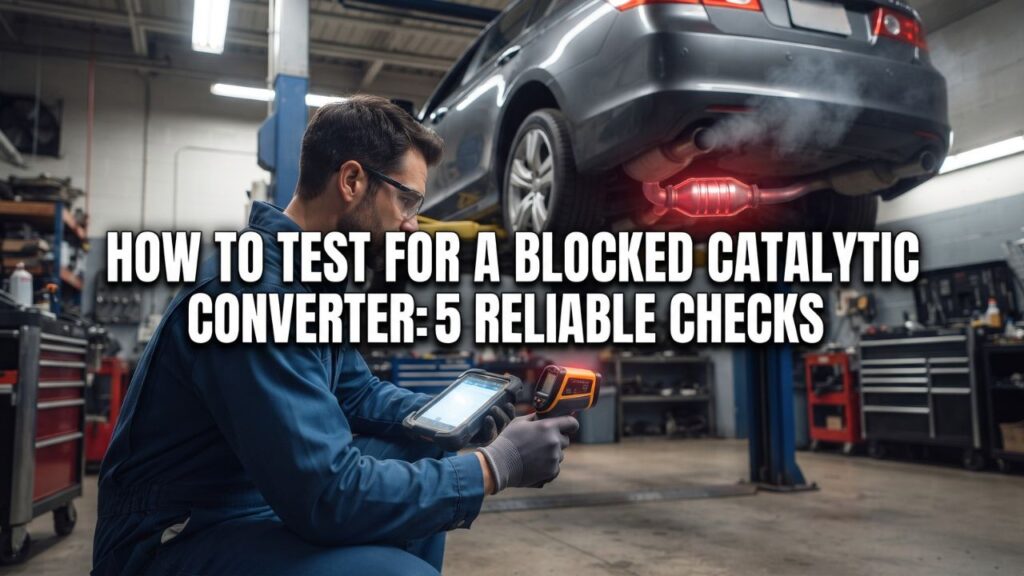
No single quick trick is perfect for every vehicle. A direct pressure measurement gives the strongest evidence of physical restriction, while the other tests can support or challenge that result.
Test 1: Measure Exhaust Backpressure
An exhaust backpressure test measures resistance to exhaust flow ahead of the suspected blockage.
A low-pressure exhaust gauge is commonly installed through the upstream oxygen-sensor port. That places the gauge ahead of the converter on many vehicles.
Basic procedure:
- Park on a level surface and secure the vehicle.
- Allow the exhaust to cool before removing an oxygen sensor.
- Locate the upstream oxygen sensor ahead of the converter.
- Disconnect and remove the sensor using the proper socket.
- Install the backpressure gauge adapter in the sensor port.
- Start the engine and note pressure at idle.
- Hold the engine near the RPM specified by the service information and watch whether pressure remains stable or rises.
- Shut the engine off and reinstall the oxygen sensor to the specified procedure.
Walker lists a general guideline of under 1.5 psi at idle and under 3 psi at 2,000 RPM. High pressure before the converter with low pressure after it points strongly toward a blocked converter. High pressure both before and after the converter may point farther downstream toward a restricted muffler or pipe.
The trend matters too. Pressure that continues climbing while RPM is held is more suspicious than a brief spike that immediately settles.
Safety Tip: Oxygen sensors and converter housings can reach temperatures capable of causing severe burns. Let the exhaust cool before removing parts, and follow the vehicle’s service procedure for sensor removal and installation.
Test 2: Use an Intake Manifold Vacuum Gauge
A manifold vacuum test is less direct, but it can reveal the effect that exhaust restriction has on engine breathing.
Connect a vacuum gauge to a suitable intake-manifold vacuum source according to the vehicle’s service information.
Start the engine and note the stable idle reading. Then raise engine speed to about 2,500 RPM and hold it.
A normal engine may show an initial vacuum drop as the throttle opens, followed by recovery and stabilization.
With a restricted exhaust, vacuum may begin reasonably but gradually fall while the engine is held at steady RPM. The engine is struggling to move spent gases out, so its ability to draw a fresh charge into the cylinders drops.
NAPA describes this pattern as a useful indicator of exhaust backpressure: vacuum drops as RPM rises and fails to recover normally when restriction is present.
Do not judge the converter from one vacuum number. Altitude, camshaft design, ignition timing, valve timing, intake leaks, and engine condition can change manifold vacuum.
Test 3: Compare Converter Inlet and Outlet Temperature
An infrared thermometer can provide another clue after the engine and catalyst reach operating temperature.
Measure near the converter inlet and outlet without touching the exhaust.
A working catalyst produces heat during its chemical reactions, so outlet temperature can be higher than inlet temperature under suitable operating conditions. Walker notes that a rear converter weld area that is much cooler than the front may indicate that the catalyst is not lighting off or that the exhaust mixture is wrong.
Temperature alone does not confirm a blockage.
Engine load, air-fuel ratio, converter position, outside temperature, catalyst activity, and recent driving all affect the reading. A converter can be restricted and still become extremely hot.
Use infrared temperature results as supporting information rather than replacing a backpressure measurement.
Test 4: Check Scan-Tool Data and Trouble Codes
Connect an OBD-II scanner and read:
- Stored codes
- Pending codes
- Freeze-frame data
- Misfire counts
- Fuel trims
- Upstream oxygen-sensor data
- Downstream oxygen-sensor data
- Catalyst monitor readiness
P0420 means catalyst efficiency below threshold on Bank 1. P0430 applies to Bank 2 on vehicles that monitor two banks.
Those codes do not mean “converter blocked.”
A converter can lose chemical activity while still flowing exhaust freely. A melted or collapsed converter can also restrict exhaust before catalyst-efficiency logic sets either code.
If the catalyst monitor shows Not Ready, a recently disconnected battery or cleared codes may mean the vehicle has not yet completed the required monitor conditions.
Scan data is most useful when combined with drivability symptoms and a direct restriction test.
Test 5: Inspect for Internal or External Damage
Inspect the converter and nearby exhaust once everything is cool.
Look for:
- A crushed converter housing
- Impact marks
- Blue or rainbow heat discoloration
- Collapsed exhaust pipe
- Loose heat shields
- Broken hangers
- Exhaust leaks
- Rattling inside the converter
Walker notes that damaged substrate or internal matting can sometimes be detected by gently checking the converter housing for loose internal material. It also states that a melted substrate can appear normal at the ends while being damaged farther inside.
A rattle indicates internal material may have broken apart, but it does not prove the passages are blocked.
Key Takeaway: Use backpressure as the strongest test for physical restriction, then use vacuum, temperature, scan data, and inspection to confirm the diagnosis and locate the blockage.
Symptoms That Suggest a Blocked Catalytic Converter
Testing makes more sense when the symptom pattern fits exhaust restriction.
Power Drops as Engine Load Increases
A blocked exhaust often shows its worst behavior when the engine needs to move a large volume of gas.
The car may idle fairly well yet struggle during:
- Hard acceleration
- Highway merging
- Climbing hills
- Higher RPM
- Heavy loads
- Towing
The engine can feel as though the accelerator stops producing more power past a certain point.
This pattern occurs because exhaust gases cannot escape quickly enough through the restricted passages.
The Engine May Start and Then Stall
A severe blockage can let the engine start but prevent it from maintaining airflow.
As exhaust pressure builds, engine speed may fall until the engine stalls.
Hard starting has many other causes, so this symptom should trigger testing rather than an immediate converter replacement.
The Converter May Rattle
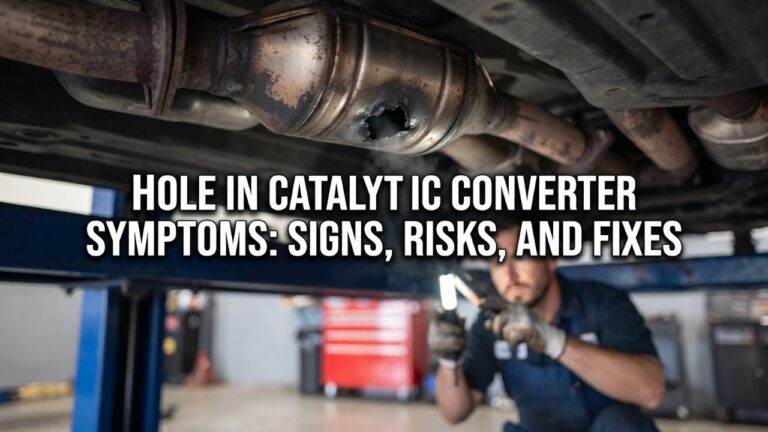
A cracked ceramic substrate can break into pieces inside the converter housing.
Loose pieces may produce a metallic rattle, especially at idle, during startup, or as RPM changes.
Those fragments can shift and partially block the remaining exhaust passages.
A loose heat shield can imitate the sound, so locate the rattle before condemning the converter.
Excessive Heat Can Appear
A converter damaged by a rich mixture or misfire can run extremely hot.
Walker states that normal converter temperature should generally remain below about 1,200°F, while prolonged operation above roughly 1,600°F can damage catalyst material and still higher temperatures can destroy the substrate or its supporting mat.
A glowing converter or severe heat under the vehicle calls for prompt diagnosis.
Key Takeaway: Loss of power under load, stalling, rattling, and excess exhaust heat fit a restricted-converter pattern, especially when several appear together.
Blocked Catalytic Converter vs Bad Oxygen Sensor
A bad oxygen sensor can trigger catalyst-related codes, but it does not normally create the same exhaust backpressure as a blocked converter.
A Blocked Converter Restricts Gas Flow
The defining mechanical problem is resistance to exhaust leaving the engine.
Direct pressure testing can expose that restriction.
You may see:
- High backpressure ahead of the converter
- Weak acceleration
- Falling manifold vacuum at steady RPM
- Hard starting
- Stalling
- Excess exhaust heat
A Bad O2 Sensor Produces Faulty Feedback
An oxygen sensor measures oxygen content in the exhaust stream.
A failed sensor may respond slowly, remain stuck at an abnormal signal, or set its own sensor-related code.
It may also affect fuel control on systems where the upstream sensor is used for mixture adjustment.
A downstream sensor can create misleading catalyst-monitor information, but replacing it will not open a physically melted honeycomb.
P0420 Alone Does Not Settle the Question
A P0420 or P0430 is an emissions-efficiency code.
It does not report converter backpressure.
If the vehicle drives normally and only has an efficiency code, test the emissions system before assuming the converter is blocked.
If the vehicle has severe low power and a pressure gauge shows excessive backpressure, physical restriction becomes much more likely.
Key Takeaway: Oxygen-sensor faults affect electrical feedback; a blocked converter creates physical exhaust resistance that can be measured with a pressure test.
Backpressure Test Results: How to Read Them
A pressure number becomes more useful when you compare readings at different points and engine speeds.
| Test Result | Possible Meaning |
| Low pressure at idle and higher RPM | Exhaust flow likely not badly restricted |
| High pressure ahead of converter | Converter or another downstream part may be restricted |
| High pressure before converter, low after converter | Converter restriction strongly suspected |
| High pressure before and after converter | Restriction may be farther downstream |
| Pressure keeps rising at steady RPM | Increasing restriction under greater exhaust flow |
| Normal pressure but P0420/P0430 | Catalyst efficiency problem may exist without blockage |
Walker recommends checking pressure ahead of and behind the converter when possible. High pressure ahead of the converter points toward catalyst restriction, while high pressure behind it can point toward a muffler or resonator restriction.
This comparison prevents a blocked muffler or crushed tailpipe from being blamed on the catalytic converter.
Can You Test a Blocked Converter Without Removing It?
Yes. In most cases, removal is not the first diagnostic step.
Backpressure, vacuum, temperature, and scan-tool tests can all be performed with the converter installed.
Backpressure Testing Requires Access, Not Converter Removal
Removing the upstream oxygen sensor often gives access for a pressure gauge.
That is much less invasive than removing a rusted exhaust assembly.
If the vehicle has a dedicated exhaust pressure test port, use the manufacturer’s procedure.
Vacuum Testing Needs No Exhaust Disassembly
An intake-manifold vacuum gauge leaves the exhaust system untouched.
It can show a restriction pattern, though it cannot identify the exact blocked part by itself.
Scan Testing Is Fully External
An OBD-II scanner plugs into the diagnostic connector inside the vehicle.
It can expose catalyst, misfire, sensor, and fuel-control problems that may explain why the converter failed.
This test should usually come early because fixing a misfire after replacing the converter is backwards; the same fault may damage the replacement.
Key Takeaway: A converter can usually be evaluated without removal by combining OBD data with vacuum and backpressure measurements.
Tests I Would Not Rely on by Themselves
Some popular tests offer clues but are too weak to justify an expensive replacement alone.
The Tailpipe Hand Test
People sometimes hold a hand near the tailpipe and judge exhaust flow.
That is not a calibrated test.
Pulse strength changes with engine design, RPM, valve timing, muffler design, and exhaust layout.
It may reveal almost no flow in a severe blockage, but it cannot quantify restriction.
The Temperature Test Alone
A hotter inlet or cooler outlet may look suspicious, but converter temperature changes with operating conditions.
Use temperature with other data.
A backpressure gauge answers the blockage question more directly.
P0420 or P0430 Alone
A catalyst-efficiency code says the catalyst monitor detected poor emissions performance.
It does not prove the honeycomb is physically plugged.
Misfires, exhaust leaks, oxygen-sensor faults, and fuel-control problems should be checked before a converter is replaced from the code alone.
Rattling Alone
Loose ceramic material means something inside may be damaged, but the remaining passages may still flow exhaust.
A damaged converter may need replacement for structural reasons even without severe restriction, yet the rattle cannot tell you the pressure level.
What Causes a Catalytic Converter to Become Blocked?
A converter often becomes restricted because another fault overheats or contaminates its internal substrate.
Persistent Misfires
A misfire may send unburned fuel into the exhaust.
That fuel can burn inside the converter and drive temperature high enough to melt the ceramic passages.
A flashing check-engine light associated with an active misfire should not be ignored.
Rich Air-Fuel Mixture
A leaking injector, fuel-control fault, or other rich-running condition can send excess fuel downstream.
Continued overheating may damage the catalyst and eventually collapse passages.
Oil Burning
Worn piston rings, valve seals, turbocharger faults, or other engine problems may allow engine oil into the combustion chamber.
Burned oil can leave deposits on the converter substrate and reduce catalyst activity.
Coolant Entering the Cylinders
A head-gasket leak or another internal engine fault may allow coolant into combustion.
Contamination can damage catalyst material and create deposits.
Physical Impact
Road debris or bottoming out can crack the ceramic substrate.
Broken pieces may shift inside the shell and restrict exhaust flow.
Key Takeaway: Misfires, excess fuel, oil, coolant, overheating, and physical damage can destroy the substrate, so the root cause should be corrected before installing another converter.
What to Do if Testing Confirms a Blocked Converter
A physically melted or collapsed converter generally needs replacement.
Cleaning cannot restore a ceramic core whose passages have fused shut or broken apart.
Before installing the replacement, diagnose why the original failed.
Check for:
- Active misfires
- Fuel-control problems
- Oil consumption
- Coolant consumption
- Ignition faults
- Injector faults
- Damaged oxygen sensors
- Exhaust leaks
Do not remove the converter and replace it with a straight pipe. EPA OBD guidance treats removal or bypass of required emissions equipment as tampering on vehicles that were built with that system.
For a U.S. vehicle that may still be within federal emissions coverage, check the warranty information before paying for a converter replacement.
When Should You Stop Driving?
A mild catalyst-efficiency code with normal drivability is different from severe physical restriction.
Stop normal driving sooner if the vehicle:
- Cannot accelerate safely
- Repeatedly stalls
- Has a flashing check-engine light
- Produces a strong burning smell
- Has a glowing converter
- Runs extremely hot underneath
- Cannot maintain road speed
- Develops severe misfire symptoms
A blocked converter can make highway merging or crossing traffic unsafe because engine power may fall sharply when load rises.
Do not keep forcing the engine at full throttle to see if the clog clears. A melted or collapsed substrate does not repair itself through hard acceleration.
Conclusion
The most dependable answer to how to test for a blocked catalytic converter is to measure exhaust backpressure ahead of the converter and compare the readings with vehicle specifications. A general reference from Walker is less than 1.5 psi at idle and less than 3 psi at 2,000 RPM, though the factory specification should control the diagnosis.
Vacuum testing, temperature comparison, scan-tool data, and physical inspection strengthen the diagnosis. Falling manifold vacuum at steady RPM supports an exhaust restriction, while P0420 or P0430 indicates catalyst-efficiency trouble rather than directly proving a clog.
If pressure is high before the converter but normal after it, the converter becomes the main suspect. If pressure remains high farther downstream, check the muffler, resonator, and pipes before ordering a catalyst.
I’d also find the reason the converter became blocked. A misfire, rich mixture, oil burning, coolant leak, or another engine fault can destroy a replacement converter if the original cause remains.
FAQs About Testing a Blocked Catalytic Converter
What is the best test for a blocked catalytic converter?
A direct exhaust backpressure test is one of the strongest ways to confirm physical restriction. A pressure gauge is installed ahead of the converter, commonly through the upstream oxygen-sensor port. High pressure that rises as engine speed increases points toward restricted exhaust flow.
What should catalytic converter backpressure be?
Walker gives a general reference of less than about 1.5 psi at idle and less than 3 psi at 2,000 RPM. Exact limits vary by vehicle, exhaust system, and test location, so factory service specifications should take priority.
Can I test a clogged catalytic converter with a vacuum gauge?
Yes. Connect a vacuum gauge to a suitable intake-manifold source and compare idle vacuum with the reading while holding the engine near 2,500 RPM. Vacuum that gradually falls instead of stabilizing can point toward exhaust restriction. The test does not identify the blocked component by itself.
Will a blocked catalytic converter always set P0420?
No. P0420 measures catalyst efficiency on Bank 1, not physical backpressure. A converter can become restricted before that code appears, and a converter can set P0420 while still flowing exhaust normally.
Can an infrared thermometer confirm a blocked converter?
Not by itself. Inlet and outlet temperature differences provide supporting information about catalyst activity and heat distribution, but driving conditions and engine mixture change the readings. Use temperature alongside backpressure, scan data, and other tests.
Can a clogged muffler look like a blocked catalytic converter?
Yes. Both can restrict exhaust flow and cause weak acceleration, poor high-RPM performance, or stalling. Measuring pressure before and after the catalytic converter can help locate the restriction. High pressure remaining downstream points toward a muffler, resonator, or pipe problem.
Can you test a catalytic converter by removing the oxygen sensor?
The upstream oxygen-sensor port is commonly used to install an exhaust backpressure gauge. Removing the sensor and driving with the port open is not a good primary DIY test because hot exhaust exits through the opening and can affect nearby parts. Use the port for controlled pressure measurement instead.
Does a rattling catalytic converter mean it is blocked?
Not always. Rattling suggests that internal ceramic material may be cracked or loose. The broken pieces can shift and create a restriction, but some rattling converters still flow exhaust. A pressure test shows whether the damaged converter is actually creating excessive backpressure.