Where Is the Catalytic Converter on a Car Located? Full Guide
A catalytic converter sits in the exhaust system after exhaust gases leave the engine and before they reach the muffler and tailpipe. On many modern cars it is mounted close to the exhaust manifold, sometimes inside the engine bay, while other vehicles place it farther underneath the floor along the exhaust pipe.
Its exact position matters if you are trying to inspect a converter, diagnose a P0420 or P0430 code, check for exhaust damage, or identify the part before ordering a replacement. Looking only under the middle of the car can miss a close-coupled converter tucked next to the engine.
Modern vehicles often place the converter near the engine because a catalyst has to become hot before it can clean the exhaust properly. Keeping it close to the exhaust ports lets hot gases reach the catalyst sooner after a cold start.
Under U.S. federal emissions rules, the EPA classifies catalytic converters as specified major emissions-control components. On qualifying light-duty vehicles, the federal emissions defect warranty covers these components for 8 years or 80,000 miles, subject to the applicable warranty terms.
For where is the catalytic converter on a car located, start at the exhaust manifold and trace the exhaust toward the rear of the vehicle. The converter usually looks like an enlarged metal canister built into the exhaust pipe, often with heat shields and oxygen sensors positioned before and after it.
Some cars have one converter, while others use two, three, or more catalyst units. Engine layout, number of cylinder banks, emissions certification, turbocharger placement, and exhaust design all affect the number and position.
The sections below show the common locations, how to identify the converter, how layouts differ between front-wheel-drive and rear-wheel-drive cars, why V6 and V8 engines often use multiple units, and how to inspect the exhaust safely.
Where Is the Catalytic Converter on a Car Located?
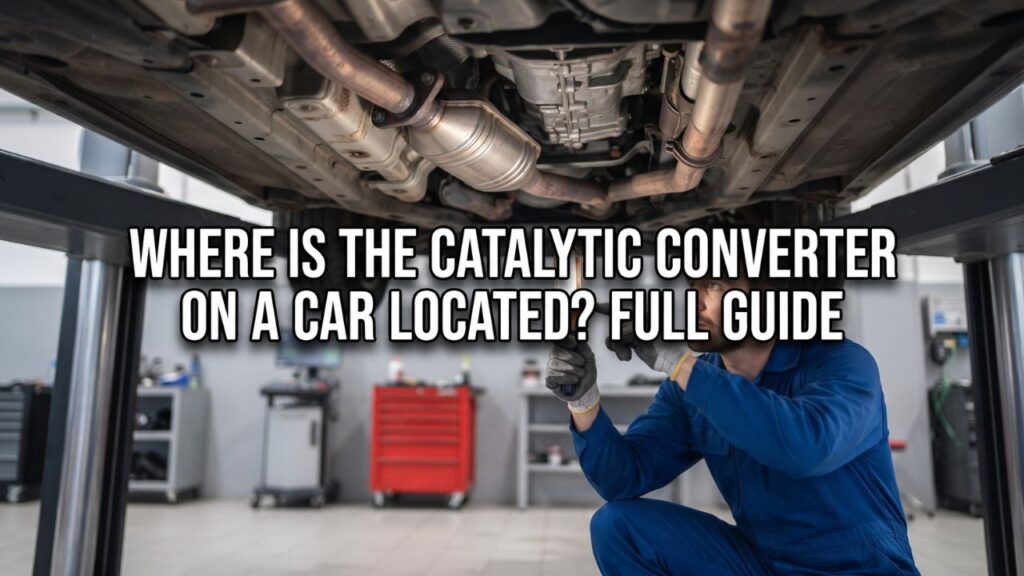
The catalytic converter is installed between the engine’s exhaust outlet and the muffler.
A simplified gasoline-car exhaust path normally looks like this:
Engine → Exhaust manifold → Catalytic converter → Resonator → Muffler → Tailpipe
Some vehicles add more converters, oxygen sensors, flex pipes, particulate filters, or other exhaust components between those points.
Close-Coupled Converter Near the Engine
A close-coupled catalytic converter sits very close to the engine.
It may be:
- Bolted directly to the exhaust manifold
- Integrated into the manifold assembly
- Mounted in the downpipe just below the manifold
- Positioned near the firewall
- Located low in the engine bay near the transmission
This location lets hot exhaust reach the catalyst quickly.
Cold-start emissions are a major challenge because a cold catalyst does little until it warms enough for chemical reactions to begin. Mounting the unit near the engine shortens that warm-up period.
Close-coupled converters can be difficult to see from beneath the vehicle because heat shields, the subframe, engine components, or the firewall can hide them.
Underbody Converter Beneath the Car
An underbody converter sits farther downstream along the exhaust pipe.
Common positions include:
- Under the front seats
- Near the transmission tunnel
- Beneath the front half of the passenger compartment
- Along the centerline of the vehicle
- Ahead of the resonator or muffler
Older vehicles commonly used a single underbody converter. Modern cars may combine a close-coupled catalyst near the engine with another converter farther downstream.
An underbody converter is often easier to recognize because you can see the enlarged housing in the exhaust pipe once the car is safely raised.
Converter Integrated Into the Exhaust Manifold
Some engines use a manifold catalytic converter, where the catalyst housing and exhaust manifold are built into one assembly.
This design can make the converter appear to be part of the engine rather than a separate canister under the car.
The assembly may sit:
- At the front of a transverse engine
- Between the engine and radiator
- Between the engine and firewall
- On either side of a V6 or V8 engine
Replacing this type can require more engine-bay disassembly than replacing an underfloor bolt-on converter.
Key Takeaway: The converter always sits in the exhaust stream after the engine, but it may be attached to the manifold, tucked near the engine, or mounted farther beneath the vehicle.
How to Identify the Catalytic Converter Under a Car
A catalytic converter usually looks like a widened metal section of the exhaust system.
Its shape varies, so do not rely on one visual design.
Look for an Enlarged Metal Housing
Most converters are wider than the exhaust pipe connected to them.
Common shapes include:
- Oval canister
- Flattened oval
- Short cylinder
- Bulged metal housing
- Manifold-shaped catalyst assembly
The inlet and outlet narrow back down to exhaust-pipe diameter.
A muffler is normally much larger and located farther toward the rear of the vehicle. A resonator may also resemble a small muffler, which is why following the complete exhaust path is useful.
Look for Heat Shields
Catalytic converters operate at high temperatures, so many have metal shielding above, below, or around the housing.
The shield may look like a thin stamped-metal cover.
A heat shield can hide most of the converter body, making the part look different from replacement-product photos.
Do not remove a heat shield simply to make the converter easier to see. The shield protects the vehicle floor and nearby components from exhaust heat.
Follow the Oxygen Sensors
Oxygen sensors are another strong clue.
Many gasoline vehicles use:
- An upstream sensor before the converter
- A downstream sensor after the converter
The upstream sensor helps the engine computer manage air-fuel mixture on many systems. The downstream sensor helps monitor catalyst operation.
Sensor layout varies, and vehicles with several converters can have several sensors.
If you see an enlarged exhaust housing with electrical sensors threaded into the pipe before and after it, you have probably found a catalytic converter.
Follow the Exhaust From the Engine
When visual identification is difficult, tracing the system is simpler.
Start where the exhaust manifold leaves the cylinder head. Follow the pipe away from the engine until you reach the first enlarged catalyst housing.
Continue downstream because another converter may be installed farther back.
Key Takeaway: Identify the converter by following the exhaust, looking for a widened metal housing, heat shielding, and nearby oxygen sensors.
Where Is the Converter on a Front-Wheel-Drive Car?
Front-wheel-drive cars commonly use a transverse engine, meaning the crankshaft sits across the vehicle from side to side.
This layout often puts the exhaust manifold at either the front or rear side of the engine.
Converter at the Front of the Engine
On some engines, the exhaust manifold faces the radiator.
The close-coupled converter may sit directly below the manifold near the front of the engine bay.
A heat shield often covers most of the assembly.
This position can sometimes be seen from above after opening the hood.
Converter Behind the Engine
Other transverse engines place the exhaust manifold on the firewall side.
The converter may then sit between the engine and firewall or drop down behind the engine into the exhaust tunnel.
This arrangement can make the converter harder to see and harder to remove.
Second Converter Under the Floor
Some front-wheel-drive vehicles use a second converter farther down the exhaust.
The layout can look like:
Engine → Manifold catalyst → Flex pipe → Underbody catalyst → Resonator → Muffler
If you find one catalyst next to the engine, do not assume it is the only one.
Key Takeaway: Front-wheel-drive cars often place the first converter very close to the transverse engine, with some models adding another catalyst under the floor.
Where Is the Converter on a Rear-Wheel-Drive Car or Truck?
Rear-wheel-drive vehicles commonly use a longitudinal engine, with the engine and transmission pointing toward the rear axle.
The exhaust runs backward along one or both sides of the transmission.
Inline-Engine Layout
A four-cylinder or six-cylinder inline engine may feed one primary exhaust path.
The converter can sit near the engine outlet or underneath the vehicle beside the transmission.
The exhaust then continues rearward to the resonator and muffler.
V6 and V8 Layout
V engines have two cylinder banks and usually two exhaust manifolds.
That can lead to two separate converter paths:
Bank 1 → Converter 1
Bank 2 → Converter 2
Each bank may have its own close-coupled converter.
Some vehicles then merge both pipes farther downstream, while others maintain dual exhaust paths.
Trucks and SUVs
Trucks and body-on-frame SUVs often have more open space underneath, which can make underbody converters easier to see.
The same accessibility is one reason certain truck and SUV converters have historically been attractive targets for theft.
Do not crawl under a truck simply because it appears to have plenty of ground clearance. Use the correct lifting and support procedure if inspection requires getting underneath.
Key Takeaway: Rear-wheel-drive vehicles often place converters along the transmission tunnel, while V6 and V8 models may have one converter for each cylinder bank.
How Many Catalytic Converters Does a Car Have?
There is no single number that applies to every car.
Many simple exhaust systems use one main converter, while newer and larger engines can use several catalyst units.
Cars With One Converter
A small inline engine may route all exhaust through one manifold and one catalytic converter.
This layout is common on many older four-cylinder vehicles and some simpler exhaust systems.
Cars With Two Converters
Two-converter layouts are common for several reasons.
A vehicle may have:
- One close-coupled converter plus one underbody converter
- One converter for each bank of a V6
- One converter for each bank of a V8
- A primary catalyst followed by a secondary catalyst
Finding two metal canisters does not mean one is automatically a resonator. Check the sensor layout and vehicle diagram.
Cars With More Than Two
Some modern vehicles use multiple catalyst bricks to meet cold-start and full-temperature emissions targets.
A V-engine may have a close-coupled converter on each bank plus one or more downstream catalysts.
Turbocharged engines can also use catalysts close to the turbo outlet where exhaust temperature is high.
If you need the exact count for repair or replacement, use the VIN, emissions label, factory parts diagram, or vehicle service information.
Key Takeaway: A car may have one converter or several; engine-bank layout and emissions-system design determine the number.
Is the Catalytic Converter Closer to the Engine or Muffler?
It is usually closer to the engine, especially on modern vehicles.
Catalysts need heat to operate. Exhaust gases are hottest immediately after leaving the cylinders, so putting the converter near the exhaust manifold helps it warm quickly.
An underbody converter can still sit several feet behind the engine, but it normally remains upstream of the muffler.
If you are looking beneath the car and find a large canister near the rear bumper, it is more likely to be the muffler than the catalytic converter.
A typical location sequence is:
Front of vehicle: Engine → Converter → Resonator → Muffler → Tailpipe Rear of vehicle
Actual routing changes with engine placement and exhaust design, but the converter stays ahead of the muffler in the exhaust flow.
Why Do Modern Cars Put Catalytic Converters Near the Engine?
Cold-start emissions explain much of the design.
A cold catalyst cannot process exhaust at full capacity. During the first period after startup, the engine and exhaust system are warming rapidly.
Placing the catalyst close to the exhaust ports exposes it to hotter gases sooner.
This is one reason modern engine bays may have bulky heat-shielded exhaust assemblies packed close to the cylinder head.
Close placement also changes repair access. A converter near the floor can sometimes be removed from beneath the car, while a manifold-mounted unit may require removing shields, sensors, braces, intake components, or other engine-bay parts.
The location therefore affects both emissions behavior and replacement labor.
Where Is the Catalytic Converter on a Hybrid?
A gasoline-electric hybrid still has a catalytic converter because its internal-combustion engine produces exhaust whenever it runs.
The converter remains in the exhaust path between the engine and rear exhaust system.
Many hybrids position catalysts close to the engine to promote rapid warm-up during periods when the gasoline engine starts after being off.
Some hybrids have underbody converters that are easy to access, while others tuck the catalyst tightly into the engine-side exhaust assembly.
Hybrid exhaust systems can start or stop heating as the gasoline engine cycles, so follow vehicle-specific service precautions before working around the system.
High-voltage hybrid components also create hazards unrelated to the converter. Do not disturb orange high-voltage cables or electrical assemblies while inspecting the exhaust.
Where Is the Catalytic Converter on a Diesel Car?
Diesel exhaust systems can contain more emissions components than a basic gasoline system.
A modern diesel may use:
- Diesel oxidation catalyst
- Diesel particulate filter
- Selective catalytic reduction catalyst
- Ammonia slip catalyst
- Sensors and dosing equipment
Some of these parts are packaged together in one large exhaust aftertreatment assembly.
The oxidation catalyst generally sits relatively close to the engine or turbocharger so exhaust heat can activate it.
A large canister underneath a modern diesel is not automatically a single conventional catalytic converter. It may contain several aftertreatment stages.
Use the vehicle-specific exhaust diagram before identifying or replacing any diesel emissions component.
How to Find Your Car’s Catalytic Converter Safely
A visual inspection is simple only when the vehicle can be accessed safely.
Let the Exhaust Cool
Do not inspect the converter immediately after driving.
Catalytic converters and nearby exhaust pipes can stay hot long after the engine is switched off.
Wait until the entire exhaust is cool before placing your hands near it.
Park on a Level Surface
Use firm, level ground.
Set the parking brake and secure the vehicle against movement.
If raising the car is required, use approved lifting points and rated jack stands.
Never rely on a hydraulic jack alone while any part of your body is beneath the car.
Start at the Engine
Find the exhaust manifold and trace the exhaust rearward.
Look for a wider canister near the engine first.
Then continue along the exhaust system because a second converter may sit under the floor.
Use the Emissions Label or Vehicle Information
The underhood emissions label can help identify the emissions family, but it may not provide a simple drawing of every converter.
A factory service manual, manufacturer parts catalog, or VIN-specific exhaust diagram is better for an exact location.
This becomes more useful when the vehicle has several converters and you need to identify Bank 1 versus Bank 2 or an upstream versus downstream unit.
Key Takeaway: Let the exhaust cool, support the vehicle correctly, trace the exhaust from the engine, and use a vehicle-specific diagram if more than one catalyst is present.
Why Catalytic Converter Location Matters
Location affects diagnosis, replacement cost, heat management, and accessibility.
Diagnosis
If a scan tool reports Bank 1 or Bank 2 catalyst performance, you need to identify which exhaust bank contains the affected converter.
Replacing the wrong unit will not fix the fault.
Oxygen Sensor Identification
A converter’s position helps separate upstream and downstream oxygen sensors.
Sensor identification matters during testing because the two sensors have different roles on many vehicles.
Repair Labor
An exposed underbody converter may be relatively accessible.
A manifold-integrated converter can require much more disassembly, raising labor time.
Heat Exposure
Converters mounted close to the engine expose nearby wiring, shields, hoses, and body panels to high exhaust temperature.
Damaged heat shields should therefore be repaired rather than discarded.
Theft Exposure
Underbody converters with easy access can be more exposed to theft than converters packed tightly into the engine bay.
High-clearance vehicles can provide more room to reach the exhaust without lifting the vehicle.
Anti-theft shields, protected parking, alarms, and other deterrents are available for models with repeated theft problems.
Key Takeaway: Converter position affects which component a fault code refers to, how sensors are identified, repair access, heat shielding, and theft exposure.
Conclusion
For where is the catalytic converter on a car located, look in the exhaust system after the exhaust manifold and before the muffler. On many modern cars, the first converter sits close to the engine so it can heat quickly, while other vehicles place the main converter underneath the floor.
Front-wheel-drive cars often hide the catalyst beside or behind the transverse engine. Rear-wheel-drive cars and trucks may place it along the transmission tunnel. V6 and V8 engines commonly use separate converters for their two cylinder banks, and some vehicles add downstream catalysts.
Look for a widened metal exhaust housing, heat shields, and nearby oxygen sensors. Trace the exhaust from the engine toward the rear rather than searching only the middle of the car.
If I needed the exact converter for diagnosis or replacement, I would confirm its position with vehicle-specific service information before ordering parts. This matters most on cars with multiple converters, where Bank 1, Bank 2, close-coupled, and downstream units can look very similar.
FAQs About Catalytic Converter Location
Is the catalytic converter under the car?
Often, yes. Many converters sit underneath the front or middle section of the vehicle along the exhaust pipe. Modern cars can also place a converter high in the engine bay, directly against the exhaust manifold, so it may not be easy to see from underneath.
Is the catalytic converter near the engine?
Many modern converters are very close to the engine. These close-coupled units receive hot exhaust quickly, allowing the catalyst to warm soon after startup. Some are integrated directly into the exhaust manifold.
Is the catalytic converter before or after the muffler?
The catalytic converter is before the muffler in the exhaust flow. Exhaust travels from the engine through the converter and then continues toward the resonator, muffler, and tailpipe.
How can I tell the catalytic converter from the muffler?
A converter is normally closer to the engine and smaller than the main muffler. It often has heat shielding and oxygen sensors nearby. The muffler is usually farther toward the rear and has a larger chamber intended to reduce exhaust noise.
Do all cars have one catalytic converter?
No. Some vehicles use one, while others have two or more. V6 and V8 engines may have separate units for each cylinder bank, and some modern vehicles use close-coupled converters followed by additional underbody catalysts.
Why is my catalytic converter in the engine bay?
Mounting the converter close to the engine exposes it to hotter exhaust, helping the catalyst reach operating temperature faster after startup. Some manufacturers integrate the catalyst directly into the exhaust manifold for this reason.
Where are the oxygen sensors in relation to the catalytic converter?
Many gasoline vehicles have an upstream oxygen or air-fuel sensor before the converter and a downstream oxygen sensor after it. Vehicles with multiple converters can use several sensors, so exact placement should be checked against the vehicle’s exhaust diagram.
Can I see the catalytic converter without lifting the car?
Sometimes. A close-coupled converter may be visible from the engine bay, while a low-mounted unit may be visible by looking beneath the side of the vehicle. Do not crawl underneath unless the vehicle is safely supported with equipment designed for that purpose.