How to Fix a Stopped Up Catalytic Converter: Safe Repair Steps
A mildly contaminated catalytic converter may sometimes improve after the engine fault causing the buildup is repaired, but a converter with melted, collapsed, or badly blocked internal passages normally needs replacement. Before buying a converter, confirm that exhaust restriction is really the problem and repair any misfire, rich fuel mixture, oil burning, or coolant leak that caused it.
A stopped-up converter restricts the engine’s exhaust flow. The car may idle reasonably well yet lose power during acceleration because exhaust volume rises as engine speed increases. A severe restriction can cause hard starting, stalling, excessive heat, or an engine that will not stay running.
Trying to force the blockage out can create more problems. Drilling holes, breaking out the internal catalyst, installing a straight pipe, or driving with part of the exhaust removed does not repair the converter and can violate U.S. emissions law.
For U.S. vehicles, the EPA identifies catalytic converters as specified major emission-control components. On eligible light-duty vehicles, these components receive federal emissions warranty protection for 8 years or 80,000 miles, whichever comes first, subject to the applicable warranty terms. Check warranty coverage before paying for a replacement.
The safest approach to how to fix a stopped up catalytic converter starts with diagnosis. If the converter is only contaminated and its internal structure is still intact, fixing the engine problem may stop further buildup, and a converter-safe cleaner may have limited usefulness in mild cases. If the honeycomb has melted or collapsed, chemicals cannot reopen those passages.
I would treat a flashing Check Engine light, red-hot converter, repeated stalling, or major power loss as a reason to stop driving rather than experiment with cleaning products. The next sections cover diagnosis, cleaning limits, replacement, root causes, and the signs that tell you the converter is too damaged to save.
How to Fix a Stopped Up Catalytic Converter Safely
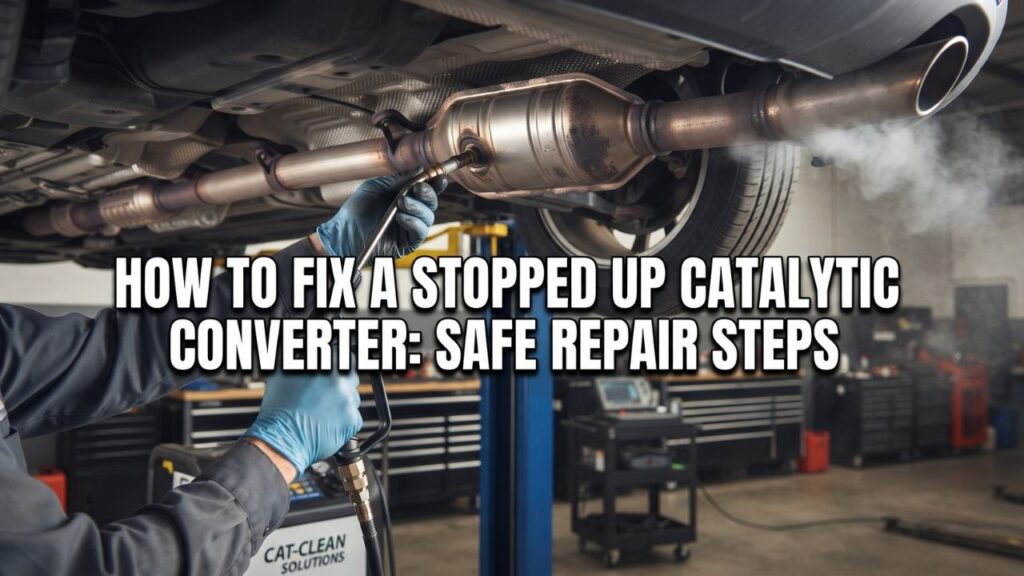
The repair depends on why exhaust flow is restricted.
A converter coated with light deposits is different from one whose internal ceramic substrate has melted into a solid obstruction.
Confirm That the Converter Is Actually Restricted
Do not replace the converter based only on a P0420 or P0430 code.
Those codes refer to catalyst performance, not necessarily physical blockage. An exhaust leak, oxygen-sensor problem, misfire, or fuel-control fault can produce catalyst-related codes without clogging the converter.
Signs that support an exhaust restriction include:
- Weak acceleration
- Loss of high-RPM power
- Trouble climbing hills
- Engine that starts but stalls
- Hard starting
- Excessive heat near the converter
- Rattling from the converter
- Sulfur or rotten-egg exhaust odor
- High exhaust backpressure
If the engine does not crank at all, look at the battery, starter, wiring, or starting system first. A clogged converter normally affects the engine after it begins turning.
Repair the Engine Problem That Caused the Clog
Converters often fail because another engine fault sends abnormal material or heat into the exhaust.
Common causes include:
- Ignition misfire
- Leaking fuel injector
- Rich air-fuel mixture
- Oil burning
- Internal coolant leak
- Excessive fuel pressure
- Damaged oxygen or air-fuel sensor
- Long-term engine-control fault
Walker Exhaust lists misfires, fuel-system faults, oil contamination, coolant contamination, and overheating among common causes of converter damage.
Fixing the converter without repairing one of these faults can damage the replacement.
Decide Between Cleaning and Replacement
Cleaning is only worth considering when the internal catalyst remains structurally sound and the restriction appears related to light contamination.
Replacement is normally needed when the converter has:
- Melted passages
- Collapsed substrate
- Broken catalyst material
- Severe physical restriction
- Internal rattling from broken material
- Heavy oil or coolant contamination
- Damage from extreme overheating
A converter that is physically blocked is a mechanical failure. Pouring a cleaner into the fuel tank cannot rebuild broken ceramic or reopen fused passages.
Key Takeaway: Confirm the restriction, repair the engine fault that caused it, and replace the converter if its internal structure is melted, collapsed, broken, or heavily contaminated.
Can a Stopped Up Catalytic Converter Be Cleaned?
Sometimes, but only in limited situations.
The word “clogged” can describe several very different converter conditions.
Light Deposits May Respond to Cleaning
A converter that is beginning to collect deposits but still has open passages may sometimes improve after the underlying fuel or ignition problem is corrected.
Some converter-safe fuel additives are marketed for reducing light deposits.
If you use one:
- Follow the product instructions exactly
- Use only a product approved for catalytic converters
- Do not exceed the recommended amount
- Do not expect it to repair physical damage
- Stop if the engine has severe restriction symptoms
AutoZone states that cleaning additives may have some usefulness when clogging is just beginning, while a converter requiring removal usually points toward replacement.
The key distinction is deposit buildup versus structural damage.
Melted Honeycomb Cannot Be Cleaned
The converter contains a ceramic or metallic substrate with many narrow passages.
Extreme heat can melt these passages together.
Walker notes that normal converter temperatures on a properly running engine generally remain below about 1,200°F, while repeated operation above 1,600°F can harm the catalyst coating. Damaged matting and melted substrate commonly appear above about 1,700°F.
Once the passages fuse together, cleaner cannot reopen them.
Replacement is the proper repair.
Removing and Washing the Converter Is Usually a Poor Plan
Online instructions sometimes recommend removing a converter and washing it with detergent, degreaser, or high-pressure water.
That method can damage the internal substrate, leave contamination behind, create disposal issues, or fail to reach material deep inside the converter.
If the unit needs to come off the vehicle because restriction is severe, replacing a confirmed failed converter usually makes more sense than trying to pressure-wash a fragile catalyst.
Key Takeaway: Cleaning may have limited use for light deposits in an intact converter. It cannot repair melted, collapsed, cracked, or badly contaminated catalyst material.
How to Confirm a Catalytic Converter Is Stopped Up
Good diagnosis prevents replacement of an expensive part that was not actually causing the problem.
Several tests can support or rule out exhaust restriction.
Check the Driving Symptoms
A restricted converter often creates symptoms that become worse as engine speed rises.
Typical behavior includes:
- Normal or nearly normal idle
- Slow acceleration
- Engine feels restricted above a certain RPM
- Poor highway performance
- Trouble climbing grades
- Engine stalls after running
- Starting becomes harder as restriction worsens
This pattern occurs because an idling engine produces far less exhaust gas than an engine under load.
A fully blocked converter can prevent the engine from staying running.
Scan the OBD-II System
Check stored and pending trouble codes.
Useful code groups include:
- P0420 — Catalyst efficiency below threshold, Bank 1
- P0430 — Catalyst efficiency below threshold, Bank 2
- P0300-series — Misfire codes
- Fuel-trim codes
- Oxygen-sensor codes
- Air-fuel sensor codes
Record the codes before clearing them.
A misfire code may be more important than the catalyst code because an active misfire can be the reason the converter overheated.
Measure Exhaust Backpressure
Backpressure testing is one of the stronger ways to confirm physical restriction.
A technician can measure pressure through an oxygen-sensor port or another approved test point.
Walker gives these general reference values:
- Less than about 1.5 PSI at idle
- Less than about 3 PSI at 2,000 RPM
Vehicle specifications take priority.
High pressure ahead of the converter with lower pressure behind it supports a restricted-converter diagnosis. High pressure behind the converter may point toward a blocked muffler or another downstream restriction instead.
Check Engine Vacuum
A vacuum gauge can also provide clues.
With the engine running, intake vacuum may fall as RPM is held if exhaust restriction continues building.
Vacuum readings can also change because of valve timing, ignition timing, mechanical engine faults, and other conditions, so this test should not stand alone.
Inspect for Heat Damage
Heat discoloration on the converter housing can point toward an overheating event.
Possible signs include:
- Blue or bronze shell discoloration
- Strong hot-metal smell
- Red glow
- Melted nearby material
- Damaged heat shield
- Rattling substrate
Never touch a recently operated converter. Exhaust components can remain hot long after shutdown.
Key Takeaway: Driving symptoms, OBD-II data, exhaust backpressure, vacuum behavior, and physical heat damage together provide a much stronger diagnosis than a catalyst code alone.
What Causes a Catalytic Converter to Become Stopped Up?
A converter rarely becomes badly restricted for no reason.
Finding the cause protects the replacement unit.
Misfires and Excess Fuel
A misfire leaves part or all of a cylinder’s fuel mixture unburned.
That fuel enters the exhaust and may burn inside the converter.
Possible causes include:
- Worn spark plugs
- Failed ignition coil
- Injector fault
- Low compression
- Wiring problem
- Incorrect fuel mixture
Repeated fuel burning inside the converter can raise its temperature enough to melt the substrate.
A flashing Check Engine light often points toward a severe active misfire. Do not continue normal driving with that warning.
Rich Air-Fuel Mixture
A rich mixture means the engine is receiving more fuel than it should relative to the available air.
Possible causes include:
- Leaking injector
- Faulty fuel-pressure regulator
- Excess fuel pressure
- Incorrect sensor reading
- Restricted intake airflow
- Ignition failure
A rich engine may produce black exhaust, poor fuel economy, fuel odor, rough running, or fouled spark plugs.
Excess fuel can also destroy the converter through overheating.
Oil or Coolant Contamination
An engine that burns oil sends oil-related ash and deposits into the exhaust.
An internal coolant leak can send coolant-derived contaminants into the converter.
Possible sources include:
- Worn piston rings
- Valve-seal problems
- PCV-system fault
- Head-gasket leak
- Cracked cylinder head
- Other internal engine damage
Walker states that oil fouling and internal coolant leaks can coat or poison the catalyst.
A new converter installed on an engine that is still consuming large amounts of oil or coolant may fail again.
Physical Damage and Internal Breakage
Road impact, long-term heat cycling, corrosion, or severe overheating may crack the converter substrate.
Broken pieces can shift inside the shell and partially cover the outlet.
That may cause:
- Rattling
- Intermittent power loss
- Increasing exhaust restriction
- Sudden worsening after a bump or temperature change
Key Takeaway: Misfires, rich fueling, oil burning, coolant leaks, and internal catalyst breakage are common causes of a stopped-up converter and should be addressed before replacement.
When Replacement Is the Correct Fix
Replacement becomes the sensible repair once internal catalyst damage is confirmed.
Trying to save a physically destroyed converter usually adds labor without solving the restriction.
Replace a Melted or Collapsed Converter
A melted substrate may look normal at the inlet and outlet while the middle section has fused internally.
Walker warns that internal melting may not always be visible from the ends.
Backpressure testing and physical inspection are more useful than assuming the converter is open because light can be seen through part of it.
If the substrate has collapsed, replacement is required.
Replace a Converter With Broken Internal Material
Rattling from inside the converter can mean the catalyst brick has fractured.
Loose material may move around and block the outlet.
Once the substrate breaks apart, there is no dependable way to restore its original structure.
Check Federal Emissions Warranty Coverage
Before purchasing a replacement, check the vehicle age, mileage, and warranty booklet.
The EPA states that specified major emission-control components, including catalytic converters, are covered under the federal emissions warranty for 8 years or 80,000 miles on eligible vehicles, subject to warranty conditions.
A newer vehicle with an original converter may qualify for manufacturer repair.
Use a Legal Replacement Converter
Use a replacement approved for the vehicle and the emissions requirements where it is registered.
Some states have converter rules beyond federal requirements.
Do not install a straight pipe or remove required emissions hardware.
EPA guidance treats removal or disabling of required emissions equipment as tampering.
Key Takeaway: Melted, collapsed, broken, or severely restricted converters need replacement. Check emissions warranty coverage and use a converter approved for the vehicle.
What Not to Do With a Clogged Catalytic Converter
Several common shortcuts either fail to solve the problem or create a larger one.
Do Not Drill Holes in the Converter
Drilling the housing does not repair the internal catalyst.
It creates an exhaust leak, may release hot gases near the floor or wiring, and alters the emissions system.
It also makes proper diagnosis harder.
Do Not Break Out the Catalyst
Some people try to punch or break the honeycomb out of a blocked converter.
That destroys the emissions component, can send pieces farther down the exhaust, and may violate federal anti-tampering rules.
The correct repair for a physically failed converter is replacement.
Do Not Install a Straight Pipe as a Repair
Replacing a required converter with plain exhaust pipe disables the emissions-control system.
EPA guidance identifies this type of modification as tampering.
Use a compliant converter matched to the vehicle.
Do Not Keep Driving a Severe Misfire
An active misfire can be what destroyed the converter in the first place.
A flashing Check Engine light, rough running, fuel smell, or severe shaking calls for prompt diagnosis.
Continuing to drive may send more fuel into the converter and raise its temperature again.
Do Not Replace the Converter Before Finding the Cause
A replacement converter is expensive.
Before installing one, check:
- Misfire codes
- Fuel trims
- Injector operation
- Fuel pressure
- Spark plugs
- Ignition coils
- Oil consumption
- Coolant loss
- Exhaust leaks
- Oxygen-sensor operation
I would not install a new converter until the fault that damaged the old one has been addressed.
Key Takeaway: Avoid drilling, gutting, bypassing, or repeatedly overheating a clogged converter. Fix the engine fault and replace physically damaged catalyst material.
Can You Drive With a Stopped Up Catalytic Converter?
A lightly restricted converter and a nearly blocked converter create very different levels of risk.
Mild Symptoms May Allow a Short Trip for Diagnosis
A short drive to a repair shop may be possible if:
- Check Engine light is steady
- Engine runs smoothly
- Acceleration remains normal
- No smoke is present
- Exhaust is not glowing
- Vehicle is not stalling
- No strong exhaust fumes enter the cabin
Do not interpret this as permission to postpone the repair for weeks.
Restriction can worsen.
Severe Symptoms Call for Towing
Stop driving if you notice:
- Flashing Check Engine light
- Severe misfire
- Major loss of acceleration
- Vehicle cannot maintain traffic speed
- Repeated stalling
- Converter glowing red
- Smoke underneath the vehicle
- Strong burning odor
- Exhaust fumes entering the passenger area
Park away from dry leaves, grass, or other combustible material if the exhaust is extremely hot.
A converter damaged by raw fuel can reach temperatures high enough to damage the catalyst and nearby components.
Key Takeaway: Mild symptoms may permit a short trip for diagnosis, but flashing warning lights, severe power loss, stalling, smoke, or extreme heat are reasons to stop and tow the vehicle.
How to Prevent the Replacement Converter From Clogging Again
A new converter should not be treated as the end of the repair.
The upstream engine problem needs to stay corrected.
Repair Misfires Promptly
Replace worn ignition parts according to the vehicle’s service schedule and diagnose a misfire as soon as it appears.
Do not drive for long periods with a flashing Check Engine light.
Watch Oil and Coolant Consumption
Frequent oil top-offs or unexplained coolant loss may point toward an internal engine problem.
If oil or coolant is entering the cylinders, the converter may become contaminated again.
Fix Fuel-System Faults
Leaking injectors and fuel-pressure faults can send excessive fuel into the exhaust.
Check fuel trims and related diagnostic data if the engine shows rich-running symptoms.
Do Not Ignore Exhaust Leaks
Leaks near oxygen sensors can interfere with exhaust readings and catalyst monitoring.
Repair damaged pipes, flex sections, flanges, and gaskets before judging converter operation.
Conclusion
The proper approach to how to fix a stopped up catalytic converter is to confirm the restriction first, repair the engine fault that caused it, and then decide if the converter is still structurally usable. Light contamination may sometimes improve after the root problem is corrected, but cleaners cannot repair melted or collapsed catalyst passages.
Backpressure testing, OBD-II codes, fuel-trim checks, misfire diagnosis, exhaust inspection, and temperature clues can separate a true clog from other engine problems. High pressure ahead of the converter is much stronger evidence of physical restriction than a P0420 code by itself.
If the substrate is melted, broken, heavily contaminated, or badly blocked, replace the converter with a legal vehicle-approved unit. Check federal emissions warranty coverage before paying for the repair.
I would avoid drilling, gutting, or bypassing the converter. Those shortcuts do not correct the reason the part failed and may leave the vehicle with exhaust leaks, emissions problems, or another damaged converter later.
FAQs About Fixing a Stopped Up Catalytic Converter
Can a Clogged Catalytic Converter Unclog Itself?
A physically melted or collapsed converter will not unclog itself.
Minor deposits may change after the engine fault causing them is corrected, but a severe mechanical restriction does not disappear through normal driving. Confirm restriction before deciding on cleaning or replacement.
Will Catalytic Converter Cleaner Fix a Clog?
It may have limited use for light contamination in an intact converter.
Cleaner cannot rebuild melted catalyst material, reconnect broken substrate, or reopen passages that have fused together. Severe power loss or high backpressure usually points toward diagnosis and replacement rather than a fuel additive.
Can I Pressure-Wash a Catalytic Converter?
Pressure washing is not a dependable repair for a restricted converter.
The internal substrate is fragile, contaminants may remain deep inside it, and water or cleaning chemicals may damage the unit. A converter bad enough to require removal for severe restriction usually needs replacement.
How Do I Know if the Converter Is Clogged or Just Bad?
A converter that has lost catalyst efficiency may trigger P0420 or P0430 while the car still drives normally.
A physically clogged converter is more likely to cause weak acceleration, falling power as RPM rises, high exhaust backpressure, hard starting, excessive heat, or stalling.
Can a Bad O2 Sensor Make the Converter Seem Clogged?
A faulty oxygen sensor can contribute to catalyst-related codes and incorrect fuel control, but it does not normally create a physical exhaust blockage by itself.
Backpressure testing can separate a real restriction from a sensor or catalyst-monitoring problem.
Is It Safe to Drive With a Partially Clogged Converter?
A mildly restricted converter may allow the vehicle to drive for a short distance, but the restriction can worsen.
Do not continue driving if the car loses substantial power, stalls, misfires severely, shows a flashing Check Engine light, smokes, or develops extreme exhaust heat.
How Much Backpressure Indicates a Clogged Catalytic Converter?
Walker gives general reference values of less than about 1.5 PSI at idle and less than about 3 PSI at 2,000 RPM.
Vehicle-specific specifications take priority. High pressure measured ahead of the converter, with lower pressure behind it, supports a restricted-converter diagnosis.