Can a Clogged Catalytic Converter Cause Stalling? Signs & Fixes
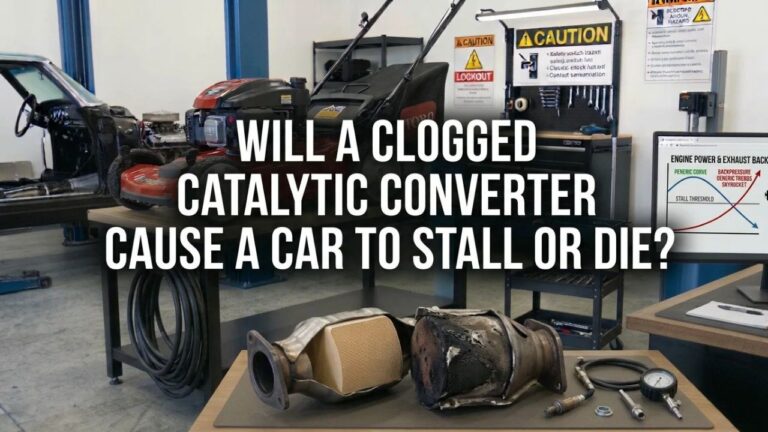
Yes, a severely restricted catalytic converter can make an engine stall. A blockage prevents exhaust gases from leaving freely, creating excessive backpressure that interferes with cylinder breathing. The engine may lose power first, then run rough, stall at idle or under load, become difficult to restart, or fail to start if the restriction becomes extreme.
A converter-related stall usually develops with other symptoms. Sluggish acceleration, poor high-RPM power, hard starting, abnormal exhaust heat, and a feeling that the engine cannot breathe are stronger clues than stalling by itself.
The advantage of identifying an exhaust restriction correctly is avoiding unnecessary fuel-pump, ignition, or sensor replacement. Stalling has many possible causes, so a catalytic converter should be tested rather than diagnosed from one symptom.
For U.S. owners, the EPA classifies catalytic converters as specified major emissions-control components covered by the federal emissions warranty for 8 years or 80,000 miles, subject to warranty conditions. A vehicle still inside that period may qualify for manufacturer-paid repair if the converter has failed because of a covered defect.
The answer to can a clogged catalytic converter cause stalling becomes clearer once exhaust restriction is separated from simple catalyst inefficiency. A converter can trigger a P0420 or P0430 code without being physically clogged. Stalling is more likely when the internal substrate has melted, collapsed, broken apart, or become restricted enough to block exhaust flow.
I’d pay closest attention to stalling paired with major power loss as the engine warms up or RPM rises. That pattern fits an exhaust restriction better than a vehicle that stalls randomly with no change in acceleration.
The sections below explain why a blocked converter can shut an engine down, the symptoms that point toward restriction, how technicians confirm the problem, other faults that mimic it, and what needs to be repaired before a replacement converter is installed.
Why Can a Clogged Catalytic Converter Cause Stalling?
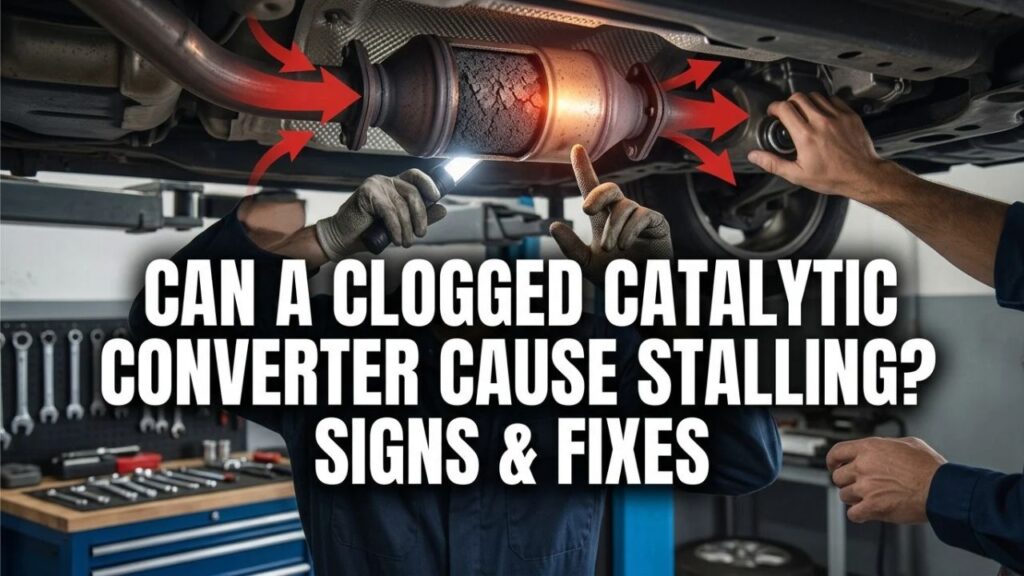
A four-stroke engine must expel burned gases during every exhaust stroke. The catalytic converter sits in that exhaust path.
When its internal passages become restricted, the engine has to push exhaust against increasing pressure.
Excessive Exhaust Backpressure Builds Up
A healthy converter contains many small passages that let exhaust gases flow through while the catalyst treats pollutants.
If those passages become blocked, pressure rises upstream of the converter.
Walker states that excessive backpressure can affect air-fuel operation and that high pressure ahead of the converter points toward converter restriction. Its diagnostic guidance gives general reference values below about 1.5 psi at idle and 3 psi at 2,000 RPM, while vehicle specifications may differ.
At low levels of restriction, the driver may notice only slower acceleration.
As the blockage becomes worse, the engine may struggle to clear each cylinder of burned gases.
Fresh Air and Fuel Cannot Enter the Cylinders Normally
An engine relies on spent gases leaving before the next intake charge enters.
Severe exhaust restriction leaves more residual gas behind. That reduces the amount of fresh air and fuel the cylinders can accept.
Engine output then falls.
Under enough restriction, combustion may become unstable enough for the engine to stall.
This is why a blocked converter can produce symptoms that feel similar to fuel starvation: the accelerator is pressed, yet the engine cannot make normal power.
Stalling May Get Worse Under Load
A restricted exhaust may allow the engine to idle when exhaust volume is low.
Accelerating, climbing a hill, or driving at highway speed produces much more exhaust.
A partially clogged converter can then act like a bottleneck. Power drops as RPM rises, and the engine may stumble or stall when the restriction becomes severe.
Walker lists stalling, delayed acceleration, hard starting, and loss of power among drivability problems associated with a failing or clogged converter.
A Severe Restriction Can Prevent Restarting
After a stall, the engine may crank but struggle to restart because the exhaust path remains blocked.
CarParts notes that severe converter restriction can create enough backpressure to cause stalling or even prevent an engine from running.
Some vehicles may restart after sitting for a while, then develop the same problem again as exhaust flow and temperature rise.
That hot-versus-cold pattern can be a useful diagnostic clue, though it does not prove the converter is responsible.
Key Takeaway: A clogged converter can stall an engine by trapping exhaust and creating excessive backpressure. Symptoms often become worse as engine load and exhaust volume increase.
Signs the Catalytic Converter May Be Causing the Stall
Stalling alone is too broad for a converter diagnosis. Look for a group of symptoms that point toward restricted exhaust flow.
Strong Loss of Acceleration
One of the clearest clues is a major drop in power.
The engine may feel acceptable at low speed, then struggle badly when you press the accelerator.
A common description is that the car feels as if something is holding it back.
AutoZone identifies sluggish acceleration and reduced engine output as common signs of converter restriction because exhaust cannot flow out normally.
A clogged fuel filter or weak fuel pump can create similar behavior, so testing still matters.
Engine Stalls After Warming Up
Some restricted converters become more troublesome after the vehicle has been running for several minutes.
Heat can affect a damaged substrate, and increasing exhaust volume can expose a restriction that was less noticeable during cold idle.
A car may:
- Start normally
- Idle for a few minutes
- Begin losing power
- Run rough
- Stall
- Become difficult to restart
That sequence is more suspicious for exhaust restriction than a stall that occurs with no other drivability change.
The Engine Will Not Rev Normally
A severely clogged converter can make the engine feel capped at a certain RPM.
Pressing farther on the accelerator produces more noise or load but little extra engine speed.
This may be most noticeable while driving rather than revving in Park or Neutral because the engine produces greater exhaust volume under load.
Hard Starting Appears With the Stalling
A blocked exhaust can affect both starting and running.
If the engine takes longer to start, then has poor power and stalls once running, converter restriction belongs on the diagnostic list.
AutoZone includes difficulty starting among symptoms associated with excessive backpressure from a clogged converter.
Excessive Heat Develops Around the Converter
Restriction and converter damage can be associated with abnormal heat.
Walker states that a properly running engine normally keeps converter temperatures below roughly 1,200°F, while operation above about 1,600°F can damage catalyst material and temperatures above roughly 1,700°F may melt or damage the substrate.
A converter that glows red, produces smoke, or creates extreme heat under the vehicle needs immediate attention.
Do not crawl under a hot vehicle to inspect it.
The Converter Rattles
A rattle from inside the converter can mean the ceramic substrate has broken apart.
Loose pieces may shift inside the shell. In some cases, broken material can move into a position that further restricts exhaust flow.
Walker lists broken and melted substrates among common converter failures.
Check-Engine Light Is On
A failed converter may set P0420 for Bank 1 or P0430 for Bank 2.
Those codes indicate catalyst-efficiency problems. They do not prove there is a physical blockage.
A converter can be chemically weak but still flow exhaust normally.
For stalling, evidence of restriction matters more than a catalyst-efficiency code alone.
Key Takeaway: Converter-related stalling usually appears with power loss, hard starting, poor high-RPM response, excess heat, or a damaged substrate. P0420 or P0430 alone does not confirm a clog.
Can a Clogged Catalytic Converter Cause Stalling at Idle?
Yes, a severe restriction can cause an engine to stall at idle, though many other faults cause idle stalling more often.
At idle, exhaust volume is relatively low. A mildly restricted converter may therefore allow the engine to remain running.
A nearly blocked converter can create enough residual exhaust pressure to disturb combustion even at low engine speed.
Stalling at idle is more suspicious for converter restriction when the vehicle also has poor acceleration, refuses to rev freely, or becomes difficult to restart.
If the engine runs strongly during acceleration but stalls only when coming to a stop, other causes deserve close attention. These can include throttle-body deposits, idle-control faults on older vehicles, vacuum leaks, EGR problems, electrical faults, or sensor failures.
RepairPal also lists a clogged converter as one possible source of excessive backpressure and engine stalling while stressing that many other systems can create the same symptom.
Can a Clogged Converter Make the Car Stall While Driving?
Yes. A severe restriction can make the engine lose enough power to stall while the vehicle is moving.
This may occur during acceleration, highway driving, or climbing a grade because those conditions increase exhaust flow.
A stall in traffic creates a safety concern because engine power disappears unexpectedly. Steering assist and brake assist can also change after the engine stops, depending on vehicle design.
If the vehicle repeatedly stalls while moving, avoid treating it as a problem to monitor over several more trips.
Arrange diagnosis before normal driving continues.
A car that restarts after cooling down still has a fault that needs repair. Temporary recovery does not mean the restriction has cleared.
How a Catalytic Converter Becomes Clogged
A converter often becomes restricted because another engine fault damages the internal substrate.
Replacing the converter without correcting that fault can damage the new part.
Misfires Can Melt the Substrate
A misfire can send unburned fuel and oxygen into the exhaust.
That mixture can react inside the converter and generate extreme heat.
Walker lists misfires, weak spark, low compression, and air-fuel imbalance among conditions that can overheat and melt catalytic-converter substrates.
Once ceramic passages melt together, exhaust flow can become restricted.
A flashing check-engine light commonly accompanies a severe active misfire. Do not continue loading the engine heavily when that warning is present.
Rich Fuel Mixtures Can Overheat the Converter
Too much fuel entering the engine can send excess hydrocarbons into the exhaust.
Possible causes include leaking injectors, fuel-pressure faults, ignition trouble, or incorrect sensor input.
If that fuel burns inside the converter, substrate temperature can rise enough to damage it.
Repair the rich condition before replacing a melted converter.
Oil or Coolant Can Contaminate the Honeycomb
An engine that burns oil can send ash and deposits through the exhaust.
An internal coolant leak can contaminate catalyst surfaces as well.
Walker identifies excessive oil consumption and internal coolant leakage as causes of converter contamination.
Contamination may reduce catalyst function and contribute to blocked passages over time.
Broken Substrate Can Restrict Flow
Road impact, thermal damage, corrosion, or repeated overheating can crack the ceramic structure.
Loose pieces can shift or collect downstream.
Walker notes that converter failures can involve structural damage, broken substrates, and debris from an upstream converter blocking a downstream unit.
Key Takeaway: Misfires, rich running, oil burning, coolant leakage, and physical substrate damage can turn a converter into an exhaust restriction. Repair the original cause before installing another converter.
How to Tell If the Converter Is Actually Clogged
Proper diagnosis matters because fuel, ignition, sensor, and electrical faults can imitate converter symptoms.
Scan All Trouble Codes First
Start with an OBD-II scan.
Do not focus only on P0420 or P0430.
Look for codes related to:
- Misfires
- Fuel mixture
- Mass airflow
- Oxygen sensors
- Throttle control
- Fuel pressure
- Camshaft or crankshaft position
- Engine temperature
Walker recommends repairing other engine codes before diagnosing the converter because those faults can affect catalyst operation and diagnostic readings.
Measure Exhaust Backpressure
A backpressure test is one of the more direct ways to find a restricted exhaust.
A technician can measure pressure at suitable exhaust-sensor ports and compare pressure before and after the converter.
Walker states that high backpressure ahead of the converter indicates converter restriction, while high pressure farther downstream may point toward a restricted muffler or resonator.
The test also prevents a damaged muffler from being mistaken for a clogged converter.
Use an Engine Vacuum Test
A vacuum gauge can also provide evidence of exhaust restriction.
Walker describes a test in which engine vacuum is observed at idle and again around 2,500 RPM. A large sustained vacuum drop can point toward a blocked exhaust, though valve timing and other engine faults can affect the reading.
Vacuum testing can suggest restriction, but it may not identify the exact blocked component.
Inspect Converter Temperature and Condition
Temperature measurements may add useful information when combined with other tests.
A damaged converter may also show:
- Shell discoloration
- Internal rattling
- Impact damage
- Melted substrate
- Collapsed passages
Temperature alone does not prove a converter is clogged. A misfire can make a converter extremely hot even before a major restriction develops.
Key Takeaway: Diagnose a suspected clog with scan data, exhaust-backpressure testing, vacuum behavior, and physical inspection. Do not replace a converter from a catalyst code or stalling symptom alone.
Other Problems That Can Cause the Same Stalling Symptoms
A clogged converter is only one possibility.
Several faults can cause stalling plus poor acceleration.
Weak Fuel Pump or Low Fuel Pressure
A fuel pump that cannot maintain pressure under load can make the engine hesitate, lose power, and stall.
The symptoms may become worse during acceleration, making the problem easy to confuse with exhaust restriction.
A fuel-pressure test can separate the two.
Crankshaft or Camshaft Sensor Failure
An intermittent crankshaft-position sensor can shut the engine off suddenly if the engine computer loses the timing signal.
Heat-related sensor failures may allow the vehicle to restart after cooling.
That can look similar to a converter problem, though the dramatic power-loss pattern before the stall may be absent.
Ignition Problems
Bad coils, worn spark plugs, wiring faults, or other ignition problems can cause misfires and stalling.
They can also damage the catalytic converter if unburned fuel repeatedly enters the exhaust.
This creates a situation where the ignition problem comes first and converter restriction develops later.
Vacuum or Airflow Problems
Large vacuum leaks, mass-airflow sensor faults, throttle-body problems, or EGR faults can disturb the air-fuel mixture enough to cause rough running and stalls.
RepairPal lists airflow, fuel, electrical, sensor, and exhaust faults among common stalling causes.
Charging-System Problems
A failing alternator or poor electrical connection can reduce system voltage until the engine shuts down.
Electrical stalling may also be accompanied by dim lights, battery warnings, unusual gauge behavior, or multiple electrical faults.
Key Takeaway: Fuel-pressure, ignition, sensor, airflow, and charging-system faults can mimic converter stalling. Test the exhaust restriction before buying a catalytic converter.
Can Catalytic Converter Cleaner Stop the Stalling?
Not if the converter is physically melted, collapsed, or broken.
A chemical cleaner cannot rebuild a damaged ceramic honeycomb or reopen passages that have fused together from extreme heat.
Light deposits are different, but a vehicle that is already stalling from confirmed exhaust backpressure has moved beyond a problem I would try to solve with an additive.
A converter with rattling substrate, severe restriction, or melted passages generally requires replacement.
More importantly, find out why the converter became damaged.
Installing another converter behind an engine that still misfires, burns oil, leaks coolant internally, or runs excessively rich can repeat the failure.
Is It Safe to Drive if the Car Is Stalling From a Clogged Converter?
Repeated stalling should be treated as a reason to stop normal driving.
A vehicle that stalls while entering traffic, crossing an intersection, or traveling at highway speed can place the driver in a difficult situation.
Do not continue driving if the car has:
- Repeated stalls
- Severe loss of acceleration
- A flashing check-engine light
- Extreme converter heat
- Smoke from underneath
- A glowing exhaust component
- Major engine overheating
- A no-start after stalling
Move the vehicle to a safe location if possible and arrange professional diagnosis or towing when normal operation cannot be trusted.
If the vehicle still drives normally and the only symptom is a P0420 or P0430 code, the situation is different. A catalyst-efficiency code does not prove that the exhaust is restricted.
What to Do After a Clogged Converter Is Confirmed
Once testing confirms restriction, the repair should address both the converter and the reason it failed.
First, correct any active misfire, rich mixture, oil-consumption problem, coolant leak, or other engine fault.
Next, replace the damaged converter with the correct unit for the vehicle and emissions certification.
U.S. owners should check warranty coverage before paying out of pocket. EPA states that catalytic converters are among the major emissions parts covered for 8 years or 80,000 miles under the federal emissions warranty, subject to eligibility requirements.
After repairs, scan the vehicle again and verify that the original engine fault has not returned.
A replacement converter should not be treated as the complete repair if the condition that destroyed the old one is still present.
Conclusion
Yes, can a clogged catalytic converter cause stalling has a clear answer: severe converter restriction can create enough exhaust backpressure to make an engine lose power, run poorly, stall, or become difficult to restart.
The strongest clues are stalling combined with sluggish acceleration, poor high-RPM performance, hard starting, abnormal converter heat, or a rattling and damaged substrate. P0420 or P0430 alone does not prove the converter is clogged.
I would confirm restriction with proper testing before replacing parts. Once a clogged converter is verified, repair the misfire, fueling problem, oil consumption, coolant leak, or other root cause first, then replace the converter if its substrate is physically damaged.
FAQs About a Clogged Catalytic Converter and Stalling
Can a Clogged Catalytic Converter Cause a Car to Shut Off?
Yes. If exhaust flow becomes restricted enough, excessive backpressure can interfere with engine breathing until combustion becomes unstable and the engine shuts off.
A car that repeatedly loses power before shutting off is more suggestive of restriction than a random electrical-style stall with no prior performance change.
Will a Clogged Catalytic Converter Cause Stalling at Idle?
It can if the restriction is severe.
A mild blockage may cause more trouble during acceleration because exhaust volume is higher. A nearly blocked converter can interfere with operation even at idle and may make the engine difficult to keep running.
Can a Clogged Catalytic Converter Cause Stalling When Hot?
Yes. Some converter restrictions become more noticeable after the exhaust system heats up and the engine is producing greater exhaust volume.
Hot stalling has other possible causes, including crankshaft sensors, ignition modules, fuel pumps, and electrical faults, so temperature-related stalling still needs diagnosis.
Can a Bad Catalytic Converter Cause Hard Starting and Stalling?
A heavily restricted converter can cause both.
Backpressure makes it difficult for the engine to clear exhaust gases, which can interfere with starting and stable combustion. Severe restriction can even contribute to a crank-no-start condition.
Does P0420 Mean My Converter Is Clogged?
No. P0420 means catalyst efficiency on Bank 1 is below the expected threshold.
A converter can lose emissions-cleaning ability without blocking exhaust flow. Testing for backpressure is needed when physical restriction is suspected.
How Do You Confirm a Clogged Catalytic Converter?
A technician can measure exhaust backpressure before and after the converter, check engine vacuum behavior, review scan data, and inspect converter temperature and physical condition.
High pressure upstream of the converter provides much stronger evidence of a clog than a catalyst-efficiency code alone.
Can a Clogged Catalytic Converter Fix Itself?
A melted, collapsed, or broken substrate cannot repair itself.
Light deposits may change with operating conditions, but a converter producing confirmed high backpressure and stalling should be properly diagnosed. Physical internal damage generally calls for replacement.
Should I Drive a Car That Keeps Stalling From a Clogged Converter?
No. Repeated stalling can leave you without normal engine power in traffic, and a severely restricted converter can also create excessive heat.
If the vehicle has major power loss, repeated stalls, extreme exhaust heat, smoke, or a flashing check-engine light, stop normal driving and arrange repair or towing.