How Long Does a Catalytic Converter Last? Mileage, Age, and Signs
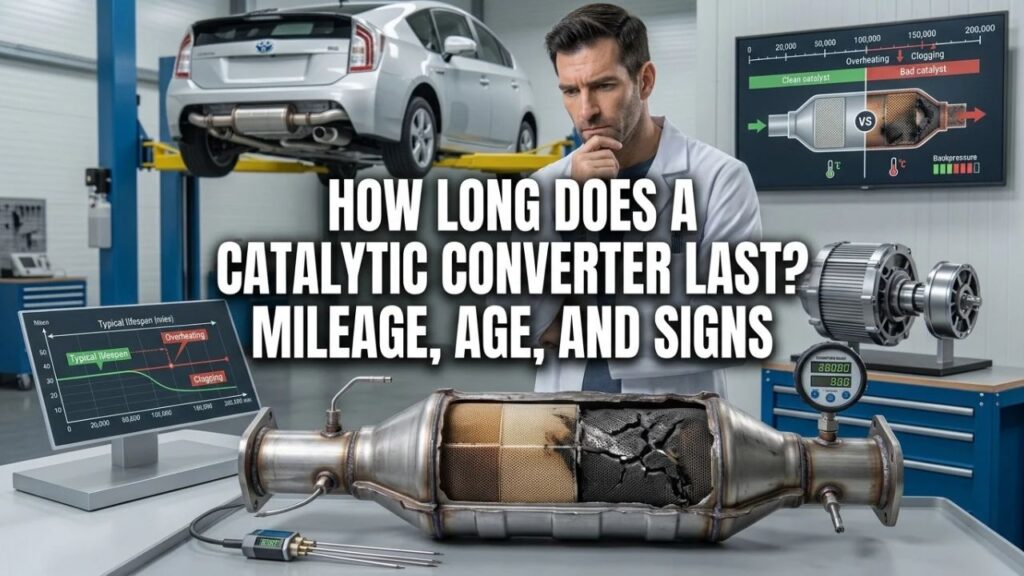
A catalytic converter can often last 10 years or more and commonly reaches 100,000 miles or beyond when the engine is running correctly. Many original converters remain functional for the life of the vehicle. Misfires, excess fuel, burning oil, coolant contamination, corrosion, and physical damage can shorten that lifespan dramatically.
A converter does not wear according to a fixed maintenance interval like engine oil or brake pads. Its lifespan depends heavily on what enters the exhaust. A healthy engine gives the catalyst a much better chance of reaching high mileage, while an unresolved engine fault can damage a relatively new converter.
Long converter life also saves more than the price of the exhaust part. Catching a misfire, rich mixture, oil-burning problem, or coolant leak early can prevent catalyst damage and may stop a separate engine problem from becoming more expensive.
For U.S. vehicles, the EPA requires specified major emissions components, including catalytic converters, to receive federal warranty coverage for 8 years or 80,000 miles, whichever comes first, under applicable warranty conditions. That figure is a warranty period rather than an expected replacement interval.
The practical answer to how long does a catalytic converter last is around 10 years or 100,000 miles as a broad reference, with many converters lasting much longer. Cars.com gives about 10 years or 100,000 miles as an average reference, while Walker states that converters are designed to last the life of the vehicle when operating conditions remain correct.
A better way to judge converter life is to look at vehicle condition, mileage, engine health, emissions codes, exhaust flow, and physical symptoms together. The sections below explain normal lifespan, early-failure causes, warning signs, high-mileage expectations, replacement timing, and steps that can reduce the chance of premature failure.
How Long Does a Catalytic Converter Usually Last?
Around 10 Years Is a Common Reference
Ten years is a reasonable broad lifespan estimate for a catalytic converter on a properly maintained passenger vehicle.
Cars.com states that catalytic converters often last 10 years or longer, while AutoZone gives a similar estimate and notes that many units can operate beyond 100,000 miles.
Age alone does not determine condition. A 12-year-old converter on a well-running highway-driven car can still work correctly, while a much newer converter can fail after repeated misfires.
The converter should therefore be tested based on symptoms and diagnostic data rather than replaced simply because the vehicle reaches its tenth birthday.
100,000 Miles Is Not an Automatic Replacement Point
A catalytic converter does not normally have a scheduled 100,000-mile replacement interval.
The 100,000-mile figure is better treated as a common lifespan reference. Many original converters remain functional well past that mileage.
AutoZone states that a properly operating converter can exceed 100,000 miles and, in some cases, remain functional as long as the vehicle itself.
If a 120,000-mile vehicle has no catalyst codes, no exhaust restriction, no unusual noises, and passes its required emissions checks, replacing the converter simply because of mileage offers little reason.
Some Converters Last the Life of the Vehicle
A catalytic converter has no bearings, gears, pistons, or other normal wear components inside it.
The catalyst-coated internal substrate can remain functional for a very long time if engine combustion stays within the intended range and contamination does not damage the catalyst.
EPA information on aftermarket converter replacement states that an original converter was designed to last the life of the vehicle when the vehicle is properly used and maintained. Walker gives similar guidance for properly operating vehicles.
That does not mean every converter will survive indefinitely. Rust, impact damage, thermal stress, contamination, and engine faults can still end its service life.
Key Takeaway: Ten years or roughly 100,000 miles is a useful general reference, but a healthy original converter can last far longer and does not need replacement simply because it reaches a certain age or mileage.
What Shortens Catalytic Converter Lifespan?
Engine Misfires
A severe or repeated misfire is one of the fastest ways to damage a converter.
During a misfire, some fuel may leave the cylinder without completing normal combustion. That fuel can enter the hot exhaust and burn inside the converter.
The added heat can damage or melt the ceramic substrate.
Possible misfire causes include:
- Worn spark plugs
- Weak ignition coils
- Damaged plug wires on vehicles that use them
- Fuel-injector faults
- Low compression
- Intake leaks
- Mechanical engine problems
A flashing check engine light commonly indicates a severe misfire condition that deserves prompt attention.
Continuing to drive through a strong misfire can shorten a converter’s life far more quickly than ordinary mileage.
Rich Fuel Mixture
An engine running rich receives more fuel than it can burn correctly.
Excess fuel entering the exhaust raises converter temperature and can damage the catalyst.
Possible causes include leaking injectors, excessive fuel pressure, airflow-measurement faults, temperature-sensor problems, or another issue affecting fuel control.
Clues may include poor fuel economy, black exhaust smoke, fuel odor, rough running, or abnormal fuel-trim readings.
Installing a new converter without repairing the rich condition can lead to another failed converter.
Burning Engine Oil
An oil-burning engine can contaminate the catalyst over time.
Oil entering the combustion chambers creates ash and deposits that travel into the exhaust. Those deposits can coat catalyst surfaces and interfere with exhaust-gas conversion.
Common causes include:
- Worn piston rings
- Valve-stem seal wear
- Valve-guide wear
- PCV-system faults
- Turbocharger oil leakage
If the oil level repeatedly drops between changes without an obvious external leak, check the cause before blaming the converter alone.
Coolant Entering the Cylinders
Internal coolant leakage can also damage the converter.
A leaking head gasket, cracked cylinder head, or other internal cooling-system problem may allow coolant into one or more cylinders.
Possible clues include unexplained coolant loss, persistent white exhaust after warm-up, startup misfires, overheating, or unusual deposits on spark plugs.
The converter may eventually lose emissions performance if contamination continues.
Physical Damage and Corrosion
Converters live underneath the vehicle in a harsh environment.
Road debris, impacts, water, salt, and repeated heating and cooling can damage the shell, substrate, welds, or attached exhaust pipes.
Cars.com lists corrosion and physical damage among conditions that can shorten converter life.
Short trips can also contribute to exhaust-system corrosion because the exhaust may not stay hot long enough to remove condensed moisture. Walker notes that cold exhaust operation allows moisture and acidic condensation to remain in the system longer.
Key Takeaway: Misfires, excess fuel, oil, coolant, road damage, and corrosion can shorten converter life far more than normal mileage alone.
Can a Catalytic Converter Fail Before 100,000 Miles?
Yes.
A converter can fail far earlier than 100,000 miles if an engine problem creates damaging exhaust conditions.
A severe misfire can overheat the catalyst quickly. An engine that continually burns oil or coolant can contaminate the catalyst long before the rest of the exhaust system appears worn.
Early failure should therefore trigger a search for the cause rather than an automatic assumption that the converter was simply a bad part.
If a converter fails at 40,000, 60,000, or 70,000 miles, check:
- Misfire history
- Spark plugs and ignition coils
- Fuel trims
- Injector operation
- Oil consumption
- Coolant loss
- Exhaust leaks
- Oxygen-sensor operation
- Physical exhaust damage
For a U.S. vehicle still inside applicable federal emissions coverage, also check the warranty booklet before paying for replacement. The federal period for specified major emissions components is 8 years or 80,000 miles under the applicable conditions.
What Are the Signs a Catalytic Converter Is Wearing Out?
P0420 or P0430 Check Engine Code
The most familiar catalyst-related codes are:
- P0420 — Catalyst System Efficiency Below Threshold, Bank 1
- P0430 — Catalyst System Efficiency Below Threshold, Bank 2
These codes mean the vehicle computer has detected catalyst performance below its programmed threshold.
They do not automatically prove the converter itself is the only faulty component.
Exhaust leaks, oxygen-sensor issues, misfires, and fuel-control faults can affect catalyst-monitor results.
Before replacing a converter, diagnose related codes and inspect the engine and exhaust system.
Loss of Engine Power
A converter can become physically restricted if its internal substrate melts, breaks apart, or becomes heavily obstructed.
Restriction may cause:
- Slow acceleration
- Poor high-RPM power
- Trouble climbing hills
- Stalling
- Hard starting
- A feeling that the engine cannot breathe
This type of failure is different from a converter that simply loses emissions efficiency.
A catalyst-efficiency code can exist without a serious blockage, and a blocked converter can sometimes create major driveability trouble before a catalyst-efficiency code appears.
Rattling From Under the Vehicle
A broken internal substrate can rattle inside the converter housing.
The noise may be most noticeable during startup, idle, or changes in engine speed.
A loose heat shield can create a similar sound, so rattling alone does not confirm internal converter breakage.
Physical inspection may be needed.
Sulfur-Like Exhaust Smell
A sulfur or rotten-egg-like odor can sometimes accompany catalyst or fuel-control problems.
Odor alone is not enough for diagnosis because fuel quality, rich operation, and other exhaust conditions can change exhaust smell.
Combine the odor with scan data, engine operation, and emissions testing.
Failed Emissions Test
A converter may lose emissions-conversion ability while the car still feels normal to drive.
That can result in a check engine light or failed emissions inspection before any major power loss occurs.
This is one reason catalyst condition should not be judged solely from how the engine feels.
Key Takeaway: Catalyst codes, power loss, rattling, abnormal exhaust odor, and emissions-test failure can point toward converter trouble, but each symptom needs diagnosis before replacement.
Does a Catalytic Converter Need Regular Replacement?
No.
A catalytic converter is not normally a scheduled maintenance part.
Cars.com states that converters should be replaced only when needed rather than at a routine time interval.
There is no normal rule such as:
- Replace every 60,000 miles
- Replace every 100,000 miles
- Replace every 10 years
A converter that continues meeting emissions requirements and allows normal exhaust flow can remain in service.
This differs from parts such as spark plugs, filters, belts, or fluids that may have defined maintenance intervals.
If a shop recommends converter replacement based only on age or mileage, ask what test showed that the converter is defective.
How Long Do Aftermarket Catalytic Converters Last?
Aftermarket converter lifespan varies more than original-equipment lifespan because construction, catalyst loading, certification, vehicle application, and warranty level differ.
Some aftermarket converters are designed as cost-conscious replacements after the original unit is no longer covered. Premium replacements can use heavier housings, application-specific catalyst formulations, and stronger flanges or brackets.
Warranty length also varies.
For example, Walker currently lists a 5-year/50,000-mile emissions and structural warranty on its CARB-compliant CalCat line. Its EPA-compliant Ultra range lists a 25,000-mile emissions warranty and 5-year/50,000-mile structural warranty.
Those warranty figures should not be interpreted as exact lifespans. A converter can operate past its warranty period.
Fitment matters too. EPA information warns that some aftermarket products may not work properly with every OBD application, so the correct cataloged converter should be selected for the exact vehicle.
Can a Catalytic Converter Last 200,000 Miles?
Yes, it is possible.
A converter has a much better chance of reaching 200,000 miles when:
- The engine does not misfire
- Fuel control remains correct
- Oil consumption stays low
- Coolant does not enter the cylinders
- The exhaust has no damaging leaks
- The converter is not physically struck
- The vehicle reaches normal operating temperature regularly
Mileage alone does not guarantee that a 200,000-mile converter is weak.
A high-mileage car can still have its original converter and pass catalyst monitoring if the internal substrate remains intact and the catalyst retains enough emissions-conversion capability.
At the same time, a 200,000-mile converter deserves proper diagnosis if P0420, P0430, rattling, restriction, or emissions failure appears. Age and mileage can contribute to deterioration even without a single dramatic failure event.
How Can You Make a Catalytic Converter Last Longer?
Fix Misfires Quickly
Do not continue normal driving with a strong misfire.
If the check engine light is flashing and the engine is shaking or running on fewer cylinders, diagnose the ignition, fuel, or mechanical problem promptly.
Correcting a failed spark plug or ignition coil costs far less than adding a converter to the same repair.
Keep the Engine Fuel System in Good Condition
Fuel-control faults that create rich operation can raise converter temperature.
Do not ignore:
- Poor fuel economy
- Fuel odor
- Black smoke
- Injector faults
- Abnormal fuel trims
- Related engine codes
A converter cannot correct the engine’s fuel mixture. It only treats the exhaust that arrives from the engine.
Monitor Oil Consumption
Check the oil level regularly, especially on a high-mileage engine.
If the engine begins using substantially more oil between changes, diagnose the cause.
Adding oil keeps the engine lubricated, but it does not stop combustion-chamber oil from reaching and contaminating the catalyst.
Investigate Coolant Loss
A slowly dropping coolant level with no visible external leak deserves attention.
Internal coolant leakage can affect the converter and may signal a serious engine problem.
Do not repeatedly top up the reservoir for months without finding where the coolant is going.
Use the Correct Replacement Converter
If replacement becomes necessary, match the converter to the exact year, engine, emissions family, and certification requirements.
A physically similar converter is not automatically the correct part.
Walker states that identifying the original failure cause before installing another converter is an important step in preventing repeat failure.
Key Takeaway: Fast repair of misfires, correct fuel control, low oil consumption, a sealed cooling system, and proper replacement-part selection give the converter the best chance of reaching high mileage.
When Should a Catalytic Converter Be Replaced?
When Catalyst Efficiency Is Confirmed to Be Too Low
A persistent P0420 or P0430 can support converter replacement after other likely causes have been checked.
The diagnostic process should include related codes, exhaust leaks, sensor data, fuel trims, and engine condition.
Do not replace the converter first if the engine has an unresolved misfire or rich-running problem.
When the Converter Is Physically Restricted
A clogged converter may need replacement when tests confirm excessive exhaust restriction.
Signs can include major power loss, inability to rev normally, hard starting, stalling, and excessive exhaust heat.
Backpressure or other manufacturer-specified testing can confirm a restriction before parts are ordered.
When the Internal Substrate Is Broken or Melted
Rattling ceramic material, melted passages, or loose internal pieces indicate physical damage.
A cleaner or fuel additive cannot rebuild a broken substrate.
Replacement is normally required after the cause of the damage is corrected.
When the Housing Is Badly Damaged
A hard impact can crush the shell or fracture the internal structure.
Severe rust can also damage converter connections or create exhaust leaks.
The repair decision should consider both the converter body and surrounding exhaust components.
Key Takeaway: Replace the converter when testing confirms poor catalyst efficiency, physical restriction, broken internal material, or serious structural damage—not simply because the vehicle reached a certain mileage.
Should You Replace Oxygen Sensors With the Catalytic Converter?
Not automatically.
An oxygen sensor should be replaced when testing, service information, or its maintenance schedule shows that replacement is needed.
The upstream and downstream sensors play different roles in fuel control and catalyst monitoring.
A downstream oxygen sensor does not have to be replaced solely because the converter is being changed unless the procedure, condition, or diagnosis calls for it.
Likewise, installing a new oxygen sensor will not repair a melted or contaminated converter.
If the converter failed after a fuel-control problem, check sensor operation carefully because incorrect sensor data may have contributed to the condition.
Conclusion
How long does a catalytic converter last? Around 10 years or 100,000 miles is a useful general reference, but many converters last much longer and some remain functional for the entire life of the vehicle.
The converter’s lifespan depends heavily on engine condition. Misfires, rich fuel mixtures, oil burning, coolant contamination, physical damage, and corrosion can cause early failure, while a well-maintained engine may carry its original catalyst far beyond 100,000 miles.
I would not replace a converter based on age alone. Diagnose catalyst codes, check engine operation, inspect for restriction or physical damage, and repair any upstream fault before fitting a new unit. U.S. owners with a younger vehicle should also check federal emissions warranty coverage before paying for replacement.
FAQs About Catalytic Converter Lifespan
Can a Catalytic Converter Last 150,000 Miles?
Yes. A catalytic converter can remain functional at 150,000 miles or beyond if the engine has run correctly and the catalyst has not been overheated, contaminated, clogged, or physically damaged. Mileage alone does not determine replacement.
Can a Catalytic Converter Last 200,000 Miles?
Yes. Some original converters reach 200,000 miles and remain serviceable. Regularly fixing misfires and fuel problems, controlling oil consumption, and preventing coolant contamination improve the chances of very long service life.
Do Catalytic Converters Wear Out With Age?
They can deteriorate with age from thermal cycling, corrosion, contamination, and gradual catalyst degradation. Age does not create a fixed expiration date. A 12- or 15-year-old converter can still function correctly if it passes its diagnostic and emissions requirements.
Should I Replace My Catalytic Converter at 100,000 Miles?
No, not solely because it reaches 100,000 miles. A functioning converter is not normally replaced on a mileage schedule. Replace it when diagnosis confirms low catalyst efficiency, restriction, internal breakage, contamination, or structural damage.
Why Did My Catalytic Converter Fail Before 80,000 Miles?
Early failure can result from severe misfires, excess fuel, burning oil, coolant entering the cylinders, physical impact, or a defective component. If the vehicle is within applicable U.S. federal emissions warranty limits, check warranty coverage before paying for the repair.
How Do I Know When My Catalytic Converter Is Near the End of Its Life?
Common clues include P0420 or P0430, failed emissions testing, reduced acceleration, rattling from the converter, unusual exhaust odor, or excessive restriction. These symptoms can have other causes, so testing should confirm the converter before replacement.
Does a Catalytic Converter Last Longer With Highway Driving?
Regular trips that bring the engine and exhaust fully to operating temperature can reduce moisture accumulation compared with repeated very short trips. Converter life still depends more heavily on engine condition, fuel control, oil consumption, coolant contamination, and physical condition.
Can a New Catalytic Converter Fail Quickly?
Yes. A new converter can fail early if the engine still has a severe misfire, rich mixture, oil-burning problem, coolant leak, or another fault that damaged the original converter. The root cause should be repaired before or during converter replacement.