Overheated Catalytic Converter Symptoms: Causes, Signs, and Fixes
An overheated catalytic converter may produce extreme underbody heat, a hot or burning smell, weak acceleration, rough running, dark heat discoloration, and in severe cases a converter shell that glows red. The converter is often being overheated by an engine problem such as a misfire or overly rich fuel mixture rather than by a fault inside the converter alone.
Excessive converter temperature can damage the catalyst coating and eventually melt or collapse the internal honeycomb. Once that happens, exhaust flow may become restricted, causing additional power loss, poor fuel economy, stalling, or difficulty reaching higher RPM.
Catching the cause early can save the converter from permanent thermal damage. A misfire, leaking injector, bad ignition component, incorrect air-fuel mixture, or another combustion fault needs attention before installing a replacement converter.
In the United States, the EPA identifies catalytic converters as major emissions-control components covered for 8 years or 80,000 miles under the federal emissions defect warranty on qualifying light-duty vehicles, subject to the warranty conditions. If the vehicle is still inside that period, checking coverage before paying for replacement makes sense.
The most concerning overheated catalytic converter symptoms are a red-hot converter, severe burning odor, large power loss, active misfiring, and excessive heat coming through the floor. Those signs call for prompt diagnosis rather than continued driving.
A converter normally operates hot because chemical reactions occur inside it. The problem begins when abnormal exhaust gases force it to process large amounts of unburned fuel or when another fault pushes temperature beyond the range the catalyst and substrate can tolerate.
The sections below explain the main symptoms, temperature ranges, common causes, diagnostic checks, possible damage, and what to do if the converter appears to be overheating.
Overheated Catalytic Converter Symptoms to Watch For
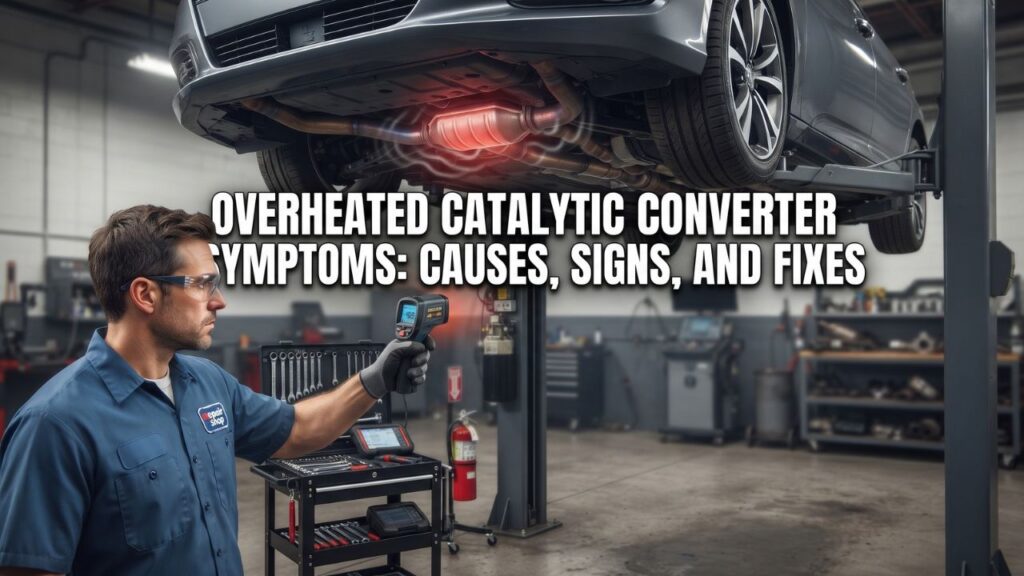
Converter overheating can produce both visible and drivability symptoms. Some signs come from the excessive heat itself, while others appear after the internal substrate begins to melt or restrict exhaust flow.
Red-Hot or Glowing Converter
A catalytic converter that visibly glows red or orange is operating at an abnormally high temperature.
A glowing shell is not a normal nighttime appearance. It often means excess fuel is burning inside the converter because combustion did not finish properly inside the engine.
Walker states that converters can become red hot when excessive fuel reaches the catalyst with enough oxygen for that fuel to burn inside the converter. Common causes include rich operation, exhaust leaks combined with a rich mixture, and engine misfires.
If the converter is glowing, shut the vehicle off in a safe place away from dry grass, leaves, fuel, or other combustible material.
Strong Burning or Hot-Metal Smell
An overheated exhaust system may produce a sharp hot-metal or burning odor.
The smell may come from the converter itself or from nearby material being heated by the converter shell. Underbody coatings, road debris, oil contamination, plastic, or damaged heat shielding can contribute.
A sulfur or rotten-egg odor can occur with exhaust-system or fuel-mixture problems, but it does not prove the converter is overheating. Diagnosis still needs to identify the engine fault.
Excessive Heat Under the Vehicle
All catalytic converters become hot during operation, but unusual heat around the center tunnel, firewall, or floor can signal trouble.
You may notice more heat through the floor than usual or smell hot material after parking.
Do not touch the converter to judge its temperature. Exhaust parts can cause severe burns long after the engine has been shut off.
Weak Acceleration
As excessive heat damages the internal substrate, the honeycomb passages may begin to melt or collapse.
That creates exhaust restriction. The engine can no longer push exhaust gases out freely, so acceleration becomes sluggish.
The problem may be mild around town but much more obvious during:
- Highway merging
- Hill climbing
- Higher RPM
- Heavy throttle
- Towing or carrying load
A converter that overheats without melting may not cause an immediate power loss. Weak acceleration becomes more suspicious once restriction develops.
Engine Loses Power as RPM Rises
A partial blockage often becomes worse as exhaust volume increases.
The vehicle may idle normally, accelerate acceptably at first, then stop pulling strongly above a certain RPM.
This pattern fits a restricted exhaust because the narrowed passages can handle low exhaust flow but not the volume produced under load.
Rough Running or Misfiring
A misfire is often a cause of converter overheating rather than a result.
The engine may shake, stumble, hesitate, or flash the check-engine light. Unburned air and fuel then enter the exhaust and can burn inside the converter.
Walker lists misfires, poor spark, low compression, air-fuel imbalance, and fuel-system problems among conditions that can drive converter temperature upward.
Check-Engine Light
The check-engine light may appear with:
- P0300-series misfire codes
- P0171/P0172-type mixture codes
- Oxygen-sensor faults
- P0420 or P0430 catalyst codes
- Other fuel or ignition faults
A P0420 or P0430 code does not automatically mean the converter overheated. Those codes indicate catalyst performance below the expected threshold.
The more useful codes may be the ones explaining why the converter became too hot.
Blue, Bronze, or Rainbow Discoloration
Severe heating can change the color of stainless or steel converter shells.
Walker notes that bronze or blue rainbow discoloration can indicate elevated converter temperature.
Discoloration alone does not identify the cause, but it gives you evidence that the exhaust section has experienced high heat.
Rattling From the Converter
A converter that has suffered thermal damage may develop an internal rattle.
The ceramic substrate can crack, melt unevenly, or break apart. Loose pieces may shake inside the metal housing at startup, idle, or during acceleration.
A loose heat shield can create a similar rattle, so sound alone is not proof of internal damage.
Key Takeaway: The strongest overheating warnings are a glowing shell, excessive underbody heat, burning odor, active misfire, heat discoloration, and power loss that worsens as RPM rises.
How Hot Is Too Hot for a Catalytic Converter?
A catalytic converter normally runs at temperatures far above the surrounding exhaust pipe because chemical reactions inside it release heat.
The question is not if the converter becomes hot, but if it becomes hot enough to damage its coating, retaining material, or substrate.
Normal Operating Temperature
Walker states that converter operating temperatures commonly fall around 500°F to 800°F, with temperatures reaching roughly 1,200°F under heavy load in some conditions.
Those figures are general references rather than a specification for every vehicle. Converter location, engine load, catalyst design, exhaust flow, and sensor strategy all affect temperature.
Temperature That Can Damage the Catalyst
Walker diagnostic guidance states that operation above roughly 1,600°F can damage the precious-metal coating and reduce converter life. Damage to matting or substrate can occur at still higher temperatures.
A converter does not need to look melted from the outside for internal damage to occur.
Temperature That Can Melt the Substrate
Severe overheating can melt the ceramic passages into a more solid mass.
Walker notes that converter substrate meltdown requires extremely high internal temperatures and identifies engine misfire as a common cause of this type of failure.
Once passages collapse, replacement may be required because exhaust can no longer move through the unit normally.
Key Takeaway: Converters normally run several hundred degrees hot, but sustained temperatures around 1,600°F and above can begin damaging catalyst materials, with still higher heat capable of destroying the substrate.
What Causes a Catalytic Converter to Overheat?
An overheated converter is often the victim of another engine problem.
Replacing it without correcting that fault can lead to the same failure again.
Engine Misfire
Misfire is one of the main causes of catastrophic converter overheating.
When a cylinder does not ignite its air-fuel charge correctly, unburned fuel and oxygen can leave the cylinder and enter the exhaust.
The converter then becomes a place where that fuel can burn.
Possible misfire causes include:
- Worn spark plugs
- Failing ignition coils
- Damaged plug wires
- Faulty injectors
- Low compression
- Valve problems
- Air-fuel imbalance
If the check-engine light is flashing, treat the misfire as a prompt service issue.
Rich Air-Fuel Mixture
A rich mixture contains more fuel than the engine can burn correctly.
Possible causes include:
- Leaking fuel injector
- Excessive fuel pressure
- Faulty mass airflow sensor
- Faulty oxygen or air-fuel sensor
- Incorrect coolant-temperature data
- Fuel-control problems
Extra fuel entering the converter raises its workload and temperature.
Poor Ignition Spark
Weak spark may allow incomplete combustion even when a full misfire code has not yet appeared.
The converter then receives higher levels of hydrocarbons than intended.
Inspect worn plugs, coils, ignition wiring, and related components when overheating occurs with hesitation or rough operation.
Low Engine Compression
Low compression can cause a cylinder to burn poorly.
Valve damage, piston-ring wear, head-gasket faults, or other mechanical problems can leave extra fuel in the exhaust.
A compression or leak-down test may be needed if ignition and fuel checks do not explain the misfire.
Leaking Fuel Injector
An injector that leaks or stays open too long can send excess fuel into one cylinder.
Symptoms may include:
- Rich exhaust smell
- Poor fuel economy
- Hard starting
- Rough idle
- Fouled spark plug
- Negative fuel trims
- Misfire
A replacement converter will remain at risk until the injector fault is corrected.
Exhaust Leak With Rich Operation
An exhaust leak can allow outside air into the exhaust stream.
When excess fuel is already present, the added oxygen can support combustion inside the converter. Walker lists this combination as one path to a red-hot or melted catalyst.
Excessive Engine Load
Heavy load can raise exhaust temperature, though a correctly running system is built to tolerate normal vehicle use.
Overheating becomes more likely when high load combines with a fuel, ignition, cooling, or exhaust fault.
Oil or Coolant Contamination
Oil and coolant more commonly contaminate or coat the catalyst than directly create a classic fuel-fed thermal event.
Oil burning can come from worn rings, valve seals, or turbocharger problems. Coolant may enter the cylinders through a head-gasket or cylinder-head fault.
Either condition can damage converter performance and contribute to long-term failure.
Key Takeaway: Misfires and rich operation are major causes of converter overheating because they send unburned fuel into the exhaust, where it can burn inside the catalyst.
Can an Overheated Catalytic Converter Become Clogged?
Yes.
Severe heat can melt the internal honeycomb and reduce the size or number of open exhaust passages.
The restriction may begin gradually and become worse over time.
Partial Restriction
A partially melted converter may still flow enough exhaust for normal idle.
Under acceleration, exhaust volume rises and backpressure increases. This can cause:
- Slow acceleration
- Poor high-RPM power
- Reduced gas mileage
- Hesitation
- Increased engine load
Severe Restriction
A badly melted substrate may become close to a solid blockage.
The engine may then:
- Stall after starting
- Refuse to rev
- Lose most of its power
- Struggle to maintain road speed
- Become difficult to start
Walker states that a converter operated too long at excessive temperature can melt the substrate into a mass that restricts exhaust flow and causes sluggish performance.
If the car cannot accelerate safely with traffic, continued driving is not sensible.
How to Diagnose an Overheated Catalytic Converter
Temperature is only one part of the diagnosis. The goal is to confirm the heat problem and identify what created it.
Scan the Vehicle for Codes
Start with stored and pending OBD-II codes.
Look beyond catalyst codes. Pay close attention to:
- Misfire codes
- Rich or lean mixture codes
- O2 sensor codes
- Air-fuel sensor codes
- Injector-related faults
- MAF or MAP sensor faults
Freeze-frame data can show engine load, RPM, temperature, and fuel-control conditions when the fault was recorded.
Check Fuel Trims
Short-term and long-term fuel trims show how much correction the engine computer is applying to the fuel mixture.
Large negative values may support a rich-running condition. Positive corrections may point toward another mixture problem.
Fuel trims need to be interpreted with the engine design and operating condition in mind.
Check for Active Misfires
Many scan tools display cylinder misfire counts.
If one cylinder repeatedly misfires, diagnose ignition, injector operation, compression, and related mechanical condition before focusing only on the converter.
Measure Converter Temperature
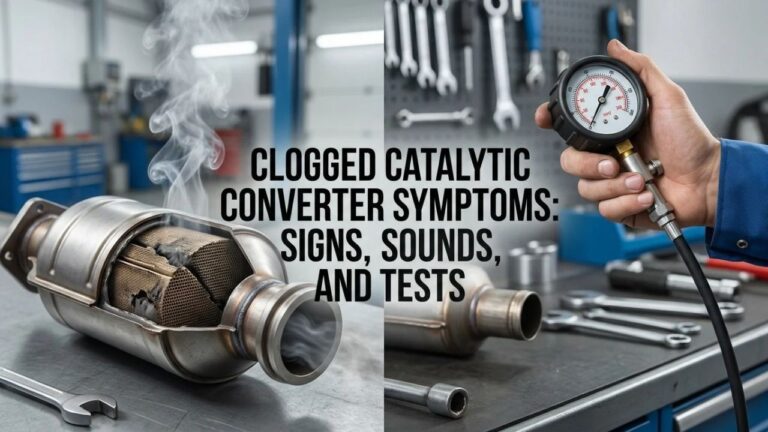
An infrared thermometer can compare converter inlet and outlet temperatures without physical contact.
Walker notes that converter temperature readings vary with the amount of work the catalyst is doing and warns that excessive rear temperature can indicate an emissions problem.
Do not use one temperature reading as proof that the converter needs replacement.
Engine load, mixture, test duration, and converter design change the result.
Test Exhaust Backpressure
If overheating may have melted the substrate, test for restriction.
Walker gives general screening references of less than about 1.5 psi at idle and less than 3 psi at 2,000 RPM, while stressing that backpressure varies by application.
High pressure ahead of the converter points toward converter restriction. High pressure behind it may indicate a blocked muffler or resonator.
Vehicle-specific specifications should control the final diagnosis.
Inspect the Converter Shell
Look for:
- Blue or bronze heat marks
- Dents
- Cracks
- Loose heat shields
- Melted nearby components
- Rattling
- Signs of road impact
A shell that looks normal does not rule out internal melting.
Key Takeaway: Use codes, misfire data, fuel trims, temperature readings, backpressure tests, and physical inspection together to find both the overheating and its root cause.
Can an Overheated Catalytic Converter Damage Other Parts?
Yes. Extreme exhaust heat can affect more than the converter.
Oxygen Sensors
Sensors mounted near the converter live in a hot environment by design, but abnormal thermal conditions can shorten their life or damage wiring and connectors.
Inspect harness routing if the converter has been glowing or nearby insulation shows heat damage.
Exhaust Pipes and Gaskets
High temperature can stress flanges, gaskets, welds, and flex sections.
An exhaust leak may then develop and add another problem to the repair.
Heat Shields and Underbody Parts
Heat shields protect the floor, wiring, fuel-system components, and other nearby parts.
A missing or damaged shield becomes more serious when the converter is overheating.
Inspect surrounding material for discoloration, melting, or distortion.
The Converter Itself
Thermal damage may destroy:
- Catalyst coating
- Ceramic substrate
- Internal matting
- Structural support
Once the substrate melts or breaks apart, replacement is commonly required.
Is It Safe to Drive With an Overheated Catalytic Converter?
Driving should be limited if there are strong signs that the converter is actively overheating.
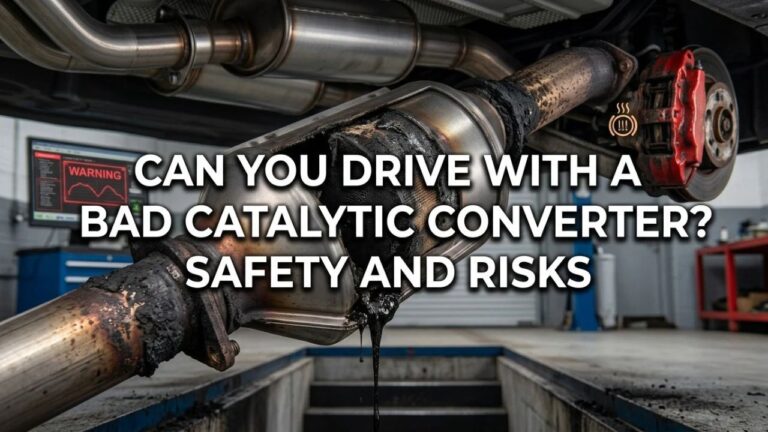
Do not continue normal driving with a converter that is glowing red, a flashing check-engine light, severe misfiring, major power loss, or a strong burning smell.
A red-hot converter creates a fire concern if the car is parked over dry vegetation, leaves, trash, leaking fluids, or other combustible material.
A severe misfire can also continue feeding fuel into the converter and make the thermal damage worse.
If the vehicle begins losing enough power that it cannot keep up with traffic, have it towed rather than forcing it to continue under load.
Safety Tip: Never inspect an overheated converter by touching it or immediately crawling beneath the vehicle. Park on a noncombustible surface, shut the engine off, and allow the exhaust to cool fully before physical inspection.
What to Do if the Catalytic Converter Is Overheating
The first repair should target the fault creating excess heat.
Do not begin by installing another converter.
- Stop driving if the converter is glowing, the check-engine light is flashing, or the vehicle has severe power loss.
- Scan the vehicle for engine and catalyst codes.
- Diagnose active misfires.
- Check air-fuel mixture and fuel trims.
- Test injectors and fuel pressure when indicated.
- Check ignition components.
- Inspect for exhaust leaks.
- Test compression if a mechanical misfire is suspected.
- Measure exhaust backpressure if restriction is possible.
- Replace the converter only if testing shows it has suffered permanent damage.
I recommend confirming the cause before approving an expensive converter replacement. A new catalyst cannot survive for long if raw fuel continues entering the exhaust.
How to Prevent Catalytic Converter Overheating
Most prevention comes from keeping combustion problems from continuing long enough to damage the catalyst.
Address:
- Flashing check-engine lights promptly
- Persistent misfires
- Rough running
- Rich fuel mixtures
- Leaking injectors
- Worn ignition components
- Oil consumption
- Coolant entering the cylinders
- Exhaust leaks
- Abnormal fuel pressure
Regular engine maintenance also reduces the chance that small ignition or fuel problems will continue unnoticed.
Do not keep driving simply because the car still moves. A misfire that feels minor to the driver can expose the converter to a large amount of unburned fuel.
Conclusion
The main overheated catalytic converter symptoms are abnormal underbody heat, burning smells, heat discoloration, a red-hot converter shell, rough running, weak acceleration, and power loss that becomes worse as exhaust flow rises.
Misfires and overly rich mixtures are among the main causes because they allow unburned fuel to enter the converter and burn inside it. If the heat becomes high enough, the catalyst coating can deteriorate and the internal substrate can melt or collapse.
A glowing converter or flashing check-engine light deserves quick attention. Diagnose the misfire, fuel mixture, injector condition, ignition system, exhaust leaks, and backpressure rather than replacing the converter first.
If thermal damage has already melted or broken the substrate, replacement may be necessary. Fix the engine fault before installing the new unit so the same overheating cycle does not repeat.
FAQs About Overheated Catalytic Converter Symptoms
What happens when a catalytic converter overheats?
Excessive heat can damage the catalyst coating, weaken internal support material, and eventually melt or crack the honeycomb substrate. A melted substrate can restrict exhaust flow, leading to poor acceleration, higher backpressure, stalling, or reduced fuel economy.
Why would a catalytic converter glow red?
A converter can glow red when its temperature becomes extremely high. One common cause is unburned fuel entering the exhaust from a misfire or rich mixture and burning inside the converter. A glowing unit should be treated as an abnormal condition rather than normal converter operation.
Can bad spark plugs overheat a catalytic converter?
Yes. Worn or fouled spark plugs can cause incomplete combustion or misfires. Fuel that fails to burn in the cylinder may enter the exhaust and burn inside the converter, creating temperatures high enough to damage the catalyst.
Can a bad ignition coil cause catalytic converter overheating?
Yes. A weak or failed ignition coil can cause one or more cylinders to misfire. The unburned fuel and oxygen from that cylinder may reach the converter and generate intense heat as they react inside it.
Can a rich fuel mixture make the converter glow?
Yes. Excess fuel entering the exhaust is a common cause of converter overheating. If enough oxygen is present, the extra fuel can burn inside the catalyst and raise the shell and substrate to damaging temperatures.
Does an overheated catalytic converter always need replacement?
No. If the problem is caught before the catalyst or substrate suffers permanent damage, repairing the engine fault may be enough. A converter with melted, collapsed, broken, or badly contaminated internal material generally needs replacement after the root cause is corrected.
Can an overheated catalytic converter cause loss of power?
Yes. Excessive heat can melt the internal honeycomb and restrict exhaust flow. The engine then has to push exhaust against higher backpressure, which can cause sluggish acceleration and severe power loss at higher RPM.
Can I drive if my catalytic converter is glowing red?
No normal driving should continue with a visibly glowing converter. Shut the vehicle off in a safe location away from combustible material. A glowing shell may indicate an active misfire or rich condition feeding fuel into the converter, and continued operation can worsen the damage or create a fire hazard.