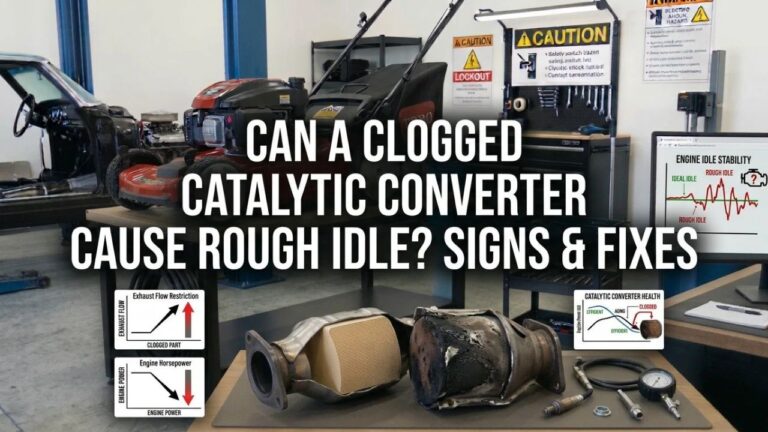
Can a Bad Catalytic Converter Cause Rough Idle? Causes and Fixes
Yes, a damaged catalytic converter can cause rough idle when its internal substrate becomes clogged, melted, or collapsed enough to restrict exhaust flow. The restriction creates excess exhaust backpressure, which can interfere with cylinder clearing and make the engine shake, stumble, surge, or struggle to maintain a steady idle.
The distinction between a restricted converter and one that has simply lost catalyst activity matters. A converter can trigger an emissions-efficiency code while still flowing exhaust normally. In that situation, rough idle may come from a different engine problem.
Rough idle also has many more common causes, including vacuum leaks, worn spark plugs, weak ignition coils, dirty or faulty fuel injectors, intake-air problems, and misfires. Replacing an expensive converter before ruling those out can leave the original problem untouched.
There is useful U.S. protection to check before paying for some converter repairs. The EPA states that specified major emissions components, including catalytic converters, are covered by the federal emissions warranty for 8 years or 80,000 miles, whichever occurs first, on qualifying light-duty vehicles.
So, can a bad catalytic converter cause rough idle on its own? It can, but restriction is usually the connection. If the converter’s honeycomb still flows freely and only its emissions-cleaning ability has declined, a rough idle points more strongly toward another engine or fuel-control fault.
I’d check for misfire codes, vacuum leaks, ignition trouble, and fuel-mixture problems before assuming the converter is responsible. The sections below explain how a blocked converter affects idle, which symptoms strengthen the diagnosis, what else causes the same complaint, and how a technician can confirm exhaust restriction.
Can a Bad Catalytic Converter Cause Rough Idle Directly?
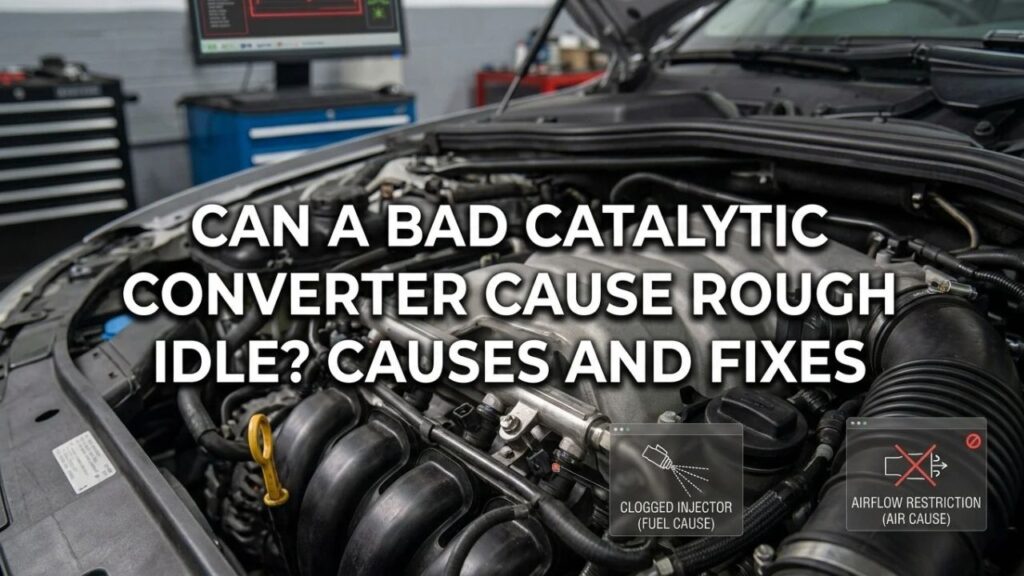
A catalytic converter can disturb idle when it physically restricts the exhaust stream.
The converter sits downstream from the engine. Every cylinder has to push spent combustion gases through the exhaust system before taking in a fresh charge for the next cycle.
A Clogged Converter Creates Exhaust Backpressure
Inside the converter is a honeycomb-like substrate containing many small passages.
If those passages become blocked by melted material, carbon deposits, oil residue, coolant contamination, or broken substrate pieces, exhaust has less room to escape.
Pressure then builds upstream of the restriction.
At idle, the engine is operating at low speed with small amounts of air and fuel entering each cylinder. Disturbing exhaust flow can make combustion less stable, leading to shaking or fluctuating RPM.
A clogged converter is recognized as one possible cause of rough idle and poor engine operation because the exhaust restriction interferes with normal gas flow.
A Chemically Failed Converter May Not Affect Idle
Not every bad converter is clogged.
The catalyst coating can lose its ability to process emissions while the internal passages remain open.
A vehicle in that condition may:
- Run normally
- Accelerate normally
- Idle smoothly
- Show a check engine light
- Store P0420 or P0430
- Fail an emissions inspection
This is why an emissions-efficiency code does not automatically explain a rough-running engine.
A converter that flows normally has much less reason to disturb idle mechanically.
Exhaust Restriction Can Leave More Residual Gas in the Cylinders
An engine depends on the exhaust stroke to clear burned gases.
Excess backpressure makes that process harder. More residual exhaust can remain in the cylinder and dilute the fresh air-fuel charge.
That can produce unstable combustion, especially if the restriction is severe.
The engine may then:
- Shake at idle
- Surge
- Misfire
- Stall
- Lose power as RPM rises
The worse the blockage becomes, the more likely you are to notice symptoms beyond idle.
Key Takeaway: A catalytic converter is most likely to cause rough idle when it is physically restricted, not merely because its catalyst efficiency has dropped.
Signs the Rough Idle May Come From a Clogged Catalytic Converter
Rough idle by itself is weak evidence of converter failure.
The diagnosis becomes more convincing when several exhaust-restriction symptoms appear together.
The Engine Also Loses Power During Acceleration
Power loss is one of the stronger clues.
A severely restricted converter limits the amount of exhaust the engine can move as RPM and load increase.
The car may feel reasonably normal at very light throttle but struggle when:
- Accelerating onto a highway
- Climbing a hill
- Passing another vehicle
- Revving above a certain RPM
- Carrying a heavy load
In severe cases, the engine may refuse to rev normally.
This pattern fits exhaust restriction better than a mild catalyst-efficiency problem.
Rough Idle Comes With Stalling or Surging
A badly restricted exhaust can make idle control increasingly unstable.
RPM may rise and fall instead of holding steady. The engine may shake heavily when stopped in Drive, then recover somewhat when the throttle is opened.
A severely blocked converter can eventually contribute to stalling because the engine cannot move gases through the normal four-stroke cycle properly.
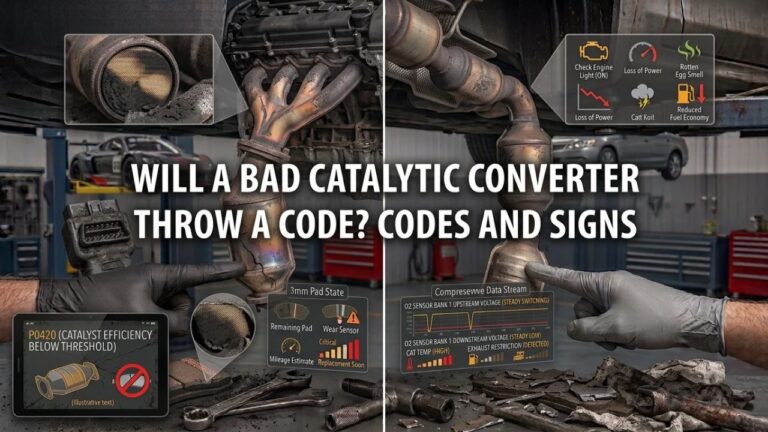
P0420 or P0430 Is Stored
Two common catalyst-monitor codes are:
- P0420 — Catalyst System Efficiency Below Threshold, Bank 1
- P0430 — Catalyst System Efficiency Below Threshold, Bank 2
These codes tell you that the powertrain control module has detected catalyst behavior outside its expected range.
They do not prove the converter is clogged.
AutoZone notes that catalyst-efficiency faults can occur without obvious drivability problems and that oxygen-sensor or exhaust-system faults can also be involved.
A rough idle plus P0420 should therefore trigger diagnosis rather than automatic converter replacement.
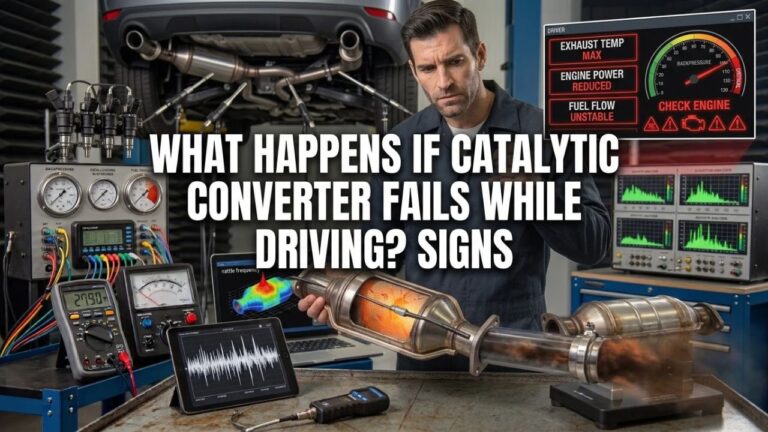
The Converter Runs Extremely Hot
A converter can overheat when unburned fuel reaches it.
Misfires and excessively rich mixtures are common reasons raw fuel enters the exhaust. The fuel may burn inside the converter and raise substrate temperature enough to damage or melt it.
Warning signs can include:
- Strong heat under the vehicle
- Burning odor
- Heat-damaged converter housing
- Smoke from nearby material
- A converter glowing red in a severe case
A glowing converter is not a normal operating condition.
Stop driving and diagnose the engine before further damage occurs.
The Converter Rattles
The ceramic substrate can crack or break apart.
Loose internal pieces may create a rattle that changes with engine speed or vibration.
A broken substrate can also move inside the housing and partially block exhaust flow.
Heat shields can produce similar rattling sounds, so the noise alone does not identify internal converter failure.
A Sulfur-Like Exhaust Smell Appears
Some converter and fuel-mixture problems produce an odor commonly compared with rotten eggs.
This symptom is not specific enough to diagnose a converter by itself.
A rich mixture, fuel-quality issue, or engine-control fault may be involved, and some of those same faults can damage the converter.
Key Takeaway: Rough idle is more suspicious for converter restriction when it appears with power loss, stalling, excessive converter heat, rattling, or other signs that exhaust flow is being blocked.
Other Problems That Cause Rough Idle More Often
Before replacing a catalytic converter, check faults that directly disturb combustion.
RepairPal’s rough-idle diagnostic pages repeatedly identify vacuum leaks, spark plugs, and ignition coils among common causes on popular vehicle applications.
Vacuum Leaks
Unmetered air entering the intake can make the air-fuel mixture too lean.
Common leak areas include:
- Intake manifold gaskets
- Vacuum hoses
- PCV hoses
- Brake-booster vacuum connections
- Throttle-body seals
A vacuum leak often becomes most noticeable at idle because manifold vacuum is high and airflow through the throttle is low.
Fuel-trim data may show the engine computer adding fuel in response to the extra air.
Worn Spark Plugs or Weak Ignition Coils
Ignition faults are major rough-idle suspects.
A weak spark may fail to ignite the mixture consistently, creating a cylinder misfire.
Possible symptoms include:
- Rough idle
- Shaking
- Hesitation
- Lack of power
- Flashing check engine light
- Misfire codes such as P0300 through P0308
Firestone identifies rough running, stumbling, power loss, and poor fuel economy among common misfire symptoms.
A long-running misfire can also overheat and damage the catalytic converter, which means the rough idle may have started before the converter failed.
Fuel Injector Problems
A dirty, restricted, leaking, or electrically faulty injector can disturb one cylinder’s fuel delivery.
A restricted injector may create a lean misfire.
A leaking injector may make the mixture too rich and send unburned fuel into the exhaust.
Both situations can produce rough idle.
Dirty Throttle Body or Idle-Air Problems
Electronic throttle systems control the small amount of air needed to maintain idle.
Heavy deposits around the throttle plate can disturb airflow on some engines.
Older vehicles may use a separate idle air control valve that can stick or become contaminated.
The exact system depends on the vehicle.
Oxygen Sensor or Air-Fuel Sensor Faults
An upstream oxygen or air-fuel sensor provides information the engine computer uses to adjust mixture.
Incorrect feedback can push fueling too rich or too lean under some conditions.
Walker Products lists rough idle, hesitation, misfire, and poor fuel economy among possible oxygen-sensor fault symptoms.
The downstream oxygen sensor has a different primary job: monitoring exhaust after the converter. A downstream sensor fault should not automatically be blamed for a rough idle.
Engine Mechanical Problems
Low compression can also cause unstable idle.
Possible mechanical causes include:
- Burned valve
- Worn piston rings
- Valve-timing fault
- Head-gasket problem
- Camshaft damage
These faults require different tests from a catalytic converter diagnosis.
Key Takeaway: Vacuum leaks, ignition faults, injector problems, sensor errors, and mechanical engine faults should usually be checked before blaming a catalytic converter for rough idle.
How to Diagnose Rough Idle From a Catalytic Converter
Do not diagnose a blocked converter from sound or a trouble code alone.
A useful diagnosis combines scan data, engine checks, and a direct test of exhaust flow when restriction is suspected.
Scan All Stored and Pending Trouble Codes
Start with an OBD-II scan.
Do not look only for P0420 or P0430.
Codes that may explain the original cause include:
- P0300 random misfire
- Cylinder-specific P0301–P0308 misfires
- Lean mixture codes such as P0171 or P0174
- Rich mixture codes
- Oxygen-sensor codes
- Mass-airflow sensor codes
- Fuel-pressure or injector-related faults
If misfire codes are present, diagnose them before replacing the converter.
A converter may be the victim of the problem rather than its source.
Check Live Misfire and Fuel-Trim Data
A capable scan tool can show more than stored codes.
Misfire counts may identify one cylinder that is running poorly.
Fuel trims can show whether the engine computer is adding or removing large amounts of fuel.
A rough idle driven by one weak ignition coil looks very different diagnostically from a whole-engine exhaust restriction.
Inspect for Vacuum and Intake Leaks
Check hoses, intake connections, PCV plumbing, and other likely leak points.
A professional smoke test is useful for locating small intake leaks that are difficult to see.
Fixing a vacuum leak may restore smooth idle without touching the exhaust system.
Check for Exhaust Leaks
An exhaust leak near an upstream oxygen sensor can introduce outside air into the exhaust stream.
That can distort sensor readings and complicate catalyst diagnosis.
Inspect:
- Exhaust manifold
- Manifold gasket
- Flex pipe
- Flanges
- Cracked pipes
- Sensor mounting points
Repair leaks before judging converter operation from oxygen-sensor data.
Test Exhaust Backpressure
A direct backpressure test is one of the stronger ways to confirm a restricted exhaust.
A technician can install a pressure gauge at an appropriate test point and compare readings with the vehicle manufacturer’s diagnostic specification.
Pressure that rises abnormally as engine speed increases can point toward exhaust restriction.
The location of the blockage still needs to be identified because a muffler or damaged exhaust pipe can also restrict flow.
Use Engine Vacuum Behavior as Another Clue
A vacuum gauge can also show a pattern associated with restricted exhaust.
The useful clue is the trend, not one universal vacuum number.
With sustained engine speed, manifold vacuum that progressively falls can indicate that exhaust pressure is building and the engine is having more trouble clearing its cylinders.
Engine condition, altitude, valve timing, and other faults can affect vacuum readings, so combine this test with other evidence.
Do Not Replace the Converter From P0420 Alone
P0420 is an emissions-monitor result, not a statement that the converter is physically plugged.
Before replacement, check for:
- Misfires
- Rich running
- Oil consumption
- Coolant burning
- Exhaust leaks
- Sensor faults
- Engine mechanical problems
This also lowers the chance that a new converter will be damaged by the same unresolved fault.
Key Takeaway: Confirm converter restriction with engine data and exhaust-flow testing rather than treating a catalyst code or rough idle as proof that the converter is clogged.
What Causes a Catalytic Converter to Clog or Melt?
Converters are designed for hot exhaust, but several engine faults can push them outside normal operating conditions.
Repeated Misfires Send Fuel Into the Exhaust
A cylinder that does not burn its mixture can send oxygen and fuel downstream.
That unburned fuel may ignite inside the converter.
Converter temperature can then rise enough to damage the ceramic substrate.
This creates a common failure chain:
Misfire → unburned fuel → converter overheating → melted substrate → exhaust restriction → low power and rough running.
Repairing only the converter leaves the first problem in place.
Rich Running Can Overheat the Converter
Excess fuel can come from:
- Leaking injector
- Excessive fuel pressure
- Faulty sensor input
- Air-metering problem
- Fuel-control fault
A rich-running engine may show black exhaust smoke, poor fuel economy, fuel odor, or negative fuel trims.
Oil Burning Can Contaminate the Substrate
Engine oil entering the cylinders leaves ash and deposits after combustion.
Over time, those deposits can coat or obstruct converter passages.
Oil consumption should be diagnosed before installing an expensive replacement converter.
Coolant Can Poison the Catalyst
Internal coolant leaks can send coolant through the combustion chamber and into the exhaust.
Possible signs include:
- Unexplained coolant loss
- White exhaust vapor after warm-up
- Sweet exhaust odor
- Overheating
- Cooling-system pressure problems
Coolant contamination can damage the catalyst coating and internal substrate.
Physical Impact Can Break the Honeycomb
The converter sits low on many vehicles.
Road debris, off-road impacts, or collision damage can crack the internal ceramic structure.
Loose pieces may rattle or shift into a position that restricts flow.
Key Takeaway: Misfires, rich fueling, oil burning, coolant contamination, and physical damage can destroy the converter’s internal substrate and eventually restrict exhaust flow.
Can You Drive With Rough Idle From a Bad Catalytic Converter?
A mild rough idle does not always mean the car must stop immediately, but severe converter restriction can worsen quickly.
Driving is a poor idea if the vehicle has:
- A flashing check engine light
- Severe power loss
- Frequent stalling
- A converter that appears red-hot
- Smoke or a strong burning smell
- Heavy misfiring
- Trouble maintaining road speed
A flashing check engine light often points to an active misfire that can damage the converter further.
If the engine only has a steady check engine light and still runs normally, arrange diagnosis rather than guessing at the failed part.
Check federal emissions-warranty coverage before approving converter replacement on a qualifying U.S. vehicle. The EPA lists the catalytic converter among the components covered for 8 years or 80,000 miles under specified federal emissions warranty provisions.
Conclusion
Yes, can a bad catalytic converter cause rough idle has a qualified answer: a converter can make an engine idle roughly when its internal substrate becomes restricted enough to create excess exhaust backpressure. A converter that has merely lost catalyst efficiency may set an emissions code without affecting idle quality.
Look for the full symptom pattern. Rough idle combined with poor acceleration, inability to rev, stalling, unusual converter heat, or internal rattling makes exhaust restriction more plausible. Rough idle with a cylinder misfire code, lean fuel trims, or an intake leak points elsewhere first.
Diagnosis should start with trouble codes, live engine data, ignition and fuel checks, vacuum leaks, and exhaust leaks. A backpressure or suitable vacuum test can then confirm suspected exhaust restriction.
I would not replace a converter solely because P0420 appears beside a rough idle complaint. Find the condition that caused the rough running first, since a misfire or rich mixture may be the reason the converter became damaged in the first place.
FAQs About Catalytic Converters and Rough Idle
Can a clogged catalytic converter make the engine shake at idle?
Yes. A severe restriction can create excess exhaust backpressure and interfere with the engine’s ability to clear spent gases from the cylinders. Combustion may become unstable, producing shaking or fluctuating RPM. Check for power loss, stalling, and other restriction symptoms before blaming the converter.
Will P0420 cause rough idle?
P0420 itself does not cause rough idle. It is a diagnostic code indicating that catalyst-system efficiency is below the expected threshold on Bank 1. The vehicle can have P0420 and idle normally. Rough idle suggests an additional problem or a converter that has become physically restricted.
Can a bad catalytic converter cause a misfire?
A severely clogged converter can interfere with cylinder breathing enough to contribute to poor combustion and misfire-like running. The reverse sequence is very common too: an ignition or fuel-related misfire sends unburned fuel into the exhaust and damages the converter. Diagnose the original misfire before replacing parts.
Does a bad catalytic converter cause rough idle only when cold?
It can, but cold rough idle is not specific to a converter. Vacuum leaks, fuel-control problems, temperature-sensor faults, ignition trouble, and other issues may become more noticeable during cold operation. Converter restriction usually produces other symptoms as exhaust flow demand rises.
Can a catalytic converter be clogged without a check engine light?
Yes. A physical restriction does not guarantee an immediate catalyst-efficiency code. The vehicle may show reduced power, poor acceleration, heat, or stalling before the control module stores a converter-related code. Exhaust backpressure testing is more direct when blockage is suspected.
Can a bad oxygen sensor cause rough idle and look like converter failure?
Yes. An upstream oxygen or air-fuel sensor that sends incorrect information can disturb fuel control, producing rough idle or poor fuel economy. Sensor and fuel problems can also contribute to converter damage. Test sensor behavior and fuel trims rather than replacing the converter from a code alone.
Will replacing the catalytic converter fix rough idle?
Only if converter restriction is actually causing the rough idle. A new converter will not repair a vacuum leak, weak ignition coil, worn spark plug, injector fault, intake problem, or low-compression cylinder. Confirm the cause first, and correct any fault that damaged the old converter before installing the replacement.