Can a Bad Catalytic Converter Cause a Misfire? Signs and Causes
Yes, a severely clogged or internally collapsed catalytic converter can indirectly cause engine misfires by restricting exhaust flow and creating excessive backpressure. A converter that has simply lost its emissions-cleaning ability usually will not cause a misfire. In many cases, the sequence actually runs the other way: an existing engine misfire damages the converter.
That distinction matters because replacing the catalytic converter without diagnosing the engine can become an expensive mistake. A bad coil, worn spark plug, leaking injector, compression problem, or rich mixture can continue sending unburned fuel into the exhaust and damage the replacement converter.
Correct diagnosis separates an exhaust restriction from a normal catalyst-efficiency failure. If the converter is physically plugged, the engine may struggle to push exhaust gases out, causing poor acceleration, rough running, stalling, and misfires under load.
For U.S. owners, the catalytic converter is one of the specified major emissions components covered by the federal emissions design-and-defect warranty for 8 years or 80,000 miles, whichever comes first, on eligible light-duty vehicles. Before paying for an expensive converter replacement, checking the vehicle’s warranty booklet may therefore be worthwhile.
The answer to can a bad catalytic converter cause a misfire depends mainly on the type of converter failure. A restricted or melted converter can interfere with engine breathing, while a converter that merely triggers a P0420 or P0430 efficiency code may leave the engine running normally.
I would treat a flashing Check Engine Light as a more urgent clue than a catalyst code alone. EPA OBD guidance states that a flashing malfunction light can indicate a severe misfire capable of damaging the catalytic converter in a short period. The sections below explain the two-way relationship between converter failure and misfires, the symptoms that point toward restriction, useful diagnostic tests, and what should be repaired first.
Can a Bad Catalytic Converter Cause a Misfire?
Yes, but usually only when the catalytic converter has become severely restricted, melted, collapsed, or internally damaged enough to obstruct exhaust flow.
A catalytic converter sits in the exhaust stream after combustion has already taken place. It normally does not control spark delivery, injector operation, or engine compression, so a basic catalyst-efficiency failure does not directly stop a cylinder from firing.
How a Clogged Converter Can Create a Misfire
During the exhaust stroke, the piston pushes burned gases out of the cylinder through the exhaust valves.
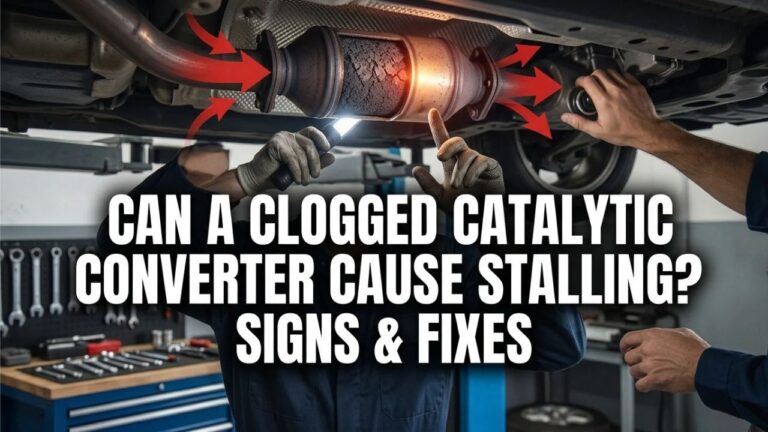
If the catalytic converter is badly blocked, those gases cannot leave the exhaust system freely. Backpressure rises upstream of the restriction.
The cylinder may then retain more exhaust gas than intended. That leftover gas reduces the amount of fresh air and fuel entering during the next cycle and can interfere with combustion.
At higher engine speed or heavy throttle, exhaust volume rises sharply. This is why a restricted converter may cause stronger symptoms under acceleration than at idle.
Possible effects include:
- Hesitation during acceleration
- Loss of high-RPM power
- Rough running under load
- Random or multiple-cylinder misfires
- Stalling after the engine warms up
- Hard starting in severe cases
Walker notes that a plugged converter can produce sluggish performance and loss of power, while its diagnostic guidance links excessive exhaust backpressure with changes in engine air-fuel behavior.
When a Bad Converter Usually Does Not Cause Misfires
A converter can fail chemically without becoming physically blocked.
The catalyst coating may lose its ability to process exhaust pollutants while exhaust still flows through the honeycomb passages normally. In that situation, the vehicle may store P0420 or P0430 while showing little or no change in drivability.
A catalyst-efficiency code by itself is therefore not proof that the converter is causing a misfire.
P0420 means the catalyst system on Bank 1 is operating below the expected efficiency threshold. P0430 indicates the same basic condition on Bank 2.
A Broken Substrate Can Cause Intermittent Problems
The ceramic or metallic substrate inside a converter can crack or break apart.
Loose pieces may rattle inside the housing. In some cases, broken material can shift and partially obstruct the exhaust outlet.
That can make symptoms inconsistent. The engine may run normally during one trip and lose power during another if the loose material changes position.
Key Takeaway: A converter can cause misfires when physical damage creates enough exhaust restriction to disturb combustion; a simple catalyst-efficiency failure usually does not.
A Misfire Is More Likely to Damage the Catalytic Converter
When misfire codes and a converter code appear together, the engine misfire often came first.
This direction of failure is important because installing a new converter without fixing the misfire can damage the new part.
Unburned Fuel Enters the Exhaust
A normal combustion event burns most of the air-fuel charge inside the cylinder.
During a misfire, some of that mixture may leave the cylinder without burning completely. The unburned hydrocarbons then travel into the exhaust system.
Once that mixture reaches the hot catalytic converter, it can burn inside the converter rather than inside the cylinder.
Converter Temperature Can Rise Sharply
The extra fuel burning inside the converter generates intense heat.
Walker identifies engine misfire as a common cause of converter meltdown and states that prolonged overheating can melt the internal substrate into a solid mass. Once that happens, the damaged material can obstruct exhaust flow and create the restriction that later contributes to poor running.
This can create a cycle:
- An ignition, fuel, or compression fault causes a misfire.
- Unburned fuel reaches the catalytic converter.
- Converter temperature rises.
- Internal material melts or breaks down.
- Exhaust flow becomes restricted.
- Engine performance gets worse.
- The restriction may contribute to more misfiring.
Common Problems That Start the Chain
Before blaming the catalytic converter for a misfire, check more common causes such as:
- Worn or fouled spark plugs
- Weak ignition coils
- Damaged plug wires on vehicles that use them
- Leaking or restricted fuel injectors
- Low fuel pressure
- Intake vacuum leaks
- Dirty or faulty MAF sensor
- Low cylinder compression
- Burned valves
- Incorrect valve timing
- Oil entering the combustion chamber
- Coolant entering a cylinder
- Rich air-fuel mixture
AutoZone also lists misfires, rich mixtures, oil contamination, and coolant contamination among problems that can contribute to converter clogging or damage.
Key Takeaway: Misfires often damage catalytic converters before converter restriction becomes severe enough to create further drivability problems.
Signs the Catalytic Converter May Be Causing the Misfire
A misfire code alone does not identify a clogged converter.
Look for a group of symptoms that suggests exhaust cannot leave the engine freely.
Power Drops as RPM Increases
One of the stronger clues is an engine that idles reasonably well but loses power as speed and load increase.
A clogged exhaust becomes more restrictive as exhaust volume rises. You may press the accelerator farther while the engine struggles to gain RPM.
This differs from some ignition faults, which may produce sharp jerking or a distinct cylinder miss without the same feeling that the entire engine cannot breathe.
Acceleration Becomes Sluggish
A restricted converter can make the vehicle feel heavy or slow even though the engine is running.
Walker lists sluggish acceleration and loss of power among common drivability symptoms of a bad or restricted converter.
Severe restriction may limit the engine to a fairly low RPM regardless of throttle position.
The Engine Runs Better Cold Than Hot
A damaged converter may become more restrictive as exhaust temperature rises.
A vehicle may start and drive reasonably well for a short period, then lose power or begin running roughly once the exhaust gets hot.
This symptom is not exclusive to catalytic converters, so it should lead to testing rather than immediate replacement.
Converter Rattling
A metallic rattle from inside the converter can mean the substrate has broken apart.
Rattling does not prove the exhaust is blocked, but broken internal material raises the possibility that pieces have shifted into the exhaust path.
Excessive Converter Heat
A converter that becomes extremely hot may be processing excess unburned fuel or suffering from severe restriction.
A glowing converter is a serious warning sign. Stop operating the vehicle and diagnose the cause rather than continuing to drive.
Do not touch the exhaust system during or shortly after testing. Converter and exhaust temperatures can cause severe burns.
Sulfur or Rotten-Egg Odor
Some converter and mixture problems can produce a sulfur-like smell.
The odor alone does not prove the converter is clogged. Rich operation, fuel composition, and other exhaust faults can also contribute.
Multiple Cylinders Misfire on the Same Bank
A severely restricted converter on one bank of a V-type engine may disturb several cylinders feeding that converter.
For example, misfires spread across cylinders on one bank combined with major power loss can make a bank-specific exhaust restriction worth checking.
A persistent misfire isolated to one cylinder is usually more likely to come from that cylinder’s ignition, injector, air leak, or mechanical condition.
Key Takeaway: Loss of power at higher RPM, excessive exhaust heat, rattling, sluggish acceleration, and multiple misfires associated with one exhaust bank make converter restriction more plausible.
Catalytic Converter Misfire Codes and What They Mean
An OBD-II scanner is one of the best starting points because it shows if the computer sees a catalyst problem, a misfire, or both.
P0300
P0300 means random or multiple-cylinder misfire detected.
This code does not identify the catalytic converter as the cause.
Possible sources include ignition, fuel delivery, vacuum leaks, mechanical engine trouble, and severe exhaust restriction.
P0301 Through P0308
These codes point toward specific cylinders.
Examples include:
- P0301 — Cylinder 1 misfire
- P0302 — Cylinder 2 misfire
- P0303 — Cylinder 3 misfire
- P0304 — Cylinder 4 misfire
The sequence continues for engines with more cylinders.
A single-cylinder code makes me more suspicious of a plug, coil, injector, compression problem, or localized air leak than of a catalytic converter.
P0420
P0420 means catalyst system efficiency below threshold on Bank 1.
The code does not literally mean “replace the catalytic converter.” Misfires, exhaust leaks, mixture problems, oxygen-sensor faults, oil contamination, or converter failure may all need to be checked.
AutoZone lists cylinder misfire among conditions that can appear with or contribute to P0420.
P0430
P0430 is the Bank 2 counterpart to P0420 on engines with two banks.
If P0430 appears with multiple misfires on Bank 2 and the engine loses power badly under load, testing that bank for exhaust restriction becomes more useful.
A Flashing Check Engine Light
A flashing Check Engine Light normally means the computer has detected a severe misfire condition with the potential to damage the catalytic converter.
Current U.S. OBD regulations require the malfunction indicator to blink during operating conditions where detected engine misfire makes catalyst damage imminent.
Do not treat a flashing light as a normal P0420 warning.
Key Takeaway: P0300-series codes identify misfires, while P0420 and P0430 identify catalyst-efficiency problems; seeing both means the cause-and-effect relationship still needs diagnosis.
How to Test a Catalytic Converter for a Misfire Problem
Do not replace the converter based on symptoms or codes alone.
A proper diagnosis checks the engine first, then tests exhaust restriction if the symptoms support it.
Scan All Stored and Pending Codes
Read all codes before clearing anything.
Pay attention to:
- P0300-series misfires
- P0171/P0174 lean codes
- P0172/P0175 rich codes
- Oxygen-sensor codes
- MAF or MAP sensor codes
- P0420/P0430
- Fuel-pressure or injector-related codes
Freeze-frame data is useful because it records engine conditions when the fault appeared.
If the misfire occurred under heavy load and higher RPM while the vehicle also has severe power loss, exhaust restriction becomes more plausible.
Diagnose the Misfire Before Condemning the Converter
Check spark plugs, coils, injectors, intake leaks, fuel pressure, and compression according to the code pattern.
For a single-cylinder misfire, moving an ignition coil to another cylinder can sometimes show if the code follows the coil, provided the vehicle design permits that test.
Do not continue swapping parts if basic testing points toward a mechanical engine problem.
Perform an Exhaust Backpressure Test
Backpressure testing is one of the more direct ways to identify a clogged exhaust.
A pressure gauge can be connected at an appropriate exhaust test point, often using an oxygen-sensor port with the correct equipment.
Walker lists typical reference readings of less than 1 psi at idle and less than 3 psi at 2,500 RPM for many vehicles. Those are general diagnostic figures, not universal specifications; the vehicle maker’s data should take priority.
High pressure upstream of the converter points toward restriction farther down the exhaust. Comparing pressure at different test locations can help isolate the blockage.
Use a Vacuum Gauge When Appropriate
An engine vacuum test can also show signs of exhaust restriction.
Manifold vacuum may appear normal at idle, then progressively fall when engine speed is held above idle if exhaust pressure continues building.
Vacuum readings can also be affected by valve timing, mechanical engine condition, and intake problems, so this test should be interpreted with the rest of the diagnosis.
Check Converter Temperature Carefully
An infrared thermometer can identify unusual temperature patterns, but temperature alone is not enough to condemn a converter.
A hot converter may indicate active catalyst operation, excess fuel entering the exhaust, or severe overheating.
A converter that is cold may have stopped reacting chemically, yet still allow exhaust flow normally.
Inspect for Internal Rattling or Damage
With the exhaust fully cooled, a technician may check for signs of loose internal material.
A rattle can point toward a broken substrate.
Physical inspection becomes more meaningful when it agrees with high backpressure, power loss, and scan data.
Key Takeaway: Scan data, ignition and fuel checks, compression testing, and measured exhaust backpressure provide a stronger diagnosis than replacing a converter based on P0420 or rough running alone.
Can an Oxygen Sensor Make It Look Like the Converter Causes a Misfire?
Yes, oxygen-sensor faults can complicate diagnosis, but upstream and downstream sensors have different jobs.
Upstream Oxygen Sensor
The upstream sensor sits before the catalytic converter.
Its signal is used heavily in fuel-control calculations on many vehicles. Incorrect information from this sensor can contribute to a mixture that is too rich or too lean.
A severe mixture error can cause rough running or misfire symptoms.
Downstream Oxygen Sensor
The downstream sensor sits after the converter and is used mainly to monitor catalyst operation on many OBD-II vehicles.
A downstream sensor fault can trigger catalyst-related codes without the converter itself being bad.
It is less likely than an upstream mixture-control problem to be the direct source of a genuine engine misfire.
Vehicle control strategies vary, so scan data and manufacturer diagnostic information should guide the test.
Should You Replace the Catalytic Converter First?
Usually not when active misfire codes are present.
Find out why the engine is misfiring before installing a new converter unless testing has already confirmed that converter restriction itself is the primary problem.
Walker specifically advises correcting misfire, rich/lean, airflow, oxygen-sensor response, cooling-system, and related engine faults before installing a replacement converter. A new converter can fail again if the original cause remains.
A useful repair sequence is:
- Read all diagnostic codes.
- Diagnose active engine misfires.
- Repair ignition, fuel, air, or mechanical faults.
- Check exhaust backpressure if restriction symptoms remain.
- Confirm catalyst failure with appropriate testing.
- Replace the converter only when failure has been established.
- Recheck scan data after the repair.
That sequence reduces the chance of replacing an expensive exhaust component that was only a victim of another problem.
Can You Drive With a Catalytic Converter Misfire Problem?
A vehicle with a steady Check Engine Light may still drive normally, but it should be diagnosed soon.
A flashing Check Engine Light deserves much faster action because it indicates a severe misfire condition that can overheat the catalytic converter. EPA guidance recommends reducing speed and seeking service promptly during this condition.
Stop driving if you notice:
- Severe loss of engine power
- Converter or exhaust glowing red
- Smoke from beneath the vehicle
- Strong burning odor
- Repeated stalling
- Extreme exhaust heat
- Engine that cannot maintain normal speed
- Severe shaking with a flashing Check Engine Light
A clogged converter can get hotter as restriction and engine load increase. Driving hard, towing, or climbing long grades can add more heat.
I would arrange towing if the converter is glowing, the engine can barely run, or power loss makes the vehicle unsafe in traffic.
Conclusion
Yes, can a bad catalytic converter cause a misfire has a qualified answer: a severely clogged, melted, or collapsed converter can create enough exhaust backpressure to disturb cylinder filling and combustion, which may produce misfires.
A converter that has simply lost catalyst efficiency usually does not cause the engine to misfire. P0420 or P0430 without major power loss or exhaust restriction should therefore lead to diagnosis rather than an automatic converter replacement.
The reverse sequence is more common and more damaging. Spark, fuel, compression, or mixture faults can create misfires that send unburned fuel into the exhaust, overheat the converter, and eventually melt its internal substrate.
I would diagnose active P0300-series codes first, then test backpressure if the engine still shows strong signs of exhaust restriction. Fixing the original engine fault before replacing the converter gives the replacement part a much better chance of surviving.
FAQs About Catalytic Converters and Engine Misfires
Can a Clogged Catalytic Converter Cause P0300?
Yes. Severe exhaust restriction can contribute to random or multiple-cylinder misfires and may lead to a P0300 code.
P0300 has many other causes, including worn plugs, ignition coils, injector problems, vacuum leaks, fuel-pressure faults, and low compression. Confirm exhaust restriction before blaming the converter.
Can P0420 Cause a Misfire?
P0420 itself cannot cause a misfire because it is only a diagnostic code indicating low catalyst efficiency on Bank 1.
The condition behind P0420 may exist alongside a misfire. In many cases, an engine misfire or mixture fault is actually what damaged the converter and triggered P0420.
Can a Bad Catalytic Converter Cause Rough Idle?
A severely restricted converter can contribute to rough running and may affect idle when blockage becomes extreme.
Mild catalyst-efficiency loss normally does not create a rough idle. Spark plugs, coils, vacuum leaks, injectors, throttle contamination, and compression problems are often stronger suspects.
Can a Bad Catalytic Converter Cause a Single-Cylinder Misfire?
It is possible but less typical.
A clogged converter usually affects several cylinders that share the restricted exhaust path rather than one isolated cylinder. A persistent P0301, P0302, or similar single-cylinder code should lead first to that cylinder’s spark, fuel, air, and compression.
Will Replacing the Catalytic Converter Fix a Misfire?
Only if testing confirms that converter restriction is causing the misfire.
If the real cause is a bad coil, spark plug, injector, vacuum leak, rich mixture, or compression problem, replacing the converter will not repair the misfire and may expose the new converter to the same damaging condition.
How Do I Know if My Catalytic Converter Is Clogged?
Common clues include major loss of power under load, difficulty reaching higher RPM, sluggish acceleration, excessive converter heat, rattling, stalling, and high measured exhaust backpressure.
A backpressure test is far more useful than judging the converter from a P0420 code alone.
Can a Bad Oxygen Sensor Cause a Misfire and Catalytic Converter Code?
Yes. An upstream oxygen-sensor problem can contribute to an incorrect air-fuel mixture on some vehicles, which may lead to rough running and converter stress.
A downstream sensor can also create or contribute to catalyst-monitoring faults. Scan data should be checked before replacing either the sensor or converter.
Can Driving With a Misfire Ruin a Catalytic Converter?
Yes. A severe misfire can send unburned fuel and oxygen into the exhaust, where the mixture can burn inside the catalytic converter and raise its temperature enough to damage or melt the substrate.
If the Check Engine Light is flashing, reduce driving and have the misfire diagnosed promptly rather than waiting for a catalyst code to appear.