How to Tell if Catalytic Converter Is Bad by Temperature Checks
A temperature test can show if a catalytic converter is producing heat from its chemical reactions, but it should be treated as a screening test rather than a final diagnosis. Once fully warmed, the outlet is often warmer than the inlet. Little temperature change, reversed temperatures, or extreme heat can point toward a problem that needs further testing.
The biggest mistake is using one fixed temperature difference as a universal pass-or-fail number. Converter design, engine load, air-fuel mixture, exhaust flow, ambient conditions, measurement location, and how long the engine has been running can all change the readings.
A careful inlet-versus-outlet comparison is still useful. It can show that the catalyst has reached operating temperature, reveal severe overheating, and help decide if you should move next to OBD-II data, oxygen-sensor testing, or an exhaust-backpressure check.
Catalytic converters are major emissions components in the United States. EPA states that specified major emissions components, including catalytic converters, receive federal emissions warranty coverage for 8 years or 80,000 miles on qualifying light-duty vehicles, subject to warranty conditions.
For how to tell if catalytic converter is bad by temperature, the safest rule is to compare the inlet and outlet only after the converter is fully hot. Walker Exhaust states that many converters begin light-off around 350°F and are fully lit around 500°F. Under normal conditions, its rear weld-ring reading may be as much as about 150°F hotter than the front.
A small temperature difference does not automatically condemn a modern three-way converter. Late-model engines can run clean enough that the converter has little extra fuel to oxidize, and some converters show very little temperature rise at idle. Temperature readings therefore make more sense when combined with symptoms and other diagnostic data.
The checks below cover the correct measuring points, useful temperature patterns, overheating clues, infrared-thermometer technique, clogged-converter diagnosis, P0420/P0430 codes, and the follow-up tests that can confirm what the temperature reading suggests.
How to Tell if Catalytic Converter Is Bad by Temperature
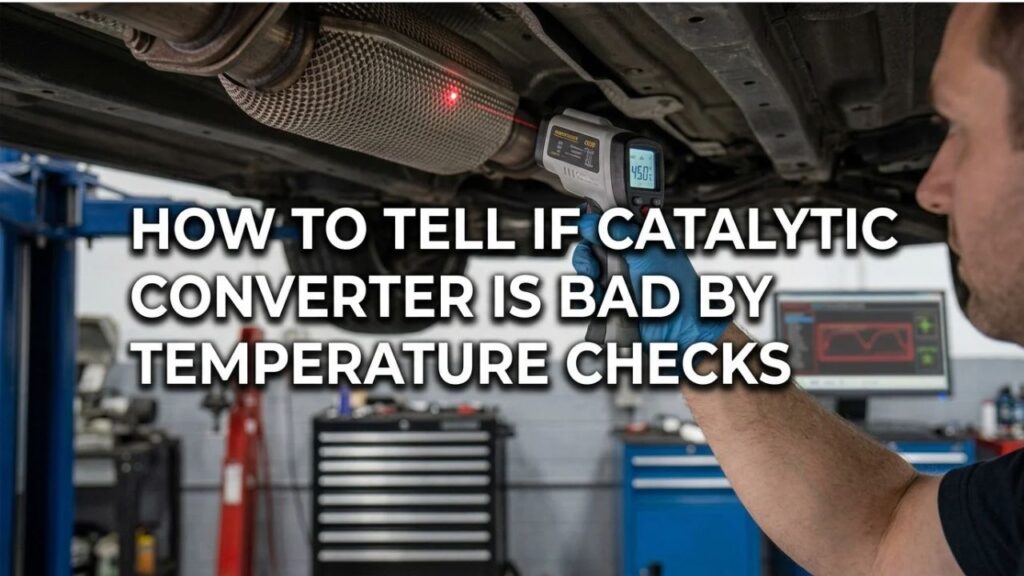
Measure the exhaust surface immediately before and after the converter after the vehicle has reached full operating temperature. A working converter commonly produces some temperature rise as exhaust passes through the catalyst.
Temperature alone cannot prove that the converter meets its emissions target. EPA testing found that temperature rise can indicate catalyst activity, but readings vary greatly among vehicles and operating conditions.
Outlet Temperature Is Higher Than the Inlet
A warmer outlet generally indicates that chemical reactions are occurring inside the converter.
The catalyst converts pollutants such as hydrocarbons and carbon monoxide, and those reactions release heat. Walker recommends comparing the front and rear weld rings with a pyrometer or infrared thermometer once the engine is fully warmed.
A modest rise is therefore usually a positive sign.
Do not require an exact 100°F or 150°F difference on every vehicle. EPA’s catalyst activity research found an average increase of about 60°F among 17 vehicles with good converters in one test mode, yet individual results ranged from a temperature decrease to increases of several hundred degrees.
Inlet and Outlet Temperatures Are Nearly the Same
Equal temperatures can mean the catalyst is not producing much reaction heat, but that result is not enough to call the converter bad.
Possible explanations include:
- Converter has not reached light-off temperature
- Engine is idling with little catalyst activity
- Modern engine is producing very clean exhaust
- Measurement points are inconsistent
- IR thermometer is reacting differently to the two surfaces
- Catalyst has lost activity
AA1Car notes that some late-model three-way converters may show only about 20-30°F of temperature difference, and some can show almost no measurable difference at idle.
If the check engine light is off, performance is normal, and the vehicle passes its emissions monitor, a tiny temperature difference by itself is weak evidence of failure.
Inlet Temperature Is Higher Than the Outlet
An outlet cooler than the inlet can suggest that the catalyst is inactive, but first make sure the converter is fully warmed and that both measurements were taken correctly.
An EPA catalyst study found that inactive converters tended to show outlet temperatures below inlet temperatures during controlled test modes. The same research also stressed that exhaust-system layout and operating conditions create large variations.
A repeat reading after proper warm-up is sensible before moving toward replacement.
If the pattern remains, check OBD-II catalyst data, oxygen sensors, fuel control, misfire history, and exhaust leaks.
Key Takeaway: A warmer outlet supports catalyst activity, but a small or reversed temperature difference should trigger more diagnosis rather than automatic converter replacement.
Catalytic Converter Temperature Chart for Diagnosis
The figures below are diagnostic reference points, not universal pass-or-fail specifications.
| Temperature observation | What it may indicate | What to do next |
| Converter below roughly 350°F | Catalyst may not be lit off | Warm vehicle fully and retest |
| Around 500°F or higher at converter area | Many converters should be active | Compare inlet and outlet |
| Outlet modestly hotter than inlet | Catalyst activity likely present | Check codes and symptoms if needed |
| Little or no temperature difference | Can be normal or indicate weak catalyst | Retest under proper conditions; check OBD data |
| Outlet cooler than inlet repeatedly | Possible inactive catalyst | Check O2 data, leaks, fuel control |
| Rear more than about 150°F hotter | Converter may be processing excess emissions | Check misfires and rich mixture |
| Extremely hot or glowing converter | Severe overheating | Stop operation and diagnose engine fault |
Walker states that most converters begin light-off at roughly 350°F and reach full light-off around 500°F. It also notes that a rear weld-ring reading more than about 150°F above the front may point to an engine emissions problem.
Older EPA training material lists converter shell temperatures around 600-800°F during normal operation and much higher internal catalyst temperatures. Those figures demonstrate how hot a converter can become, but they should not be used as a universal modern diagnostic specification.
How to Check Catalytic Converter Temperature With an IR Thermometer
An infrared thermometer is the simplest tool for a non-contact temperature comparison.
The goal is consistency. Measure comparable surfaces at the front and rear of the same converter rather than pointing at random sections of pipe, heat shields, or the converter body.
1. Check for Trouble Codes First
Connect an OBD-II scanner before doing the heat test if one is available.
Look for:
- P0420 — catalyst efficiency below threshold, Bank 1
- P0430 — catalyst efficiency below threshold, Bank 2
- P0300-series misfire codes
- Fuel-trim faults
- Oxygen-sensor faults
A catalyst code does not always mean the converter itself caused the problem. Misfires, exhaust leaks, fuel-control faults, coolant contamination, oil burning, and sensor issues can contribute to catalyst trouble.
Underhood Service recommends checking engine problems before replacing a converter because an unresolved fault can damage the replacement part.
2. Warm the Engine and Converter Fully
A cold converter tells you very little.
Drive the vehicle long enough to bring the engine and exhaust system to normal operating temperature. Idling from cold may take longer to create representative catalyst conditions.
EPA notes that catalytic converters need heat before they become active, and cold-start operation produces much higher emissions before catalyst temperature rises.
3. Park Safely
Park on a flat surface in a well-ventilated area.
Apply the parking brake and keep clothing, hands, tools, and the thermometer away from moving belts, fans, hot exhaust parts, and rotating components.
Never crawl beneath a vehicle supported only by a jack.
If the converter cannot be reached safely with the vehicle on the ground, use proper lifting equipment or have the test performed at a shop.
4. Measure the Front Weld Ring
Aim the IR thermometer at the metal pipe or weld-ring area immediately before the converter.
Walker recommends measuring near the point where the inlet pipe is welded to the converter body.
Record the temperature.
Try to use a clean, similarly colored surface for both readings. Infrared thermometers can read shiny, rusty, painted, and heavily corroded surfaces differently because surface emissivity changes.
5. Measure the Rear Weld Ring
Take a second reading immediately after the converter at the rear weld ring.
Keep the measuring distance and angle as similar as practical.
Record the outlet value.
6. Calculate the Difference
Subtract the inlet temperature from the outlet temperature.
For example:
- Inlet: 620°F
- Outlet: 700°F
- Difference: +80°F
That pattern shows a temperature rise through the converter.
Another example:
- Inlet: 650°F
- Outlet: 640°F
- Difference: -10°F
That result deserves a repeat test and more diagnosis, but it does not prove failure by itself.
7. Repeat the Test
Take several readings rather than relying on one instant measurement.
If possible, compare readings after a normal drive rather than after extended idling alone.
A stable pattern is more useful than one number taken from a changing exhaust system.
Key Takeaway: Measure comparable inlet and outlet weld-ring surfaces after full warm-up, record several readings, and use the temperature difference as a clue rather than a final verdict.
What Temperature Difference Means the Converter Is Good?
There is no universal number that proves every catalytic converter is healthy.
The Old 100°F Rule
Older diagnostic references often used a rule stating that the outlet should be at least 100°F hotter than the inlet.
That rule makes more sense on older oxidation converters and engines that send more hydrocarbons and carbon monoxide into the catalyst.
AA1Car states that older two-way converters could show at least a 100°F rise.
Modern Three-Way Converters Can Show Less
Modern fuel-injected engines control air-fuel ratio much more tightly.
Less unburned fuel reaches the converter under normal operation, so there may be less chemical heat produced.
AA1Car notes that late-model converters may show only 20-30°F difference at some operating conditions.
That is why a modern converter should not automatically fail a DIY test because the outlet is only 25°F warmer.
Walker’s 150°F Reference
Walker states that the rear weld-ring temperature may run as much as 150°F higher than the front under normal conditions.
A rise beyond that level may indicate that the converter is working unusually hard because the engine is sending excess emissions into it.
That distinction matters: a much hotter outlet is not always proof of an excellent converter. It can be evidence of a problem upstream.
Key Takeaway: Ignore universal “must be 100°F hotter” rules; modern converters can show small temperature rises, while an unusually large rise can point toward an engine fault.
What Does an Overheating Catalytic Converter Mean?
An abnormally hot converter often means fuel or oxygen is reaching the catalyst in quantities that create excessive reaction heat.
The converter may be reacting correctly to a problem created elsewhere.
Engine Misfire
A misfiring cylinder can send unburned fuel and oxygen into the exhaust.
That mixture can burn inside the converter and create extreme heat.
Underhood Service identifies ignition misfire as a major cause of catastrophic converter overheating and states that severe heat can damage or melt the substrate.
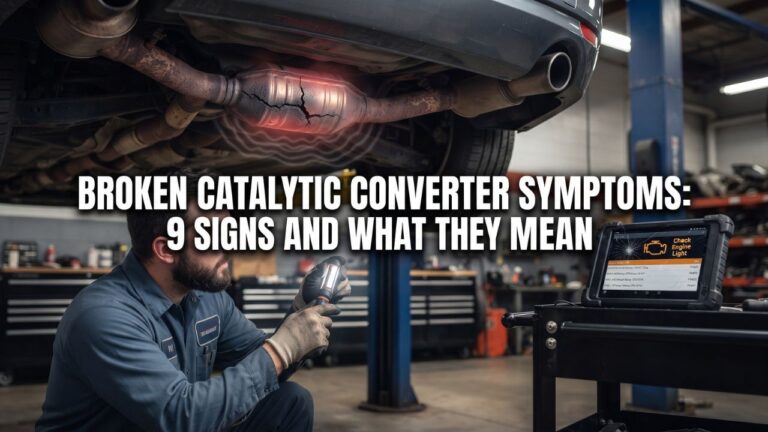
Do not keep driving with a flashing check engine light. A flashing MIL commonly signals a misfire severe enough to threaten the catalyst.
Rich Air-Fuel Mixture
A rich mixture sends excess fuel into the exhaust.
Possible causes include:
- Leaking fuel injector
- Incorrect fuel pressure
- Faulty sensor input
- Ignition problem
- Engine-control fault
The converter may become far hotter than normal while oxidizing the excess hydrocarbons.
Oil or Coolant Contamination
Engine oil or coolant entering the combustion chamber can contaminate the catalyst.
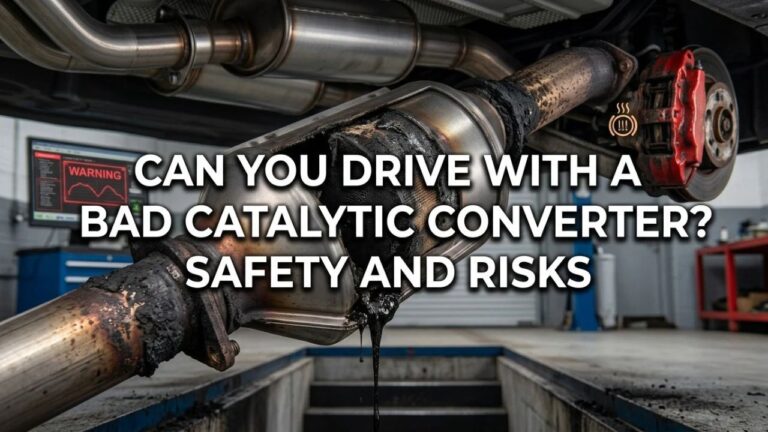
Contamination may reduce conversion ability, raise emissions, and eventually damage the substrate.
Replacing the converter before repairing the engine fault risks damaging the new unit.
Extremely Hot or Glowing Converter
A converter glowing red is not a normal diagnostic temperature pattern.
Shut the engine off when safe and diagnose the cause.
Avoid parking over dry grass, paper, leaves, fuel, or other combustible material when the exhaust is severely overheated.
Key Takeaway: Extreme converter temperature often points to a misfire or rich-running engine, and the upstream engine fault should be repaired before replacing the converter.
Can Temperature Tell If a Catalytic Converter Is Clogged?
Not reliably.
A temperature check measures heat activity. A clogged converter is an exhaust-flow restriction, so the stronger diagnostic method is a backpressure test.
Why a Clogged Converter Can Run Hot
A melted or collapsed catalyst can trap exhaust flow and create excessive heat.
Symptoms may include:
- Loss of power
- Poor acceleration
- Engine struggling at higher RPM
- Stalling
- Excess exhaust heat
- Poor fuel economy
- Hard starting in severe cases
Temperature may support the diagnosis but cannot measure how freely exhaust is moving.
Use an Exhaust Backpressure Test
A technician can remove the upstream oxygen sensor and connect a low-pressure gauge before the converter.
CarParts notes that readings above roughly 1-1.25 psi at idle or around 3 psi at 2,500 rpm can point toward excessive restriction, though exact limits vary by vehicle.
Underhood Service gives another general reference of less than 1 psi at idle and no more than about 4 psi during a snap-throttle test.
Vehicle-specific service data should take priority over a generic limit.
Check Engine Vacuum as Another Clue
A vacuum gauge can also reveal exhaust restriction.
If intake vacuum starts normally and steadily drops as engine speed is held above idle, restricted exhaust becomes one possible cause.
That test is indirect, so backpressure measurement gives clearer evidence.
Key Takeaway: Temperature can suggest converter trouble, but suspected clogging should be confirmed with exhaust backpressure or another flow-related test.
Why Temperature Testing Can Give the Wrong Answer
A catalytic converter temperature test is easy to perform, which can make it look more precise than it is.
The Converter Was Not Fully Warm
A converter that has not reached light-off temperature may show little or no heat rise.
Retest only after the engine and exhaust are fully warmed.
The Engine Was Left at Idle
Some modern converters cool substantially at idle.
A lack of temperature rise while parked does not necessarily reproduce what happens under road load.
The Measurement Points Were Different
Do not compare one reading from the converter shell with another from a thin exhaust pipe.
Pipe thickness, rust, surface coating, heat shields, welds, brackets, and airflow all change surface temperature.
EPA’s catalyst testing work specifically noted that pipe joints, brackets, flanges, and heat sinks can distort readings.
The Infrared Thermometer Is Reading Surface Emissivity
An IR thermometer does not directly measure exhaust-gas temperature.
It measures infrared energy from the surface.
A shiny stainless section can read differently from a rusty or dark surface at the same actual temperature.
The Engine Has Another Fault
A converter may be perfectly capable of converting pollutants while running far hotter than normal because of a misfire.
The temperature test can therefore identify heat activity without proving that the engine and catalyst system are healthy as a whole.
Key Takeaway: Warm-up, idle conditions, measuring location, surface finish, and engine faults can all distort a catalytic-converter temperature test.
Better Tests to Confirm a Bad Catalytic Converter
Temperature works best as one part of a larger diagnostic process.
Check Upstream and Downstream Oxygen Sensors
Most OBD-II gasoline vehicles use an oxygen sensor before the converter and another after it.
The upstream sensor reacts rapidly to changes in exhaust oxygen. A healthy converter stores and releases oxygen, so the downstream signal should usually be more stable than the upstream signal.
If the downstream waveform closely follows the upstream waveform under the conditions used by the vehicle’s catalyst monitor, converter efficiency may be low.
Underhood Service describes P0420/P0430 monitoring as a mathematical comparison of upstream and downstream sensor activity performed by the engine computer.
Check for P0420 or P0430
P0420 normally refers to catalyst-system efficiency below threshold on Bank 1.
P0430 refers to Bank 2 on engines with two cylinder banks.
Do not replace the converter from the code alone.
Check for:
- Exhaust leaks
- Misfires
- Oil consumption
- Coolant consumption
- Fuel-control faults
- Sensor faults
- Technical service information for the vehicle
Test Exhaust Backpressure
Use a pressure test when the main complaint is poor acceleration or loss of power under load.
A converter can lose emissions activity without becoming clogged, and it can become restricted without immediately setting a catalyst-efficiency code.
Backpressure and catalyst-efficiency tests answer different questions.
Inspect for Physical Damage
Look for:
- Dented converter housing
- Rattling substrate
- Heat discoloration
- Cracks
- Impact damage
- Scorched surrounding components
A broken substrate may rattle when the exhaust is cool and the housing is lightly checked during diagnosis.
Do not strike a hot converter or work beneath an unsupported vehicle.
Key Takeaway: O2 sensor data, catalyst codes, backpressure, engine diagnostics, and physical inspection give a stronger diagnosis than temperature alone.
Conclusion
For how to tell if catalytic converter is bad by temperature, compare inlet and outlet temperatures only after the converter is fully warmed. A warmer outlet generally supports catalyst activity, while a repeatedly cooler outlet or little temperature change can justify more testing.
Do not condemn a modern converter because it fails an old 100°F rule. Some late-model vehicles show only a small temperature difference, while a converter that runs far hotter than expected may actually be reacting to a misfire, rich mixture, or another engine problem.
My recommendation is to use the IR thermometer as a fast screening tool, then confirm suspicious results with trouble codes, upstream and downstream O2 sensor behavior, exhaust-backpressure testing, and inspection for the engine fault that may have damaged the catalyst.
FAQs About Catalytic Converter Temperature Testing
What should the inlet and outlet temperature of a catalytic converter be?
There is no single temperature that applies to every vehicle. Walker states that many converters start light-off near 350°F and are fully lit near 500°F. Once active, the rear weld-ring surface often becomes warmer than the front. The actual temperature varies with engine load, converter design, exhaust flow, and fuel mixture.
How much hotter should the catalytic converter outlet be?
A modest rise can indicate catalyst activity, but no universal difference applies. Older rules often called for 100°F or more. Modern three-way converters may show only 20-30°F under some conditions. Walker notes that rear temperatures can be as much as about 150°F above the front during normal operation.
Does a bad catalytic converter run hotter or colder?
Either pattern can occur. An inactive catalyst may produce little extra heat or show an outlet cooler than the inlet. A converter receiving unburned fuel from a misfire can become dangerously hot. A melted or restricted substrate may also create abnormal heat. Temperature direction must be interpreted with the engine symptoms.
Can I test a catalytic converter with an infrared thermometer?
Yes. Measure comparable surfaces directly before and after the converter once it is fully warmed. A non-contact IR thermometer is useful for finding temperature differences, but surface condition affects the reading. Use the result with OBD-II data and other tests rather than as the only diagnostic method.
Does a 100°F temperature difference prove the catalytic converter is good?
No. A temperature rise shows heat-producing catalyst activity, but it does not prove that the converter meets the vehicle’s emissions-efficiency requirement. EPA research found large temperature variation even among working converters. Modern catalyst monitoring relies heavily on oxygen-sensor data and computer calculations.
Can a clogged catalytic converter have normal temperatures?
Yes. Temperature and exhaust restriction are different measurements. A partially blocked converter can sometimes show temperatures that appear plausible while still limiting exhaust flow. If the vehicle loses power under load or struggles at higher RPM, an exhaust-backpressure test is a stronger check for restriction.
Is a glowing red catalytic converter bad?
A glowing converter indicates extreme heat and should be treated as a serious fault. Common causes include an ignition misfire or excessively rich mixture sending unburned fuel into the catalyst. Stop operating the vehicle when safe and diagnose the engine fault before the converter suffers further thermal damage.