How Much to Install Catalytic Converter? Costs and Labor Rates
Professional catalytic-converter replacement often costs about $1,000 to $4,000 in the United States, though some straightforward aftermarket jobs can cost less and certain luxury, hybrid, truck, or manifold-integrated setups can exceed that range. The converter itself usually drives most of the bill; labor is often a smaller share.
The price can be frustrating because two cars with the same failure code may receive quotes thousands of dollars apart. Converter design, precious-metal content, exhaust layout, emissions certification, rust, and the number of converters on the vehicle can all change the repair bill.
A good estimate separates the converter price, labor, diagnostic charges, hardware, oxygen sensors, and related repairs. That makes it easier to compare quotes and spot a shop replacing extra parts without a clear reason.
RepairPal’s estimate updated September 3, 2026 places the average U.S. catalytic-converter replacement at 2,280–2,480, including about 236–347 in labor and 2,044–2,133 in parts. AAA gives a broader total range of roughly 1,000–4,000, which reflects how much vehicle design changes the final bill.
Before asking how much to install catalytic converter, check the vehicle’s age and mileage. The EPA says specified major emissions components, including catalytic converters, receive federal emissions warranty coverage for 8 years or 80,000 miles, whichever comes first, when the applicable warranty conditions are met.
The sections below break down part and labor charges, show current vehicle-specific examples, compare OEM and aftermarket converters, explain state-related costs, cover extra charges that can appear on a quote, and show when the federal emissions warranty may remove most or all of the repair cost.
How Much to Install Catalytic Converter in the U.S.?
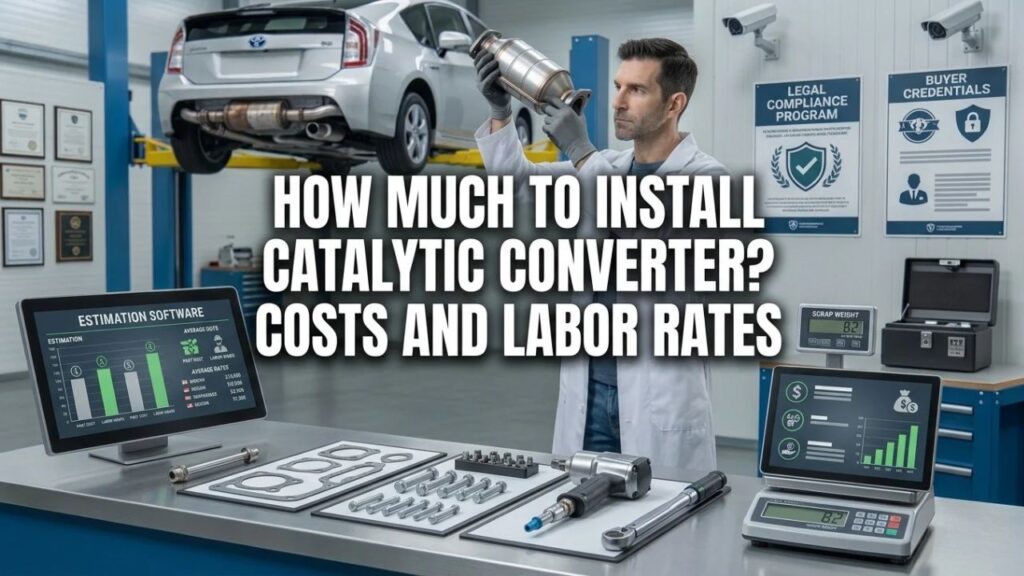
A realistic professional replacement budget for many vehicles is 1,000–4,000, though prices outside that range are possible.
The part normally accounts for the largest portion of the total.
Average Parts and Labor Cost
RepairPal currently puts the average total at 2,280–2,480. Its estimated labor portion is 236–347, leaving more than $2,000 of the average bill tied to parts.
AAA lists catalytic-converter parts at roughly 300–2,500 and says shop labor rates may run around 160–200 per hour in its current cost discussion.
AutoZone gives a similarly broad direct-fit converter range of roughly 300–2,500 for the part, with the exact price controlled heavily by vehicle design.
Lower-Cost Jobs
Older vehicles with a simple exhaust layout and an approved aftermarket converter can fall well below the current national average.
A universal converter may also cost less than a direct-fit assembly. The tradeoff is that universal units commonly require cutting, fitting, welding, or clamping rather than a straightforward bolt-in swap.
That extra fabrication can reduce part cost while adding labor.
Higher-Cost Jobs
The total can climb above $3,000 when the vehicle uses:
- An expensive OEM converter
- More than one catalytic converter
- A converter built into the exhaust manifold
- A complex turbocharged exhaust layout
- A large truck or SUV exhaust system
- A luxury or performance application
- A CARB-approved part with a higher purchase price
- Additional oxygen sensors or damaged exhaust hardware
RepairPal currently lists some mainstream vehicles near or above $3,000, showing that high converter bills are not limited to exotic cars.
Key Takeaway: Plan around 1,000–4,000 for many professional jobs, but the exact converter fitted to the vehicle matters far more than a national average.
How Much Is Labor to Install a Catalytic Converter?
Labor is often smaller than the converter price itself, but access and corrosion can change the charge.
RepairPal’s current general estimate puts labor at about 236–347 for the average replacement.
Bolt-On Converter Labor
A direct-fit converter may attach with flanges and bolts.
The technician removes exhaust fasteners, disconnects any sensors that interfere with removal, replaces required gaskets or hardware, installs the new assembly, and checks for leaks.
A clean bolt-on system can be fairly straightforward.
Weld-In Converter Labor
Universal converters often require fabrication.
The technician may need to:
- Measure the existing exhaust.
- Cut out the old converter.
- Position the new unit correctly.
- Weld or clamp it into the pipe.
- Check sensor placement.
- Inspect for exhaust leaks.
The converter may be inexpensive, yet fabrication can raise the labor charge.
Rusted Hardware Can Raise the Bill
Exhaust components live beneath the vehicle and see water, road salt, heat cycles, and corrosion.
A job becomes more involved if bolts snap, flanges are badly rusted, studs need extraction, or sections of pipe crumble during removal.
A shop may quote extra labor for these conditions because they cannot always be predicted before disassembly.
Manifold-Integrated Converters Cost More to Access
Some catalytic converters are built into or very close to the exhaust manifold.
RepairPal notes that certain converters are integrated directly into the exhaust manifold, making the job different from replacing a simple converter farther downstream.
Access may involve heat shields, sensors, engine-bay components, or tightly packed fasteners.
Key Takeaway: Straightforward labor may stay in the low hundreds, while rust, welding, manifold integration, and difficult access can raise the installation charge.
Current Catalytic Converter Replacement Cost Examples
One national average cannot show the full range, so vehicle-specific estimates are more useful.
RepairPal’s September 2026 figures illustrate how far prices can spread among common models.
| Vehicle | Current Estimated Replacement Cost |
| Ford F-150 | 1,591–1,656 |
| Nissan Altima | 1,577–1,682 |
| Toyota Camry | 1,872–1,950 |
| Toyota Corolla | 2,039–2,103 |
| Honda CR-V | 2,330–2,554 |
| Honda Accord | 2,737–2,916 |
| Chevrolet Silverado 1500 | 2,928–3,063 |
| Honda Civic | 2,591–3,673 |
These are broad estimates rather than quotes for every model year, engine, ZIP code, or emissions package.
Kelley Blue Book also shows large regional and vehicle differences. A 2021 Honda Civic estimate in one ZIP code was about 1,769–1,937, while a 2025 Ram 3500 Mega Cab example was about 3,368–3,662.
Why the Same Model Can Have Different Prices
One model name may cover several:
- Engine sizes
- Drivetrain layouts
- Emissions certifications
- Exhaust configurations
- Model years
- Converter locations
A V6 or V8 may use multiple converters where a four-cylinder version uses fewer.
Location Also Changes the Quote
Shop labor rates differ by city and state.
Parts requirements can also change with emissions rules. A converter legal for one federal-emissions vehicle may not be legal for a California-certified version of the same model.
Key Takeaway: Vehicle-specific quotes are far more useful than a single national price because engine, exhaust layout, emissions certification, and location can move the bill by thousands of dollars.
OEM vs. Aftermarket Catalytic Converter Cost
One of the biggest pricing choices is OEM versus aftermarket.
Both can be legal choices when the correct part is used for the vehicle and local emissions rules.
OEM Catalytic Converter
An OEM converter comes from the vehicle manufacturer or its approved parts channel.
OEM units are often the most expensive option because they are built for the exact emissions calibration and exhaust layout used by that vehicle.
AAA states that OEM converters may cost substantially more than aftermarket alternatives.
OEM may make sense when:
- The vehicle is still under emissions warranty
- No approved aftermarket unit exists
- The vehicle has strict emissions certification
- Fitment has been troublesome with low-cost parts
- The owner wants a factory replacement
Direct-Fit Aftermarket Converter
A direct-fit aftermarket converter is shaped to replace the factory part without major fabrication.
It may include flanges, pipes, mounting points, or sensor bungs in the needed locations.
AutoZone lists direct-fit converter prices from roughly $300 to $2,500, showing that aftermarket does not always mean inexpensive.
A high-quality direct-fit unit can reduce labor compared with a universal converter because little or no fabrication is needed.
Universal Converter
A universal unit is usually a simpler converter body intended to work across more than one application.
It may need to be welded into the existing exhaust.
The part can cost much less, but installation quality becomes more dependent on the exhaust shop.
The converter must still meet the vehicle’s emissions requirements.
Key Takeaway: OEM usually costs more, direct-fit aftermarket parts balance fit and price, and universal converters can lower parts cost while adding fabrication work.
Why California-Compliant Converters Can Cost More
California applies its own replacement-converter rules.
CARB states that aftermarket catalytic converters must receive an Executive Order exemption before they can legally be sold and installed for the approved California applications. The correct part must match the vehicle’s make, model, model year, engine size, and engine family.
You Cannot Pick Any Aftermarket Converter
A converter that physically bolts onto the vehicle may still be the wrong emissions part.
CARB-approved replacements are application-specific.
For a California vehicle, verify the Executive Order and part number before purchase.
CARB Approval Can Raise Parts Cost
CARB-approved converters must meet additional testing, durability, labeling, and application requirements.
That can reduce the number of low-cost choices compared with vehicles that accept federal-emissions replacement converters.
A cheap converter that cannot legally be installed on the vehicle is not a real saving.
Check the Underhood Emissions Label
The underhood emissions label can identify the vehicle’s certification and engine family.
A repair shop or parts supplier can use that information with the VIN to select the correct converter.
Key Takeaway: Emissions certification can change the part you are allowed to install, so confirm federal or CARB requirements before comparing prices.
Extra Costs That Can Appear on the Repair Bill
The converter may not be the only part needed.
A clear estimate should show each additional charge instead of hiding everything inside one total.
Diagnostic Fee
A P0420 or P0430 code does not automatically prove the converter itself needs replacement.
Diagnosis may include:
- OBD-II scan data
- Oxygen-sensor readings
- Exhaust leak inspection
- Fuel-trim checks
- Misfire diagnosis
- Backpressure testing
- Temperature checks
Paying for correct diagnosis can prevent a very expensive wrong repair.
Oxygen Sensors
Oxygen sensors are often positioned before and after the catalytic converter.
They may be reused if they are working correctly and can be removed without damage.
A seized, damaged, or faulty sensor may need replacement.
AAA notes that related oxygen-sensor work can add several hundred dollars to some repairs.
Gaskets, Bolts, Clamps, and Flanges
Exhaust gaskets and hardware are smaller expenses, but old parts may not be reusable.
Rusted flanges or pipe sections can turn a converter replacement into a larger exhaust repair.
Repairing the Fault That Killed the Converter
A converter often fails because something else damaged it.
Common causes include:
- Engine misfires
- Rich air-fuel mixture
- Leaking fuel injectors
- Oil burning
- Coolant entering the cylinders
- Ignition faults
Installing a new converter without repairing the root cause can destroy the replacement.
Key Takeaway: Diagnostic work, sensors, hardware, damaged exhaust pipes, and the engine fault behind the converter failure can add to the quoted installation cost.
Is Catalytic Converter Installation Covered by Warranty?
It can be.
Before paying $1,000 or more, check the vehicle’s warranty status.
Federal 8-Year/80,000-Mile Coverage
The EPA says catalytic converters are specified major emissions components covered for 8 years or 80,000 miles, whichever comes first, under the applicable federal emissions defect warranty.
This warranty can apply to used vehicles too because the coverage follows the vehicle rather than only the original buyer.
Coverage still depends on the reason for failure and the warranty conditions.
Manufacturer Warranty May Provide More Coverage
Some automakers or states may provide emissions coverage beyond the federal minimum.
Check:
- Warranty booklet
- VIN-specific manufacturer information
- Dealer service history
- State emissions warranty rules
A dealer can confirm coverage using the VIN.
Theft Is Different From Failure
If the converter was stolen, an emissions defect warranty normally is not the route for payment.
Comprehensive auto insurance may cover catalytic-converter theft, subject to the policy and deductible.
Key Takeaway: Check the 8-year/80,000-mile federal emissions warranty before authorizing a customer-pay converter replacement.
How to Lower Catalytic Converter Installation Cost
A high repair quote does not always mean the cheapest converter is the answer.
The goal is to reduce cost without installing the wrong emissions part or repeating the repair.
Get More Than One Written Quote
Ask each shop to list:
- Converter brand
- OEM or aftermarket
- Part number
- Labor charge
- Diagnostic charge
- Gaskets and hardware
- Oxygen sensors
- Taxes and fees
- Warranty
Quotes are much easier to compare when the same items are visible.
Ask About a Legal Direct-Fit Aftermarket Option
If the vehicle is outside warranty, an approved direct-fit aftermarket converter may cost less than OEM.
Confirm that it matches the vehicle’s emissions certification.
For California-certified vehicles, verify the CARB application rather than buying solely by make and model.
Use an Exhaust Shop for Fabrication Work
A muffler or exhaust specialist may have more experience welding universal converters and repairing rusted exhaust pipes.
That can make sense for an older vehicle where a legal universal replacement is available.
Diagnose Before Ordering Parts
I would not buy a converter based solely on P0420 or P0430.
An exhaust leak, sensor problem, engine misfire, fuel-control fault, or damaged wiring can produce related symptoms or codes.
A correct diagnosis is much cheaper than replacing a good converter.
Key Takeaway: Compare itemized quotes, check legal aftermarket choices, use the right type of shop, and confirm the converter has actually failed before spending money.
Is It Worth Installing a New Catalytic Converter?
That depends mainly on the vehicle’s condition and value.
A $2,500 converter repair on a well-maintained vehicle worth $15,000 is a very different decision from the same repair on a car with major transmission, engine, rust, and suspension problems.
Consider:
- Vehicle market value
- Engine condition
- Transmission condition
- Rust
- Other upcoming repairs
- Remaining loan balance
- Emissions-test requirements
- Insurance involvement
- Warranty coverage
Do not judge the repair by converter cost alone.
A vehicle that is otherwise reliable may still make financial sense to repair even when the converter bill looks high.
Conclusion
For how much to install catalytic converter, a useful U.S. budget is roughly 1,000–4,000 for parts and professional labor, with RepairPal’s September 2026 average sitting at about 2,280–2,480.
The converter itself usually accounts for most of the bill. Labor can be only a few hundred dollars on a straightforward job, while rust, welding, difficult access, manifold-integrated designs, multiple converters, and added exhaust repairs can push the total higher.
Before approving the repair, verify the diagnosis, check OEM versus legal aftermarket options, and confirm the vehicle’s emissions certification. Also check the 8-year/80,000-mile federal emissions warranty if the vehicle is still within that period.
I would compare at least two itemized quotes on a high-cost replacement. A quote is much easier to judge when you can see exactly how much is going toward the converter, labor, sensors, hardware, diagnosis, and any related repair.
FAQs About Catalytic Converter Installation Cost
How Much Is Labor Only to Install a Catalytic Converter?
RepairPal’s September 2026 national estimate places catalytic-converter replacement labor at about 236–347 on average. Actual labor can be higher when the converter is hard to reach, bolts are badly rusted, welding is required, or damaged exhaust pipes need repair.
Why Does Catalytic Converter Replacement Cost So Much?
The converter itself contains costly catalyst materials and must meet strict emissions requirements. Vehicle-specific construction also raises prices. RepairPal’s current average assigns more than $2,000 of its typical 2,280–2,480 bill to parts rather than labor.
Can I Install a Cheap Universal Catalytic Converter?
Only if the converter is legal for the vehicle’s emissions configuration and can be installed correctly. Universal converters usually require welding or fabrication. California vehicles need the correct CARB-approved application, so a generic converter cannot simply be installed because the pipe size matches.
Is an Aftermarket Catalytic Converter Cheaper Than OEM?
Usually. Aftermarket converters can cost much less than factory units, though premium direct-fit and CARB-approved parts can still be expensive. Compare the exact legal part rather than assuming every aftermarket converter fits every emissions package.
How Much Does a Catalytic Converter Cost Without Labor?
Current estimates vary widely. AAA lists parts at roughly 300–2,500, while RepairPal’s current average parts charge is about 2,044–2,133 across its replacement estimates. Vehicle and converter design account for much of the difference.
Can a Catalytic Converter Replacement Cost More Than $3,000?
Yes. RepairPal currently lists some common vehicles near or above $3,000, and AAA gives a broad professional replacement range extending to about $4,000. Luxury vehicles, trucks, multiple converters, OEM parts, and complex exhaust designs can go higher.
Does Insurance Pay for Catalytic Converter Replacement?
Insurance may pay when the converter is stolen or damaged by a covered event under comprehensive coverage. Mechanical failure from age, contamination, or engine problems is normally handled as a repair rather than an insurance claim. Policy terms and deductibles decide the actual payment.
Is a Catalytic Converter Covered for 8 Years or 80,000 Miles?
Federal emissions rules provide 8 years or 80,000 miles of coverage for specified major emissions components such as the catalytic converter under applicable warranty conditions. Check the warranty booklet and contact an authorized dealer before paying for a qualifying repair.