When Did Catalytic Converters Become Mandatory on U.S. Cars?
Catalytic converters became widely used on new U.S. passenger cars beginning with the 1975 model year. Federal law did not simply state that every car must contain a catalytic converter; instead, increasingly strict exhaust-emission standards pushed automakers to adopt catalytic converters as the practical way to meet those limits.
The major turning point came with the Clean Air Act of 1970. Congress required a 90% reduction in emissions from new automobiles by 1975 and gave the newly created Environmental Protection Agency broad authority over vehicle pollution.
By the 1975 model year, catalytic converters had entered widespread U.S. production. EPA historical records state that automakers began equipping new cars with pollution-reducing converters designed to operate on unleaded gasoline.
So, when did catalytic converters become mandatory in practical terms? For most people, 1975 is the key year. The legal story is slightly more precise: federal regulations required vehicles to meet emissions limits, and catalytic converters became the dominant technology used to comply.
The closely related question when were catalytic converters required has the same answer for mainstream U.S. passenger cars: catalytic converters became broadly necessary during the 1975 model-year transition, although some vehicles and applications followed different emissions strategies or timelines.
The history makes more sense when the 1970 law, 1975 rollout, unleaded gasoline requirement, and later three-way catalyst development are viewed together.
When Did Catalytic Converters Become Mandatory in the United States?
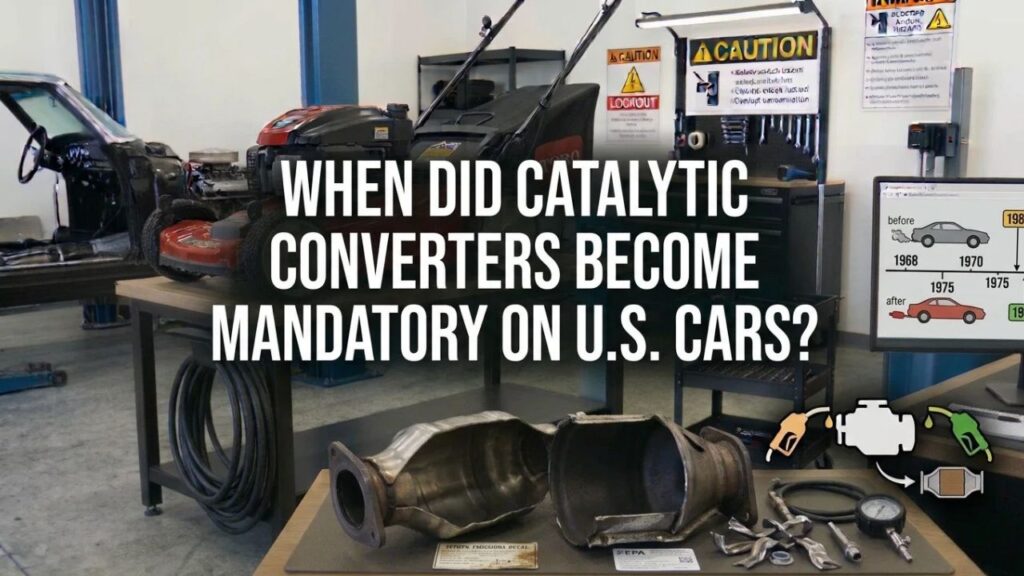
The answer commonly given is 1975, but the regulation was based on emissions performance rather than a simple component mandate.
The Clean Air Act of 1970 Set the Direction
The Clean Air Act of 1970 changed federal vehicle-emissions regulation substantially.
EPA records show that Congress called for a 90% reduction in emissions from new automobiles by 1975. The new standards targeted pollutants such as:
- Hydrocarbons
- Carbon monoxide
- Nitrogen oxides
Automakers had only a few years to develop technology capable of cutting exhaust pollution dramatically.
Early emissions-control methods included:
- Carburetor calibration changes
- Ignition timing changes
- Air injection
- Exhaust gas recirculation
- Leaner fuel mixtures
Those methods reduced certain pollutants but were not enough to meet all later targets while maintaining acceptable drivability.
Catalytic converters became a major part of the solution.
The 1975 Model Year Was the Major Turning Point
EPA historical material identifies 1975 as the year first-generation catalytic converters appeared widely in response to hydrocarbon and carbon-monoxide standards.
EPA’s historical account also states that starting with the 1975 model year, U.S. automakers equipped new cars with pollution-reducing catalytic converters designed for unleaded fuel.
This is why 1975 is generally treated as the beginning of the catalytic-converter era in the United States.
Not Every 1975 Car Followed Exactly the Same Rule
The historical picture contains some exceptions.
An EPA decision from the period noted that approximately 85% of 49-state cars and nearly all California cars were expected to use catalytic converters during the 1975 model year. Some vehicles were able to meet interim federal standards through other emissions-control methods.
That distinction matters.
It is more accurate to say catalytic converters became widely necessary to meet emissions standards in 1975 than to say Congress passed a law containing the sentence “every car must have a catalytic converter.”
Key Takeaway: The Clean Air Act of 1970 set strict emissions targets, and the 1975 model year became the point when catalytic converters entered widespread use on U.S. passenger cars.
When Were Catalytic Converters Required on New Cars?
For mainstream U.S. passenger vehicles, 1975 model-year cars mark the transition.
The requirements developed through emissions standards rather than a universal equipment list.
Emissions Limits Drove the Requirement
Federal regulators set limits for pollutants leaving the tailpipe.
Manufacturers could theoretically use any technology capable of meeting those standards.
In practice, catalytic converters provided one of the most practical methods for meeting increasingly strict hydrocarbon and carbon-monoxide limits.
EPA historical material states that automakers concluded oxidation catalysts were their best option for meeting the required standards within the mandated timeframe.
California Had Stricter Standards
California already had a long history of severe smog problems and stricter vehicle-emissions regulation.
EPA documents from the 1975 period indicate that California’s standards were tighter than those applying to most of the other states, making catalytic converters nearly universal on California-certified cars during that model year.
California later continued to maintain its own vehicle-emissions program under federal waivers.
This is one reason vehicle emissions labels still distinguish between:
- Federal emissions vehicles
- California emissions vehicles
- Vehicles certified for both systems
Imported Cars Also Had to Meet U.S. Emissions Rules
Imported vehicles were not exempt from the emissions requirements.
EPA issued guidance in 1975 concerning catalyst-equipped vehicles that had been operated overseas using leaded fuel. A converter contaminated by lead could no longer be assumed to meet U.S. emissions standards.
That illustrates how closely the converter, fuel type, and emissions certification were connected.
Key Takeaway: New cars had to meet federal or applicable California emissions limits, and catalytic converters became the standard method for doing so during the 1975 model-year transition.
Why Did Cars Suddenly Need Catalytic Converters?
Vehicle pollution had become a major public-health and air-quality problem by the late 1960s and early 1970s.
Cities with heavy traffic experienced severe smog, and automobiles were major sources of several regulated pollutants.
Carbon Monoxide Had to Be Reduced
Carbon monoxide forms when fuel does not burn completely.
Older carbureted engines produced far more carbon monoxide than modern electronically controlled engines.
Early oxidation catalytic converters converted much of that carbon monoxide into carbon dioxide.
Hydrocarbon Emissions Were Another Target
Unburned hydrocarbons leave the engine when some fuel escapes complete combustion.
These compounds contribute to ground-level ozone and smog.
Oxidation catalysts helped convert hydrocarbons primarily into carbon dioxide and water.
Nitrogen Oxides Required More Development
The first catalytic converters were mainly oxidation catalysts that targeted hydrocarbons and carbon monoxide.
Nitrogen-oxide control initially relied more heavily on techniques such as exhaust gas recirculation.
Later, three-way catalytic converters were developed to handle:
- Hydrocarbons
- Carbon monoxide
- Nitrogen oxides
EPA’s transportation timeline identifies 1981 as the period when sophisticated three-way catalysts, oxygen sensors, and onboard electronic controls appeared on most new cars.
Key Takeaway: Early catalytic converters mainly reduced hydrocarbons and carbon monoxide, while later three-way converters added strong nitrogen-oxide control.
Why Did Catalytic Converters Require Unleaded Gasoline?
The arrival of catalytic converters changed gasoline too.
Lead and catalytic converters do not work well together.
Lead Damages Catalyst Material
Tetraethyl lead had been added to gasoline for decades to increase octane and reduce engine knock.
The problem was that lead compounds in the exhaust contaminated catalyst surfaces.
EPA historical records explain that leaded gasoline could seriously degrade catalytic converters and cause them to stop meeting emissions standards.
A lead-contaminated converter could lose its ability to process exhaust pollutants.
Unleaded Gasoline Was Introduced Before the 1975 Cars Arrived
EPA required widespread availability of at least one grade of unleaded gasoline by July 1, 1974.
The stated reason included protecting catalytic converters expected on many 1975 vehicles.
That timing was intentional.
Consumers needed access to the correct fuel before catalyst-equipped 1975 cars reached dealerships in large numbers.
Fuel Filler Openings Were Changed
Catalyst-equipped vehicles were commonly fitted with smaller fuel-filler openings.
Unleaded gasoline pumps used smaller nozzles, helping prevent drivers from accidentally filling catalyst-equipped cars with leaded gasoline.
Labels near the fuel filler also warned drivers to use unleaded fuel only.
Key Takeaway: Catalytic converters and unleaded gasoline arrived together because lead damages catalyst surfaces and can make the emissions-control system stop working properly.
Did Cars Before 1975 Have Catalytic Converters?
Most U.S. production cars before the 1975 model year did not use the catalytic-converter systems that became common afterward.
They still had other emissions-control equipment.
Earlier Cars Used Different Pollution Controls
Before widespread converter adoption, manufacturers experimented with:
- Air-injection pumps
- Positive crankcase ventilation
- Ignition timing changes
- Carburetor adjustments
- Exhaust gas recirculation
- Evaporative-emissions controls
These technologies reduced certain pollutants but had limits.
Catalytic Technology Existed Before Mass Adoption
The concept of catalytic exhaust treatment existed before 1975.
What changed in the mid-1970s was large-scale application to mass-produced passenger vehicles.
Federal standards, fuel availability, catalyst technology, and manufacturing capacity reached the point where converters became practical for mainstream cars.
A Pre-1975 Vehicle Does Not Automatically Need a Retrofit
A vehicle originally built without a catalytic converter is generally treated according to the emissions requirements that applied to its original configuration and jurisdiction.
Owners should not assume a 1960s or early-1970s car must be retrofitted simply because modern cars use converters.
State inspection requirements may differ, so local rules still matter.
Key Takeaway: Catalytic-converter technology existed earlier, but 1975 was the first model year in which it became a mainstream U.S. passenger-car emissions system.
What Type of Catalytic Converter Did 1975 Cars Use?
The first widespread converters were simpler than the systems found on modern cars.
Early Cars Used Oxidation Catalysts
First-generation converters mainly controlled:
- Hydrocarbons
- Carbon monoxide
These are commonly called two-way oxidation catalysts.
They promoted oxidation reactions that changed harmful exhaust compounds into less harmful products.
Early Systems Did Not Work Like Modern Three-Way Converters
Modern gasoline vehicles typically use three-way catalyst technology capable of reducing:
- Hydrocarbons
- Carbon monoxide
- Nitrogen oxides
For a three-way converter to work properly, the engine must control the air-fuel mixture very closely.
That became much easier with electronic fuel control and oxygen sensors.
Three-Way Catalysts Became Common Around 1981
EPA identifies 1981 as a major milestone because new cars began using more advanced three-way catalysts together with oxygen sensors and onboard electronic control.
This system became the foundation for modern gasoline emissions control.
Key Takeaway: Most early 1975 catalytic converters were oxidation catalysts; three-way converters became widespread later as oxygen sensors and electronic fuel control improved.
Did the Clean Air Act Directly Require Catalytic Converters?
Not in the simple way the phrase “mandatory catalytic converter” may suggest.
The Clean Air Act established emissions requirements.
The Law Focused on Pollution Limits
The federal government established how much pollution new vehicles could emit.
Manufacturers then had to engineer vehicles capable of meeting those standards.
A catalytic converter became one of the central technologies used to comply.
Manufacturers Chose Catalytic Technology
EPA historical material states that automakers concluded catalytic oxidation systems offered their strongest route toward meeting the new standards within the available timeframe.
That is why the legal requirement and the converter became closely linked.
This Distinction Still Matters Today
Modern emissions rules still generally regulate vehicle emissions and certified emissions systems rather than giving owners permission to substitute or remove individual components at will.
Once a vehicle is certified with a catalytic converter as part of its emissions system, removing or defeating that component can violate federal anti-tampering rules.
Were Catalytic Converters Mandatory in 1974?
Not for mainstream U.S. cars in the way they became during the 1975 model-year rollout.
The important transition occurred around the change from 1974 to 1975 models.
Unleaded gasoline availability was required in 1974 specifically because catalyst-equipped 1975 cars were about to enter the market.
Some technology development and limited catalyst use occurred earlier, but 1975 remains the standard answer when discussing mass adoption in the United States.
Were Catalytic Converters Mandatory Everywhere at the Same Time?
No.
Vehicle-emissions laws developed differently around the world.
The 1975 date refers specifically to the major U.S. transition.
Other countries introduced catalytic-converter requirements later according to their own:
- Emissions regulations
- Fuel standards
- Vehicle fleets
- Leaded-gasoline phaseouts
A vehicle’s country of sale and model year therefore matter when determining if it originally had a converter.
Did Trucks Get Catalytic Converters in 1975 Too?
Passenger cars and light trucks did not always follow exactly the same emissions schedules.
Some light trucks adopted catalytic converters later than passenger cars because standards, weight classifications, and engine applications differed.
By later decades, catalytic converters became standard emissions equipment across gasoline-powered light-duty vehicles sold in the United States.
Heavy-duty gasoline and diesel applications followed their own regulatory schedules and emissions technologies.
This is another reason 1975 should be understood primarily as the major passenger-car milestone, not a universal date for every motor vehicle category.
What Happened After Catalytic Converters Became Common?
Catalyst systems continued to change rapidly after the first generation.
1977 Clean Air Act Amendments
Congress amended the Clean Air Act again in 1977.
The changes adjusted emissions deadlines and continued the federal push toward cleaner vehicles. EPA identifies 1977 as another major milestone in vehicle-emissions regulation.
1981 Brought Modern Three-Way Catalyst Systems
By 1981, three-way converters, oxygen sensors, and electronic controls had become common on new cars.
These systems controlled all three major regulated gasoline-engine exhaust pollutants much more successfully.
Electronic Fuel Injection Improved Catalyst Control
Carburetors gradually gave way to electronic fuel injection.
Electronic control allowed engines to keep the mixture close to the stoichiometric air-fuel ratio needed for strong three-way catalyst operation.
OBD Systems Added Catalyst Monitoring
Later vehicles gained onboard diagnostics capable of monitoring emissions components.
Modern OBD-II vehicles commonly use oxygen sensors before and after the converter to evaluate catalyst operation.
This is why today’s vehicles can store codes such as:
- P0420
- P0430
Those codes did not exist on the first converter-equipped 1975 cars.
Key Takeaway: Converter technology progressed from simple oxidation catalysts in the 1970s to electronically controlled three-way systems and onboard catalyst monitoring in later vehicles.
Why Is 1975 the Date Most People Remember?
Several major changes occurred at almost the same time.
The 1975 model year brought together:
- Much tighter emissions standards
- Widespread catalytic-converter installation
- Unleaded gasoline use
- New emissions-system designs
- Major changes to engine calibration
EPA later summarized the period by identifying 1975 as the year catalytic converters appeared as a major emissions-control technology.
That combination made 1975 one of the biggest turning points in American automotive emissions history.
Conclusion
For when did catalytic converters become mandatory, the best short answer is the 1975 model year in the United States. That was when catalytic converters entered widespread use on new passenger cars as automakers worked to meet much stricter federal emissions standards.
The Clean Air Act of 1970 created the regulatory pressure by calling for dramatic reductions in vehicle pollution by 1975. The law focused on emissions limits rather than simply naming a catalytic converter as mandatory equipment.
For when were catalytic converters required, the same 1975 date applies to the broad U.S. passenger-car transition. Some vehicles met interim standards without converters, and trucks and other vehicle classes followed different schedules.
The technology then continued developing. Early oxidation converters focused mainly on hydrocarbons and carbon monoxide, while three-way catalytic converters paired with oxygen sensors became widespread around 1981 and established the basic system still used on modern gasoline cars.
FAQs About When Catalytic Converters Became Mandatory
What year did catalytic converters become mandatory in the U.S.?
The 1975 model year is generally treated as the start of widespread catalytic-converter use in the United States. Federal emissions standards drove manufacturers toward converters, although the regulations primarily set emissions limits rather than directly ordering every vehicle to use the same device.
Did all 1975 cars have catalytic converters?
Not literally every U.S. 1975 passenger car. EPA historical documents indicate that about 85% of 49-state cars and nearly all California cars were expected to use converters during that model year. Converter use became increasingly widespread afterward.
Were catalytic converters required because of the Clean Air Act?
The Clean Air Act of 1970 imposed strict vehicle-emissions targets. Manufacturers adopted catalytic converters as a major method for meeting those standards. The law regulated allowable emissions rather than simply specifying one required component for every car.
Why did unleaded gasoline appear at the same time?
Lead damages catalytic-converter materials. EPA required broad availability of an unleaded gasoline grade by July 1, 1974, so owners of catalyst-equipped 1975 vehicles would have suitable fuel available.
Did 1974 cars have catalytic converters?
Most mainstream U.S. 1974 passenger cars did not use catalytic converters. The major production transition occurred with the 1975 model year, although catalyst development and limited applications existed earlier.
When did three-way catalytic converters become common?
EPA identifies 1981 as the period when advanced three-way catalysts, oxygen sensors, and onboard electronic controls became common on new cars. These systems reduced hydrocarbons, carbon monoxide, and nitrogen oxides.
Did trucks start using catalytic converters in 1975?
Not all truck categories followed the same schedule as passenger cars. Light trucks and heavier vehicles were subject to different standards and phase-in dates. The 1975 milestone applies most directly to U.S. passenger cars.
Are catalytic converters still required on modern gasoline cars?
Modern gasoline vehicles sold in the United States must meet emissions standards, and catalytic converters are a standard part of certified emissions-control systems. Removing or disabling required emissions equipment can violate federal anti-tampering rules.