Will a Bad Catalytic Converter Throw a Code? Codes and Signs
Yes, a failing catalytic converter often causes the check engine light to come on and stores a diagnostic trouble code, most commonly P0420 or P0430. A converter can still be damaged, restricted, or beginning to fail without setting a code, so the absence of a warning light does not prove the converter is healthy.
That distinction matters because replacing a converter based only on a code can be an expensive diagnostic mistake. Oxygen-sensor faults, exhaust leaks, misfires, fuel-mixture problems, oil burning, and coolant entering the combustion chambers can all affect catalyst-monitor readings or damage the converter.
Correct diagnosis separates two different questions: Is the converter still cleaning the exhaust gases properly, and is exhaust flowing through it without excessive restriction? The vehicle computer is primarily designed to monitor emissions performance. A partially plugged converter can sometimes cause severe power loss before the computer stores a catalyst-efficiency code.
For U.S. vehicles, the EPA states that standardized OBD-II systems are present on 1996 and newer light-duty cars and trucks, and these systems monitor emission-control components and illuminate the check engine light when qualifying faults are detected.
So, will a bad catalytic converter throw a code? In many cases, yes, but not every type or stage of failure produces an immediate code. P0420 normally identifies catalyst efficiency below threshold on Bank 1, while P0430 identifies the same condition on Bank 2. Those codes describe what the computer detected; they do not prove by themselves that the converter must be replaced.
A good diagnosis starts by reading all stored and pending codes, checking monitor readiness, looking for misfire or fuel-trim faults, inspecting the exhaust for leaks, and reviewing oxygen-sensor data. The sections below explain which codes a failing converter can trigger, why a bad converter may set no code, what symptoms matter, and how to confirm the fault before buying an expensive exhaust part.
What Codes Can a Bad Catalytic Converter Cause?
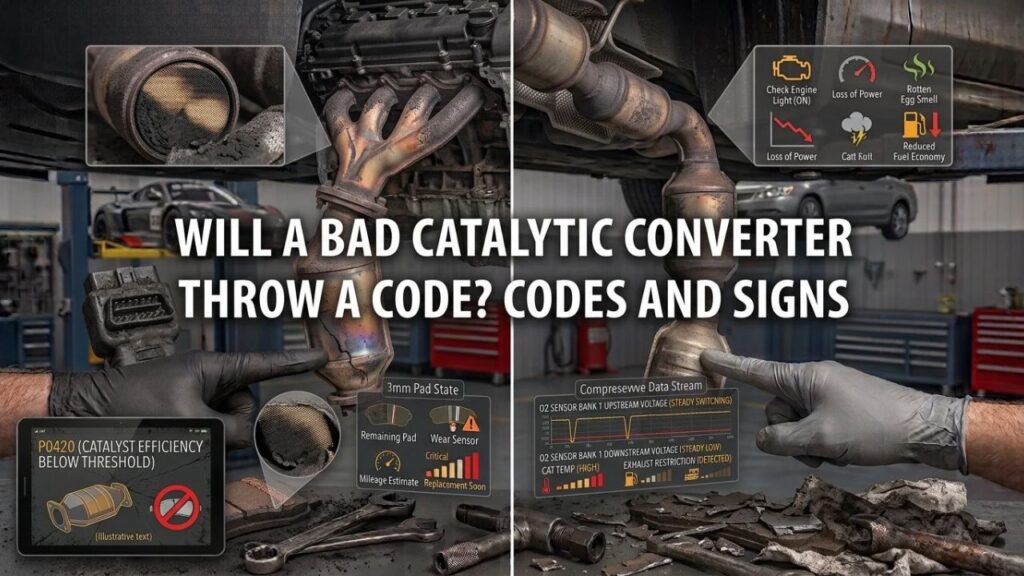
P0420 — Catalyst Efficiency Below Threshold, Bank 1
P0420 is the code most closely associated with catalytic-converter trouble.
It means the engine computer has determined that the catalyst on Bank 1 is not meeting the expected conversion-efficiency threshold. On an inline four-cylinder engine with one exhaust bank, Bank 1 is generally the only bank involved.
The computer commonly evaluates signals from oxygen sensors placed before and after the converter. The upstream sensor responds to changes in exhaust oxygen created by engine operation, while a properly working catalyst changes the pattern seen by the downstream sensor.
When downstream activity begins resembling upstream activity closely enough under the required test conditions, the computer may determine that the converter’s oxygen-storage and emissions-conversion behavior has dropped below the calibrated threshold.
P0420 does not translate directly to “replace catalytic converter.”
Possible causes include:
- A degraded catalytic converter
- A damaged upstream or downstream oxygen sensor
- An exhaust leak
- A rich or lean fuel mixture
- Persistent engine misfires
- Oil or coolant contamination
- Wiring faults affecting an oxygen sensor
A converter may be the failed component, but those other causes need to be checked before replacement.
P0430 — Catalyst Efficiency Below Threshold, Bank 2
P0430 represents the Bank 2 version of the same catalyst-efficiency fault.
Bank 2 is found on engines with separate cylinder banks and exhaust-monitoring paths, such as many V6 and V8 engines. The exact bank location depends on which side contains cylinder number one.
P0430 can result from an aging or contaminated converter, oxygen-sensor trouble, exhaust leakage, misfires, or incorrect fuel control on that bank.
If P0420 and P0430 appear together, diagnosis should extend beyond assuming that two converters failed at exactly the same time. A shared engine condition that affects both banks may be contributing to the catalyst readings.
Other Codes May Point to the Cause
A converter may be damaged by another engine problem long before P0420 or P0430 appears.
Related codes may include:
- P0300–P0308: Engine misfire codes
- P0171/P0174: Lean-mixture codes
- P0172/P0175: Rich-mixture codes
- Oxygen-sensor circuit or heater codes
- Fuel-system codes
- Manufacturer-specific catalyst or emissions codes
A severe misfire can send unburned fuel into the converter. That fuel can burn inside the catalyst and create extreme heat, damaging or melting its internal substrate.
If a misfire or fuel-control problem exists, repairing the converter without correcting that cause can damage the replacement part.
Key Takeaway: P0420 and P0430 are the main catalyst-efficiency codes, but related misfire, fuel, exhaust, and oxygen-sensor faults should be diagnosed before the converter is condemned.
Will a Bad Catalytic Converter Throw a Code Every Time?
No. A damaged catalytic converter can exist without an active check engine light or stored catalyst-efficiency code.
The reason is that the OBD system does not directly inspect every part of the converter. It uses sensors and programmed tests to judge emissions-system behavior.
Several situations can leave you with a converter problem and no P0420 or P0430.
The Catalyst Monitor Has Not Run Yet
OBD-II monitors do not all run continuously.
The catalyst monitor generally needs specific operating conditions before it completes its test. Engine temperature, vehicle speed, load, fuel level, previous faults, and drive-cycle conditions can affect monitor operation.
If the battery was disconnected or codes were recently cleared, the catalyst monitor may show Not Ready.
A scan tool can display readiness status.
A vehicle with a Not Ready catalyst monitor has not yet completed the required self-test, so the absence of P0420 or P0430 at that moment is weak evidence that the converter is healthy.
EPA inspection guidance specifically recognizes catalyst-monitor readiness as part of OBD testing on 1996-and-newer vehicles.
The Converter Is Partially Restricted
A catalytic converter can develop an internal restriction if its substrate melts, breaks, collapses, or becomes obstructed.
The driver may notice:
- Weak acceleration
- Loss of power at higher RPM
- Difficulty climbing hills
- Engine struggling under load
- Excessive exhaust heat
- Poor top-end performance
A catalyst-efficiency monitor is not the same as a direct exhaust-backpressure test.
A restriction may therefore create driveability symptoms without immediately setting P0420 or P0430.
The Failure Has Not Crossed the Computer’s Threshold
Catalysts normally lose some conversion capacity gradually.
The computer does not set a code at the first measurable sign of aging. The monitored result has to reach the programmed failure threshold under suitable test conditions.
A converter can therefore be degraded without yet crossing that threshold.
The OBD System or Sensors Cannot Detect the Fault Correctly
A diagnostic system can have faults of its own.
EPA documented a case involving certain Chrysler vehicles where catalytic converters could deteriorate while defective OBD operation failed to illuminate the check engine light as intended.
That is not a reason to distrust OBD-II generally. It simply shows that a warning system is not proof against every possible converter problem.
Key Takeaway: A bad converter may set no code if the catalyst monitor has not run, the failure is mainly a restriction, deterioration has not crossed the calibrated threshold, or another monitoring fault interferes with detection.
Can P0420 or P0430 Mean Something Other Than a Bad Converter?
Yes.
A catalyst-efficiency code tells you that the computer sees a catalyst-monitor result outside its expected range. It does not identify the failed part with complete certainty.
Bad Oxygen Sensor
The computer depends on oxygen-sensor data to judge catalyst operation.
A slow, biased, contaminated, or electrically faulty sensor can provide misleading information.
Replacing an oxygen sensor simply because P0420 appears is also poor diagnosis. The sensor needs to be tested.
Exhaust Leak
An exhaust leak near the converter or oxygen sensors can introduce outside air and alter sensor readings.
Small leaks may be difficult to hear.
Inspect flanges, manifold connections, flex sections, welds, sensor threads, and damaged exhaust pipes as appropriate for the vehicle.
Misfire
A persistent misfire can damage the converter and may also interfere with catalyst-monitor results.
Misfire codes deserve attention before installing a new converter.
A flashing check engine light commonly indicates a severe misfire condition that can damage the catalyst. Reduce driving and diagnose the engine fault.
Rich Fuel Mixture
Too much fuel raises hydrocarbon levels entering the exhaust and can overheat the converter.
Possible causes include injector problems, fuel-pressure faults, airflow measurement errors, sensor faults, or other fuel-control problems.
Oil or Coolant Entering the Exhaust
An engine that burns oil can contaminate the catalyst.
Coolant entering the cylinders from an internal engine fault can also damage catalyst material.
A new converter will not repair those engine conditions.
If the source remains, the replacement converter can fail again.
Key Takeaway: P0420 or P0430 can involve the converter, oxygen sensors, exhaust leaks, misfires, mixture faults, or engine contamination, so testing should come before parts replacement.
Symptoms of a Bad Catalytic Converter With a Code
Check Engine Light
A steady check engine light may be the only symptom of reduced catalyst efficiency.
This is common with P0420 or P0430 because a converter can lose emissions-conversion capacity while the vehicle still appears to drive normally.
An OBD-II scanner is needed to see which code caused the light.
Failed Emissions Inspection
A catalyst code or illuminated malfunction indicator lamp can cause problems during an OBD-based emissions inspection.
Inspection rules vary by state, so local requirements should be checked separately.
Clearing the code immediately before an inspection is not a repair. Doing so resets readiness monitors, which may leave the vehicle showing Not Ready.
Reduced Acceleration
A physically restricted converter can choke exhaust flow.
The engine may feel normal at idle but struggle as RPM and load rise.
Loss of high-speed or uphill power is more suggestive of restriction than a simple catalyst-efficiency code by itself.
Rattling From the Converter
A broken catalyst substrate can create a metallic rattle from under the vehicle.
Noise may change with engine speed or when the exhaust system is cold.
A rattle does not prove that every part of the converter has stopped functioning, but internal breakage deserves inspection.
Sulfur-Like Exhaust Odor
Some converter or fuel-control problems may create an unusual sulfur-like odor.
Odor alone is not enough to diagnose the catalyst. Rich running, fuel quality, engine faults, and other exhaust conditions can alter smell.
Key Takeaway: An efficiency failure may cause little beyond a check engine light, while a restricted or physically damaged converter can produce power loss, rattling, heat, or abnormal exhaust behavior.
Can a Catalytic Converter Be Clogged Without a Code?
Yes.
This is one of the main reasons a check engine light should not be used as the only test for a clogged converter.
The catalyst monitor is primarily assessing emissions-related catalyst behavior. A plugged substrate is a physical exhaust-flow problem.
The two conditions can occur together, but they are not identical.
A heavily restricted converter may eventually contribute to other codes through poor engine operation, yet P0420 is not specifically a “clogged converter” code.
MechanicBase makes the same distinction in its P0430 explanation, stating that an obstructed converter tends to create a different symptom pattern rather than automatically producing that efficiency code.
If restriction is suspected, diagnosis may involve checking exhaust backpressure, comparing pressure at suitable points, performing manufacturer-specified vacuum tests, or using other service procedures appropriate to the vehicle.
Do not drill holes into an exhaust system or remove oxygen sensors on a hot exhaust simply to perform an improvised test.
How the Car Detects Catalytic Converter Efficiency
Upstream Oxygen Sensor
The upstream oxygen or air-fuel-ratio sensor sits before the catalyst on most modern gasoline systems.
Its signal helps the engine computer manage fuel delivery and tells the diagnostic system what the exhaust looks like before treatment.
Catalytic Converter
Inside the converter, catalyst-coated material promotes chemical reactions that reduce harmful exhaust pollutants.
The converter also stores and releases oxygen as operating conditions change.
Downstream Oxygen Sensor
A downstream sensor sits after the converter.
The computer compares sensor behavior before and after the catalyst.
A healthy converter changes the exhaust pattern enough that the downstream signal should not simply duplicate the upstream signal.
If the programmed test determines catalyst performance has fallen below the required threshold, P0420 or P0430 may be stored.
EPA documentation confirms that federal OBD requirements include monitoring of catalyst and oxygen-sensor systems on covered vehicles.
Key Takeaway: OBD-II judges catalyst performance indirectly through programmed tests and sensor data, which explains why a trouble code identifies a monitored condition rather than proving one failed component.
How to Diagnose a Suspected Bad Catalytic Converter
1. Scan Every Stored and Pending Code
Start with an OBD-II scanner.
Do not read only P0420 or P0430 and stop.
Look for:
- Misfire codes
- Fuel-trim codes
- Oxygen-sensor codes
- Temperature-related codes
- Manufacturer-specific emissions faults
Pending codes are useful because a monitor may detect a fault before the conditions needed to command the check engine light have been met.
2. Check Readiness Monitors
Find the catalyst-monitor status.
If it reads Not Ready after codes were cleared or the battery was disconnected, the vehicle may need the manufacturer’s drive-cycle conditions before the monitor completes.
Do not interpret an empty code list during this period as a confirmed repair.
3. Check for Exhaust Leaks
Inspect for leakage before and near the oxygen sensors.
Look for soot marks, damaged gaskets, cracked components, loose connections, and failed flex sections.
Repair relevant leaks before judging catalyst efficiency from sensor data.
4. Check Engine Operation
A converter is downstream of the engine, so upstream faults matter.
Check:
- Misfire counts
- Short- and long-term fuel trims
- Oil consumption
- Coolant loss
- Injector operation
- Air and fuel measurement faults
Correct faults that could damage the catalyst before fitting a replacement converter.
5. Examine Oxygen-Sensor Data
A scan tool with live data can display upstream and downstream oxygen-sensor behavior.
Interpretation varies because newer vehicles may use wideband air-fuel-ratio sensors rather than conventional narrowband sensors.
Use service information for the exact vehicle rather than expecting every sensor graph to look identical.
6. Test for Exhaust Restriction if Power Is Low
A car with major power loss but no catalyst code may need a restriction test.
Backpressure testing can reveal an exhaust blockage that oxygen-sensor comparison alone may not identify.
The exact pressure limits and test locations depend on the vehicle, so factory service specifications should guide the test.
Key Takeaway: Scan all codes, confirm monitor readiness, inspect for leaks, correct engine faults, evaluate sensor data, and test exhaust restriction before replacing the converter.
Should You Replace the Catalytic Converter for a P0420 Code?
Not until diagnosis supports replacement.
P0420 is strongly associated with catalyst deterioration, but replacing an expensive converter without checking the engine and sensor system can waste money.
A sensible diagnostic order is:
- Read all codes and freeze-frame data.
- Check for misfires and mixture faults.
- Inspect the exhaust for leaks.
- Confirm oxygen-sensor operation.
- Evaluate catalyst-monitor data.
- Test for restriction if driveability symptoms point to blockage.
- Replace the converter if the evidence confirms failure.
If the converter was damaged by rich operation, repeated misfires, oil consumption, or coolant contamination, correct that fault first.
Check Federal Warranty Coverage Before Paying
In the United States, the EPA states that catalytic converters are among the specified major emission-control components covered by the federal emissions warranty for 8 years or 80,000 miles, whichever occurs first, subject to the applicable warranty conditions.
Before approving an expensive converter replacement on a qualifying vehicle, check the warranty booklet and speak with an authorized dealer.
State warranty rules may provide separate protection in some cases.
Can You Keep Driving With a Catalytic Converter Code?
A steady P0420 or P0430 with normal vehicle operation is different from severe power loss, overheating, or a flashing check engine light.
A catalyst-efficiency code should still be diagnosed rather than ignored.
Stop treating the issue as routine driving if you notice:
- A flashing check engine light
- Severe engine misfire
- Major loss of power
- Excessive heat under the vehicle
- Strong burning smell
- Converter or exhaust glowing
- Engine stalling under load
A flashing check engine light can indicate a misfire severe enough to threaten the converter.
A severely restricted exhaust can also cause worsening driveability.
Conclusion
Will a bad catalytic converter throw a code? Often, yes. P0420 on Bank 1 and P0430 on Bank 2 are the two codes most closely associated with catalyst efficiency falling below the computer’s programmed threshold.
A converter can still fail without either code. Physical restriction, early deterioration, incomplete readiness monitoring, sensor faults, or other diagnostic conditions can leave a damaged converter without an immediate warning light. That is why a no-code condition does not rule out exhaust restriction.
I recommend treating a catalyst code as the beginning of diagnosis rather than an automatic parts order. Check related engine codes, exhaust leaks, oxygen-sensor behavior, fuel control, monitor status, and exhaust restriction before deciding that the converter itself is the failed component.
FAQs About Catalytic Converter Codes
What Code Does a Bad Catalytic Converter Usually Throw?
The most common codes are P0420, Catalyst System Efficiency Below Threshold on Bank 1, and P0430, the equivalent fault for Bank 2. Other codes may appear if misfires, oxygen sensors, fuel control, or another engine problem contributed to converter damage.
Can a Bad Catalytic Converter Cause No Check Engine Light?
Yes. A converter may be restricted, physically damaged, or partly degraded before the OBD system turns on the check engine light. A catalyst monitor that has not completed its self-test can also leave the vehicle without an active catalyst code.
Can a Clogged Catalytic Converter Throw P0420?
It can appear alongside P0420, but P0420 specifically represents catalyst efficiency below threshold rather than exhaust restriction. A clogged converter may cause weak acceleration and high backpressure without setting P0420. Restriction should be tested separately when the symptoms fit.
Does P0420 Always Mean the Catalytic Converter Is Bad?
No. A degraded converter is a common cause, but oxygen-sensor faults, exhaust leaks, misfires, incorrect fuel mixture, oil consumption, and other problems can contribute to the same monitored condition. Diagnosis should confirm the cause before the converter is replaced.
Can a Bad O2 Sensor Cause a Catalytic Converter Code?
Yes. The computer relies on oxygen-sensor information when evaluating the catalyst. A faulty sensor, wiring problem, or misleading sensor signal can contribute to P0420 or P0430. Test the sensor rather than replacing it solely because a catalyst code is present.
Will a Bad Catalytic Converter Cause a Misfire Code?
A converter fault does not normally create a misfire code directly, but severe exhaust restriction can interfere with engine breathing and operation. More often, the relationship runs the other direction: repeated engine misfires send unburned fuel into the converter and can overheat or damage it.
Can You Have P0420 Without Any Driving Symptoms?
Yes. Reduced catalyst conversion efficiency may turn on the check engine light while the vehicle still starts, idles, accelerates, and drives normally. The primary problem at that stage may be increased emissions rather than an obvious driveability change.
Will Disconnecting the Battery Clear a Catalytic Converter Code?
Disconnecting power may clear diagnostic information on some vehicles, but it does not repair the fault. It can also reset readiness monitors. If the underlying condition remains, the code can return after the catalyst monitor runs again under the required driving conditions.