Is the Catalytic Converter Part of the Exhaust System? Explained
Yes. A catalytic converter is a component of a vehicle’s exhaust system. Exhaust gases flow from the engine through the exhaust manifold and piping, pass through the converter for emissions treatment, then continue toward the resonator, muffler, and tailpipe. Its exact location changes with vehicle and engine design.
This placement is necessary because the converter must process exhaust gases before they leave the vehicle. Unlike a muffler, which mainly reduces exhaust noise, the converter changes harmful exhaust compounds through chemical reactions inside its catalyst-coated honeycomb.
The converter also interacts closely with the engine-management system. Modern vehicles commonly have oxygen sensors positioned before and after the converter. Sensor data helps the powertrain control module manage the air-fuel mixture and monitor catalyst operation.
The U.S. Environmental Protection Agency states that catalytic converters have been installed on most 1975 and newer passenger cars and light-duty trucks to reduce exhaust emissions. EPA material also identifies the converter as an integral emissions component installed directly in the exhaust-gas path.
For the question is the catalytic converter part of the exhaust system, the answer is clearly yes, but it also belongs to the vehicle’s emissions-control system. Those descriptions are not contradictory. Physically, it sits in the exhaust assembly; functionally, it is one of the main emissions-treatment devices.
One detail worth remembering is that modern cars do not always have one obvious converter underneath the middle of the floor. Some converters are mounted very close to the engine or built into the exhaust manifold, and V6 or V8 layouts may use more than one.
The sections below explain the converter’s position in the exhaust path, its relationship with the manifold, oxygen sensors, muffler, and tailpipe, how it treats exhaust gases, and what changes when the converter fails or becomes clogged.
Is the Catalytic Converter Part of the Exhaust System?
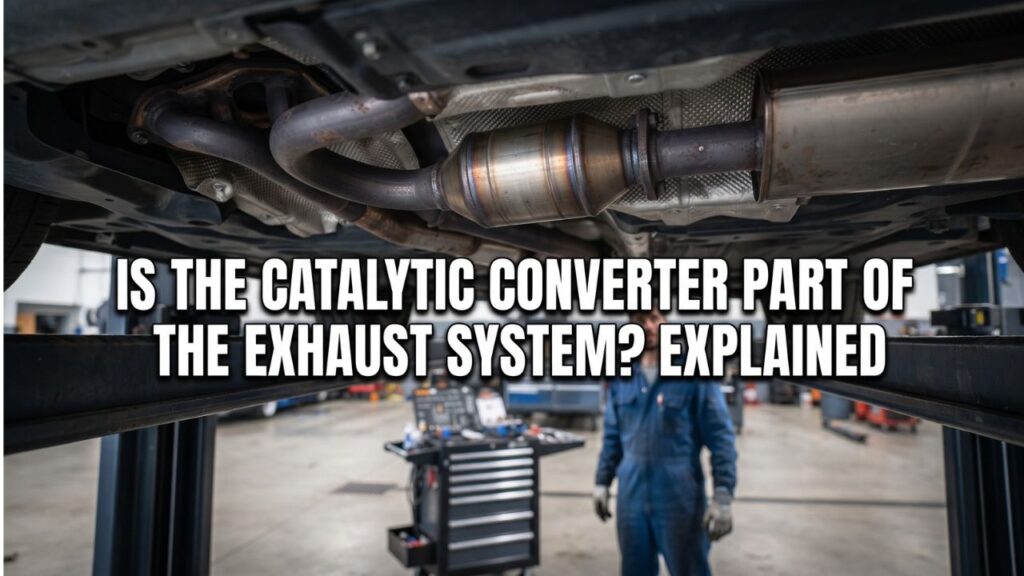
Yes. The catalytic converter sits directly in the path traveled by exhaust gas and forms a physical section of the exhaust assembly.
Walker lists the catalytic converter alongside the exhaust manifold, flex pipe, oxygen sensors, resonator, pipes, muffler, gaskets, and clamps as components associated with a vehicle’s exhaust system.
It Sits Directly in the Exhaust Flow
Combustion gases leave each engine cylinder and enter the exhaust manifold.
From there, they normally travel through a front pipe, downpipe, or manifold outlet toward the converter. The gases must pass through the catalyst material before traveling farther toward the rear exhaust components.
A simplified gasoline-vehicle exhaust path looks like this:
Engine → Exhaust manifold → Catalytic converter → Resonator → Muffler → Tailpipe
The exact order can vary because some vehicles place sensors, flex sections, turbochargers, secondary converters, or other emissions hardware at different points.
It Is Physically Connected to Exhaust Pipes
The converter is normally attached to exhaust tubing by:
- Bolted flanges
- Welded joints
- Clamps
- Gaskets
- Integrated manifold connections
Some replacements include long sections of pipe as one assembly. Others consist mainly of the converter body and are welded into the existing exhaust.
This direct physical connection is another reason the converter is considered an exhaust-system component rather than a separate device mounted somewhere else on the car.
It Also Belongs to the Emissions-Control System
The converter has two identities from a system standpoint.
It is physically part of the exhaust because exhaust gas flows through it.
It is also part of the emissions-control system because its main job is to reduce pollutants rather than simply route or quiet exhaust gases.
EPA material describes original-equipment catalytic converters as integral components of a vehicle’s emissions and engine systems.
Key Takeaway: The catalytic converter is physically part of the exhaust system and functionally part of the emissions-control system.
Where Is the Catalytic Converter in the Exhaust System?
Most catalytic converters are positioned between the engine’s exhaust manifold and the muffler.
The exact location depends heavily on vehicle design.
Close-Coupled Converter Near the Engine
Many modern gasoline vehicles place a converter very close to the exhaust manifold.
Some are bolted directly to the manifold. Others are built into the manifold assembly itself.
This close position lets hot exhaust gases reach the catalyst quickly after the engine starts.
Catalysts need heat to begin processing pollutants. Putting the converter closer to the engine reduces the time needed for it to reach its working temperature after a cold start.
Underfloor Catalytic Converter
Some vehicles use a larger converter farther down the exhaust pipe underneath the floor.
It may look like an enlarged metal section in the exhaust, often surrounded by a heat shield.
EPA vehicle-emissions material traditionally describes the converter as positioned ahead of the muffler and relatively close to the exhaust manifold.
Many newer vehicles combine a close-coupled converter with another catalyst farther downstream.
Vehicles Can Have Multiple Converters
Not every vehicle uses one catalytic converter.
Possible layouts include:
- One main converter on an inline four-cylinder engine
- One converter for each cylinder bank on a V6 or V8
- Close-coupled converters plus downstream converters
- Several catalyst units in complex emissions systems
A dual-exhaust vehicle may have separate converters serving each bank of cylinders.
The number should be confirmed from the vehicle’s exhaust layout rather than guessed from engine size alone.
Key Takeaway: The converter normally sits between the exhaust manifold and muffler, but modern designs may place one or several converters close to the engine and farther underneath the vehicle.
What Parts Make Up the Exhaust System?
The catalytic converter works as part of a chain of components.
Each section handles a different part of gas routing, emissions treatment, noise control, or system movement.
Exhaust Manifold
The exhaust manifold attaches to the cylinder head and collects exhaust gas leaving the cylinders.
Separate exhaust ports feed into the manifold before the gases are directed toward a common outlet.
Some engines use tubular headers instead of a traditional cast manifold.
On newer vehicles, the catalytic converter may be integrated into this assembly.
Flex Pipe
A flex section lets part of the exhaust system move slightly as the engine rocks on its mounts.
Without some flexibility, repeated engine movement could place stress on pipes, welds, flanges, or the converter.
Not every exhaust uses the same flex-pipe arrangement.
Catalytic Converter
The converter treats pollutants in the exhaust gases.
Inside is typically a ceramic or metallic substrate containing many small passages. The substrate is coated with catalyst materials that promote chemical reactions as hot gases flow through.
Walker identifies platinum, palladium, and rhodium among the precious metals commonly used in converter catalyst coatings.
Oxygen Sensors
Modern gasoline vehicles commonly use oxygen or air-fuel-ratio sensors around the converter.
An upstream sensor measures exhaust conditions before the converter.
A downstream sensor measures exhaust after the catalyst and helps the vehicle monitor converter operation.
The exact number of sensors varies with engine configuration and emissions system.
Resonator
A resonator targets certain sound frequencies in the exhaust.
Some vehicles do not use one. Others may have one or several resonating chambers incorporated into the piping or muffler assembly.
Its main purpose is sound control rather than emissions conversion.
Muffler
The muffler reduces engine exhaust noise.
It uses chambers, tubes, perforations, packing material, or combinations of those designs to reduce sound energy.
A muffler and catalytic converter can look similar from underneath the vehicle, but their jobs are very different.
Tailpipe
The tailpipe is the final exhaust section.
It directs treated exhaust gases away from the vehicle and releases them into the atmosphere behind or near the rear of the vehicle.
Key Takeaway: A typical exhaust system includes the manifold, connecting pipes, catalytic converter, oxygen sensors, resonator, muffler, and tailpipe, along with mounting and sealing hardware.
What Does the Catalytic Converter Do?
The catalytic converter reduces harmful compounds before exhaust gases leave the tailpipe.
It does this through chemical reactions rather than by simply trapping pollutants like a conventional filter.
It Treats Carbon Monoxide
Carbon monoxide (CO) is produced during combustion and is poisonous to humans.
The catalyst promotes oxidation that converts carbon monoxide into carbon dioxide.
This is one reason exhaust leaks ahead of or around the converter should not be ignored.
It Treats Unburned Hydrocarbons
Hydrocarbons are fuel compounds that pass through the engine without being fully burned.
The converter promotes reactions that turn much of this material into carbon dioxide and water vapor.
An engine that sends excessive unburned fuel into the converter can overheat and damage it.
It Reduces Nitrogen Oxides
Modern three-way catalytic converters also reduce nitrogen oxides (NOx).
These compounds form during high-temperature combustion and contribute to air pollution.
The converter promotes reactions that break them down into less harmful gases, including nitrogen.
It Needs Hot Exhaust Gas
Catalyst reactions need heat.
That is why modern converters are often mounted relatively close to the engine.
A close-coupled converter heats much faster after startup than one positioned several feet farther downstream.
This placement also explains why converters and their heat shields can become extremely hot during normal operation.
Key Takeaway: The converter chemically treats carbon monoxide, hydrocarbons, and nitrogen oxides as exhaust gases pass through its catalyst-coated internal structure.
Is the Catalytic Converter the Same as the Muffler?
No. The catalytic converter and muffler are separate exhaust-system components with different jobs.
They may both look like enlarged metal chambers along the exhaust pipe, which creates some confusion.
| Feature | Catalytic Converter | Muffler |
| Main job | Reduce exhaust pollutants | Reduce exhaust noise |
| Typical location | Closer to engine | Farther toward rear |
| Internal design | Catalyst-coated substrate | Chambers, tubes, or sound-absorbing material |
| Connected to O2 sensors | Commonly | Usually no |
| Emissions function | Yes | Primarily no |
| Failure can trigger catalyst codes | Yes | No catalyst-efficiency code |
The catalytic converter normally sits upstream of the muffler, meaning exhaust reaches the converter first.
A muffler problem may make the car louder.
A converter problem may trigger an emissions code, create excessive heat, or restrict exhaust flow if its internal passages become damaged.
How Oxygen Sensors Work With the Catalytic Converter
Oxygen sensors are closely tied to converter operation, even though they are separate components.
Modern OBD-II vehicles commonly have sensors before and after the catalyst.
Upstream Oxygen Sensor
The upstream sensor is positioned before the converter.
Its readings help the engine computer manage the air-fuel mixture.
If the mixture becomes too rich or too lean, the powertrain control module can adjust fuel delivery within its control range.
Downstream Oxygen Sensor
The downstream sensor sits after the converter.
Its signal helps monitor catalyst performance.
The engine computer compares sensor behavior before and after the converter. If the downstream readings suggest the catalyst is no longer treating exhaust as expected, a catalyst-related trouble code may be stored.
Sensor Codes Do Not Always Mean the Converter Is Bad
A P0420 or P0430 code is commonly associated with low catalyst-system performance.
That does not automatically prove the converter needs replacement.
Exhaust leaks, engine misfires, fuel-control faults, sensor problems, and other conditions can affect the readings used to evaluate catalyst operation.
I’d diagnose those related systems before approving an expensive converter replacement solely from one trouble code.
Key Takeaway: Upstream sensors support fuel control, while downstream sensors help monitor converter operation; sensor data does not automatically prove the converter itself has failed.
How Is the Catalytic Converter Different From Other Exhaust Parts?
The converter is unusual because it sits in the exhaust pipe while performing an emissions-treatment task.
Most other exhaust components primarily route gases, control movement, seal joints, or reduce noise.
The exhaust manifold gathers gases.
Pipes carry them.
The converter treats pollutants.
The resonator and muffler control sound.
The tailpipe releases the treated gases away from the vehicle.
Thinking of the system in that order makes the converter’s role much easier to visualize.
What Happens to the Exhaust System When the Converter Fails?
Converter failure can affect the exhaust system in several ways.
The symptoms depend on the type of failure.
A Worn Catalyst May Mainly Affect Emissions
A converter can lose chemical activity without becoming physically blocked.
In this case, the engine may still run normally while the check-engine light comes on and catalyst-efficiency codes appear.
The vehicle may also fail an emissions inspection.
A Clogged Converter Restricts Exhaust Flow
If the internal honeycomb melts, collapses, or becomes badly blocked, exhaust flow is restricted.
Backpressure rises ahead of the converter.
Possible symptoms include:
- Weak acceleration
- Limited high-RPM power
- Hard starting
- Poor fuel economy
- Excessive exhaust heat
- Stalling
The engine can feel as though it cannot breathe because burned gases are having trouble leaving.
A Broken Converter May Rattle
The ceramic substrate can crack after overheating, impact, or severe internal damage.
Broken pieces may move around inside the converter shell and produce a rattle.
Loose pieces may also shift into a position that partially blocks exhaust flow.
Key Takeaway: A converter can fail chemically without restricting exhaust, or fail physically and create backpressure, heat, rattling, and major drivability problems.
Can the Exhaust System Work Without a Catalytic Converter?
Exhaust gas can physically travel through a pipe without a converter, but removing the converter is not a proper road-vehicle repair.
The converter is part of the vehicle’s certified emissions-control configuration.
EPA regulations prohibit removing or disabling required emissions-control devices on vehicles subject to federal emissions requirements.
Removal can also cause:
- Check-engine lights
- Catalyst-efficiency codes
- Increased harmful emissions
- Failed emissions testing
- Changes in exhaust odor
- Possible noise changes
- Legal problems with vehicle emissions compliance
If a converter is clogged or damaged, the correct repair is to identify what caused the failure and install a compliant replacement when needed.
Is the Catalytic Converter Part of the Engine?
Not in the usual mechanical classification.
The catalytic converter handles gases produced by the engine, but it sits downstream in the exhaust and emissions system.
Some modern converters are mounted so close to the engine that they appear to be part of it.
A converter can even be integrated into an exhaust-manifold assembly, which physically places it against the engine.
Its role still remains exhaust after-treatment rather than internal engine operation.
Conclusion
The answer to is the catalytic converter part of the exhaust system is yes. Exhaust gas passes directly through it after leaving the engine, and the converter normally sits between the exhaust manifold and downstream components such as the resonator, muffler, and tailpipe.
Its main purpose separates it from ordinary exhaust piping. The converter uses catalyst-coated material to reduce harmful exhaust compounds, while other parts mainly route gases or reduce sound. Oxygen sensors positioned around the converter also connect its operation with the vehicle’s engine-management and emissions-monitoring systems.
Modern layouts can place the converter underneath the vehicle, directly beside the engine, inside the manifold assembly, or in several positions when a vehicle uses multiple converters. That variation does not change its basic place in the exhaust-gas path.
I’d think of the exhaust system as one continuous route: the manifold collects the gases, the converter treats them, the muffler quiets them, and the tailpipe releases them. That simple layout explains why the catalytic converter belongs to both the exhaust and emissions-control systems.
FAQs About Catalytic Converters and the Exhaust System
Where Is the Catalytic Converter Located in the Exhaust System?
It is normally located between the engine’s exhaust manifold and the muffler. Many modern vehicles place it very close to the engine so it heats quickly after startup. Some vehicles also use a second converter farther underneath the floor.
Does Exhaust Go Through the Catalytic Converter?
Yes. Exhaust gases must pass through the converter’s internal catalyst-coated substrate. Chemical reactions inside the converter reduce carbon monoxide, hydrocarbons, and nitrogen oxides before the gases continue toward the muffler and tailpipe.
Is the Catalytic Converter Before or After the Muffler?
The catalytic converter is normally before the muffler in the direction of exhaust flow. The engine produces the exhaust, the converter treats pollutants, and the muffler reduces sound before gases leave through the tailpipe.
Is the Catalytic Converter Connected to the Exhaust Manifold?
It can be. Some converters connect to the manifold through a short pipe, while close-coupled converters may bolt directly to it. Certain vehicles combine the converter and exhaust manifold into one assembly.
Is the Catalytic Converter Part of the Emissions System Too?
Yes. It is physically a component of the exhaust system and functionally a major emissions-control device. Its job is to chemically convert several harmful exhaust pollutants into less harmful compounds before they leave the vehicle.
Are Oxygen Sensors Part of the Catalytic Converter?
No. Oxygen sensors are separate components, though they work closely with the converter. OBD-II vehicles commonly have sensors before and after the catalyst to provide fuel-control information and monitor converter operation.
Is the Muffler Part of the Catalytic Converter?
No. The muffler and catalytic converter are separate parts. The converter treats exhaust pollutants, while the muffler reduces exhaust noise. Both sit along the same exhaust-gas path.
Can a Car Have More Than One Catalytic Converter?
Yes. Some V6 and V8 engines use separate converters for each cylinder bank. Other vehicles may use close-coupled converters near the engine plus additional converters farther downstream, so the exact number varies by engine and emissions design.