What Causes a Catalytic Converter to Clog? Main Causes and Fixes
A catalytic converter usually becomes clogged after another engine or exhaust problem overheats, contaminates, melts, or breaks its internal honeycomb. Engine misfires, an overly rich fuel mixture, burning oil, internal coolant leaks, and severe heat are among the main causes. Once the internal passages become badly restricted, exhaust flow and engine power can drop sharply.
A converter rarely plugs up for no reason. If the original engine fault remains, replacing the converter alone can lead to another failure.
That makes finding the root cause just as important as confirming the restriction. Correcting a misfire, fuel-control fault, oil-burning problem, or coolant leak before installing another converter can prevent the replacement from suffering the same damage.
For U.S. owners, there is also a useful warranty point. The EPA identifies catalytic converters as specified major emissions components covered under applicable federal emissions warranties for 8 years or 80,000 miles, whichever occurs first. Coverage conditions apply, so checking the vehicle’s warranty booklet can be worthwhile before paying for replacement.
For what causes a catalytic converter to clog, it helps to separate three types of failure: a substrate that melts and blocks exhaust flow, a substrate coated by oil, coolant, or carbon deposits, and a physically broken substrate that shifts inside the housing. All three can reduce exhaust flow, but they begin for different reasons.
A P0420 or P0430 code also does not automatically mean the converter is clogged. Those codes relate to catalyst operating efficiency. A converter can lose emissions-cleaning ability while still allowing exhaust to pass through normally.
The sections below explain the most common causes of blockage, the symptoms that suggest real exhaust restriction, diagnostic tests, what may save the converter, and which underlying faults should be repaired before a new one is installed.
What Causes a Catalytic Converter to Clog?
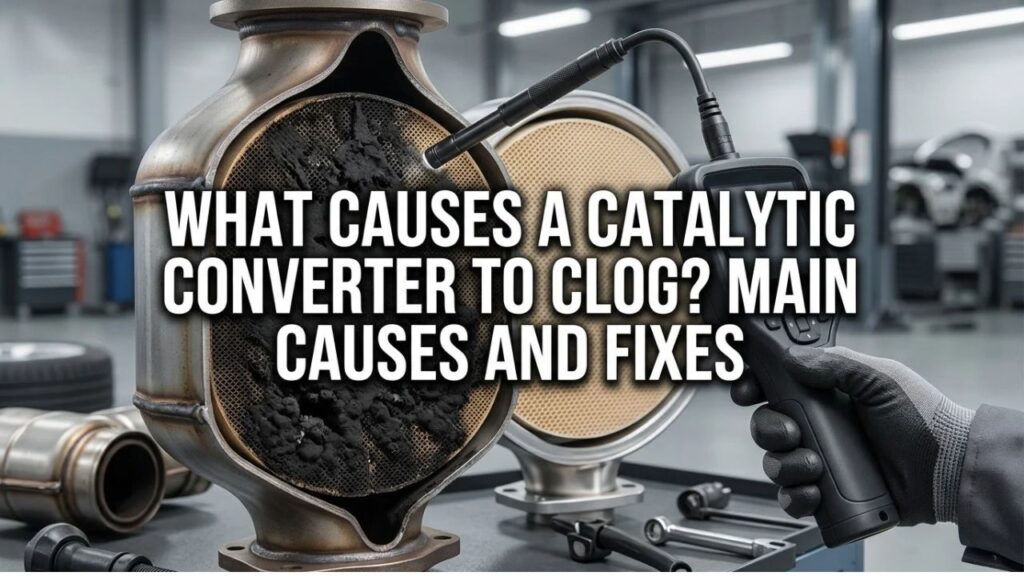
Most clogged converters trace back to excess heat, contamination, or physical damage. The converter itself is often the victim rather than the original fault.
Engine Misfires
A misfire occurs when one or more cylinders fail to burn their air-fuel charge correctly.
Some of the unburned fuel and oxygen can enter the exhaust. When that mixture reaches the hot converter, it may burn inside the catalyst instead of inside the cylinder.
That extra combustion can raise converter temperature enough to damage or melt the ceramic substrate. Walker lists engine misfire as a major cause of converter thermal meltdown and explains that the melted substrate can turn into a solid mass that restricts exhaust flow.
Common misfire causes include:
- Worn or fouled spark plugs
- Weak ignition coils
- Damaged ignition wires on equipped vehicles
- Faulty injectors
- Low compression
- Valve problems
- Incorrect engine timing
A flashing Check Engine Light paired with rough running should be addressed quickly because prolonged misfire can ruin a converter that was previously healthy.
Rich Air-Fuel Mixture
An engine running rich receives more fuel than it can burn properly.
Excess fuel can pass into the exhaust and burn inside the catalytic converter, raising temperature and leaving carbon deposits behind.
Possible reasons for a rich mixture include:
- Leaking fuel injectors
- Excessive fuel pressure
- Faulty oxygen or air-fuel sensors
- Incorrect MAF or MAP sensor readings
- Engine-temperature sensor faults
- Restricted air intake
- Fuel-control problems
Walker notes that rich operation can both overheat the converter and contribute to carbon deposits that coat the substrate.
Burning Engine Oil
Oil entering the combustion chambers can travel into the exhaust after it burns.
Common sources include worn piston rings, worn cylinder walls, damaged valve-stem seals, or some crankcase ventilation faults.
Oil residue can coat the small passages and catalyst surfaces inside the converter. Over time, deposits may reduce both exhaust flow and the catalyst’s ability to contact exhaust gases.
Blue or gray exhaust smoke, frequent oil top-offs, oily spark plugs, and declining oil level can point toward an oil-consumption problem.
Replacing the converter without addressing heavy oil consumption can contaminate the new unit.
Internal Coolant Leaks
Coolant should never enter the combustion chamber or exhaust system.
A failed head gasket, cracked cylinder head, intake-gasket fault on certain engines, or another internal cooling-system leak can allow coolant into a cylinder.
Coolant contamination can coat or chemically damage the catalyst surface. Walker specifically lists internal coolant leaks among causes of converter poisoning.
Possible clues include:
- Unexplained coolant loss
- Persistent white exhaust smoke after warm-up
- Sweet exhaust odor
- Coolant-contaminated spark plugs
- Cooling-system pressure problems
- Engine overheating
Excessive Converter Temperature
A catalytic converter operates at high temperature by design, but excessive heat can destroy the honeycomb.
Walker notes that catalyst temperatures above about 1,600°F may cause damage even when there is no obvious external sign of melting.
High temperature can come from misfires, rich operation, excessive engine load, combustion imbalance, or exhaust-system faults.
Once the substrate melts, passages that were designed to carry exhaust can become partially or completely blocked.
Carbon and Combustion Deposits
Poor combustion can create carbon deposits that accumulate in the exhaust stream.
A converter exposed to long-term rich operation, oil consumption, or poor engine maintenance may develop deposits across the honeycomb passages.
This type of contamination can gradually restrict flow rather than causing the sudden blockage associated with a melted substrate.
Broken or Shifted Internal Substrate
The ceramic honeycomb inside a converter is held in position within the metal housing.
Road impacts, corrosion, thermal stress, age, or internal overheating can crack the substrate.
Broken pieces may shift and partly block the converter outlet. Walker also notes that failure of the support mat can let the brick move inside the housing and restrict exhaust flow.
A rattling sound from the converter is one possible clue.
Debris From an Upstream Converter
Some vehicles use more than one catalytic converter in the same exhaust path.
If an upstream converter breaks apart, fragments can travel downstream and plug another unit.
This is less common than misfire or contamination, but it matters on multi-converter systems. Walker specifically identifies debris from an upstream converter as one possible source of downstream blockage.
Chemical Contamination
Certain materials can poison or coat the catalyst.
Walker lists silicone-based sealants that are not converter-safe, coolant, excessive oil, high-sulfur fuel, improper fuel, and some additives among possible contamination sources.
Use fluids, sealants, and fuel that meet the vehicle maker’s specifications.
Key Takeaway: Misfires, rich operation, oil burning, coolant leaks, overheating, carbon deposits, and physical substrate damage are the main routes to converter blockage.
How Does a Catalytic Converter Become Physically Clogged?
A catalytic converter contains a honeycomb-like substrate with many small exhaust passages.
Those passages provide a large surface area for catalytic material while still allowing exhaust gases to flow through.
Melting Can Close the Passages
When converter temperature becomes excessive, the ceramic structure can deform or melt.
Instead of thousands of open channels, part of the core may become a dense mass.
The engine then has to push exhaust through a much smaller opening.
Deposits Can Coat the Honeycomb
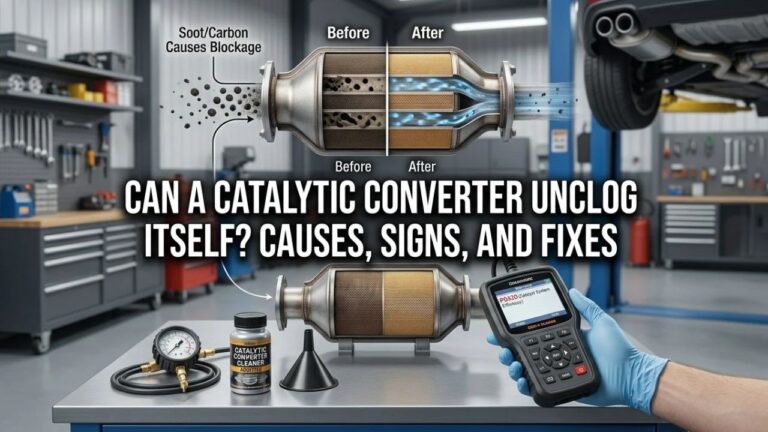
Oil ash, coolant contamination, carbon, and other residues can accumulate on internal surfaces.
Deposits can make the passages narrower and reduce catalyst activity.
This type of deterioration may develop gradually.
Broken Pieces Can Block the Outlet
A fractured substrate can move inside the housing.
Pieces may rotate, collapse, or collect near the outlet.
That can create an intermittent restriction if the material shifts as the vehicle moves.
Key Takeaway: A converter becomes physically clogged when its honeycomb melts, accumulates heavy deposits, or breaks apart and obstructs the exhaust path.
What Are the Signs of a Clogged Catalytic Converter?
A truly blocked converter usually creates drivability symptoms because the engine cannot expel exhaust freely.
Loss of Power During Acceleration
Poor acceleration is one of the stronger signs of exhaust restriction.
The engine may idle reasonably well yet struggle as RPM and exhaust volume increase.
Cars.com and AutoZone both identify sluggish acceleration or loss of power as common symptoms of converter restriction.
Engine Struggles at Higher RPM
A restricted converter may let enough exhaust through for idle but not enough for higher engine speed.
The engine can feel as if it hits an invisible limit as you press the accelerator.
In severe cases, it may not rev beyond a certain range.
Hard Starting or Stalling
A badly blocked exhaust can make an engine difficult to start or keep running.
Some vehicles may start normally when cold, then lose power or stall as exhaust pressure and temperature rise.
Excessive Heat
A restricted or overloaded converter can become extremely hot.
A glowing converter should be treated as a serious warning sign.
Stop driving and diagnose the cause rather than continuing to operate the vehicle.
Rattling From Under the Vehicle
A rattling sound can indicate a cracked substrate moving inside the converter shell.
Rattling alone does not prove blockage, but it raises concern about internal physical damage.
Rotten-Egg or Sulfur Smell
A sulfur-like exhaust odor can occur with converter or fuel-mixture problems.
It is not a reliable stand-alone diagnosis because fuel composition and rich combustion can produce similar smells.
Poor Fuel Economy
A clogged exhaust can make the engine work harder and can interfere with normal engine operation.
Fuel economy may fall, especially when the driver needs more throttle to compensate for reduced power.
Key Takeaway: Strong power loss under load, limited RPM, excessive heat, rattling, stalling, and poor acceleration are stronger clogging clues than a catalyst code by itself.
Does P0420 Mean the Catalytic Converter Is Clogged?
No. P0420 does not specifically mean the converter is physically blocked.
P0420 means catalyst system efficiency below threshold on Bank 1. P0430 describes the same general problem on Bank 2.
A converter can trigger one of these codes while exhaust flow remains normal.
Efficiency Failure and Restriction Are Different
A converter may lose chemical activity as it ages or becomes contaminated.
The engine computer may detect that the downstream oxygen-sensor pattern is too similar to the upstream pattern and set a catalyst-efficiency code.
That condition does not prove that the honeycomb passages are blocked.
Other Faults Can Affect Catalyst Codes
Before replacing a converter, check for:
- Misfire codes
- Exhaust leaks
- Rich or lean fuel trims
- Oxygen-sensor faults
- Injector problems
- Low compression
- Intake leaks
- Oil or coolant consumption
Walker recommends correcting other engine codes and exhaust leaks before condemning the converter.
Key Takeaway: P0420 or P0430 points to catalyst operation, not necessarily physical clogging; restriction should be confirmed with drivability symptoms and testing.
How to Test for a Clogged Catalytic Converter
No single driveway test is perfect. Combining scan data with a restriction test gives a stronger answer.
Scan for Trouble Codes First
Read stored and pending OBD-II codes.
Pay close attention to:
- P0300-series misfire codes
- P0420 or P0430
- Rich or lean mixture codes
- Oxygen-sensor codes
- MAF or MAP codes
- Fuel-system faults
Fixing an active misfire before replacing the converter is especially important.
Check Exhaust Backpressure
A backpressure gauge can be connected at an appropriate test point, often through an oxygen-sensor port with the correct adapter.
Walker gives general reference values of less than 1 psi at idle and less than 3 psi at 2,500 RPM for many applications. Vehicle-specific specifications should take priority.
Pressure that rises abnormally as engine speed increases can point toward an exhaust restriction.
A blocked muffler or crushed exhaust pipe can create similar readings, so the test location matters.
Use a Vacuum Gauge
A manifold-vacuum test can also reveal a restricted exhaust.
Vacuum may start normally, then fall steadily while the engine is held at an elevated RPM.
Valve timing and other mechanical engine problems can affect vacuum readings too, so this test should be interpreted with other findings.
Compare Temperature Carefully
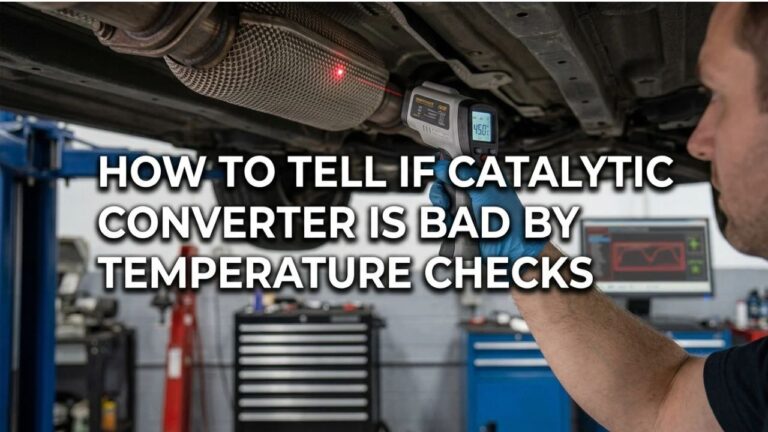
An infrared thermometer can show unusual temperature patterns across the converter.
Temperature is not a stand-alone clog test. Converter temperature changes with engine load, mixture, catalyst activity, and the amount of unburned fuel reaching it.
A very hot converter may point toward an engine problem that is overheating the catalyst rather than simple blockage.
Check for Internal Rattling
With the exhaust fully cooled, internal rattling may suggest a broken substrate.
Do not strike or damage the converter while testing it.
If rattling appears alongside high backpressure and poor acceleration, internal failure becomes much more likely.
Key Takeaway: OBD data, exhaust backpressure, vacuum behavior, temperature patterns, and physical inspection together provide a stronger diagnosis than guessing from one symptom.
Can a Clogged Catalytic Converter Be Cleaned?
It depends on what has caused the restriction.
A melted or collapsed substrate cannot be restored with a fuel additive.
Melted Substrate
Once the ceramic core has melted into a solid mass, replacement is normally required.
No liquid cleaner can rebuild the original honeycomb structure.
Broken Substrate
Broken ceramic pieces also require physical repair or converter replacement.
Cleaning does not put fractured material back into position.
Light Deposit Contamination
Minor deposits associated with an engine-running problem may change after the underlying combustion issue is repaired, but a heavily contaminated converter often remains damaged.
Fuel additives should not be treated as proof that a converter can be saved.
I would diagnose the engine fault first rather than pouring several products into the fuel tank and hoping they clear a genuine restriction.
How to Prevent Another Catalytic Converter From Clogging
A new converter can fail quickly if the original engine problem remains.
Repair Misfires Promptly
Do not continue driving for long periods with a flashing Check Engine Light or obvious misfire.
Inspect ignition, fuel delivery, and compression as needed.
Fix Oil Consumption
If the engine burns enough oil to foul spark plugs or produce regular blue exhaust smoke, determine why before installing another converter.
Worn rings, valve seals, PCV faults, or other engine problems may need attention.
Repair Coolant Leaks
Internal coolant loss can contaminate a replacement catalyst.
A cooling-system pressure test, combustion-gas test, compression test, or leak-down test may be appropriate based on symptoms.
Correct Rich Running
Check fuel trims, sensor data, injector operation, fuel pressure, and air intake.
A rich engine can overheat a new converter just as it overheated the old one.
Use Correct Fluids and Sealants
Use manufacturer-approved oil, coolant, fuel, additives, and gasket materials.
Avoid silicone sealants that are not marked as safe for oxygen sensors and catalytic converters.
Key Takeaway: The best protection for a replacement converter is to repair the misfire, fuel, oil, coolant, or mechanical problem that damaged the previous one.
Can You Drive With a Clogged Catalytic Converter?
A mildly restricted converter may still let the vehicle run, but severe restriction can make the car difficult or unsafe to drive.
Do not continue normal driving if the vehicle has:
- Major loss of acceleration
- Repeated stalling
- A glowing converter
- Smoke from beneath the vehicle
- Severe engine shaking
- A flashing Check Engine Light
- Extreme exhaust heat
- An engine that cannot maintain road speed
A severe blockage can raise exhaust pressure and temperature while reducing available engine power.
That becomes especially problematic when merging, climbing hills, or driving in fast traffic.
If the vehicle can barely accelerate or the converter is glowing, towing is the safer option.
Should You Replace the Converter Before Fixing the Engine?
No, not if another active fault is damaging it.
Walker repeatedly advises finding and repairing the root cause before installing a replacement converter because a new unit can suffer the same overheating or contamination.
A sensible repair order is:
- Read all diagnostic codes.
- Repair active misfires.
- Correct rich or lean fuel-control faults.
- Check for oil or coolant entering the engine.
- Inspect for exhaust leaks and physical damage.
- Test for exhaust restriction.
- Replace the converter if internal failure is confirmed.
- Verify that the repaired engine runs normally afterward.
That approach also prevents an expensive converter from being replaced when the real problem is somewhere else.
Conclusion
The main answer to what causes a catalytic converter to clog is excessive heat, contamination, or internal physical damage. Misfires and rich fuel mixtures can overheat and melt the honeycomb, while burning oil or leaking coolant can coat it with deposits.
A converter can also become restricted after the substrate cracks, shifts, or receives debris from another converter. These failures narrow the exhaust passages and create backpressure that may cause poor acceleration, limited RPM, stalling, and excessive heat.
Do not treat P0420 or P0430 as proof of blockage. Those codes indicate low catalyst efficiency, and the converter may still flow normally. Backpressure testing and a broader engine diagnosis provide a much stronger answer.
I would find the reason the first converter failed before replacing it. Fixing the misfire, rich mixture, oil consumption, coolant leak, or mechanical fault protects the replacement and reduces the chance of paying for the same repair twice.
FAQs About Clogged Catalytic Converters
What Is the Most Common Cause of a Clogged Catalytic Converter?
Engine problems that send excess fuel, oil, coolant, or deposits into the exhaust are among the most common causes.
Misfires and rich fuel mixtures are especially damaging because unburned fuel can burn inside the converter, raise its temperature, and melt the honeycomb into a restriction.
Can a Misfire Clog a Catalytic Converter?
Yes. A severe or prolonged misfire can send unburned fuel and oxygen into the exhaust.
That mixture can burn inside the converter and produce enough heat to damage or melt the substrate. Once melted, the honeycomb passages may become partly or completely blocked.
Can Burning Oil Clog a Catalytic Converter?
Yes. Oil that enters the combustion chambers can leave ash and deposits on the converter substrate.
Worn piston rings, valve seals, or other oil-consumption problems should be repaired before fitting a replacement converter.
Can Coolant Clog a Catalytic Converter?
Yes. Coolant entering the cylinders through an internal engine leak can travel into the exhaust and contaminate the converter.
Persistent coolant loss, white exhaust smoke after warm-up, or a sweet smell may justify checking for a head-gasket or other internal cooling-system problem.
Can a Bad Oxygen Sensor Clog the Catalytic Converter?
Indirectly, it can contribute. An oxygen-sensor fault that causes the engine to run excessively rich may send extra fuel into the converter.
The excess fuel can raise catalyst temperature and create deposits. Sensor data should be tested rather than replacing an oxygen sensor solely because a converter code appears.
Can Carbon Buildup Clog a Catalytic Converter?
Yes. Long-term poor combustion, rich operation, or oil consumption can contribute to carbon and ash deposits inside the converter.
Heavy buildup can reduce the open area of the honeycomb and interfere with exhaust flow.
Can a Catalytic Converter Clog From Old Age?
Age alone does not always create a physical blockage, but repeated heat cycles, contamination, corrosion, and long-term engine problems can weaken or damage the substrate over time.
An older converter may lose catalyst activity without becoming clogged, so restriction should still be tested rather than assumed.
How Do I Know if My Catalytic Converter Is Actually Clogged?
Strong loss of power at higher RPM, sluggish acceleration, excessive converter heat, stalling, rattling, and high measured exhaust backpressure are useful clues.
An OBD catalyst code alone cannot confirm a clog. A backpressure test or other exhaust-restriction testing provides stronger evidence of physical blockage.