Can a Catalytic Converter Unclog Itself? Causes, Signs, and Fixes
A truly clogged catalytic converter usually will not clear itself if the internal honeycomb has melted, collapsed, shifted, or broken apart. A mild restriction caused by deposits may seem to improve after the underlying engine problem is corrected, but physical damage inside the converter requires replacement rather than more driving.
This distinction matters because “clogged” can describe several different conditions. Carbon or oil residue may coat passages, while severe overheating can melt the ceramic substrate into a solid mass. Broken catalyst material can also move inside the housing and block exhaust flow.
A restricted converter raises exhaust backpressure. The engine may then struggle to expel burned gases, causing weak acceleration, limited RPM, hard starting, rough running, increased fuel use, or stalling. A car that feels better after cooling down has not necessarily repaired its converter.
For U.S. vehicle owners, the EPA treats the catalytic converter as a major emissions component covered under the federal emissions warranty for 8 years or 80,000 miles, whichever comes first, on qualifying vehicles. Checking warranty status before paying for an expensive converter replacement can save a substantial repair bill.
The direct answer to can a catalytic converter unclog itself is that a mechanically blocked converter cannot rebuild or straighten its internal structure. Light deposits may change as engine conditions improve, but melted ceramic, broken honeycomb, or a shifted substrate does not repair itself.
I’d treat any temporary improvement as a diagnostic clue rather than proof that the blockage disappeared. Debris can shift, exhaust temperature can change, and a partially blocked converter may restrict flow more under heavy load than at idle.
The sections below explain which converter problems may improve, which ones cannot, why restrictions form, how to confirm a clog, what cleaners can and cannot do, and when replacement is the proper repair.
Can a Catalytic Converter Unclog Itself?
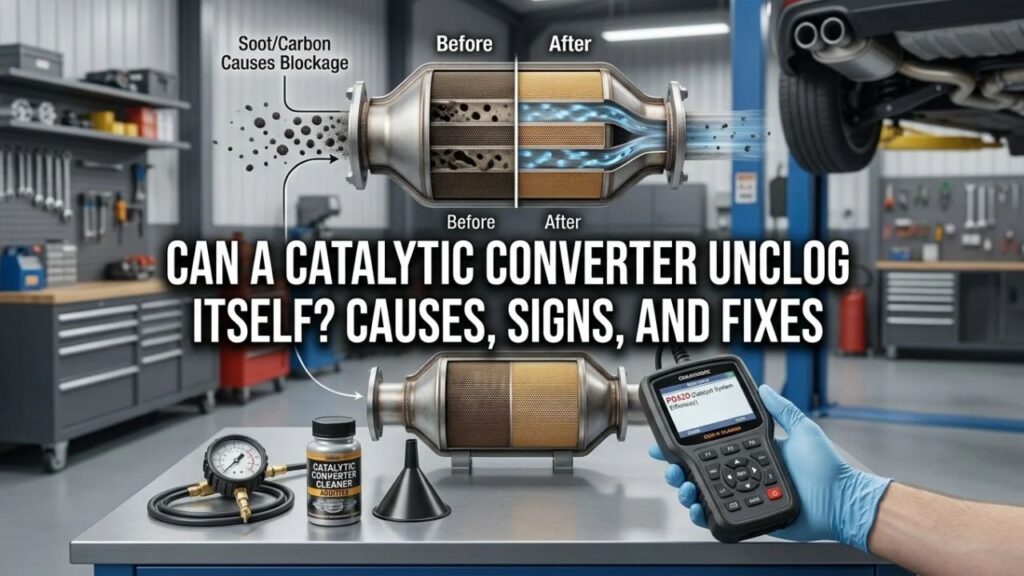
A catalytic converter can sometimes appear less restricted after operating conditions change, but a physically damaged converter does not truly repair itself.
The outcome depends on what is blocking the exhaust passages.
Light Deposits May Change After the Root Cause Is Fixed
Carbon deposits can form when an engine runs rich, burns oil, misfires, or operates poorly for a long period.
Walker identifies excessive carbon buildup, oil consumption, coolant leaks, improper fuel, and other contamination as causes of converter fouling.
If the deposits are light and the internal honeycomb remains intact, correcting the engine fault may stop new contamination. Normal exhaust heat may burn off some combustible residue over time.
That does not mean every contaminated converter will recover. Deposits can coat catalyst surfaces permanently or build deeply enough to restrict flow.
A Melted Converter Cannot Unclog Itself
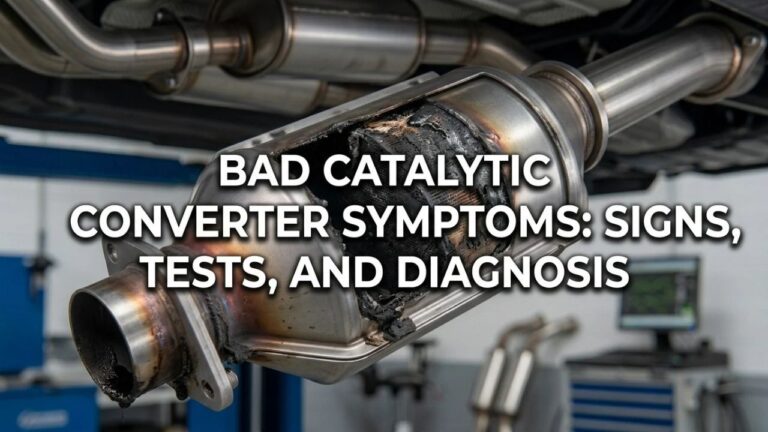
Severe overheating can melt the ceramic substrate.
Walker states that extended high temperatures can cause the substrate to melt and become a solid mass, producing loss of power and exhaust restriction.
Once the honeycomb passages have melted shut, driving cannot reopen them.
No fuel additive can rebuild the channels either. The damaged converter must be replaced after the fault that caused the overheating has been repaired.
Broken Catalyst Material May Shift Temporarily
The internal substrate can crack or break into pieces.
Those pieces may move inside the converter housing. A fragment can block exhaust flow one moment and shift enough to reduce the restriction later.
This can create confusing symptoms. The car may run badly, improve after stopping, then lose power again.
Walker notes that damaged support material or broken catalyst pieces can shift and block exhaust flow.
A rattling converter combined with intermittent loss of power points toward internal physical damage rather than a converter that is successfully cleaning itself.
Key Takeaway: Light deposits may change after the engine fault is corrected, but melted, collapsed, shifted, or broken catalyst material cannot repair itself.
Why Catalytic Converters Become Clogged
Catalytic converters normally fail because another problem damages or contaminates them.
Finding that original fault matters before a new converter is installed.
Engine Misfires Can Melt the Honeycomb
A misfire leaves some air-fuel mixture unburned inside the cylinder.
That mixture travels into the exhaust and can burn inside the converter. The extra heat may raise catalyst temperature far beyond its normal range.
Walker reports that damaged matting and melted substrates can occur at temperatures above roughly 1,700°F.
A severe or repeated misfire can therefore turn an open honeycomb structure into a partially melted blockage.
Running Rich Can Overheat the Converter
A rich-running engine receives more fuel than it can burn correctly.
Excess fuel reaching the exhaust can ignite inside the converter and create extreme heat.
Possible causes include:
- Leaking fuel injectors
- Excessive fuel pressure
- Ignition faults
- Incorrect sensor data
- Air-fuel control problems
- Repeated cold-running faults
Installing another converter while the engine remains rich can damage the replacement part too.
Burning Oil Can Coat the Catalyst
An engine that burns oil sends oil-derived residue through the exhaust.
Over time, deposits can coat the catalyst surfaces and interfere with exhaust passages.
Common sources include worn piston rings, valve-stem seal problems, turbocharger faults, or other internal engine wear.
A car that needs frequent oil top-offs deserves engine diagnosis before its converter is blamed for every emissions problem.
Coolant Can Contaminate the Converter
A leaking head gasket, cracked cylinder head, or other internal coolant leak can send coolant into the combustion chamber.
That contamination then reaches the converter.
Walker lists internal coolant leakage as a possible cause of catalyst poisoning.
Unexplained coolant loss, persistent white exhaust, or cooling-system pressure problems should be addressed before installing another converter.
Physical Damage Can Break the Substrate
Road impacts can dent the converter shell or fracture the ceramic structure inside.
Thermal shock, corrosion, and metal fatigue can also damage converter components.
A broken substrate may rattle when the vehicle starts, stops, or travels over bumps.
Key Takeaway: Misfires, rich operation, oil burning, coolant contamination, extreme heat, and impact damage are common paths to converter restriction.
Can Driving at Highway Speed Unclog a Catalytic Converter?
Highway driving cannot repair a melted or collapsed converter.
It may change symptoms when the converter has minor carbon contamination and the engine is otherwise running correctly, but there is no dependable “drive it hard and the converter will fix itself” procedure.
Higher Exhaust Temperature May Burn Some Residue
A fully warmed engine produces hotter exhaust than a cold engine making short trips.
That heat can burn some combustible residue under the right conditions.
Modern catalyst systems are also designed to operate hot enough for their chemical reactions to occur.
This is very different from repairing damaged ceramic.
If the passages are already melted shut, extra heat may make the problem worse.
Hard Driving Can Be Risky With a Restricted Converter
A clogged converter already traps heat and creates exhaust backpressure.
Heavy acceleration raises exhaust mass flow and temperature, increasing the load on the restricted system.
If the converter is glowing, the engine is severely misfiring, the check-engine light is flashing, or power drops sharply, do not attempt a high-speed “clean-out” drive.
Have the cause diagnosed instead.
Temporary Improvement Does Not Confirm a Repair
A partially restricted car may feel stronger after cooling or after broken material shifts.
The restriction can return once exhaust flow increases again.
A repeatable pattern of good low-speed operation followed by severe power loss at higher RPM deserves an exhaust backpressure test.
Key Takeaway: Highway driving may alter minor deposit-related symptoms, but it cannot reopen melted passages or repair broken converter material.
Can Catalytic Converter Cleaner Unclog a Converter?
Catalytic-converter cleaning additives are often marketed for emissions problems, but they cannot repair structural damage.
The type of failure sets the limit.
Cleaners Cannot Repair Melted Honeycomb
A chemical additive cannot reshape ceramic passages that have melted together.
It also cannot reconnect a broken substrate or restore damaged support matting.
AA1Car states that a physically plugged converter cannot be restored by cleaning and needs replacement once the internal restriction is permanent.
If backpressure testing confirms a severe mechanical blockage, a bottle added to the fuel tank is not a substitute for repair.
Cleaners May Affect Some Deposits
Certain fuel-system or combustion cleaners may reduce deposits elsewhere in an engine when used according to their instructions.
MagnaFlow has stated that combustion-system cleaners can have a place on properly maintained engines, but they are not a cure for every converter problem.
A lightly contaminated catalyst is different from one filled with melted ceramic.
Before spending money on a cleaner, first check for misfires, fuel-control problems, oil burning, coolant loss, and actual exhaust restriction.
A P0420 Code Does Not Mean the Converter Is Clogged
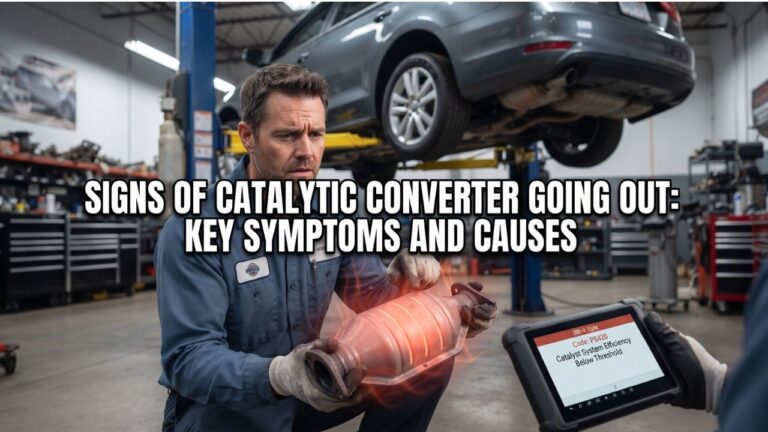
A P0420 code indicates catalyst-system performance below the expected threshold.
It does not tell you that exhaust passages are physically blocked.
Walker notes that converter-efficiency codes can appear from conditions elsewhere in the engine or exhaust system and recommends correcting other diagnostic trouble codes before condemning the converter.
A cleaner may not address a worn catalyst, oxygen-sensor fault, exhaust leak, fuel-control problem, or damaged substrate.
Key Takeaway: Cleaning products cannot fix melted or broken catalyst material, and a catalyst-efficiency code alone does not prove a clog exists.
How to Tell if a Catalytic Converter Is Actually Clogged
Testing is far more dependable than guessing from a check-engine light.
A restricted converter normally produces symptoms tied to exhaust flow.
Look for Loss of Power Under Load
A partially plugged converter may let enough exhaust pass at idle but fail once engine speed rises.
Common symptoms include:
- Slow acceleration
- Limited high-RPM power
- Difficulty climbing hills
- Sputtering under load
- Hard starting
- Stalling
- Excessive exhaust heat
As the restriction becomes worse, symptoms can appear at lower engine loads.
Measure Exhaust Backpressure
Backpressure testing is one of the clearest methods for confirming a restriction.
A pressure gauge can be fitted through an oxygen-sensor port or another approved test location.
Walker gives general reference figures of less than about 1.5 psi at idle and 3 psi at 2,000 RPM, while stressing that readings vary by application. High pressure ahead of the converter points toward converter restriction.
Use vehicle-specific specifications when they are available.
Check Engine Vacuum
An intake-manifold vacuum gauge can also reveal an exhaust restriction.
Vacuum may begin normally and then fall as RPM is held higher because the engine cannot push exhaust out freely.
This test is supportive rather than conclusive because valve timing and other engine faults can alter vacuum readings too.
Listen for Internal Rattling
A rattling sound from inside the converter can indicate cracked or loose substrate material.
EPA diagnostic material also notes that rattling may indicate broken catalyst substrate.
Rattling plus reduced power makes physical damage more likely.
Inspect for Overheating
Blue, bronze, or rainbow discoloration on the converter shell can point to excessive temperature.
Walker lists this type of shell discoloration as a sign of high converter temperatures.
A glowing-red converter is a severe warning sign. Stop driving and address the engine or exhaust fault.
Key Takeaway: Loss of power gives a clue, while backpressure testing, vacuum behavior, rattling, and heat damage give stronger evidence of a real restriction.
Can a Clogged Catalytic Converter Clear After Cooling Down?
Cooling can change the symptoms, but it does not reverse structural damage.
A vehicle with a restricted converter may run better when cold because exhaust flow is lower during certain operating conditions or because loose material has shifted.
Once the engine warms and exhaust volume rises, the restriction may become noticeable again.
Heat can also cause metal components to expand. A damaged converter or exhaust system may therefore behave differently hot versus cold.
If the same cycle repeats—normal cold operation followed by power loss after warming—test the exhaust instead of assuming the converter is cleaning itself overnight.
What to Do if the Converter Seems to Unclog
If the car suddenly runs better after a period of severe restriction, do not treat the problem as solved.
Start with the engine conditions that can damage a converter.
Check for:
- Stored or pending trouble codes
- Active misfires
- Rich fuel mixture
- Excessive oil consumption
- Coolant loss
- Exhaust leaks
- Oxygen-sensor faults
- Fuel-injector problems
- Abnormal converter heat
Next, test exhaust backpressure if the vehicle has loss of power, high-RPM restriction, or recurring stalling.
If backpressure confirms a blocked converter, replacement is generally required. EPA guidance recognizes a plugged converter as a legitimate reason for replacement and prohibits simply bypassing the emissions device with a straight pipe.
Do not replace the converter without addressing the fault that damaged it. Walker advises correcting engine, exhaust, fuel-control, and contamination problems before installing another unit.
Can You Remove the Catalytic Converter to Fix the Restriction?
Removing or hollowing out a catalytic converter is not a legal road-vehicle repair in the United States.
EPA states that removing or rendering an emissions-control device inoperative is prohibited under federal law.
A failed converter should be replaced with the correct compliant part for the vehicle and location.
Removing the internal honeycomb may reduce backpressure, but it creates an emissions-system tampering issue and can cause check-engine lights, inspection failures, exhaust changes, and other problems.
The proper sequence is diagnosis, repair of the underlying engine fault, and replacement of the failed converter if testing confirms it cannot remain in service.
Conclusion
For can a catalytic converter unclog itself, the answer depends on what created the restriction. Very light deposits may change after the engine runs correctly again, but a converter with melted, collapsed, broken, or shifted substrate cannot rebuild itself.
Do not rely on a temporary return of power, highway driving, or a cleaning additive when the car has severe restriction symptoms. Backpressure testing can show if the exhaust is actually blocked, while engine codes and related tests can identify the condition that damaged the converter.
I would fix misfires, rich running, oil consumption, coolant leaks, or other upstream faults before installing a replacement. That gives the new converter a much better chance of surviving instead of repeating the same failure.
FAQs About a Catalytic Converter Unclogging Itself
Can a Partially Clogged Catalytic Converter Clear Itself?
A minor deposit-related restriction may improve after the engine fault causing the deposits is corrected. A converter with melted ceramic, a collapsed honeycomb, or broken material blocking the outlet will not clear itself. Backpressure testing can separate a true restriction from other drivability problems.
Can High RPM Unclog a Catalytic Converter?
High RPM cannot repair structural damage. It also increases exhaust flow and heat, which can make a restricted converter run hotter. Do not rev or drive a severely restricted vehicle hard in an attempt to clear it, especially if power is dropping or the converter is overheating.
Does Driving on the Highway Clean a Catalytic Converter?
Normal highway operation brings the exhaust system fully up to temperature and may reduce some light combustible deposits in a healthy system. It cannot reopen a melted honeycomb or repair broken catalyst material. Recurring power loss still needs diagnosis.
Can a Catalytic Converter Cleaner Fix a P0420 Code?
Not reliably. P0420 indicates low catalyst-system performance, not a confirmed physical clog. Exhaust leaks, fuel-control faults, oxygen-sensor behavior, engine problems, or a worn converter can contribute to the code. Diagnose the cause before buying a cleaner or converter.
What Happens if a Catalytic Converter Is Completely Clogged?
A completely or severely blocked converter can create high exhaust backpressure. The engine may lose most of its power, struggle to rev, run rough, stall, or fail to stay running. A confirmed mechanical blockage usually requires converter replacement.
Can a Clogged Converter Get Better After the Car Cools?
The symptoms can lessen after cooling, but cooling does not rebuild damaged catalyst material. Heat-related expansion, lower exhaust flow, or loose material shifting inside the housing may temporarily change the restriction.
How Do I Know if the Converter Is Melted?
Severe loss of power, excessive backpressure, high converter temperature, shell discoloration, and internal rattling are clues. A technician may inspect the substrate or use backpressure testing to confirm the failure. Melted passages require replacement.
Should I Replace a Catalytic Converter That Keeps Clogging?
First diagnose why it is clogging. Repeated converter failure often points to an unresolved misfire, rich mixture, oil burning, coolant leak, or another engine problem. Repair the cause before installing another converter.