How Much Is It to Replace a Catalytic Converter? Full Cost Guide
Catalytic converter replacement commonly costs about $500 to $2,500 or more in the United States, including parts and labor. A simple universal converter may cost much less, while an OEM manifold-style converter, luxury-car unit, or vehicle with several converters can push the repair well beyond $3,000.
The converter itself usually accounts for most of the bill. Aftermarket parts can start at a few hundred dollars, while complex direct-fit and original-equipment assemblies may cost $1,000 to several thousand dollars before labor.
Labor also varies with the exhaust design. A shop may weld a universal converter into an accessible exhaust pipe fairly quickly, while rusted fasteners, manifold-mounted converters, multiple oxygen sensors, or tightly packaged engine bays can add substantial shop time.
Before paying out of pocket, check the vehicle’s emissions warranty. Under U.S. federal emissions-warranty rules, the original catalytic converter on qualifying light-duty vehicles is generally covered for 8 years or 80,000 miles, whichever occurs first, against qualifying defects. State or manufacturer coverage may extend farther.
For how much is it to replace a catalytic converter, a realistic budget for many mainstream vehicles is roughly $1,000 to $2,500 installed, but there are major exceptions on both sides. Older cars that accept an approved universal converter can cost less, while some European, luxury, hybrid, truck, and multi-converter systems cost several thousand dollars.
Price should not be the only concern. A converter often fails because of a misfire, rich fuel mixture, oil burning, coolant contamination, or another engine problem. Installing an expensive new converter without correcting that fault can damage the replacement.
The cost breakdown below covers parts, labor, OEM versus aftermarket converters, vehicle-specific examples, California requirements, warranty coverage, diagnostic charges, theft replacement, and ways to avoid paying for a converter that the vehicle does not actually need.
How Much Is It to Replace a Catalytic Converter in the U.S.?
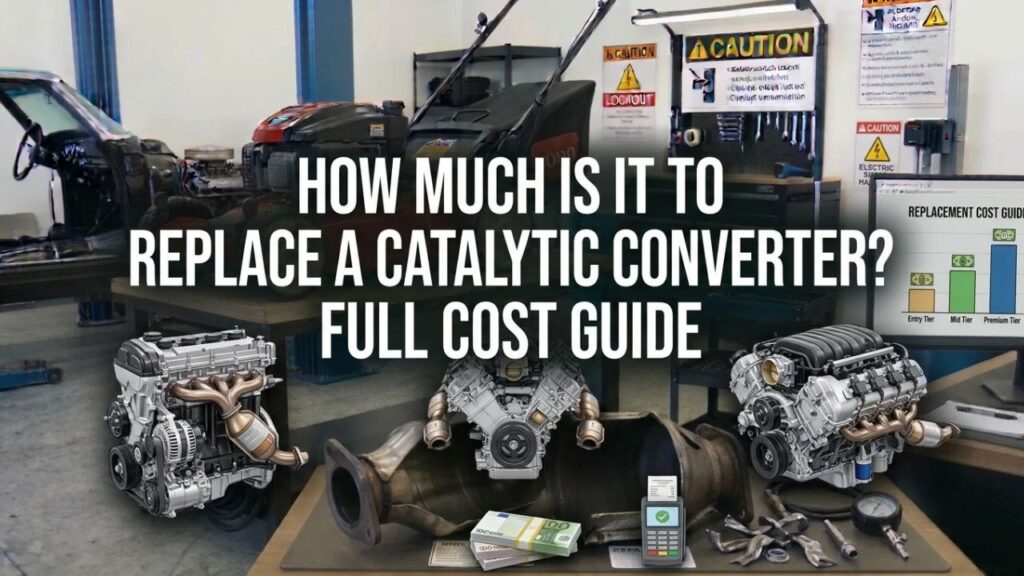
A broad installed price range is approximately $500 to $2,500+, with many late-model direct-fit repairs landing around $1,000 to $2,500.
Some vehicles fall below that range. Others can exceed $3,000, $4,000, or even $5,000 when the converter is part of a costly exhaust-manifold assembly or the vehicle has several converters.
A useful general breakdown is:
| Replacement Type | Approximate Part Cost | Approximate Installed Cost |
| Universal aftermarket converter | 100–400 | 300–800 |
| Direct-fit aftermarket converter | 300–1,500+ | 500–2,000+ |
| CARB-approved aftermarket converter | 400–1,800+ | 650–2,200+ |
| OEM converter | 800–3,000+ | 1,000–3,500+ |
| Luxury or multi-converter system | 1,500–5,000+ | 2,000–5,500+ |
These are planning ranges rather than quotes. Current repair estimates show wide differences even within one manufacturer.
For example, current RepairPal figures put Chevrolet Cruze catalytic converter replacement at roughly 1,064–1,589, Chevrolet Equinox around 1,642–1,887, and Chevrolet Silverado 1500 around 2,928–3,063. Certain Mercedes-Benz models exceed $3,000, and some reach above $4,000.
Why Is the Price Range So Wide?
Catalytic converters contain precious metals such as platinum, palladium, and rhodium. The amount and type of catalyst material vary with engine size, emissions certification, vehicle design, and converter location.
The physical assembly matters too.
A converter welded into a simple exhaust section costs far less to manufacture and replace than a unit integrated into an exhaust manifold with:
- Heat shields
- Flanges
- Oxygen-sensor ports
- Multiple catalyst bricks
- Complex bends
- Closely coupled engine connections
Vehicle-specific emissions requirements can also limit which replacement parts are legal.
Parts Usually Cost More Than Labor
Unlike some automotive repairs, converter replacement is often dominated by the price of the part.
A straightforward replacement may need only one or two hours of shop labor.
The converter itself may cost hundreds or thousands of dollars.
This is why finding a cheaper labor rate does not always cut the total bill dramatically.
Key Takeaway: Expect roughly 500–2,500+ for many catalytic converter replacements, but OEM, luxury, truck, and multi-converter applications can cost several thousand dollars more.
How Much Does the Catalytic Converter Itself Cost?
The part alone can range from around $100 for some universal aftermarket converters to $3,000 or more for certain OEM assemblies.
The correct choice depends on emissions certification, vehicle design, engine family, state law, and the exact converter location.
Universal Aftermarket Converter Cost
A universal converter is a generic unit designed to fit a range of vehicles within specified emissions and engine limits.
The old converter is cut from the exhaust, and the replacement is welded or clamped into the pipe.
Universal units often cost around $100 to $400 for the part, though approved applications and high-capacity designs can cost more.
They are most practical on exhaust systems where the original converter is mounted in a simple section of pipe with enough room for fabrication.
Not every vehicle can legally or mechanically use one.
Direct-Fit Aftermarket Converter Cost
A direct-fit converter is shaped to replace the original assembly with little or no exhaust fabrication.
It may include:
- Correct pipe bends
- Mounting flanges
- Oxygen-sensor bungs
- Heat shields
- Brackets
- Gaskets or related hardware
Current retail guidance places many direct-fit converters between approximately $300 and $2,500 for the part alone, though most ordinary aftermarket units fall well below the top of that range.
Direct-fit parts cost more than universal converters because they are built for a narrower group of vehicles.
OEM Catalytic Converter Cost
An OEM converter comes from the vehicle manufacturer or its authorized parts supply chain.
Prices commonly start around $800 to $1,000 and can climb past $3,000 for complex assemblies.
Premium and luxury models may cost substantially more.
An OEM unit may be the sensible option when aftermarket choices are unavailable, emissions rules require a specific converter, or maintaining factory calibration and fit is a priority.
Why Precious Metals Raise Converter Prices
A catalytic converter does more than provide an empty exhaust passage.
Its internal substrate carries catalyst materials that promote chemical reactions converting harmful exhaust pollutants.
Common catalyst metals include:
- Platinum
- Palladium
- Rhodium
Their market values and the quantity needed for a particular emissions system influence production cost.
A larger converter or more demanding emissions application may require more catalyst material than a small, lightly loaded unit.
Key Takeaway: The converter itself may cost from roughly $100 to several thousand dollars. Universal parts sit at the low end, while complex OEM and manifold-integrated units occupy the high end.
How Much Is Labor to Replace a Catalytic Converter?
Labor commonly adds around $100 to $500, but difficult jobs can cost more.
A shop’s hourly rate, converter location, corrosion, exhaust design, and installation method all affect the final figure.
Simple Weld-In Replacement
A universal converter in an accessible section of exhaust can be relatively quick for a muffler shop.
The technician cuts out the old converter, fits the replacement, welds or clamps it into position, and checks for leaks.
Labor can sometimes stay near the lower end of the range.
Bolt-On Direct-Fit Replacement
A direct-fit converter may sound simpler because it bolts in place, but age can complicate the job.
Exhaust hardware lives through thousands of heat cycles and road exposure.
Technicians may encounter:
- Rusted nuts
- Broken studs
- Seized oxygen sensors
- Corroded flanges
- Damaged exhaust hangers
- Broken heat-shield fasteners
Removing these parts without damaging nearby components can add time.
Manifold Catalytic Converter Labor
Some modern vehicles place the converter directly beside the engine as part of, or attached closely to, the exhaust manifold.
This design brings the catalyst up to operating temperature quickly after startup.
It can also make replacement harder.
Access may require removal of shields, sensors, braces, intake parts, or surrounding components. Labor can climb well beyond that of a converter located beneath the center of the car.
Rust Can Add Unexpected Cost
Vehicles from areas that use road salt may need extra exhaust hardware or fabrication.
A quote that assumes normal fastener removal can rise if technicians discover broken bolts or badly rusted adjoining pipes.
Ask if the estimate includes:
- Gaskets
- Flange hardware
- Clamps
- Oxygen-sensor removal
- Broken fastener repair
- Exhaust leak repair
Key Takeaway: Labor may be only 100–500 on many vehicles, but rust, broken hardware, manifold-mounted converters, and difficult access can raise the bill.
OEM vs Aftermarket Catalytic Converter Cost
The price difference between OEM and aftermarket converters can be large enough to change the entire repair budget.
Neither category should be chosen from price alone.
When an Aftermarket Converter Makes Sense
A properly approved aftermarket converter can reduce the repair cost considerably.
It can be a sensible choice for:
- Older vehicles
- Cars outside emissions warranty
- Vehicles with good approved direct-fit options
- Repairs where OEM cost approaches the vehicle’s value
Federal rules require replacement converters to meet applicable emissions requirements and be installed for the correct vehicle application.
Do not buy an inexpensive converter simply because its pipe diameter matches.
When OEM May Make More Sense
An OEM converter may be preferable when:
- Approved aftermarket coverage is limited
- The vehicle is still under warranty
- Prior aftermarket units triggered catalyst codes
- Fitment is unusually complex
- The converter is integrated into a manifold
- Local emissions rules narrow the choices
An OEM assembly may also include brackets, shields, flanges, or catalyst sections that would otherwise require several aftermarket components.
Cheap Converters Can Cost More Later
A converter that does not contain enough catalyst material for the application may trigger P0420 or P0430 despite fitting physically.
Replacing the same part twice wipes out much of the original savings.
I would compare the emissions certification and application listing before comparing the final dollar amount.
Key Takeaway: Aftermarket converters can reduce the bill substantially, but the replacement must be approved for the exact vehicle and emissions system. OEM can justify its price when fitment or emissions compatibility is uncertain.
Why Catalytic Converter Replacement Can Cost So Much
Several factors can turn a routine exhaust repair into a large bill.
Some Vehicles Have More Than One Converter
V-type engines often have separate exhaust banks.
A vehicle may have:
- One converter per bank
- Front and rear converters
- Manifold converters plus underfloor catalysts
- Several catalyst sections in one emissions system
Replacing only one failed unit may cost less, but damage from a rich mixture or severe misfire can affect more than one converter.
Manifold Converters Cost More
A close-coupled converter mounted near the cylinder head may be built into an expensive exhaust-manifold assembly.
You are paying for much more than a simple metal can in the exhaust pipe.
Luxury and Performance Cars Use Costly Assemblies
Some European and performance vehicles have tightly packaged exhaust systems with large catalyst loads and several monitored converters.
Current repair estimates for some Mercedes-Benz vehicles exceed 3,000–5,000.
This does not mean every luxury car costs that much, but it shows why a generic national average can be misleading.
Hybrid Vehicles Can Have Specialized Emissions Systems
Hybrid engines stop and restart frequently, which creates unique catalyst-temperature challenges.
Some hybrid applications use specialized exhaust layouts or costly OEM catalyst assemblies.
Part availability can affect the final bill as much as labor.
California-Compliant Parts May Cost More
California requires replacement aftermarket catalytic converters to carry California Air Resources Board approval for the exact vehicle application.
These parts commonly cost more than federal-only aftermarket versions because they must meet California certification requirements.
Several other states follow California emissions standards or related requirements, so check local rules before ordering a converter.
Does Insurance Pay for Catalytic Converter Replacement?
It may if the converter was stolen and the vehicle carries appropriate comprehensive auto coverage.
Mechanical failure normally falls under maintenance or repair rather than standard auto insurance.
Stolen Catalytic Converter
Catalytic converters became theft targets because of the precious metals inside them.
If the converter is stolen, a comprehensive policy may cover:
- Replacement converter
- Damaged exhaust pipes
- Cut oxygen-sensor wiring
- Other theft-related damage
Your deductible still applies.
If the repair costs $1,200 and the comprehensive deductible is $500, the insurance calculation may differ substantially from a policy with a $100 deductible.
Mechanical Failure
A converter that fails because of age, contamination, misfire, or internal melting is generally a mechanical repair.
Standard insurance usually does not pay for ordinary mechanical breakdowns.
Warranty coverage is the better place to check first.
Check the Catalytic Converter Warranty Before Paying
This step can save thousands of dollars.
Federal emissions warranty rules provide long coverage for specified major emissions components on qualifying light-duty vehicles.
Federal 8-Year/80,000-Mile Coverage
The U.S. EPA states that the catalytic converter is one of the major emissions components generally covered under the federal 8-year/80,000-mile emissions defect warranty.
The coverage starts from the vehicle’s original in-service date.
A qualifying defective original converter may therefore be replaced by the manufacturer rather than paid for entirely by the owner.
Warranty Does Not Cover Every Failure
Coverage can be denied if the converter was damaged by conditions outside a covered defect.
Examples may include:
- Vehicle misuse
- Unauthorized modifications
- Failure to perform required maintenance
- Impact damage
- Engine faults left unrepaired
Actual terms come from the vehicle’s warranty booklet.
Before approving a $1,500 or $2,500 replacement on a relatively new vehicle, I would check the in-service date, mileage, VIN-specific coverage, recalls, and warranty extensions.
Some Manufacturers Extend Coverage
Manufacturers sometimes issue longer emissions warranties for specific vehicles after recalls, settlements, or known defects.
A dealer can check the VIN for open campaigns or extended coverage.
Key Takeaway: The original catalytic converter may have federal emissions coverage for 8 years or 80,000 miles. Check warranty and VIN-specific coverage before authorizing an expensive replacement.
California Catalytic Converter Replacement Costs and Rules
California has stricter rules for aftermarket catalytic converters than federal-only states.
A replacement unit must be OEM or a California-approved aftermarket converter assigned to the exact application.
CARB Approval Must Match the Vehicle
The California Air Resources Board requires approved aftermarket converters to carry an Executive Order number.
Fitment is determined using information such as:
- Model year
- Make
- Model
- Engine size
- Engine family or test group
- Converter location
A converter can physically fit and still be illegal for that application.
California Parts Can Cost More
CARB-approved converters often contain more catalyst material and go through stricter certification than lower-cost federal aftermarket units.
That can raise part prices considerably.
For some vehicles, limited CARB-approved availability may make OEM replacement the practical option.
Do Not Remove the Converter Instead
Federal law prohibits removing or rendering required emissions-control equipment inoperative.
Replacing the converter with a straight pipe is not a legitimate way to avoid the replacement cost on a street vehicle.
What Other Costs Can Be Added to the Repair?
The converter quote may not be the final number if related faults are discovered.
Diagnostic Fee
A check-engine-light diagnosis or exhaust-restriction test may add roughly 100–200 or more, based on local labor rates and test time.
A good diagnosis is worth paying for when the alternative is replacing a four-figure component based only on a P0420 code.
Oxygen Sensors
Converters often have oxygen sensors before and after the catalyst.
A sensor does not automatically need replacement because the converter is being changed.
Replacement may be justified if a sensor is:
- Faulty
- Damaged
- Seized beyond reuse
- Contaminated
- Physically broken during removal
Adding several oxygen sensors can raise parts cost by hundreds of dollars.
Exhaust Gaskets and Hardware
Direct-fit installations may need new:
- Flange gaskets
- Bolts
- Nuts
- Springs
- Clamps
- Hangers
These parts are inexpensive compared with the converter but still add to the invoice.
Repairing the Cause of Converter Failure
This can be the most important extra cost.
A converter damaged by a misfire may also require:
- Spark plugs
- Ignition coil
- Fuel injector
- Engine repair
- Sensor diagnosis
Oil burning or coolant consumption can involve far larger repairs.
Key Takeaway: Diagnostic work, sensors, exhaust hardware, rust repair, and fixing the engine fault that damaged the converter can add hundreds or much more to the replacement bill.
Can You Save Money on Catalytic Converter Replacement?
Yes, but the safest savings come from choosing the correct part and shop rather than buying the cheapest converter available.
Get More Than One Quote
Prices vary between:
- Dealers
- Independent repair shops
- Exhaust specialists
- Muffler shops
A muffler shop may offer a legal universal or direct-fit solution that costs much less than a dealer’s complete OEM assembly.
Ask for the Part Number
A written estimate should identify the converter being installed.
This makes it easier to compare:
- OEM versus aftermarket
- Federal versus CARB certification
- Direct-fit versus universal
- Warranty coverage
- Included hardware
Two quotes that look dramatically different may not include comparable parts.
Diagnose P0420 Before Buying a Converter
A P0420 or P0430 code does not prove the converter needs replacement.
Possible contributors include:
- Exhaust leaks
- Engine misfires
- Fuel-control faults
- Sensor problems
- Oil consumption
- Actual catalyst deterioration
Testing first may prevent an unnecessary replacement.
Check the Emissions Warranty
This is worth repeating because the savings can be large.
If the original converter is still within qualifying federal emissions coverage, the manufacturer may be responsible for the repair.
Conclusion
For how much is it to replace a catalytic converter, a practical U.S. budget is roughly $500 to $2,500 or more, with many modern direct-fit jobs landing around 1,000–2,500 installed.
A universal aftermarket converter can keep an older, simple exhaust system closer to the lower end. OEM manifold converters, luxury vehicles, trucks, hybrids, California-certified parts, and systems with several converters can raise the total to 3,000–5,000 or beyond.
Check exactly what the quote includes before comparing prices. Part certification, labor, oxygen sensors, exhaust hardware, diagnostics, and repair of the original engine fault can change the bill considerably.
I would also check the federal 8-year/80,000-mile emissions warranty before paying for an original converter on a newer vehicle. If the car is outside coverage, get quotes for both approved aftermarket and OEM options, then choose the part that satisfies the vehicle’s emissions requirements.
FAQs About Catalytic Converter Replacement Cost
How Much Does a Catalytic Converter Cost Without Labor?
The part alone can range from roughly $100 for some universal aftermarket converters to $3,000 or more for specialized OEM assemblies.
Many mainstream direct-fit aftermarket converters fall around 300–1,500, though the exact cost varies with vehicle, emissions certification, engine, and converter location.
How Much Does a Mechanic Charge to Replace a Catalytic Converter?
Labor commonly runs about 100–500 for many vehicles.
A simple welded converter may require relatively little shop time. Manifold-mounted units, rusted exhaust systems, seized oxygen sensors, or broken hardware can increase labor substantially.
Why Does Catalytic Converter Replacement Cost $2,000 or More?
The converter may contain costly precious-metal catalyst material and be built into a complex vehicle-specific assembly.
OEM parts, California-certified converters, manifold-style units, multiple catalysts, difficult access, and high labor rates can push the installed cost beyond $2,000.
Is an Aftermarket Catalytic Converter Cheaper Than OEM?
Usually, yes.
A properly approved aftermarket converter may cost hundreds or even thousands less than the OEM assembly. The part must still be approved for the exact vehicle and local emissions rules.
Is Catalytic Converter Replacement Covered Under Warranty?
It can be.
The catalytic converter is generally one of the major emissions components covered for 8 years or 80,000 miles under the federal emissions defect warranty on qualifying light-duty vehicles.
Check the vehicle warranty booklet and VIN-specific coverage before paying for the repair.
Does Insurance Cover a Stolen Catalytic Converter?
Comprehensive auto insurance may cover catalytic converter theft and related damage, subject to the policy deductible and terms.
Mechanical converter failure is normally handled as a repair or warranty issue rather than a standard insurance claim.
Is It Worth Replacing a Catalytic Converter on an Older Car?
Compare the full repair cost with the car’s condition, value, expected remaining life, and any other repairs it needs.
A 600–1,000 exhaust repair can make sense on an otherwise dependable older car. A $4,000 repair on a vehicle with major engine, transmission, rust, or suspension problems deserves a broader repair-versus-replacement evaluation.
Can I Drive Instead of Replacing a Bad Catalytic Converter?
That depends on how it has failed, but a severely clogged, overheating, rattling, or internally damaged converter should not be ignored.
A restricted converter can cause major power loss, stalling, and excess heat. A failed emissions catalyst may also cause inspection failure. Diagnose the fault and repair the engine problem that caused it before installing the replacement.