Catalytic Converter Malfunction Symptoms: Signs, Codes, and Tests
Common signs of a failing catalytic converter include a check engine light, sluggish acceleration, reduced power at higher RPM, rattling underneath the vehicle, a sulfur-like exhaust smell, excess exhaust heat, poor fuel economy, and failed emissions testing. A clogged converter may also cause hard starting or stalling because exhaust gases cannot escape freely.
The symptoms change with the type of failure. A converter that has simply lost its ability to treat exhaust pollutants may produce little more than a check engine light. A melted or collapsed internal substrate can restrict exhaust flow and make the engine feel weak, especially during acceleration, hill climbing, or highway driving.
Recognizing the pattern early can prevent unnecessary parts replacement. Oxygen-sensor faults, exhaust leaks, rich or lean fuel mixtures, and engine misfires can create similar symptoms or contribute to converter damage, so one warning sign alone does not confirm the converter has failed.
For U.S. vehicles, the EPA states that 1996 and newer passenger vehicles use OBD systems that monitor emission-control operation and can turn on the check engine light when a qualifying malfunction is detected. The computer also stores diagnostic trouble codes that provide a starting point for diagnosis.
The most recognizable catalytic converter malfunction symptoms are P0420 or P0430 with a check engine light, reduced acceleration, rattling from broken internal material, sulfur odor, abnormal heat, and emissions-test failure. A heavily clogged unit may also cause stalling or difficulty starting.
I’d pay the most attention to combinations of symptoms rather than a single clue. Power loss plus abnormal exhaust heat points in a different direction than a car that drives normally but stores only P0420. The sections below separate those patterns and explain how a converter can be checked before replacement.
Catalytic Converter Malfunction Symptoms to Watch For
Check Engine Light
A check engine light is one of the most common early signs of catalyst trouble.
The codes most closely associated with converter performance are:
- P0420 — Catalyst System Efficiency Below Threshold, Bank 1
- P0430 — Catalyst System Efficiency Below Threshold, Bank 2
A vehicle may drive normally while one of these codes is stored. The computer has detected that catalyst performance does not meet its programmed threshold, but that does not mean the converter is physically clogged.
O’Reilly notes that P0420 and P0430 can also be associated with exhaust leaks, oxygen-sensor problems, misfires, fuel-pressure faults, and injector problems.
Sluggish Acceleration
A restricted converter can make the vehicle feel slow when you press the accelerator.
The engine must push exhaust gases through the converter. If the internal passages are partly blocked, exhaust pressure builds upstream and interferes with normal cylinder clearing.
The restriction may be difficult to notice at idle because exhaust volume is low. It becomes more obvious during:
- Hard acceleration
- Highway merging
- Hill climbing
- High-RPM operation
- Towing or carrying heavy loads
AutoZone lists poor acceleration and reduced engine output among common symptoms of a clogged converter.
Loss of Power at Higher RPM
A converter restriction often becomes more noticeable as engine speed rises.
A car may start normally and drive reasonably well at low speed, then feel as if it hits a wall when you ask for more power.
This occurs because the engine creates more exhaust as RPM and load increase. A restricted exhaust system cannot move that higher volume fast enough.
A sudden inability to rev normally deserves prompt diagnosis, especially if the engine previously pulled strongly through the same RPM range.
Rattling Under the Vehicle
A metallic rattle near the converter can indicate that the internal ceramic substrate has cracked or broken.
The sound may resemble:
- Stones shaking in a metal container
- A loose metallic vibration
- A rattle during startup
- Noise when RPM rises or falls
Broken material can remain loose inside the housing or shift into a position that partially blocks exhaust flow.
A loose exhaust heat shield can make a similar noise, so rattling does not confirm internal converter damage by itself.
Sulfur or Rotten-Egg Smell
An unusual sulfur-like or rotten-egg odor from the exhaust can appear with converter or fuel-control trouble.
The smell may occur when the catalyst is no longer processing exhaust gases as intended or when an overly rich mixture sends unusual exhaust chemistry into the converter.
Edmunds lists sulfur odor among symptoms associated with catalyst-efficiency faults such as P0430.
The smell alone does not prove the converter needs replacement. Fuel-mixture problems should also be checked.
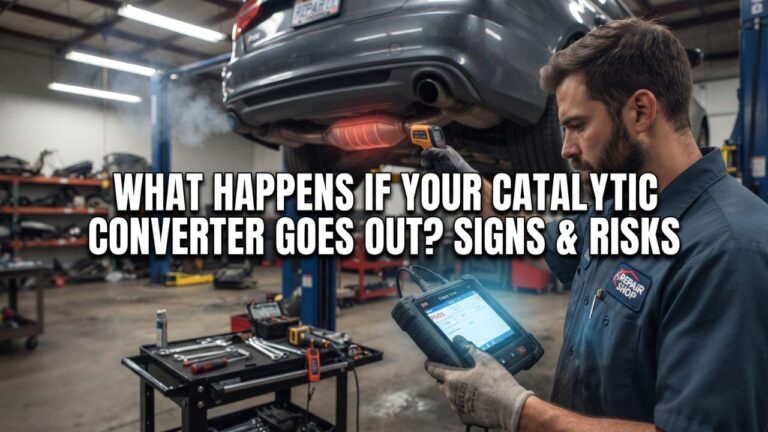
Excessive Heat Under the Vehicle
Catalytic converters operate at high temperatures during normal use, but extreme heat can indicate a serious problem.
Excess fuel entering the exhaust because of a misfire or rich mixture may burn inside the converter. This can raise internal temperature enough to damage or melt the ceramic substrate.
A converter that glows red or orange after normal driving is not behaving normally.
Do not touch or reach near an overheated exhaust system. Shut the vehicle off in a safe location away from dry vegetation or other combustible material.
Poor Fuel Economy
Fuel economy may drop when converter trouble is connected with a rich-running engine or exhaust restriction.
A restricted exhaust can make the engine work harder under load. A rich mixture can waste fuel while also damaging the converter.
Poor mileage is a weak converter symptom by itself because tire pressure, driving conditions, fuel-system faults, oxygen sensors, thermostats, and many other problems can reduce fuel economy.
Failed Emissions Test
A converter may stop processing pollutants properly before it creates major driveability symptoms.
That means a car can:
- Start normally
- Accelerate normally
- Make no unusual noise
- Show no obvious exhaust restriction
and still fail an emissions inspection because catalyst performance is below the required threshold.
This is common with an efficiency-type failure rather than a physically clogged converter.
Key Takeaway: Check engine codes, power loss, rattling, sulfur odor, excess heat, and emissions-test failure are common converter warning signs, but the symptom pattern reveals more than any single symptom.
Quick Catalytic Converter Symptom Chart
| Symptom | What it may indicate | Other possible causes |
| P0420 | Low catalyst efficiency, Bank 1 | O2 sensor, exhaust leak, mixture fault |
| P0430 | Low catalyst efficiency, Bank 2 | O2 sensor, exhaust leak, mixture fault |
| Weak acceleration | Exhaust restriction | Fuel, ignition, transmission, airflow fault |
| Power loss at high RPM | Restricted converter | Fuel-delivery or airflow problem |
| Metallic rattle | Broken catalyst substrate | Loose heat shield or exhaust hardware |
| Sulfur smell | Catalyst or rich-fuel problem | Fuel quality or mixture fault |
| Excessive converter heat | Misfire or rich mixture | Other exhaust-temperature problems |
| Poor fuel economy | Restriction or rich operation | Many engine and vehicle faults |
| Hard starting | Severe exhaust restriction | Battery, fuel, ignition, compression fault |
| Stalling | Heavy restriction | Fuel, ignition, sensor, mechanical fault |
| Failed emissions test | Reduced catalyst conversion | Other emissions-system faults |
The table is best used as a diagnostic starting point, not as a replacement checklist.
Symptoms of an Inefficient vs Clogged Catalytic Converter
Catalyst Efficiency Failure
An efficiency failure means the converter is no longer reducing emissions to the level expected by the vehicle’s diagnostic system.
The car may still drive normally.
Typical signs include:
- Steady check engine light
- P0420 or P0430
- Failed emissions inspection
- Little or no noticeable power loss
This type of problem involves chemical catalyst performance rather than a major physical blockage.
Clogged or Melted Converter
A clogged converter physically restricts exhaust flow.
Typical symptoms include:
- Poor acceleration
- High-RPM power loss
- Engine struggling under load
- Hard starting
- Stalling
- Abnormal exhaust heat
AutoZone notes that excessive backpressure from a restricted converter can cause starting trouble, poor acceleration, and heat buildup.
A catalyst-efficiency code may appear too, but a restriction and an efficiency failure are not the same diagnosis.
Broken Internal Substrate
A converter can fail mechanically without becoming completely clogged.
The ceramic honeycomb may crack from impact or heat damage.
Common clues include:
- Rattling
- Intermittent restriction
- Changing exhaust sound
- Catalyst codes
- Reduced performance if pieces shift and block flow
Loose internal pieces may move as the vehicle accelerates, brakes, or travels over bumps. That can make the symptoms appear inconsistent.
Key Takeaway: An inefficient converter may cause only a code or emissions failure, while a clogged converter usually creates driveability problems because exhaust flow is physically restricted.
What Codes Appear With Catalytic Converter Problems?
P0420 on Bank 1
P0420 indicates that catalyst efficiency on Bank 1 has fallen below the programmed threshold.
Bank 1 is the engine bank containing cylinder number one.
On many inline engines there is only one cylinder bank, so P0420 is the main catalyst-efficiency code.
The code does not identify the converter as the only possible faulty component.
P0430 on Bank 2
P0430 applies to Bank 2 on engines that use a second monitored exhaust bank.
It is common on V6 and V8 engines with separate catalyst monitoring for each side.
The diagnostic process is similar to P0420: check catalyst operation, oxygen sensors, exhaust leaks, fuel control, and related engine faults.
Misfire and Fuel Codes May Appear Too
Catalytic-converter damage frequently begins with another engine problem.
Related codes may include:
- P0300 for random or multiple misfires
- P0301 and higher cylinder-specific misfire codes
- P0171 or P0174 for lean operation
- P0172 or P0175 for rich operation
- Oxygen-sensor codes
- Air-fuel sensor codes
- Injector or fuel-control codes
A misfire or rich condition should be corrected before installing a new converter.
The EPA warns that a blinking check engine light can indicate a catalyst-damaging misfire and advises minimizing driving until the problem is repaired.
Key Takeaway: P0420 and P0430 are the main catalyst codes, but misfire, mixture, sensor, and exhaust-related codes may reveal the problem that caused or mimicked converter failure.
Why Catalytic Converter Symptoms Can Be Misleading
Bad Oxygen Sensors
The vehicle computer uses oxygen-sensor or air-fuel sensor data to monitor combustion and catalyst behavior.
A slow, biased, contaminated, or electrically damaged sensor can produce readings that resemble poor catalyst performance.
Replacing the oxygen sensor automatically is not the answer either. Sensor operation should be checked with scan data and vehicle-specific diagnostic information.
Exhaust Leaks
An exhaust leak can draw outside air into the exhaust stream.
This can alter oxygen-sensor readings and interfere with catalyst monitoring.
Inspect areas such as:
- Exhaust manifold
- Flanges
- Gaskets
- Flex pipe
- Oxygen-sensor threads
- Welds and pipe joints
Soot around a connection may provide a clue to leakage.
Engine Misfires
A misfire can create symptoms that overlap with converter trouble:
- Rough running
- Reduced power
- Check engine light
- Poor fuel economy
It can also destroy the converter by sending unburned fuel into the exhaust.
That makes misfire diagnosis a priority whenever catalyst and P0300-series codes appear together.
Rich Fuel Mixture
Too much fuel can overheat the converter.
Possible causes include:
- Leaking fuel injector
- Excessive fuel pressure
- Airflow-sensor fault
- Temperature-sensor fault
- Incorrect fuel-control data
The converter may be the damaged component, but the rich mixture remains the original fault.
Oil or Coolant Burning
Oil and coolant entering the combustion chambers can leave deposits inside the catalyst.
Clues may include:
- Blue exhaust smoke
- Falling engine-oil level
- Persistent white exhaust after warm-up
- Unexplained coolant loss
- Fouled spark plugs
A new converter can be damaged again if contamination continues.
Key Takeaway: Oxygen sensors, exhaust leaks, misfires, rich mixtures, oil burning, and coolant leakage can mimic converter trouble or cause the converter to fail.
How to Test Catalytic Converter Malfunction Symptoms
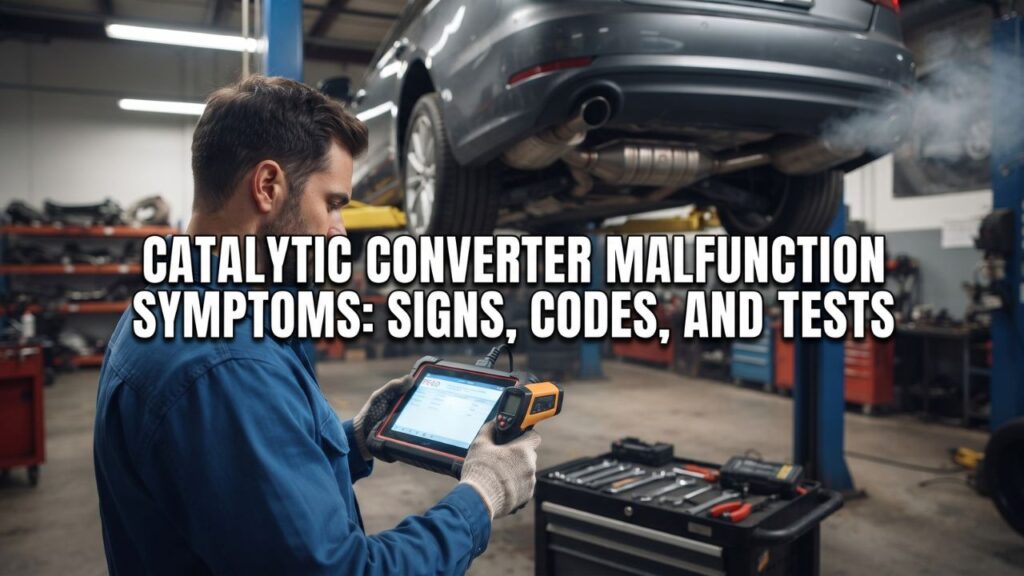
Scan All Trouble Codes
Connect an OBD-II scanner and record:
- Stored codes
- Pending codes
- Permanent codes where supported
- Freeze-frame information
- Readiness-monitor status
Do not clear codes before recording the information. Clearing them removes data that may reveal when and under what conditions the fault appeared.
A catalyst monitor marked Not Ready has not completed its diagnostic test since the last reset or power loss.
Check for Misfires First
Look for P0300-series codes and live misfire data if the scan tool supports it.
A converter should not be condemned before a severe active misfire has been addressed.
If the check engine light is flashing and the engine is shaking badly, reduce driving.
Inspect the Exhaust for Leaks and Damage
Check the system while it is cool.
Look for:
- Cracked manifolds
- Damaged flex sections
- Failed gaskets
- Loose connections
- Impact damage
- Soot around leaks
- Loose heat shields
A damaged converter shell may also reveal impact marks or severe discoloration.
Review Oxygen-Sensor Data
On many gasoline vehicles, catalyst diagnosis involves comparing data from sensors before and after the converter.
A healthy catalyst changes the exhaust-gas pattern seen downstream.
Modern wideband air-fuel sensors operate differently from older narrowband oxygen sensors, so a single generic voltage rule should not be applied to every vehicle.
Use the diagnostic procedure for the exact engine.
Test for Exhaust Backpressure
If the primary complaint is power loss, a backpressure test can reveal a physical restriction.
Pressure is commonly measured upstream of the suspected blockage using an approved test location and gauge.
High pressure before the converter points toward restricted exhaust flow.
Vehicle-specific limits should guide the result rather than a universal pressure number.
Do Not Rely on Temperature Alone
Converter inlet and outlet temperatures can add diagnostic information, but temperature alone does not prove that the converter is good or bad.
Engine load, mixture, converter design, outside temperature, and test conditions all influence exhaust temperature.
Use temperature readings alongside codes, sensor data, backpressure, and physical inspection.
Key Takeaway: Good diagnosis combines code scanning, misfire checks, leak inspection, sensor data, and backpressure testing rather than relying on one temperature reading or one trouble code.
What Causes a Catalytic Converter to Malfunction?
Misfires and Excess Fuel
Repeated misfires and rich operation can send unburned fuel into the converter.
That fuel may burn in the exhaust and raise internal temperatures high enough to damage the substrate.
A flashing check engine light deserves fast attention for this reason.
Oil and Coolant Contamination
Oil ash and coolant-related deposits can cover catalyst surfaces.
The converter may gradually lose the ability to process exhaust gases even if the internal passages remain physically open.
Repair the engine problem before fitting another converter.
Impact and Internal Breakage
The converter sits beneath the vehicle and can be struck by road debris or damaged during off-road driving.
A hard impact may crack the internal ceramic structure.
Broken pieces can rattle or restrict flow.
Age and Thermal Cycling
Converters go through repeated heating and cooling during normal driving.
Over many years and miles, catalyst performance can decline and internal components can deteriorate.
There is no fixed replacement interval. A converter that continues passing its diagnostic tests and permits normal exhaust flow does not need replacement solely because it is old.
Key Takeaway: Excess fuel, misfires, oil, coolant, physical impact, and long-term heat cycling are common paths to converter damage.
When Catalytic Converter Symptoms Mean You Should Stop Driving
A steady P0420 or P0430 with otherwise normal engine operation is different from a severe restriction or active misfire.
Arrange diagnosis soon, but some symptoms call for much faster action.
Stop normal driving if you notice:
- A flashing check engine light with severe misfire
- Major loss of acceleration
- Repeated engine stalling
- A converter glowing red or orange
- Extreme heat under the floor
- Smoke or a strong burning odor
- An engine that cannot rev normally
- Hard starting combined with severe power loss
A vehicle that cannot accelerate with surrounding traffic can also create a road-safety problem.
If the converter is still within the applicable U.S. federal emissions warranty, check coverage before paying for replacement. The EPA states that specified major emissions components, including catalytic converters, receive federal coverage for 8 years or 80,000 miles, whichever occurs first, subject to the warranty conditions.
Does a Bad Catalytic Converter Always Need Replacement?
Not every catalyst-related code means the converter needs replacement.
A repair may involve an exhaust leak, oxygen sensor, ignition part, injector, or another upstream fault if testing shows the converter itself remains sound.
A converter generally needs replacement when its internal catalyst has degraded beyond specification, the substrate has melted or broken, or the unit is physically restricted.
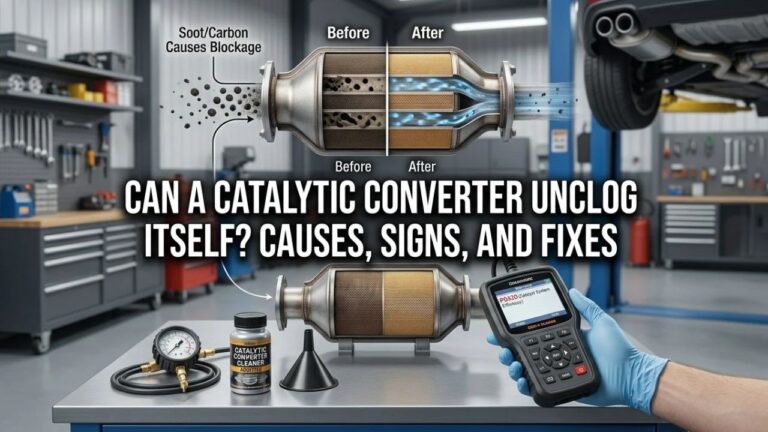
A cleaner cannot rebuild:
- Melted ceramic
- Broken honeycomb
- Missing catalyst material
- Severe internal collapse
If another engine fault damaged the converter, that fault should be repaired before or during replacement.
Otherwise, the new converter can suffer the same failure.
Conclusion
Catalytic converter malfunction symptoms can range from a simple check engine light to severe power loss, rattling, sulfur odor, high exhaust heat, hard starting, stalling, and failed emissions testing. The exact symptom pattern often reveals if the problem is mainly catalyst efficiency, physical restriction, or internal breakage.
P0420 and P0430 deserve diagnosis rather than automatic converter replacement. Oxygen sensors, exhaust leaks, misfires, rich fuel mixtures, oil burning, and coolant contamination can produce similar results or damage the catalyst.
I would start with a complete code scan and engine-condition check, then inspect the exhaust and test for restriction if the car has lost power. Confirming the failure before buying a converter reduces the chance of replacing the wrong part or damaging the replacement with an unresolved engine fault.
FAQs About Catalytic Converter Malfunction Signs
What Is the Most Common Sign of a Bad Catalytic Converter?
A check engine light with P0420 or P0430 is one of the most common signs of reduced catalyst efficiency. A physically clogged converter is more likely to produce power loss, poor acceleration, excessive heat, or difficulty reaching higher RPM.
Can a Bad Catalytic Converter Cause Rough Idle?
It can if exhaust restriction becomes severe, but rough idle has many other causes. Ignition misfires, vacuum leaks, fuel-injector faults, airflow problems, and compression issues are common possibilities. Check engine codes and live data before blaming the converter.
What Does a Bad Catalytic Converter Sound Like?
A damaged converter may produce a metallic rattling sound if its internal ceramic substrate has cracked or broken apart. A loose heat shield or exhaust bracket can make a similar noise, so the source should be inspected before the converter is replaced.
Can a Bad Catalytic Converter Cause Loss of Power?
Yes. A clogged converter can restrict exhaust flow and reduce engine output, most noticeably during acceleration or at higher RPM. The car may feel normal at idle but struggle on hills or when merging onto a highway.
Does a Bad Catalytic Converter Smell Like Rotten Eggs?
A sulfur or rotten-egg smell can occur with converter or fuel-mixture trouble. It may indicate that sulfur compounds are not being processed normally or that an overly rich mixture is affecting the exhaust. Smell alone does not confirm converter failure.
Can a Bad Catalytic Converter Cause Stalling?
A severe exhaust restriction can make the engine stall because exhaust gases cannot leave the cylinders normally. Stalling can also come from ignition, fuel, sensor, or mechanical faults, so restriction should be tested rather than assumed.
Can a Catalytic Converter Be Bad Without a Check Engine Light?
Yes. A converter can be physically restricted, damaged internally, or deteriorating before the OBD system stores a catalyst-efficiency code. The catalyst monitor may also be incomplete after codes were cleared or battery power was disconnected.
How Do You Confirm a Catalytic Converter Is Bad?
Start with a full OBD scan, check related misfire and fuel codes, inspect for exhaust leaks, review oxygen-sensor data, and test exhaust backpressure if restriction is suspected. Replacement makes sense after the evidence points to catalyst failure rather than another engine or exhaust fault.