Do Electric Vehicles Have Catalytic Converters? Full EV Guide
Fully electric cars do not have catalytic converters. A battery-electric vehicle has no gasoline or diesel engine producing combustion exhaust, so it does not need the exhaust pipe, tailpipe catalyst, oxygen-sensor arrangement, or other emissions hardware used to clean gases from an internal-combustion engine.
Hybrid vehicles are different. Conventional hybrids and plug-in hybrids still contain an internal-combustion engine, even though an electric motor can propel the vehicle for part of the trip. When that engine runs, it produces exhaust and needs emissions-control equipment.
EPA confirms that battery-electric vehicles produce zero tailpipe emissions, while plug-in hybrids produce tailpipe emissions whenever their gasoline engine operates. The agency also reports that EVs use about 87%-91% of battery and regenerative-braking energy to propel the vehicle, compared with roughly 16%-25% of gasoline energy converted to vehicle movement in conventional cars.
So, do electric vehicles have catalytic converters? If you mean a true battery-electric vehicle such as a Tesla, Ford Mustang Mach-E, Chevrolet Equinox EV, Hyundai Ioniq 5, or Nissan Leaf, the answer is no. If the vehicle is a hybrid or plug-in hybrid with a gasoline engine, it normally does have a catalytic converter.
This distinction also affects maintenance and theft risk. A battery EV owner does not need to replace a failed catalytic converter, repair an exhaust leak, or worry about someone stealing an exhaust catalyst that the vehicle never had.
The sections below explain why battery EVs do not need catalytic converters, which hybrids still use them, what happens when a plug-in hybrid drives in electric mode, what EVs use instead of an exhaust system, and how fuel-cell vehicles fit into the picture.
Do Electric Vehicles Have Catalytic Converters?
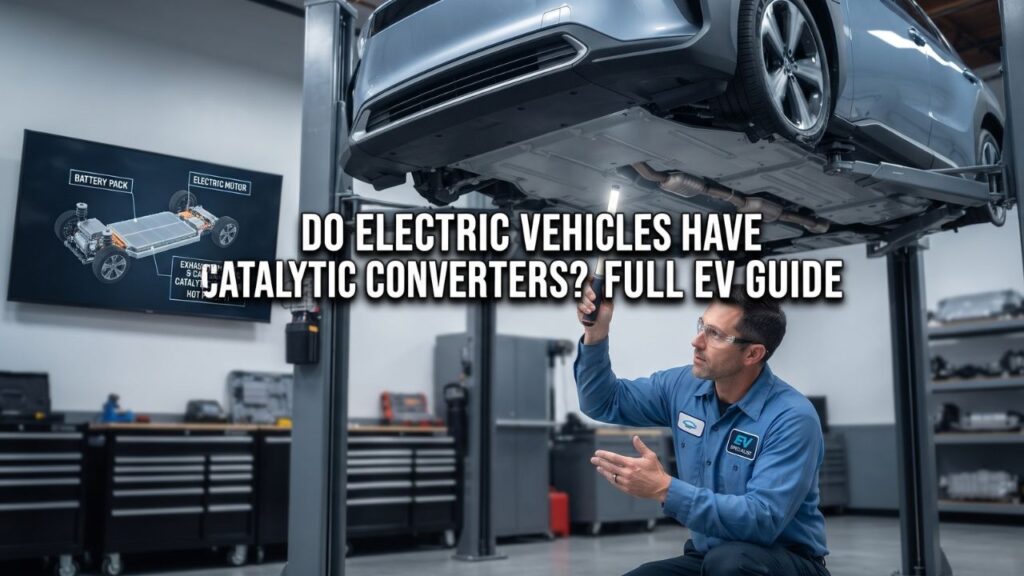
Battery-electric vehicles, usually called BEVs, do not use conventional catalytic converters.
The U.S. Department of Energy describes an all-electric vehicle as a vehicle powered by a traction battery and electric motor instead of an internal-combustion engine. Because the vehicle runs on electricity, it produces no exhaust from a tailpipe.
Why Gasoline Cars Need Catalytic Converters
A gasoline engine burns an air-fuel mixture inside its cylinders.
That combustion process can create pollutants such as:
- Carbon monoxide
- Unburned hydrocarbons
- Nitrogen oxides
The exhaust passes through a catalytic converter before leaving the tailpipe.
Catalyst materials such as platinum, palladium, and rhodium promote chemical reactions that reduce these pollutants.
An electric traction motor does not burn gasoline in cylinders, so those combustion gases are never produced onboard.
Why Battery EVs Can Skip the Converter
A BEV replaces the combustion powertrain with electrical components such as:
- High-voltage traction battery
- Electric traction motor
- Power electronics
- Inverter
- DC/DC converter
- Charging hardware
- Thermal-management system
There is no gasoline combustion process that requires a three-way exhaust catalyst.
EPA states directly that electric vehicles have a battery in place of a gasoline tank and an electric motor in place of an internal-combustion engine, resulting in no tailpipe emissions.
Key Takeaway: A true battery EV does not need a catalytic converter because it has no fuel-burning engine creating exhaust gases that require treatment.
Do Hybrid Electric Vehicles Have Catalytic Converters?
Yes. Conventional hybrid electric vehicles generally use catalytic converters because they still have an internal-combustion engine.
Examples include vehicles based on the same general powertrain concept as the Toyota Prius, Toyota Camry Hybrid, Honda Accord Hybrid, and many hybrid SUVs.
Why a Hybrid Still Needs an Exhaust System
A hybrid combines an electric motor with a gasoline engine.
At certain times the electric motor may move the car alone. At other times the gasoline engine starts to:
- Propel the vehicle
- Assist the electric motor
- Charge or support the battery system
- Provide power during heavier acceleration
- Operate under selected speed or temperature conditions
Once gasoline is burned, combustion exhaust is produced.
The Department of Energy lists an exhaust system with a three-way catalyst among the main components of a hybrid electric car.
Hybrid Engine-Off Operation Does Not Remove the Converter
A hybrid may shut its gasoline engine off at traffic lights or during low-speed electric driving.
That does not mean the converter can be removed.
The catalyst must be present whenever the gasoline engine restarts.
Hybrid emissions systems can face a special challenge because the engine may repeatedly cool while the vehicle is running electrically. Catalysts work best after reaching their required operating temperature, so manufacturers design hybrid control strategies around engine restarts and catalyst heating. EPA has examined electrically heated catalyst technology as one possible approach for hybrid and plug-in hybrid emissions systems.
Key Takeaway: Conventional hybrids still need catalytic converters because their gasoline engines continue to produce exhaust whenever they operate.
Do Plug-In Hybrid Vehicles Have Catalytic Converters?
Yes. A plug-in hybrid electric vehicle, or PHEV, normally has a catalytic converter.
A PHEV differs from a full EV because it combines a larger rechargeable battery with an internal-combustion engine.
What Happens During Electric-Only Driving?
When a plug-in hybrid is driving entirely on battery power, its gasoline engine can remain off.
During that period, the vehicle produces no tailpipe emissions from the engine.
EPA confirms that a PHEV produces no tailpipe emissions while operating only on electricity but begins producing tailpipe emissions when gasoline is used.
The catalytic converter remains installed because the engine may start later in the trip.
Why PHEVs Cannot Remove Their Catalytic Converters
A plug-in hybrid may switch to gasoline operation when:
- Battery charge becomes low
- Higher power is requested
- Cabin heating requires engine operation on some models
- Operating conditions call for engine assistance
- The vehicle enters hybrid mode
The Department of Energy lists a three-way catalyst in the exhaust system of a plug-in hybrid, along with its gasoline tank and internal-combustion engine.
That makes a PHEV much closer to a conventional hybrid than a BEV from an exhaust-maintenance standpoint.
Key Takeaway: A plug-in hybrid still carries a catalytic converter even if many trips are completed without starting the gasoline engine.
Electric Vehicle vs Hybrid Catalytic Converter Comparison
The easiest way to answer the question is to look at the vehicle’s power source.
| Vehicle type | Gasoline/diesel engine | Tailpipe exhaust | Catalytic converter |
| Battery EV (BEV) | No | No | No |
| Conventional hybrid (HEV) | Yes | Yes when engine runs | Yes |
| Plug-in hybrid (PHEV) | Yes | Yes when engine runs | Yes |
| Gasoline car | Yes | Yes | Yes |
| Diesel vehicle | Yes | Yes | Uses diesel after-treatment |
| Hydrogen fuel-cell EV | No combustion engine | Water vapor from fuel-cell operation | No conventional tailpipe catalytic converter |
The naming can cause confusion because a hybrid is often described as an “electrified” vehicle.
For this question, the presence of an internal-combustion engine is the main dividing line.
If fuel is burned onboard and combustion gases enter an exhaust system, emissions-control hardware is needed.
If propulsion comes entirely from a battery and electric motor, there is no combustion exhaust to send through a catalytic converter.
Why Full Electric Cars Do Not Have Exhaust Systems
A conventional exhaust system exists mainly to handle gases leaving a combustion engine.
It normally contains components such as:
- Exhaust manifold
- Oxygen sensors
- Catalytic converter
- Exhaust pipes
- Resonator
- Muffler
- Tailpipe
A battery EV has no combustion cylinders producing those gases.
The Department of Energy states that all-electric vehicles emit no exhaust from a tailpipe and do not contain normal liquid-fuel components such as a fuel tank, fuel line, or fuel pump.
EVs Still Need Thermal Management
The absence of an exhaust system does not mean an EV has no heat-management components.
An EV may have separate cooling circuits for its:
- Battery
- Electric motor
- Inverter
- Power electronics
- Cabin
These systems control component temperature using coolant, radiators, pumps, valves, fans, refrigerant loops, or heat pumps.
They do not perform the same job as a catalytic converter.
EVs Still Produce Some Non-Tailpipe Emissions
A battery EV has no combustion tailpipe emissions, but vehicle operation is not completely emission-free in every sense.
EPA notes that EVs still produce particulate matter from tire and brake wear, and electricity generation can create upstream emissions depending on how the electricity is produced.
Regenerative braking can reduce use of the friction brakes during many driving situations, which can also reduce brake wear.
Key Takeaway: Full EVs eliminate the conventional exhaust system, though they still have thermal-management hardware and can create tire, brake, and upstream electricity-related emissions.
Can a Catalytic Converter Be Stolen From an Electric Car?
Not from a true battery-electric car, because there is no conventional catalytic converter installed.
A thief looking beneath a BEV will not find the familiar exhaust catalyst containing platinum-group metals.
That means full EVs are not targets for catalytic converter theft in the same way gasoline vehicles and hybrids can be.
Why Hybrids Can Still Be Targets
Hybrids do contain catalytic converters.
Some hybrid converters have historically attracted theft because they contain recoverable precious metals and may experience operating conditions that preserve catalyst material well.
A hybrid should therefore not be treated like a full EV when considering converter theft.
How to Tell Which Type You Own
Check the vehicle type if you are unsure.
A battery EV normally has:
- Charging port
- High-voltage battery
- No gasoline filler
- No engine oil changes
- No exhaust tailpipe
A plug-in hybrid normally has:
- Charging port
- Gasoline filler
- Electric motor
- High-voltage battery
- Gasoline engine
- Exhaust system
If it takes gasoline, there is a strong chance it has an exhaust catalyst.
Does a Tesla Have a Catalytic Converter?
No. Tesla passenger vehicles are battery-electric vehicles.
They use high-voltage battery packs and electric motors rather than gasoline engines.
Since there is no combustion engine producing exhaust, Tesla vehicles do not need conventional catalytic converters, mufflers, or tailpipes.
The same general rule applies to other full battery EVs such as many models from Rivian, Lucid, Polestar, Hyundai, Kia, Ford, Chevrolet, Nissan, BMW, Mercedes-Benz, Volkswagen, and other manufacturers.
Always distinguish the specific powertrain, since some manufacturers sell BEVs, hybrids, plug-in hybrids, and gasoline models under the same brand.
Do Hydrogen Fuel-Cell Electric Vehicles Have Catalytic Converters?
A hydrogen fuel-cell electric vehicle is another case where terminology can be confusing.
Fuel-cell vehicles use hydrogen in a fuel-cell stack to generate electricity, which then powers an electric motor.
EPA states that a fuel-cell electric vehicle operating on hydrogen emits water vapor from the vehicle rather than conventional combustion tailpipe pollutants.
As a result, these vehicles do not need a conventional gasoline-style three-way catalytic converter in an exhaust pipe.
Fuel Cells Can Still Use Platinum Catalysts
A fuel-cell stack may use platinum as a catalyst for electrochemical reactions.
That does not make the fuel-cell stack a catalytic converter.
A catalytic converter treats combustion exhaust.
A fuel-cell catalyst helps generate electricity from hydrogen and oxygen.
The two components may contain related catalyst metals, but their jobs and locations are completely different.
Does an EV Need Oxygen Sensors or a Muffler?
A pure battery EV does not need conventional engine-exhaust oxygen sensors because there is no combustion exhaust to measure.
It also does not require a muffler for engine exhaust.
Why Gas Cars Use Oxygen Sensors
Gasoline vehicles use oxygen or air-fuel-ratio sensors to monitor oxygen content in exhaust gases.
The engine computer uses that information to control combustion and monitor catalytic-converter performance.
With no gasoline engine, a BEV does not need that exhaust feedback system.
Why EVs Can Still Make Sounds
An EV can still produce noise from:
- Tires
- Electric motors
- Gear reduction units
- Cooling pumps
- HVAC system
- Battery cooling fans
- Road and wind movement
Some EVs also generate artificial low-speed warning sounds so pedestrians can hear the vehicle approaching.
None of these requires an exhaust muffler.
Does Removing the Catalytic Converter Make a Hybrid Fully Electric?
No.
Removing emissions equipment does not change how the powertrain works.
A hybrid still contains its gasoline engine and will still burn fuel when its control system calls for engine operation.
The proper emissions equipment must remain installed on road vehicles subject to those requirements.
If a hybrid converter fails, diagnose the engine fault that damaged it and fit the correct replacement rather than treating the car as an EV.
Are Electric Vehicles Cheaper to Maintain Without a Catalytic Converter?
The absence of a catalytic converter is one part of the reduced routine powertrain maintenance associated with a BEV.
The Department of Energy states that all-electric vehicles generally need less maintenance because they have fewer moving parts and fluids than vehicles containing an internal-combustion engine. PHEVs and conventional hybrids still have gasoline engines, so their maintenance requirements are closer to those of conventional vehicles.
A full EV owner does not normally face maintenance involving:
- Catalytic converter replacement
- Engine oil changes
- Spark plugs
- Fuel injectors
- Exhaust leaks
- Muffler replacement
- Oxygen sensors
- Engine air-fuel faults
EVs still require tires, suspension work, brake inspections, cabin filters, cooling-system service where specified, and other vehicle maintenance.
The traction battery, charging system, and high-voltage electronics also introduce components that gasoline vehicles do not have.
Conclusion
So, do electric vehicles have catalytic converters? Full battery-electric vehicles do not. They have no internal-combustion engine, produce no tailpipe exhaust, and therefore have no need for a conventional exhaust catalyst.
Conventional hybrids and plug-in hybrids are different because they retain a gasoline engine. The Department of Energy specifically lists a three-way catalyst as part of both HEV and PHEV exhaust systems.
The quickest rule is simple: if the vehicle runs entirely from a battery and electric motor, there is no catalytic converter. If it can burn gasoline or diesel to propel the vehicle, expect some form of exhaust emissions-control equipment.
FAQs About Electric Vehicles and Catalytic Converters
Do fully electric cars have catalytic converters?
No. Battery-electric vehicles do not burn gasoline or diesel and have no conventional engine exhaust. EPA and the Department of Energy state that full EVs produce no tailpipe emissions, so a catalytic converter is unnecessary.
Do hybrid cars have catalytic converters?
Yes. Conventional hybrids use both an internal-combustion engine and an electric motor. The gasoline engine still creates exhaust whenever it operates, so the exhaust system contains a catalyst to reduce engine-out pollutants.
Do plug-in hybrids have catalytic converters?
Yes. A PHEV may travel some distance using electricity alone, but it also contains a gasoline engine. Once that engine starts, exhaust gases need emissions treatment, so plug-in hybrids normally have a three-way catalytic converter.
Do Tesla cars have catalytic converters?
No. Tesla road cars use battery-electric powertrains rather than gasoline engines. With no combustion exhaust to clean, they do not use conventional catalytic converters, exhaust pipes, mufflers, or tailpipes.
Can thieves steal a catalytic converter from an EV?
A thief cannot steal a conventional catalytic converter from a true battery EV because the vehicle does not have one. Hybrids and plug-in hybrids are different because their gasoline engines still require catalytic converters.
Do electric cars have exhaust pipes?
Full battery EVs do not need conventional engine exhaust pipes because they produce no combustion exhaust. Cooling systems, battery vents, and other underbody components can sometimes be mistaken for exhaust hardware, but they perform different jobs.
Do hydrogen cars have catalytic converters?
Hydrogen fuel-cell vehicles do not need a conventional gasoline-style catalytic converter because their onboard fuel-cell process produces water vapor rather than normal engine exhaust pollutants. A fuel-cell stack may use platinum catalyst material, but that component is not an exhaust catalytic converter.