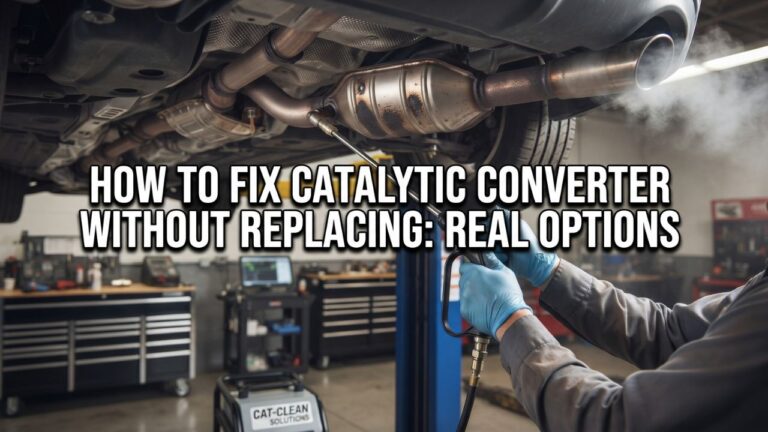
How to Fix Clogged Catalytic Converter Without Replacing It: Tips
A mildly restricted catalytic converter may improve without replacement if the real problem is carbon buildup caused by an engine fault that can be corrected. Diagnose the restriction first, repair misfires or fuel-mixture problems, fully warm the exhaust, and retest it. A melted, collapsed, broken, or heavily contaminated catalyst cannot normally be cleaned back into service.
That difference can save you from spending money on cleaners that have little chance of working. A converter described as “clogged” may have light deposits, but it may also contain ceramic passages that have physically melted together from extreme heat. Cleaning can only address the first type.
The benefit of diagnosing the cause first is that you may restore normal exhaust flow without replacing a serviceable converter. It also protects the converter from being damaged again by the same misfire, rich mixture, oil consumption, or coolant leak that caused the trouble.
For U.S. vehicles, there is another reason to check before paying for replacement. EPA states that catalytic converters are among the major emissions components covered by the federal emissions warranty for 8 years or 80,000 miles on qualifying vehicles, subject to the warranty requirements.
So, how to fix clogged catalytic converter without replacing it starts with confirming that the converter is truly restricted and finding out what created the restriction. A backpressure test is far more useful than assuming a P0420 code means the exhaust is plugged.
I’d start with engine codes, misfire history, fuel trims, exhaust backpressure, and converter temperature before pouring anything into the fuel tank. A cleaner may have a limited role with light deposits, but no additive can rebuild a cracked honeycomb or reopen ceramic passages that have melted into a solid mass.
The steps below show how to diagnose the restriction, correct the engine fault behind it, attempt the few non-replacement measures that make sense, and recognize the point where replacement is the only realistic repair.
What Does a Clogged Catalytic Converter Actually Mean?
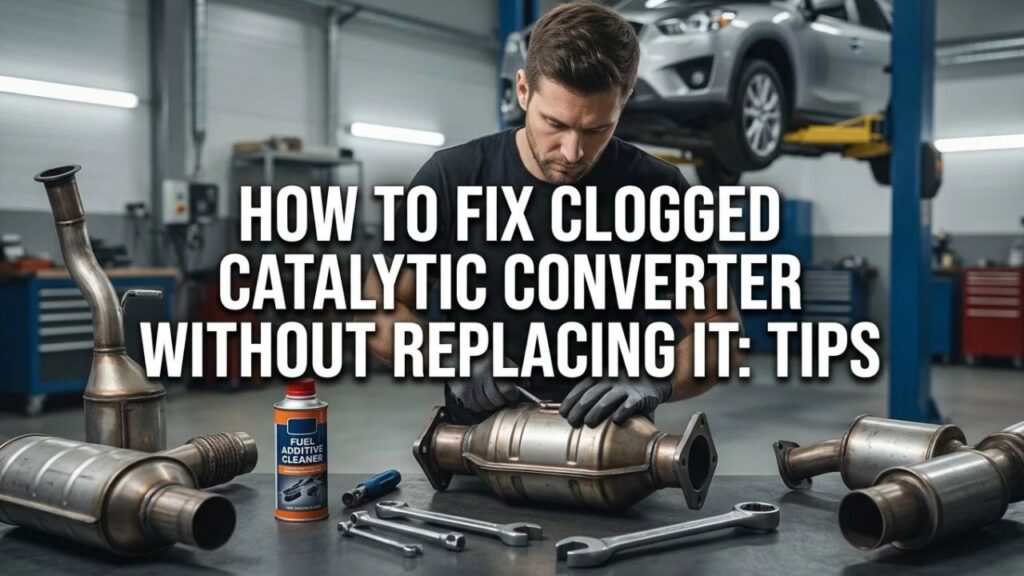
A catalytic converter contains a ceramic or metallic substrate formed into many tiny passages. Exhaust passes through these passages while catalyst materials react with pollutants.
A “clog” can describe several very different conditions.
Light Carbon or Soot Deposits
Carbon deposits can coat the substrate when combustion is poor.
Possible causes include:
- Rich air-fuel mixture
- Repeated short trips
- Weak ignition
- Incomplete combustion
- Injector problems
- Sensor faults affecting fuel control
Light deposits do not necessarily mean the internal structure is destroyed.
If the engine fault is corrected early, normal high exhaust temperature may remove some deposits during continued operation.
Melted or Collapsed Substrate
This is much more serious.
Walker explains that a converter exposed to excessive heat can melt internally. Once the ceramic substrate melts and turns into a solid restriction, the vehicle may become sluggish because exhaust flow is blocked. Common causes include engine misfires, excess fuel entering the exhaust, and other conditions that create extreme converter temperatures.
No fuel additive can reshape melted ceramic.
A physically collapsed converter needs replacement.
Broken Internal Honeycomb
The substrate can crack from impact, thermal stress, age, or severe overheating.
Loose pieces may rattle inside the housing. They can also move and partly block the outlet, causing acceleration problems that change as the broken pieces shift.
Cleaning will not repair broken catalyst material.
Oil or Coolant Contamination
Oil burning and internal coolant leaks can coat the catalyst surface.
Walker lists excessive oil consumption and coolant entering the exhaust among causes of catalyst contamination. Once the washcoat is heavily fouled, catalytic activity can fall even if exhaust still flows through the passages.
Stopping the fluid contamination is necessary, but a severely poisoned converter may still require replacement.
Key Takeaway: Light deposits may improve after the engine fault is repaired, but melted, broken, collapsed, or heavily contaminated catalyst material is not a realistic cleaning job.
How to Fix Clogged Catalytic Converter Without Replacing It
The safest approach is diagnosis first, then repair of the cause, followed by a controlled attempt to restore normal catalyst operation if the substrate is still intact.
Step 1: Scan the Vehicle for Trouble Codes
Connect an OBD-II scanner and record every stored, pending, and permanent code before clearing anything.
Pay close attention to:
- P0420 — catalyst efficiency below threshold, Bank 1
- P0430 — catalyst efficiency below threshold, Bank 2
- P0300-P0308 — engine misfires
- Rich or lean mixture codes
- Oxygen-sensor codes
- Mass-airflow sensor codes
- Fuel-pressure or injector-related codes
A P0420 or P0430 code does not prove that the converter is clogged.
These codes mainly indicate that the powertrain control module believes catalyst efficiency is below its programmed threshold. A converter can fail an efficiency monitor and still flow exhaust freely.
Fix other engine codes before assuming the converter itself is the main fault.
Step 2: Confirm That Exhaust Flow Is Restricted
A backpressure test provides much stronger evidence of a clog.
A technician can remove an upstream oxygen sensor and connect a low-pressure exhaust gauge.
Walker gives the following general reference points for many vehicles:
- About 1 psi or less at idle
- About 3 psi or less at 2,500 rpm
Vehicle-specific service data should take priority because exhaust designs differ.
If pressure is high before the converter and low after it, the converter is a likely restriction.
High pressure behind the converter may point instead to a restricted muffler or resonator.
Step 3: Fix Misfires Before Trying to Clean Anything
A misfire is one of the fastest ways to destroy a catalyst.
Unburned fuel and oxygen leave the cylinder and enter the hot converter. That mixture can burn inside the catalyst and raise temperature enough to melt the substrate.
Check:
- Spark plugs
- Ignition coils
- Plug wires on vehicles that use them
- Fuel injectors
- Compression
- Vacuum leaks
- Valve sealing
- Fuel pressure
If the check engine light is flashing, avoid continued driving until the misfire is diagnosed.
Trying to “clean” the converter while the engine continues misfiring can make the damage worse.
Step 4: Correct Rich Fuel Operation
Excess fuel can create carbon deposits and extreme converter heat.
Check fuel trims and inspect likely causes such as:
- Leaking injectors
- Excess fuel pressure
- Bad mass-airflow readings
- Faulty oxygen or air-fuel-ratio sensors
- Engine coolant temperature sensor faults
- Intake or exhaust leaks affecting sensor readings
Walker advises correcting misfire, airflow, rich/lean, and oxygen-sensor faults before condemning or replacing the converter.
A rich mixture that remains unfixed can damage both the current converter and any replacement unit.
Step 5: Address Oil or Coolant Consumption
Watch for blue exhaust smoke, falling oil level, coolant loss, white exhaust smoke after warm-up, or contaminated spark plugs.
Oil may enter the cylinders through worn piston rings, valve seals, or another engine fault.
Coolant may enter through a head-gasket leak, cracked component, or another internal cooling-system problem.
Repair the source first.
Running a cleaner through an engine that continues burning oil or coolant does not solve the contamination problem.
Step 6: Fully Warm the Converter After the Engine Fault Is Repaired
If testing points to a mild deposit problem and the converter is not rattling, melted, or severely restricted, bringing the exhaust to normal operating temperature may help burn off light carbon.
Use the vehicle normally until the engine and exhaust are fully hot.
A steady highway drive can keep converter temperature more stable than repeated short trips. Do this only if:
- The engine is running smoothly
- No flashing check-engine light is present
- The converter is not glowing
- There is no severe loss of power
- Engine temperature is normal
- The exhaust is not showing signs of extreme heat
This is not a method for repairing a physical blockage.
If the vehicle can barely accelerate or the exhaust becomes extremely hot, stop driving and diagnose the restriction.
Step 7: Retest Backpressure and Performance
After correcting the engine problem and giving the converter a normal full-temperature operating cycle, repeat the same diagnostic checks.
Compare:
- Exhaust backpressure
- Acceleration
- Fuel trims
- Catalyst codes
- Converter inlet/outlet temperature
- Downstream O2-sensor behavior
If backpressure drops and normal power returns, deposits or the original engine-control fault may have been responsible.
If pressure remains high, the converter likely has physical internal damage.
Key Takeaway: The best non-replacement strategy is to confirm restriction, repair the engine fault causing deposits or heat, fully warm an intact converter, and retest its exhaust flow.
Can Catalytic Converter Cleaner Unclog a Converter?
A fuel-tank catalyst cleaner may help with light deposits in some situations, but expectations should be modest.
These products are added to fuel and pass through the combustion process before reaching the exhaust.
They cannot directly scrub the honeycomb like a mechanical cleaning tool.
They also cannot repair:
- Melted ceramic
- Broken substrate
- Collapsed passages
- Physical impact damage
- Severe oil contamination
- Severe coolant contamination
EPA also makes an important distinction about fuel additives. Registration of an additive with EPA does not mean EPA has proven the manufacturer’s claims about fuel economy or emissions improvement. Registration mainly addresses regulatory information and safety/emissions requirements rather than proving that the product fixes a clogged converter.
If you choose to try a cleaner, use only a product intended for your fuel type and follow its label exactly.
I would only consider this after checking for misfires and rich operation. Spending money on an additive while the engine continues dumping excess fuel into the converter attacks the symptom rather than the cause.
Can Driving at Highway Speed Clean a Catalytic Converter?
Sometimes a fully warmed drive may reduce light carbon accumulation, especially after the engine problem creating the deposits has been repaired.
The key is light accumulation.
Normal converter operation creates high temperatures that can burn hydrocarbons and some carbonaceous deposits. Short-trip vehicles may spend more time with a cooler exhaust system, so an extended normal drive can place the catalyst under more stable operating conditions.
Do not use aggressive driving as an attempt to “burn out” a badly clogged converter.
Avoid hard acceleration or sustained high RPM if the vehicle has:
- Major power loss
- A flashing check-engine light
- Severe misfire
- Converter overheating
- Red-glowing exhaust
- Strong burning smell
- Stalling
- High measured backpressure
Those symptoms suggest a fault that needs repair rather than more heat.
What You Should Not Do to a Clogged Catalytic Converter
Several online methods can damage the converter, create a fire risk, expose you to chemicals, or violate emissions law.
Do Not Gut or Hollow Out the Converter
Removing the internal catalyst may make a blocked exhaust flow again, but that is not a lawful repair for a road vehicle in the United States.
EPA states that removing or rendering required emissions equipment inoperative is prohibited under federal anti-tampering law. That rule applies to vehicle owners as well as repair businesses.
A blocked converter should be repaired by correcting the root cause and installing an approved replacement if the converter itself has failed.
Do Not Pour Lacquer Thinner Into the Fuel Tank
Lacquer thinner is not vehicle fuel-system service fluid.
Its solvents may attack seals, hoses, fuel-system materials, coatings, or sensors, and there is no sound reason to treat it as a standard catalyst repair.
Use only additives specifically labeled for automotive fuel systems and compatible with the vehicle.
Do Not Pressure-Wash the Converter Internally
High-pressure water can damage fragile catalyst material.
A converter’s honeycomb is not built like a washable household filter. If the brick is already cracked or weakened, high pressure can break it apart further.
Water left inside the exhaust may also create thermal-shock problems when the converter heats again.
Do Not Soak It in Random Chemicals
Caustic cleaners, acids, strong solvents, degreasers, and household cleaning chemicals can damage the catalyst coating or substrate.
They also create disposal problems once mixed with exhaust contaminants.
Unless the vehicle or converter manufacturer provides a specific service procedure, chemical soaking is not a normal repair for a gasoline passenger-car catalytic converter.
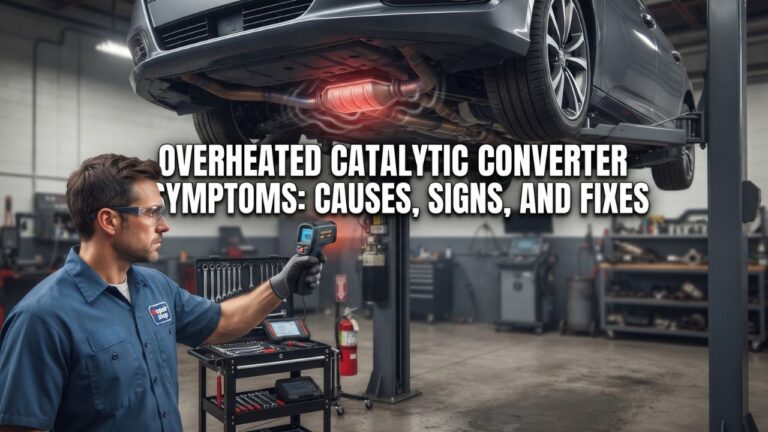
Do Not Keep Driving a Glowing Converter
A converter that glows red is receiving extreme heat.
Misfires and rich operation are common causes.
Continued driving can melt the substrate, damage nearby components, and create a fire hazard around dry grass or other combustible material.
Key Takeaway: Avoid gutting, solvent experiments, pressure washing, chemical soaking, and driving an overheated converter; these methods do not repair structural catalyst damage.
How to Tell When Cleaning Will Not Work
There is a point where attempts to save the converter stop making financial sense.
The Converter Rattles Internally
A rattle from inside the converter can indicate a cracked or loose substrate.
Broken ceramic cannot be reattached with an additive.
Loose pieces may also move and block the outlet.
Backpressure Stays High After Engine Repairs
If the engine runs correctly but exhaust pressure remains above specification before the converter, internal restriction is still present.
Walker notes that high backpressure ahead of the converter points toward a restricted converter.
That is stronger evidence than a catalyst-efficiency code alone.
The Substrate Has Melted
Severe heat can fuse the small honeycomb passages together.
Walker states that converter meltdown commonly follows misfires, rich operation, or other conditions that allow unburned fuel to burn inside the catalyst.
Once the passages become a solid mass, replacement is the realistic repair.
The Converter Is Physically Damaged
A road impact can dent the housing and break the catalyst brick.
Corrosion can also weaken the shell or surrounding exhaust pipes.
No cleaner repairs mechanical damage.
Heavy Oil or Coolant Fouling Has Poisoned the Catalyst
Fixing the engine leak stops future contamination, but the catalyst coating may already be damaged.
If emissions testing, O2-sensor data, or catalyst-efficiency testing still shows poor conversion after the engine is repaired, replacement may be needed.
Key Takeaway: Rattling, persistent high backpressure, melted passages, impact damage, or severe catalyst poisoning usually means cleaning will not restore the converter.
Why Catalytic Converters Become Clogged
A converter usually fails because something else has gone wrong.
Engine Misfires
A persistent misfire sends unburned fuel and oxygen into the exhaust.
That mixture can burn inside the converter and create enough heat to damage the ceramic substrate.
Do not install a new converter before repairing the misfire.
Rich Air-Fuel Mixture
Too much fuel can cause carbon buildup and converter overheating.
Check fuel pressure, injectors, airflow readings, oxygen sensors, and other fuel-control inputs.
Excessive Oil Consumption
Burned engine oil leaves ash and deposits in the exhaust.
A vehicle consuming large quantities of oil may contaminate the converter repeatedly until the engine problem is corrected.
Internal Coolant Leak
Coolant entering a combustion chamber can pass into the exhaust and contaminate the catalyst.
Check unexplained coolant loss before replacing an emissions component.
Impact Damage
Road debris or bottoming out can strike the converter.
A hard impact may fracture the honeycomb or move the substrate inside its shell.
Key Takeaway: Misfires, rich operation, oil burning, coolant leaks, and physical damage should be corrected before expecting any converter repair to last.
Is It Worth Trying to Save a Clogged Catalytic Converter?
It makes sense to try a non-replacement approach when diagnostic results suggest the substrate is still physically intact.
Good candidates have:
- Mild symptoms
- No internal rattle
- No signs of severe overheating
- No glowing converter
- No evidence of melted ceramic
- A repairable engine-control fault
- Backpressure only slightly above normal
- Light deposit buildup rather than structural damage
The process is mainly about repairing the cause, not washing the converter.
A bad ignition coil, leaking injector, inaccurate sensor, or fuel-pressure fault can make a healthy converter appear to be the problem.
Once those faults are repaired, the converter may return to normal operation if its substrate has survived.
Replacement becomes more sensible when the car has major power loss, verified high backpressure, rattling catalyst material, repeated overheating, or evidence of melted passages.
Check the Federal Emissions Warranty Before Buying a Converter
For qualifying U.S. vehicles, EPA requires longer warranty coverage for certain major emissions components.
Catalytic converters are among the parts covered for 8 years or 80,000 miles, whichever comes first, subject to federal warranty rules.
If the car falls within that age and mileage range, contact the vehicle manufacturer or authorized dealer before purchasing an aftermarket converter.
Have the VIN, mileage, diagnostic codes, and service records available.
Warranty coverage can turn an expensive repair into a manufacturer-covered service if the failure qualifies.
Conclusion
The realistic answer to how to fix clogged catalytic converter without replacing it is to first determine what “clogged” means. A converter with light deposits may recover after misfires, rich running, or other engine faults are corrected and the exhaust returns to normal operating temperature.
Confirm restriction with a backpressure test rather than relying only on P0420, P0430, smell, temperature, or slow acceleration. A typical diagnostic reference is around 1 psi or less at idle and 3 psi or less near 2,500 rpm, though the vehicle’s service specification should control the diagnosis.
I would avoid spending much money on cleaners until the engine has been checked. A fuel additive cannot repair melted ceramic, cracked honeycomb, severe contamination, or a substrate that has shifted and blocked the exhaust.
If the internal structure is physically damaged, replacement is the repair. Fix the engine fault first so the new converter does not suffer the same damage.
FAQs About Fixing a Clogged Catalytic Converter
Can a clogged catalytic converter clean itself?
A lightly contaminated converter may improve once the engine fault causing excess carbon is repaired and the catalyst spends enough time at normal operating temperature. A physically melted, broken, or collapsed converter cannot clean itself because the exhaust passages have been structurally damaged.
Will catalytic converter cleaner fix a clogged converter?
It may help with light deposits in some situations, but it cannot reopen melted passages or repair a broken substrate. EPA registration of a fuel additive also does not prove that the product’s repair or emissions claims work. Diagnose the cause and restriction before relying on an additive.
Can I unclog a catalytic converter by driving on the highway?
A normal highway drive after correcting an engine fault may help an intact converter reach stable operating temperature and burn light deposits. Do not try this if the converter is severely restricted, glowing, overheating, or paired with a flashing check-engine light or active misfire.
Can I remove a catalytic converter and wash it?
Routine washing is not a manufacturer-standard repair for most gasoline catalytic converters. Water pressure or chemicals can damage the fragile substrate or catalyst coating. If the unit is physically plugged from melted or collapsed material, washing will not restore the passages.
How do I know if my catalytic converter is physically clogged?
Poor acceleration that becomes worse at higher RPM is one clue, but a backpressure test is stronger evidence. High pressure before the converter with lower pressure after it points toward an internal restriction. Rattling, extreme heat, or a melted substrate also supports physical failure.
Will a bad oxygen sensor make a catalytic converter seem clogged?
A bad oxygen sensor can upset fuel control, trigger catalyst-related codes, and contribute to converter damage, but it does not physically block the exhaust by itself. Scan data should be checked before replacing the converter, especially if fuel trims or oxygen-sensor codes are abnormal.
Do I need to replace a catalytic converter if it is clogged?
If the clog comes from melted, collapsed, broken, or permanently contaminated catalyst material, replacement is usually required. If the substrate is intact and the restriction is only mild deposit buildup caused by a repairable engine fault, correcting that fault and retesting may prevent unnecessary replacement.