Does a Bad Catalytic Converter Affect Performance? Signs & Causes
A clogged or internally damaged catalytic converter can reduce engine power, make acceleration sluggish, limit higher-RPM operation, hurt fuel economy, and even cause hard starting or stalling. The strongest performance problems occur when the converter physically restricts exhaust flow rather than when it simply loses some emissions-cleaning ability.
This distinction can prevent an expensive wrong diagnosis. A P0420 or P0430 catalyst-efficiency code does not automatically mean the converter is clogged, and a vehicle can have a catalyst-efficiency problem while still accelerating normally.
A true exhaust restriction changes the way the engine breathes. Exhaust gases cannot leave the cylinders freely, backpressure rises, and the engine may feel increasingly weak as RPM and load increase. Correctly identifying that pattern helps separate converter restriction from ignition, fuel, transmission, or airflow problems.
The Federal Highway Administration reports 297,525,836 registered motor vehicles in the United States for 2024. Those vehicles cover a huge range of engine and exhaust designs, so converter symptoms and diagnostic limits can vary by application.
For does a bad catalytic converter affect performance, the short answer is yes when the converter becomes restricted, melted, broken internally, or badly contaminated. Walker lists delayed acceleration, loss of power, hard starting, stalling, and reduced fuel economy among drivability problems associated with a failing converter.
One detail deserves close attention: a converter can fail chemically without blocking exhaust flow. In that situation, the check-engine light or an emissions-test failure may appear before the driver notices any meaningful loss of power. AutoZone makes the same distinction in its P0420 guidance, noting that reduced acceleration becomes more likely when converter damage creates an exhaust restriction.
The sections below explain why a clogged converter reduces power, what the vehicle may feel like while driving, how fuel economy and RPM can change, which symptoms point somewhere else, and how technicians confirm a restriction before replacing the converter.
Does a Bad Catalytic Converter Affect Performance?
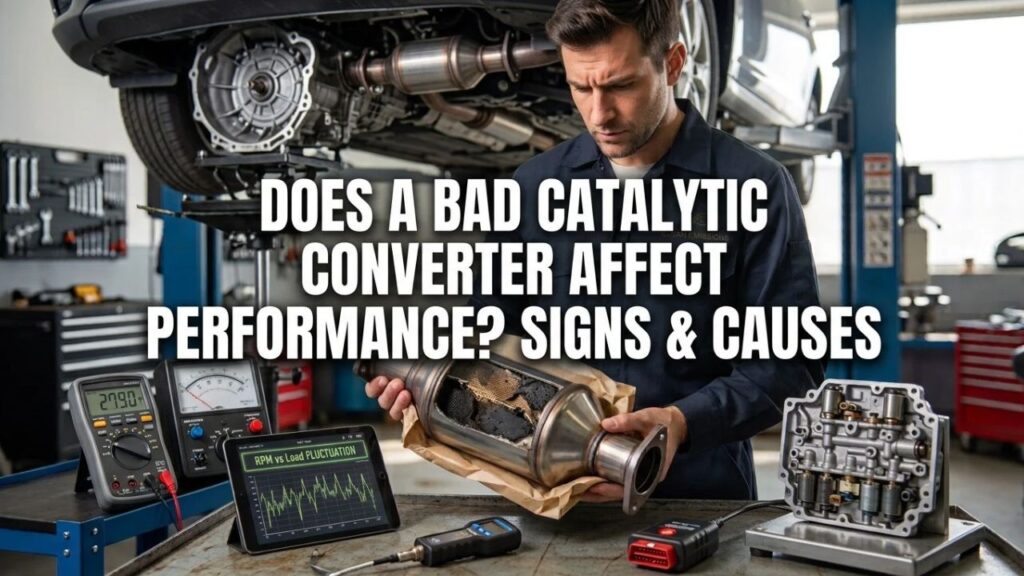
Yes, but the amount of performance loss depends on how the catalytic converter has failed.
A converter that is merely less capable of cleaning exhaust gases may have little effect on the way the engine runs. A converter with a melted, collapsed, or contaminated honeycomb can block exhaust flow enough to create severe drivability problems.
A Clogged Converter Increases Exhaust Backpressure
The engine works like an air pump. It draws air into the cylinders, burns fuel, and pushes the resulting exhaust gases out.
A restricted converter makes that last part harder.
Pressure builds in the exhaust system because gases cannot pass through the converter quickly enough. This is called exhaust backpressure.
Walker states that excessive backpressure ahead of the converter indicates converter restriction. Its diagnostic guidance gives a general reference of less than about 1.5 psi at idle and 3 psi at 2,000 RPM, while also stressing that specifications vary by application.
As backpressure rises, the cylinders may retain more exhaust gas after each exhaust stroke. That leaves less room for a fresh air-fuel charge and reduces the engine’s ability to make power.
Performance Loss Gets Worse Under Load
A mild restriction may barely be noticeable at idle.
The problem becomes clearer when exhaust flow increases during:
- Hard acceleration
- Higher RPM
- Highway merging
- Steep hills
- Towing
- Heavy vehicle loads
More engine load creates more exhaust gas. If the converter cannot pass that increased flow, backpressure rises further.
This explains why some vehicles idle smoothly yet feel weak once the accelerator is pushed harder.
Firestone identifies a restricted converter or exhaust as a cause of increased backpressure and poor acceleration.
A Fully Plugged Converter Can Stop the Engine
At the severe end of the problem, exhaust restriction can become strong enough to prevent normal engine operation.
The vehicle may start, idle briefly, then stall as exhaust pressure builds.
A severely blocked engine may also refuse to rev much beyond a certain point.
MagnaFlow lists hard starting and no-start conditions among possible symptoms when exhaust restriction becomes severe.
Key Takeaway: Converter failure affects performance most when internal damage physically restricts exhaust flow. The harder the engine tries to move air, the more obvious the power loss usually becomes.
How a Bad Catalytic Converter Changes Acceleration and Power
Reduced acceleration is one of the strongest drivability clues associated with a clogged converter.
The driver may press the accelerator farther than normal yet get less response.
Sluggish Acceleration
A partially blocked converter may cause the car to feel heavy or slow.
Typical complaints include:
- Delayed throttle response
- Weak highway merging
- Poor hill climbing
- Reduced passing power
- Slow acceleration from moderate speeds
The problem may resemble a weak fuel pump, dirty air sensor, ignition fault, or transmission issue.
One clue is that converter restriction often becomes worse as engine speed rises.
Engine Will Not Rev Freely
An engine with a restricted exhaust may rev normally at first, then reach a point where RPM rises very slowly or stops increasing.
That happens because exhaust flow demand is increasing faster than the blockage can pass it.
Severe restrictions may produce a feeling similar to hitting an invisible RPM limiter even though no electronic limiter is active.
Power May Return After the Engine Cools
Some internally damaged converters behave differently as temperature changes.
Broken or melted substrate material may shift inside the housing, creating an intermittent blockage.
A vehicle can therefore run better during one trip and worse during another.
A rattling noise from inside the converter can support suspicion of broken substrate, though a restricted converter does not have to rattle.
Turbocharged Engines Can Be More Sensitive
A turbocharger depends on exhaust flow.
Restriction downstream of the turbine can raise exhaust pressure and interfere with turbo operation. Underhood Service notes that restricted converters can create backpressure severe enough to affect turbocharger loading and durability.
A turbocharged vehicle with unexplained loss of boost or power still needs a complete diagnosis because boost leaks, wastegate faults, sensors, ignition problems, and fuel delivery can create similar symptoms.
Key Takeaway: Converter-related power loss is often most noticeable during acceleration and higher-RPM operation, when exhaust volume increases and the restriction becomes harder for the engine to overcome.
Can a Bad Catalytic Converter Affect Fuel Economy?
Yes, a restricted converter can contribute to worse gas mileage.
The engine may need more throttle to produce the same acceleration or road speed it previously achieved with less effort.
The Engine Has to Work Against the Restriction
Extra exhaust pressure means the pistons have to expend more energy pushing gases out.
The driver may compensate by pressing the accelerator farther.
That can increase fuel consumption, especially during city driving, hills, or highway acceleration.
Walker and MagnaFlow both identify reduced fuel economy as a possible result of converter or exhaust-flow problems.
Poor Mileage Can Come From the Original Fault
There is another possibility.
The converter may have been damaged by an engine that was already running too rich.
In that case, the rich condition can hurt fuel economy before the converter becomes restricted.
Possible underlying causes include:
- Leaking fuel injector
- Ignition misfire
- Incorrect sensor data
- Excessive fuel pressure
- Poor combustion
- Oil or coolant contamination
Replacing the converter without correcting the original fault may leave the fuel-economy problem unchanged and can damage the replacement converter.
Fuel Economy Alone Does Not Diagnose a Converter
Poor MPG has many possible causes.
Tire pressure, winter fuel, short trips, dragging brakes, oxygen sensors, engine temperature, injectors, ignition faults, and driving conditions can all change consumption.
Treat reduced fuel economy as supporting evidence rather than proof of converter failure.
Key Takeaway: A restricted converter can lower fuel economy by making the engine work harder, but poor MPG can also come from the engine problem that damaged the converter in the first place.
Symptoms of Performance Loss From a Bad Catalytic Converter
A single symptom rarely proves converter failure.
A group of symptoms is much more useful.
Poor Acceleration and Loss of Power
This is the classic performance complaint.
Power may drop most during high-load situations because exhaust flow is greatest then.
AutoZone lists poor acceleration and reduced engine performance among the common signs of a clogged converter.
Hard Starting
A severe blockage can make the engine difficult to start because gases from combustion cannot escape efficiently.
The vehicle may crank normally but take longer to fire.
Stalling
In extreme cases, backpressure can build until the engine can no longer maintain combustion.
The engine may start and then stall after a short period.
Limited High-RPM Performance
A partial restriction can allow acceptable operation at low RPM while severely limiting high-RPM airflow.
This pattern is especially useful when diagnosing a car that feels normal around town but loses most of its power on the highway.
Increased Exhaust or Underbody Heat
Restricted exhaust can trap heat upstream.
Excessive converter temperature may also occur if unburned fuel enters the exhaust from a rich mixture or misfire.
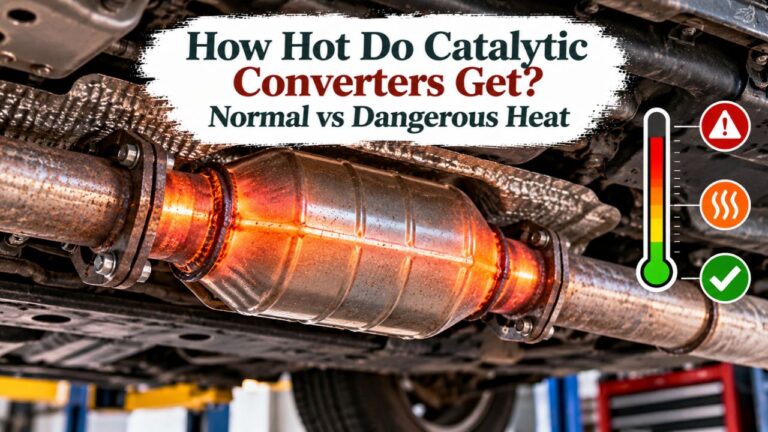
Walker states that converter temperatures above roughly 1,600°F can damage catalyst material, and melted substrate can occur at still higher temperatures.
Sulfur or Rotten-Egg Smell
A sulfur-like odor can occur with catalyst or fuel-mixture problems.
This symptom is not specific enough to diagnose the converter by itself.
Rattling Under the Vehicle
Broken catalyst material can move inside the converter housing and produce a metallic rattle.
The same internal damage may eventually obstruct exhaust passages.
Check-Engine Light
Catalyst problems commonly trigger codes such as:
- P0420
- P0430
These mean catalyst efficiency is below the expected threshold for the monitored bank.
They do not automatically mean the converter is clogged.
Key Takeaway: Converter-related performance trouble commonly combines weak acceleration with high-RPM power loss, hard starting, stalling, abnormal heat, rattling, or catalyst codes.
Does P0420 or P0430 Mean the Car Should Lose Power?
No.
A P0420 or P0430 code can appear while the vehicle still drives normally.
These codes monitor catalyst efficiency rather than directly measuring exhaust blockage.
Catalyst Efficiency and Exhaust Restriction Are Different
A catalytic converter performs two separate roles from a diagnostic perspective:
- It allows exhaust gases to flow through.
- It chemically converts pollutants into less harmful gases.
A converter can fail the second function while still flowing normally.
That may produce a check-engine light and emissions failure without obvious acceleration problems.
A Restricted Converter May Not Store P0420
The opposite is also possible.
Underhood Service notes that a converter can create significant exhaust backpressure without setting P0420 or P0430.
This is why trouble codes alone cannot confirm or rule out a clogged converter.
Other Codes Matter
Before condemning the converter, look for codes related to:
- Cylinder misfires
- Fuel trims
- Oxygen sensors
- Airflow measurement
- Coolant temperature
- Fuel pressure
Walker recommends correcting other engine codes before treating a catalyst code because engine faults can cause misleading catalyst readings or damage the converter itself.
Key Takeaway: P0420 or P0430 indicates poor catalyst efficiency, not guaranteed exhaust restriction. A clogged converter can cause severe power loss without storing either code.
Why Catalytic Converters Become Restricted
Converters normally do not clog for no reason.
Internal restriction often develops after another engine or physical problem damages the substrate.
Misfires
A severe misfire can send unburned fuel and oxygen into the exhaust.
That fuel may burn inside the converter and create extreme heat.
The ceramic substrate can eventually melt and collapse, blocking the small exhaust passages.
Walker lists misfires and poor spark among common causes of converter overheating and damage.
Rich Air-Fuel Mixture
Too much fuel can create the same type of overheating.
Possible causes include injector faults, fuel-pressure problems, sensor errors, or ignition trouble.
Oil Burning
An engine burning excessive oil can contaminate the catalyst surface.
Deposits may coat the substrate and reduce its ability to process exhaust gases.
Heavy contamination can eventually contribute to flow problems.
Coolant Entering the Engine
A leaking head gasket or another internal coolant leak can send coolant into the combustion chambers and exhaust.
Coolant contamination can damage the catalyst coating and substrate.
Physical Damage
Road impacts can dent the converter or crack its internal honeycomb.
Broken sections may shift and partially block the outlet.
Key Takeaway: Misfires, rich operation, oil burning, coolant contamination, and physical impacts can damage the converter. Repairing the cause is part of preventing another failure.
How to Tell if Performance Loss Is Really From the Converter
Poor acceleration alone is not enough to justify converter replacement.
Several tests can provide much stronger evidence.
Scan the Engine Computer
Start by reading diagnostic trouble codes and live data.
Check for catalyst codes, but also look for:
- Misfire counts
- Fuel-trim readings
- Oxygen-sensor behavior
- Airflow readings
- Throttle data
An engine problem upstream may explain both poor performance and converter damage.
Test Exhaust Backpressure
A backpressure test is one of the more direct ways to identify exhaust restriction.
A pressure gauge can be connected through an oxygen-sensor port or another approved test location.
Walker gives general diagnostic references of less than about 1.5 psi at idle and less than 3 psi at 2,000 RPM, while stressing that the exact vehicle specification should control the diagnosis.
High pressure before the converter with lower pressure after it strongly supports converter restriction.
Check Intake Vacuum
A vacuum gauge can provide another clue.
With some exhaust restrictions, manifold vacuum may begin normally and then fall while engine speed is held above idle.
Other mechanical faults can affect vacuum, so this test needs proper interpretation.
Inspect for Internal Damage
A rattling converter may contain broken substrate.
If the converter is removed during diagnosis, melted or collapsed honeycomb passages provide direct visual evidence of restriction.
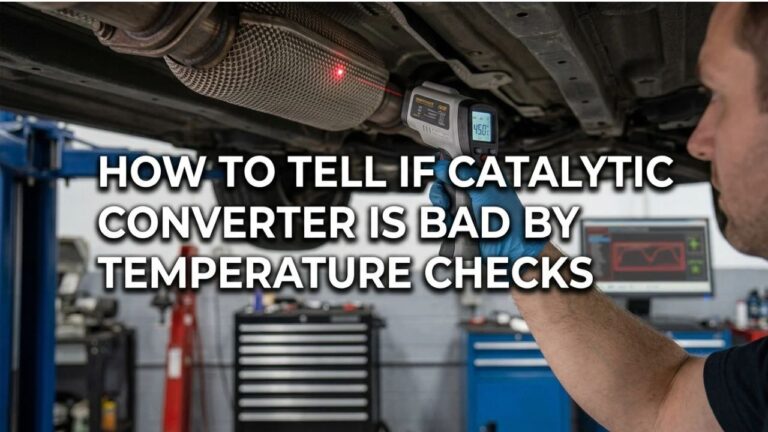
Do Not Diagnose From Temperature Alone
Infrared-temperature testing can provide information about catalyst operation, but temperature changes depend on mixture, load, converter design, and engine condition.
A hot converter is not automatically clogged.
A backpressure test gives stronger evidence when the specific concern is restricted flow.
Key Takeaway: Scan data and exhaust-backpressure testing provide much stronger evidence of a clogged converter than judging power loss, temperature, or a P0420 code alone.
Can Removing a Catalytic Converter Improve Performance?
Removing a healthy modern converter is not a proper solution to performance problems.
A good converter is designed to flow enough exhaust for the engine it serves.
MagnaFlow states that its current testing finds no meaningful performance advantage from simply removing a properly functioning modern converter.
If removing or bypassing a converter seems to restore a large amount of power, that points toward a restriction in the existing exhaust system rather than proof that catalytic converters inherently reduce modern engine performance.
There is also an emissions issue. Federal law restricts tampering with vehicle emissions-control equipment.
A failed converter should be diagnosed and replaced with a compliant part rather than eliminated.
When Should You Stop Driving?
A mildly degraded catalyst may allow normal driving while an appointment is arranged.
Severe restriction is different.
Stop driving and arrange repair if the vehicle has:
- Major sudden power loss
- Repeated stalling
- A glowing converter
- Severe misfire
- Excessive underbody heat
- Difficulty maintaining safe road speed
- A flashing check-engine light
A flashing check-engine light commonly signals a misfire severe enough to risk catalyst damage.
Driving farther can turn an engine problem into a converter replacement and may create greater heat around the exhaust system.
Conclusion
Yes, does a bad catalytic converter affect performance has a clear answer when the converter is physically restricted: it can reduce horsepower, cause sluggish acceleration, limit RPM, hurt fuel economy, create hard-start conditions, and eventually make the engine stall.
The key distinction is between catalyst efficiency and exhaust flow. A converter can trigger P0420 or P0430 without blocking the exhaust, so a check-engine light alone does not prove that the converter is responsible for power loss.
If acceleration becomes much worse as RPM or load increases, I would check exhaust backpressure along with ignition, fuel delivery, airflow sensors, and transmission operation before buying a converter.
Finding the original cause matters too. Misfires, rich operation, oil burning, coolant contamination, and internal engine faults can damage a converter. Repair those problems before fitting a replacement or the new catalyst may fail again.
FAQs About Bad Catalytic Converters and Performance
Can a Bad Catalytic Converter Cause Loss of Power?
Yes. A clogged converter restricts exhaust flow and increases backpressure, reducing the amount of fresh air the engine can process.
The power loss often becomes more noticeable during hard acceleration or at higher RPM because exhaust volume increases under those conditions.
Can a Bad Catalytic Converter Cause Slow Acceleration?
Yes. Sluggish acceleration is one of the common symptoms of a restricted converter.
The engine may feel acceptable at light throttle but struggle during highway merging, hills, or passing. Fuel, ignition, airflow, and transmission faults can create similar symptoms, so testing is needed before replacement.
Does a Bad Catalytic Converter Affect Gas Mileage?
It can. A restricted exhaust makes the engine work harder and may require more throttle to produce the same road speed.
Poor fuel economy can also come from a rich mixture or misfire that damaged the converter, so the underlying engine condition should be checked.
Can a Bad Catalytic Converter Cause the Engine to Stall?
Yes, if the restriction becomes severe.
A heavily clogged converter may allow the engine to start but prevent enough exhaust from leaving to keep it running. Backpressure builds until engine operation becomes unstable or the engine stalls.
Will a P0420 Code Cause Reduced Performance?
Not necessarily. P0420 indicates catalyst efficiency below the expected threshold.
The converter can have an efficiency problem without being physically clogged, so many vehicles with P0420 continue to drive normally. Power loss becomes more likely if the converter is also restricted.
Can a Clogged Catalytic Converter Limit RPM?
Yes. A severe restriction can prevent the engine from moving enough exhaust at higher speeds.
The engine may rev normally at low RPM and then struggle or stop increasing speed as exhaust flow demand rises.
Can Replacing a Bad Catalytic Converter Restore Power?
Yes, if a restricted converter is confirmed as the cause of the power loss.
The engine fault that damaged or clogged the old converter must also be repaired. Installing a new converter while leaving a severe misfire, rich mixture, oil-burning problem, or coolant leak unresolved can damage the replacement.
Can a Good Catalytic Converter Reduce Engine Performance?
A properly functioning modern converter should not create a noticeable power problem on an otherwise stock vehicle.
Large performance gains after reducing exhaust restriction point toward a failed or poorly matched exhaust component rather than normal operation of a healthy catalytic converter.