Can a Bad Catalytic Converter Cause Transmission Issues? Symptoms
A failing catalytic converter normally does not damage the transmission directly. A severely restricted converter can reduce engine power so much that an automatic transmission holds gears longer, downshifts more often, shifts at unexpected times, or feels as if it is slipping. The real fault may be restricted exhaust flow rather than an internal transmission problem.
That distinction matters because transmission repair can be expensive, while the actual cause may sit farther forward in the powertrain. If the engine cannot move exhaust gases out freely, it cannot produce its normal torque under load, even if the transmission itself is operating correctly.
A clogged converter often becomes more noticeable during acceleration, highway merging, hill climbing, or other high-load driving. The car may downshift after more throttle is applied, yet still fail to accelerate as expected. That combination makes the transmission easy to blame.
For U.S. vehicle owners, there is another useful detail: the EPA states that catalytic converters are among the major emissions components covered by the federal 8-year/80,000-mile emissions warranty on qualifying light-duty vehicles, subject to the warranty conditions.
If you are asking can a bad catalytic converter cause transmission issues, I’d first check for engine power loss before assuming the gearbox has failed. General Motors even tells technicians diagnosing certain automatic-transmission complaints not to overlook engine lack of power or a plugged or restricted exhaust because those faults can create erratic shifting or vibrations that resemble torque-converter trouble.
The sections below explain the connection between exhaust restriction and shift behavior, the symptoms that separate a clogged converter from true transmission failure, diagnostic tests, codes to check, and situations where both faults may exist at the same time.
Can a Bad Catalytic Converter Cause Transmission Issues Directly?
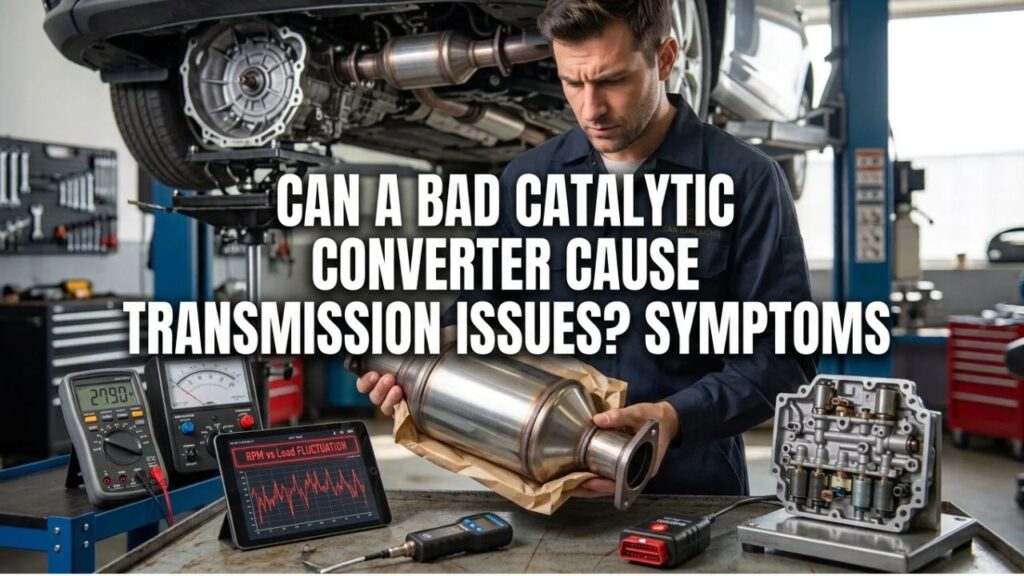
A bad catalytic converter normally does not directly damage gears, clutches, valve bodies, solenoids, or transmission fluid. The connection is usually indirect.
A restricted converter changes how the engine produces power. The transmission then reacts to that reduced power and to increased accelerator demand.
A Restricted Converter Reduces Engine Power
Exhaust gases must leave the engine after combustion. A converter with melted, collapsed, or plugged passages creates resistance in the exhaust system.
That restriction raises exhaust backpressure and limits the engine’s ability to move air through its cylinders. Common results include sluggish acceleration, difficulty reaching higher speeds, hard starting, poor fuel economy, and stalling in severe cases.
The transmission receives engine power; it does not create that power. If engine output drops sharply, a perfectly functional transmission can feel wrong because the vehicle no longer responds normally after each shift.
The Transmission May Hold a Gear Longer
Automatic transmissions use inputs such as vehicle speed and accelerator or throttle demand to decide when to change gears.
A GM service bulletin for 8L45 and 8L90 transmissions states that the transmission control module calculates upshift points primarily from throttle position and vehicle speed on those applications. The same bulletin tells technicians to confirm the engine is performing correctly before diagnosing transmission complaints.
With a blocked exhaust, you may press the accelerator farther because the vehicle feels weak. The transmission can respond by delaying an upshift or selecting a lower gear.
The shift is real, but the reason for the extra shift activity may be engine power loss.
A Converter Efficiency Fault Is Different From a Clogged Converter
This distinction is easy to miss.
A catalytic converter can lose its ability to clean exhaust gases while still flowing exhaust freely. In that situation, you may get a P0420 or P0430 code and a check-engine light with little change in acceleration or shifting.
A physically restricted converter is different. Melted or blocked internal passages interfere with exhaust flow and can cause the power loss that affects driving behavior.
Walker states that a P0420 efficiency code does not automatically mean the converter needs replacement and recommends correcting other engine faults before condemning the converter.
Key Takeaway: A converter usually affects shift behavior indirectly by reducing engine power; an emissions-efficiency fault alone may cause no transmission-like symptoms at all.
How a Clogged Catalytic Converter Can Feel Like Transmission Failure
The overlap is strongest during acceleration.
A driver feels the gear change, engine RPM, and vehicle speed at the same time, so poor engine output can easily feel like a gearbox problem.
Gear Hunting or Frequent Downshifts
Imagine cruising uphill in a higher gear. A healthy engine has enough torque to maintain speed with moderate throttle.
Now add a severe exhaust restriction.
You press farther on the accelerator, but engine output does not increase as expected. The transmission sees the increased demand and downshifts. Engine RPM rises, yet vehicle speed improves very little.
The transmission may then change gears again as speed and throttle conditions change.
That repeated behavior is often described as gear hunting.
A clogged converter is not the only cause. Low engine power from ignition, fuel, compression, turbocharger, airflow, or sensor faults can create a similar pattern.
Delayed Upshifts
A driver may describe the car as “staying in gear too long.”
If more accelerator is required to compensate for lost engine power, the transmission may remain in a lower gear longer before shifting.
This can feel like delayed shifting even though the control system is reacting to current engine load and throttle position.
GM’s diagnostic guidance specifically warns that engine lack of power, including a plugged or restricted exhaust, can cause erratic transmission shifting that may be mistaken for a transmission fault.
High RPM With Poor Acceleration
This symptom needs careful interpretation because it can point in two very different directions.
With a restricted converter, the engine may rev harder after a normal downshift, but the engine itself cannot produce normal power.
With actual transmission slip, engine RPM may flare because a clutch, belt, torque converter, or other transmission component is failing to maintain the intended ratio.
The RPM increase alone does not identify the faulty part.
Watch what happens immediately before and after the RPM change. A scan tool that displays commanded gear, input speed, output speed, engine speed, throttle position, and torque-converter slip gives far more diagnostic information.
Shudder or Vibration
Engine operation under heavy load can produce vibration that a driver interprets as transmission or torque-converter shudder.
GM specifically warns technicians that engine misfires and lack of power can create vibrations that resemble torque-converter shudder complaints. It includes plugged or restricted exhaust among the faults that should not be overlooked.
True torque-converter shudder remains possible. The point is that vibration by itself does not prove the converter inside the transmission is defective.
Key Takeaway: A restricted exhaust can cause gear hunting, late-feeling shifts, high-RPM acceleration, and vibration that closely resemble transmission trouble.
Catalytic Converter Symptoms vs Transmission Symptoms
Some symptoms overlap, but several clues point more strongly toward one system.
| Symptom | More Consistent With Catalytic Converter | More Consistent With Transmission |
| Weak acceleration in every gear | Yes | Possible |
| Engine struggles more as RPM/load rises | Yes | Possible |
| P0420 or P0430 | Yes | No, by itself |
| Rotten-egg exhaust smell | Yes | No |
| Rattle inside exhaust | Yes | No |
| Hard starting or engine stalling | Yes, if badly restricted | Usually no |
| Delayed Drive or Reverse engagement | Unlikely | Yes |
| Transmission fluid leak | No | Yes |
| RPM flare during one specific shift | Less likely | Yes |
| Transmission gear-ratio code | Not typical | Yes |
| Slipping after gear is already engaged | Less likely | Yes |
| Poor power even with transmission manually held in a lower gear | Strong clue | Possible |
Signs That Point Toward a Restricted Converter
Loss of engine power is the main clue.
AutoZone lists poor acceleration, hard starting, poor fuel economy, excess heat, and stalling among symptoms of a clogged converter. Broken internal converter material may also produce a metallic rattle.
A common pattern is that the car runs reasonably well during light driving but struggles badly when exhaust flow demand increases.
Highway acceleration can be much worse than low-speed parking-lot driving.
Signs That Point Toward the Transmission
Delayed engagement after moving the selector into Drive or Reverse raises more suspicion about the transmission itself.
Other transmission-oriented clues include:
- Fluid leakage
- Burnt-smelling transmission fluid
- A gear-ratio fault code
- Harsh engagement into Drive or Reverse
- RPM flare during a specific shift
- Transmission slipping while engine power otherwise feels normal
- Abnormal transmission whining
- Failure to select a gear
Low fluid, hydraulic pressure faults, solenoid problems, worn clutches, valve-body problems, and torque-converter faults can cause these symptoms.
Symptoms Shared by Both Problems
Both faults may cause:
- Hesitation
- Poor acceleration
- Jerking
- RPM changes
- Strange shift timing
- Warning lights
- Reduced highway performance
That overlap is why guessing from road feel alone can lead to the wrong repair.
Key Takeaway: Engine-wide power loss, exhaust-related codes, rattling, odor, and hard starting favor a converter problem; delayed engagement, fluid trouble, ratio errors, and true gear slip favor a transmission fault.
How to Diagnose Converter Problems Before Blaming the Transmission
Start with engine and exhaust diagnosis before authorizing major transmission work when the vehicle also has clear power-loss symptoms.
GM’s transmission diagnostic procedure follows the same logic by asking technicians to verify engine operation before evaluating shift quality.
Scan Every Module for Trouble Codes
Do not read only the engine computer.
A full scan can reveal:
- Catalyst codes
- Misfire codes
- Fuel-mixture codes
- Oxygen-sensor faults
- Transmission codes
- Gear-ratio faults
- Torque-converter clutch faults
- Communication or voltage problems
P0420 refers to catalyst-system efficiency below threshold on Bank 1, while P0430 applies to Bank 2.
Neither code proves that the converter is physically clogged.
Walker states that other engine codes should be corrected before converter codes are used to make a replacement decision.
Compare Commanded Gear With Actual Behavior
A capable scan tool can show if the transmission is being commanded to downshift.
That distinction is useful.
If you press harder because the engine lacks power and the computer commands a lower gear, the transmission may simply be doing what it was told to do.
If the computer commands one gear but input and output speeds show the transmission cannot maintain that ratio, actual internal slip becomes more likely.
On the GM 8L45/8L90 applications covered by its bulletin, technicians are told to watch commanded gear, engine RPM, transmission input and output speed, throttle position, solenoid commands, and torque-converter clutch slip.
Test Exhaust Backpressure
Backpressure testing is one of the more direct ways to confirm a restricted exhaust.
Walker gives general diagnostic references of less than 1.5 psi at idle and less than 3 psi at 2,000 RPM, while noting that pressure varies by application. High pressure measured ahead of the catalytic converter points toward converter restriction.
Another Walker diagnostic procedure gives a similar general reference of no more than about 1 psi at idle and 3 psi at 2,500 RPM on many vehicles.
Vehicle-specific specifications should take priority when available.
Perform an Engine Vacuum Test
A vacuum gauge can also provide evidence of exhaust restriction.
Walker describes a test where vacuum is checked at idle and again around 2,500 RPM. A large sustained drop in vacuum as engine speed is held can point toward a blocked exhaust system.
Vacuum readings can also be influenced by valve timing, ignition timing, and other engine faults, so the test should be treated as part of a larger diagnosis.
Check the Converter and Exhaust Physically
Look for:
- Crushed exhaust pipes
- Heavy converter discoloration
- Loose internal rattling
- Damaged exhaust sections
- Leaks
- Collapsed internal substrate
- Signs of overheating
A converter that has melted internally may appear normal from the outside.
Walker notes that internal substrate passages can melt or collapse while the ends still appear normal, which is another reason backpressure testing has value.
Inspect the Transmission Separately
Finding a clogged converter does not prove the transmission is healthy.
Check transmission fluid level using the correct vehicle procedure, inspect for leaks, retrieve transmission codes, and evaluate actual gear engagement and slip.
Two faults can exist at once, especially on an older or high-mileage vehicle.
Key Takeaway: Use codes, commanded-gear data, exhaust backpressure, vacuum testing, physical inspection, and transmission data to identify the failing system instead of diagnosing from shift feel alone.
Can a Bad Catalytic Converter Damage the Transmission?
Direct mechanical transmission damage from a bad catalytic converter is not the normal failure path.
The converter sits in the exhaust system. It does not circulate transmission fluid, apply clutches, control hydraulic line pressure, or physically engage transmission gears.
A severe restriction can make the powertrain work under unpleasant conditions, though.
More Throttle Can Cause More Shift Activity
If the engine loses torque, the driver often presses the accelerator farther.
That may produce more downshifts and more time in lower gears.
The extra shift activity does not prove transmission damage. It is a response to the vehicle’s inability to produce the expected acceleration.
A Transmission Can Already Have a Separate Fault
A marginal transmission may become more noticeable when engine performance changes.
For example, a vehicle might already have worn clutches or a torque-converter problem. A new engine power fault changes throttle use and driving behavior, exposing symptoms that were previously subtle.
Replacing the catalytic converter would then restore engine power but would not repair the separate transmission fault.
Do Not Assume Every Harsh Shift Is Caused by the Converter
Harsh shifting can come from transmission hydraulic faults, software adaptation, solenoid problems, sensor inputs, low fluid, internal wear, or engine faults.
The GM bulletin cited earlier makes this diagnostic point clearly: engine and chassis faults should be checked before a transmission concern is treated as an internal transmission problem.
Key Takeaway: A converter usually changes transmission behavior through engine power loss rather than physically damaging transmission components.
Can P0420 or P0430 Cause Transmission Shifting Problems?
The codes themselves do not cause anything.
They are diagnostic messages reporting that the computer sees catalyst efficiency below the expected threshold.
A vehicle with P0420 or P0430 may drive normally if exhaust flow remains unrestricted.
Walker specifically states that a P0420 low-efficiency code does not always mean the catalytic converter needs replacement. Fuel mixture, misfires, exhaust leaks, and other engine conditions can affect converter monitoring.
Shift complaints become more connected to the catalytic converter when there is evidence of physical restriction along with the code.
For example:
- Power drops under load
- The engine cannot rev freely
- Backpressure is high
- Acceleration becomes poor
- The car stalls or struggles to start
- Internal converter material has collapsed
Do not replace a transmission because P0420 appears beside a strange shift, and do not replace a converter simply because the code exists.
What Should You Fix First?
Fix the fault that diagnosis identifies.
If testing confirms severe exhaust restriction and transmission data shows normal gear operation, repair the exhaust restriction first.
Repair Misfires Before Replacing the Converter
A catalytic converter often fails because another engine problem damaged it.
Walker lists misfires, low compression, poor spark, fuel-control problems, oil contamination, coolant contamination, and excess engine load among conditions associated with converter damage.
A severe misfire can send unburned fuel into the converter and raise its temperature enough to damage the substrate.
Installing a new converter while leaving the misfire untouched risks damaging the replacement.
Recheck Shift Behavior After Engine Power Is Restored
Once the engine can produce normal power again, reassess the shift complaint.
If the transmission now shifts normally, the strange behavior may have been a reaction to low engine output.
If slipping, harsh engagement, delayed Drive or Reverse, ratio codes, or abnormal torque-converter behavior remain, continue transmission diagnosis.
Check Federal Emissions Warranty Coverage
Before paying for a converter on a qualifying U.S. vehicle, check the vehicle’s warranty booklet.
The EPA states that catalytic converters, the electronic emissions control unit, and the onboard emissions diagnostic device are specified major emissions-control components covered for 8 years or 80,000 miles, subject to federal warranty terms.
Coverage can depend on the failure, vehicle classification, maintenance, and other warranty requirements.
Key Takeaway: Repair confirmed engine or exhaust faults first, correct the condition that damaged the converter, then reevaluate any remaining transmission symptoms.
When Should You Stop Driving?
Do not keep driving normally if the vehicle has severe power loss, repeated stalling, a flashing check-engine light from an active misfire, or an exhaust component that appears to be overheating.
A badly blocked converter can restrict the engine enough to make merging or crossing traffic difficult.
A flashing check-engine light should also be taken seriously because an active misfire can overheat and damage the converter.
Stop and arrange diagnosis if you notice:
- Sudden severe loss of acceleration
- Repeated stalling
- Converter or exhaust glowing from heat
- Strong burning smell
- Flashing check-engine light
- Transmission no longer engaging a gear
- Heavy transmission slipping
- Fluid leaking from the transmission
- Vehicle unable to maintain safe road speed
Do not continue a high-load road test just to prove a fault if the vehicle is struggling badly.
Conclusion
The answer to can a bad catalytic converter cause transmission issues is yes in an indirect sense. A restricted converter can rob the engine of power, leading to delayed-feeling upshifts, more frequent downshifts, gear hunting, high-RPM acceleration, and vibrations that resemble transmission trouble.
The most useful clue is the difference between engine power loss and true gear slip. A car that is weak in every gear and shows exhaust restriction symptoms deserves engine and converter testing. A vehicle with delayed engagement, transmission fluid problems, ratio codes, or RPM flare during a specific shift deserves direct transmission diagnosis.
A P0420 or P0430 code alone does not prove the converter is clogged. Backpressure testing, scan-tool data, exhaust inspection, and a complete code scan provide a much stronger basis for the repair decision.
I’d diagnose the low-power complaint before approving major transmission work when both symptoms appear together. If the converter is restricted, correct the engine fault that caused the restriction, repair the exhaust problem, and then see which transmission symptoms remain.
FAQs About Catalytic Converters and Transmission Problems
Can a clogged catalytic converter make a transmission shift hard?
It can make shifting feel abnormal by reducing engine power and changing throttle demand. The transmission may hold a lower gear or downshift more often. A genuinely harsh gear engagement can also come from hydraulic pressure, solenoids, low fluid, adaptation, or internal transmission faults, so a hard shift needs proper diagnosis.
Can a bad catalytic converter cause transmission slipping?
A converter does not normally cause true internal clutch or gear slip. Severe exhaust restriction can make the car accelerate poorly after a shift, which may feel like slipping. True slip is more likely when engine RPM rises without the matching vehicle-speed change expected for the commanded gear.
Can a clogged catalytic converter cause delayed shifting?
Yes, it can create delayed-feeling shifts indirectly. Reduced engine torque often makes the driver use more throttle, and automatic transmissions may hold lower gears longer under greater throttle demand. GM service information also warns that engine lack of power and restricted exhaust can create erratic transmission shifting.
Can a catalytic converter cause a transmission code?
A catalytic converter fault normally produces emissions-related codes rather than a direct transmission code. Engine power problems can complicate powertrain diagnosis, and modern modules share operating information. Scan all modules and diagnose each stored code rather than assuming a catalyst code caused a transmission code.
Can P0420 make my car shift weird?
P0420 itself does not change the gears. It reports low catalyst efficiency. If the converter also has a physical blockage that reduces engine power, the car may downshift more often or hold gears differently. If the converter still flows normally, P0420 may exist with no noticeable shift change.
How do I tell a clogged catalytic converter from a bad transmission?
A clogged converter more often causes weak engine power across several gears, poor acceleration under load, exhaust-related codes, rattling, hard starting, or stalling. A transmission fault more often causes delayed gear engagement, fluid leakage, gear-ratio errors, or RPM flare during a specific shift. Backpressure and scan-data testing can separate the two.
Will replacing the catalytic converter fix transmission shifting?
It may restore normal shift behavior if the strange shifting was only the transmission reacting to engine power loss from a restricted converter. It will not repair worn transmission clutches, bad solenoids, hydraulic faults, torque-converter damage, or low fluid. Recheck the transmission after engine power returns.
Can a bad catalytic converter and bad transmission happen at the same time?
Yes. One fault does not rule out the other. An older vehicle may have converter restriction and a separate transmission problem. Diagnose engine output, exhaust backpressure, commanded gear, input and output speeds, transmission fluid condition, and stored codes before deciding which parts need repair.