Will a Clogged Catalytic Converter Cause Loss of Engine Power?
Yes. A clogged catalytic converter can cause a major loss of engine power because exhaust gases cannot leave the engine freely. As backpressure builds, the cylinders struggle to clear burned gases and take in a fresh charge. The vehicle may accelerate slowly, feel weak on hills, hesitate, or refuse to reach normal RPM.
A slight restriction may be hard to notice during idle or gentle driving. The problem usually becomes clearer as engine load rises because higher RPM creates much more exhaust flow.
A severely blocked converter can make a vehicle feel as though the engine suddenly became much smaller. Pressing the accelerator farther may produce more noise without a matching increase in speed.
For drivers asking will a clogged catalytic converter cause loss of power, exhaust restriction is the main reason. The converter does not have to be completely blocked; even partial collapse or melting of its internal honeycomb can reduce airflow enough to hurt acceleration.
The same symptoms can come from low fuel pressure, ignition misfires, transmission problems, a dirty air filter, turbocharger faults, or engine mechanical issues. Diagnosis matters before an expensive converter is replaced.
The sections below explain how a clogged converter reduces engine output, which symptoms support the diagnosis, how power loss changes with RPM, and how to confirm exhaust restriction.
Why Does a Clogged Catalytic Converter Cause Power Loss?
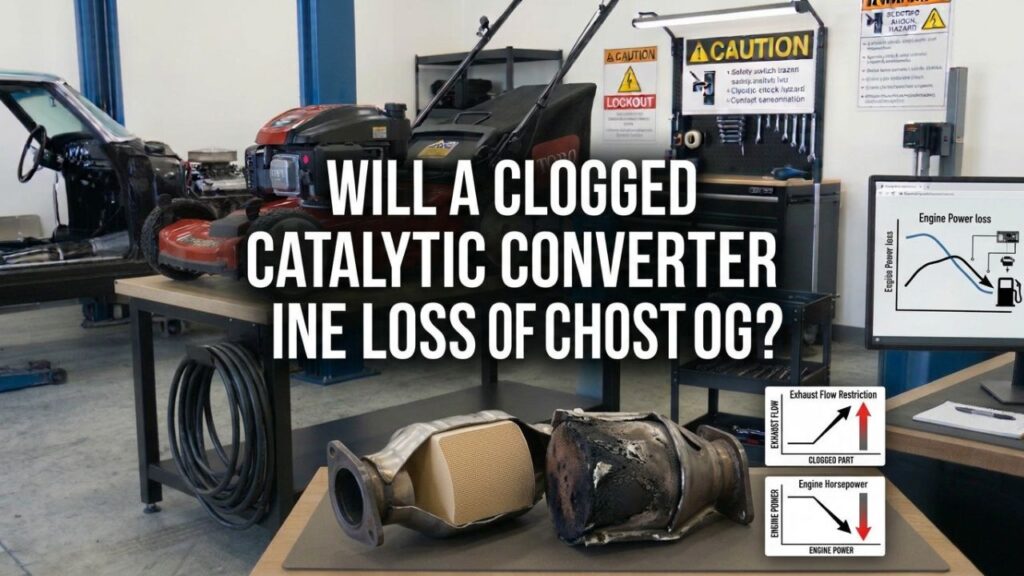
An engine has to move air in and exhaust gases out continuously.
If exhaust cannot escape, the next combustion cycle becomes less productive.
Exhaust Backpressure Builds Up
The catalytic converter contains a honeycomb-like substrate with many small passages.
Exhaust normally flows through those passages with relatively little restriction.
If the substrate melts, collapses, breaks apart, or becomes heavily contaminated, the available flow area decreases.
Pressure then builds between the engine and the blockage.
This pressure is commonly called exhaust backpressure.
The pistons have to work harder to push spent gases out of the cylinders.
Some of the engine’s output is therefore consumed simply trying to move exhaust through the restriction.
Cylinders Cannot Clear Exhaust Properly
During the exhaust stroke, the piston pushes burned gases toward the exhaust system.
A restricted converter can prevent complete cylinder clearing.
Residual gases left behind take up space that should contain fresh air and fuel during the next cycle.
Less fresh mixture generally means less combustion energy.
The result can be:
- Weak acceleration
- Poor throttle response
- Reduced torque
- Lower maximum RPM
- Increased engine load
The Problem Gets Worse as Exhaust Volume Rises
An engine produces much more exhaust at 4,000 RPM under heavy throttle than it does at idle.
A partially clogged converter may therefore create little trouble at low RPM but become a major restriction during acceleration.
This explains why some vehicles:
- Idle normally
- Drive acceptably around a parking lot
- Lose power on the highway
- Struggle badly on hills
- Stop accelerating above a certain RPM
Key Takeaway: A clogged converter reduces power by creating exhaust backpressure, preventing proper cylinder clearing, and restricting airflow more severely as engine speed increases.
What Does Power Loss From a Clogged Converter Feel Like?
Converter restriction often creates a distinctive driving pattern.
It may feel different from a single weak ignition coil or worn spark plug.
Slow Acceleration
The most common complaint is that the vehicle feels sluggish.
You press the accelerator, but engine output does not rise normally.
The car may take much longer to reach highway speed.
Engine Feels Choked at Higher RPM
A partially blocked converter can create a noticeable RPM ceiling.
For example, the engine may accelerate normally at first and then struggle badly beyond 2,500, 3,000, or 4,000 RPM.
The exact RPM varies according to the severity and location of the restriction.
This can feel as though the engine is being held back.
Poor Hill-Climbing Power
Climbing a hill places the engine under greater load.
More fuel burns, exhaust volume increases, and the converter restriction becomes more limiting.
A vehicle that seems acceptable on flat roads may suddenly feel extremely weak uphill.
Poor Highway Passing Power
Passing another vehicle requires rapid acceleration.
A clogged converter may prevent the engine from producing enough high-RPM power.
Downshifting may increase engine noise without producing the expected acceleration.
Vehicle May Recover When You Ease Off the Throttle
One interesting clue is that the engine may feel somewhat better after you reduce throttle.
Lower throttle means less exhaust flow.
The pressure upstream of the converter may decrease slightly, allowing the engine to operate more normally.
Key Takeaway: Converter-related power loss is often strongest during hard acceleration, high RPM, hill climbing, and highway passing because those conditions create the greatest exhaust volume.
Can a Partially Clogged Catalytic Converter Cause Power Loss?
Yes.
The converter does not need to be completely blocked.
A partial restriction can reduce performance long before the vehicle becomes unable to drive.
Early Restriction May Only Affect Heavy Acceleration
At first, the engine may still have enough exhaust-flow capacity for:
- Idle
- Light cruising
- Low-speed driving
The restriction becomes noticeable only when exhaust volume increases.
This can make the problem difficult to diagnose in a driveway.
The Restriction Can Progress
If the internal substrate continues melting or breaking apart, the available flow path may become smaller.
Symptoms may progress from:
- Slight hesitation
- Reduced high-RPM power
- Slow acceleration
- Rough idle
- Stalling
- Hard starting or failure to run in severe cases
The exact progression depends on the type of internal damage.
Broken Substrate Pieces Can Shift
A cracked ceramic core can break into loose pieces.
Those pieces may move inside the converter housing.
The vehicle may sometimes run better and then suddenly lose power again if broken material shifts and blocks the outlet.
A rattling sound may accompany this type of failure.
Key Takeaway: Even a partial converter blockage can reduce engine output, and symptoms often begin under heavy load before appearing during normal driving.
Can a Clogged Converter Reduce Top Speed?
Yes.
A severely restricted converter can prevent the engine from producing the airflow needed for higher vehicle speeds.
Power demand rises as speed increases.
If the exhaust system cannot move enough gas, the engine may stop gaining RPM even with the accelerator pressed deeply.
You may notice that:
- The vehicle reaches a certain speed and will not accelerate farther
- Engine RPM rises very slowly
- Full throttle produces little additional speed
- Uphill top speed drops sharply
- The transmission downshifts repeatedly trying to find power
Do not test maximum speed on public roads to diagnose this problem.
A normal acceleration test performed safely, combined with scan data and exhaust testing, provides better evidence.
Can a Clogged Catalytic Converter Cause Low RPM?
It can limit how high the engine can rev under load.
A severe restriction may make the engine struggle to climb beyond a certain RPM.
Free-Reving in Park Is Not a Reliable Test
Some drivers assume the converter is fine because the engine can rev while the transmission is in Park or Neutral.
That does not rule out restriction.
The engine is under very little load in Park.
During road acceleration, cylinder pressure, fuel delivery, and exhaust volume rise substantially.
A converter that flows enough exhaust during unloaded revving may still choke the engine under load.
Severe Blockage Can Affect Idle RPM Too
If restriction becomes extreme, even low-speed exhaust flow may be affected.
The engine may:
- Idle roughly
- Surge
- Drop below normal idle speed
- Stall
- Become difficult to restart
At that point, exhaust restriction is generally severe.
Can a Clogged Catalytic Converter Cause Loss of Power Without a Check Engine Light?
Yes.
A clogged converter can reduce power even before a catalyst-related diagnostic trouble code appears.
The engine computer primarily monitors catalyst performance through sensor data.
Physical exhaust restriction does not always trigger an immediate code.
P0420 Is Not a Clogged-Converter Code
P0420 generally means:
Catalyst System Efficiency Below Threshold, Bank 1
P0430 refers to a similar condition on Bank 2.
These codes indicate that catalyst performance is outside the computer’s expected range.
They do not directly measure exhaust blockage.
A converter can be:
- Chemically weak but physically open
- Partially clogged without P0420
- Broken internally
- Melted and restricted
- Contaminated but still flowing
This is why driveability symptoms and exhaust tests matter.
Key Takeaway: A restricted converter can cause power loss without setting P0420 or any other converter code, because catalyst monitoring and exhaust-flow testing measure different problems.
What Other Symptoms Come With Converter Power Loss?
Loss of power becomes more suspicious for a clogged converter when other related symptoms appear.
Rough Idle
Severe exhaust restriction can interfere with cylinder clearing even at idle.
The engine may shake or fluctuate in RPM.
A mild converter restriction may leave idle completely normal.
Stalling
A badly blocked exhaust can make it difficult for the engine to keep running.
Stalling may occur:
- After warming up
- During acceleration
- At traffic lights
- After a hard drive
Many other faults cause stalling, so this symptom needs diagnosis.
Misfires
Exhaust restriction can contribute to unstable combustion.
Random or multiple-cylinder misfires may appear when backpressure becomes severe.
The reverse sequence is also common: a misfire damages the converter first.
Rattling From the Converter
A broken ceramic substrate can rattle inside the housing.
The sound may change with engine speed or road vibration.
Loose heat shields can create similar noise.
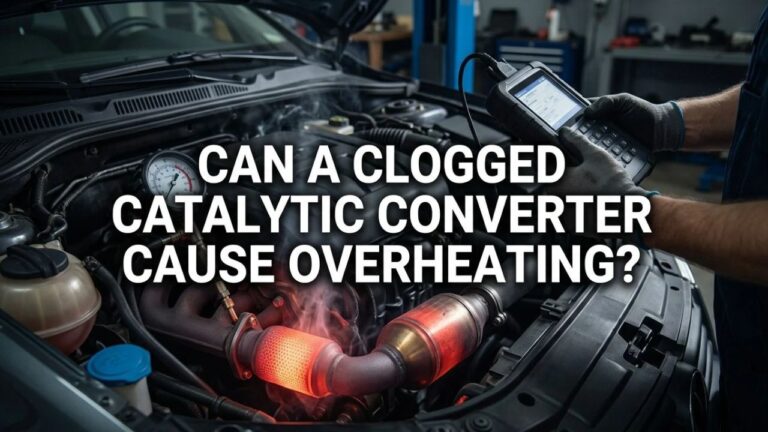
Excessive Heat
A converter damaged by excess fuel may become abnormally hot.
Warning signs include:
- Strong burning smell
- Smoke
- Extreme heat beneath the floor
- Heat-damaged components
- Glowing converter housing in severe cases
A glowing converter requires immediate attention.
Poor Fuel Economy
Power loss may make the driver press the accelerator farther to maintain normal speed.
The engine fault that damaged the converter may also increase fuel consumption.
Fuel economy alone cannot identify a clogged catalyst.
Key Takeaway: Power loss combined with high-RPM hesitation, rough idle, stalling, rattling, misfires, or excessive converter heat makes exhaust restriction more plausible.
Why Does a Catalytic Converter Become Clogged?
A converter usually does not clog without a reason.
Finding that reason protects the replacement.
Misfires Can Melt the Internal Substrate
A misfiring cylinder may send unburned fuel into the exhaust.
The fuel can ignite inside the hot converter.
This creates extreme heat that may melt the ceramic honeycomb.
Once passages deform or collapse, exhaust flow becomes restricted.
Rich Fuel Mixtures Create Excess Heat
An engine running too rich may send excessive hydrocarbons into the exhaust.
Possible causes include:
- Leaking fuel injector
- Excessive fuel pressure
- Faulty air measurement
- Fuel-control problem
- Ignition failure
Repeated overheating can damage the catalyst core.
Oil Burning Can Contaminate the Converter
Engine oil entering the combustion chamber creates ash after burning.
That material can coat the converter substrate.
Common oil-consumption causes include:
- Worn piston rings
- Worn valve seals
- Cylinder wear
- PCV-system problems
Coolant Can Damage the Catalyst
An internal coolant leak may send coolant through the cylinders and into the exhaust.
Possible causes include a failed head gasket or other internal engine damage.
Coolant residue can contaminate the catalyst and contribute to blockage.
Physical Impact Can Break the Honeycomb
A converter can be damaged by:
- Road debris
- Curbs
- Rocks
- Collision damage
- Off-road impacts
A cracked core may collapse or move inside the housing.
Key Takeaway: Misfires, rich running, oil burning, coolant contamination, and physical damage can all destroy the converter core and restrict exhaust flow.
How to Test for a Clogged Catalytic Converter
Proper testing matters because power loss has many possible causes.
Scan for Diagnostic Trouble Codes
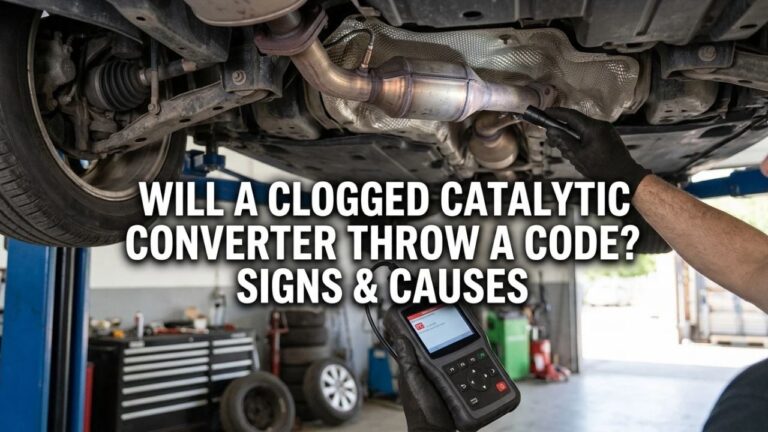
Start with an OBD-II scanner.
Look for:
- P0420 or P0430
- P0300-series misfire codes
- Lean or rich mixture codes
- Oxygen-sensor faults
- Airflow sensor codes
- Fuel-system codes
Do not focus only on catalyst codes.
The code that caused the converter damage may be more useful than a catalyst code itself.
Check Live Engine Data
Useful scan data may include:
- Fuel trims
- Misfire counters
- Oxygen-sensor activity
- Airflow readings
- Throttle position
- Engine load
A single-cylinder misfire points toward a different diagnosis than broad power loss across the entire engine.
Perform an Exhaust Backpressure Test
A backpressure test directly checks exhaust restriction.
A technician connects a suitable pressure gauge at an approved test point.
Pressure is checked at idle and at elevated engine speed.
Abnormally increasing pressure as RPM rises supports a blocked exhaust diagnosis.
Use the vehicle manufacturer’s test procedure and limits.
Check Manifold Vacuum
A vacuum gauge can also provide a clue.
A restricted exhaust can cause manifold vacuum to gradually drop while the engine is held at an elevated RPM.
Vacuum readings are influenced by engine condition, valve timing, altitude, and other faults, so this test should be combined with other evidence.
Inspect the Exhaust System
Look for:
- Crushed exhaust pipes
- Impacted converter housing
- Loose internal rattling
- Collapsed muffler
- Broken exhaust components
A clogged muffler can create symptoms similar to a clogged converter.
Compare Temperature Carefully
Technicians sometimes measure exhaust temperature before and after the converter.
Temperature testing can provide supporting information, but it does not directly prove restriction.
Engine load, mixture, catalyst activity, and measurement location can all change the readings.
Backpressure testing is a more direct way to check blockage.
Key Takeaway: Scan data can identify related engine faults, while exhaust backpressure testing provides stronger evidence that the converter or another exhaust component is physically restricted.
Clogged Catalytic Converter vs. Fuel Delivery Problem
Both can produce weak acceleration.
The symptom pattern and test results help separate them.
| Symptom | Clogged converter | Low fuel pressure |
| Poor acceleration | Common | Common |
| High-RPM power loss | Common | Common |
| Exhaust backpressure high | Yes | No |
| Fuel pressure low | No | Yes |
| Converter rattling | Possible | No |
| Engine may run better at light throttle | Yes | Yes |
| Lean codes | Possible indirectly | Common |
| Exhaust restriction test fails | Yes | No |
Fuel pressure should be measured rather than guessed.
A weak fuel pump can imitate converter restriction surprisingly well.
Clogged Converter vs. Bad Ignition Coil
A failed ignition coil more often causes a cylinder-specific problem.
A clogged converter tends to affect a broader section of the engine.
Bad Coil Pattern
Common clues include:
- P0301, P0302, or another single-cylinder misfire
- Rough idle
- Shaking under load
- Misfire moving when coils are swapped
Clogged Converter Pattern
Common clues include:
- Broad loss of power
- Increasing restriction at higher RPM
- Multiple-cylinder misfires
- Poor hill climbing
- Abnormal backpressure
Both conditions can exist together if the ignition fault damaged the converter.
Can You Drive With a Clogged Converter and Loss of Power?
Driving should be limited until the cause is known.
A mild restriction may allow normal low-speed driving, but the blockage can worsen.
Stop driving and arrange inspection if you notice:
- Severe power loss
- Flashing check engine light
- Frequent stalling
- Strong burning odor
- Smoke
- Converter glowing red
- Engine unable to maintain traffic speed
A severe restriction can leave you stranded.
An active misfire can also continue overheating the converter while you drive.
Will Replacing the Catalytic Converter Restore Power?
Yes, if the converter is the actual restriction.
Removing the blockage allows exhaust to flow normally again, which can restore acceleration and high-RPM performance.
The repair will not fix power loss caused by:
- Weak fuel pump
- Failed ignition coil
- Worn spark plugs
- Low compression
- Turbocharger problem
- Transmission issue
- Intake restriction
The problem that damaged the old converter also needs repair.
A new converter installed behind an engine that is still misfiring or running rich may fail again.
Conclusion
So, will a clogged catalytic converter cause loss of power? Yes. A restricted converter can create excessive exhaust backpressure that prevents the engine from clearing burned gases and moving enough fresh air through the cylinders.
The power loss is often most noticeable during acceleration, hill climbing, highway passing, and higher RPM. A partially clogged converter may leave idle and light cruising nearly normal while severely limiting performance under load.
Do not diagnose the converter from weak acceleration alone. Fuel delivery faults, ignition problems, transmission issues, intake restrictions, and engine mechanical problems can create similar symptoms.
If converter restriction is suspected, I would check diagnostic codes and live data first, then confirm exhaust flow with a proper backpressure test. If the converter is blocked, repair the engine fault that caused the damage before installing a replacement.
FAQs About Clogged Catalytic Converters and Power Loss
Can a clogged catalytic converter make a car barely accelerate?
Yes. Severe restriction can limit exhaust flow enough that the engine cannot produce normal power under load. The vehicle may accelerate very slowly, struggle on hills, or refuse to reach higher RPM even with the accelerator pressed deeply.
Can a partially clogged catalytic converter reduce horsepower?
Yes. A partial blockage increases exhaust backpressure and restricts airflow through the engine. The loss may be small at low RPM and much more noticeable during hard acceleration, when the engine needs to move a greater volume of exhaust.
Will a clogged catalytic converter cause power loss at high RPM?
Yes. High-RPM power loss is a common pattern because exhaust volume increases with engine speed and load. A restriction that causes little trouble at idle may become severe when the engine is accelerating hard.
Can a clogged catalytic converter cause poor throttle response?
Yes. If exhaust cannot leave the engine freely, opening the throttle may not produce the expected increase in airflow and power. The vehicle can hesitate, feel sluggish, or respond slowly to accelerator input.
Can a clogged catalytic converter cause no check engine light?
Yes. Physical restriction does not always trigger a catalyst-efficiency code immediately. A converter can restrict exhaust flow while the engine computer has not yet detected a condition that turns on the check engine light.
Can a clogged catalytic converter cause stalling?
A severe blockage can contribute to stalling because the engine cannot move exhaust gases through the system normally. Stalling can also result from fuel, ignition, airflow, sensor, or mechanical problems, so the exhaust should be tested before replacement.
Does P0420 mean the converter is clogged?
No. P0420 indicates that catalyst efficiency on Bank 1 is below the computer’s expected threshold. It does not directly measure exhaust flow. A converter can set P0420 without being clogged, and a restricted converter may sometimes exist without P0420.
Will removing a clogged catalytic converter restore power?
Removing a required catalytic converter is generally not an appropriate repair and may violate emissions laws. If testing confirms that the converter is restricted, replace it with a legal, vehicle-compatible unit and repair the engine condition that caused the blockage.