Blocked Catalytic Converter Symptoms in Gas and Diesel Engines
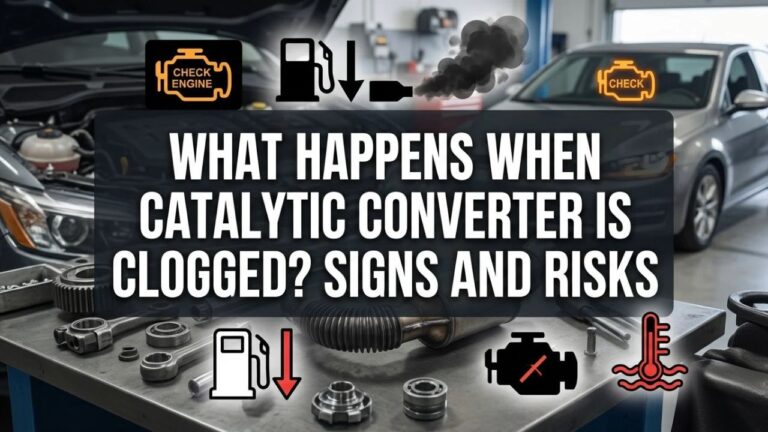
A blocked catalytic converter can make an engine feel weak, choked, and unable to rev normally because exhaust gases cannot leave the cylinders freely. Common signs include sluggish acceleration, poor high-RPM power, rough idle, hard starting, stalling, misfires, declining fuel economy, abnormal exhaust heat, and sometimes rattling from damaged material inside the converter.
A mild restriction may cause almost no trouble while idling. Once you accelerate, climb a hill, tow a load, or reach higher RPM, exhaust volume rises and the blockage becomes much easier to notice.
The most telling blocked catalytic converter symptoms are often power-related rather than emissions-related. Walker notes that a plugged converter can make a vehicle sluggish and cause loss of power when the internal substrate melts into a restrictive mass.
Do not confuse catalyst efficiency with physical blockage. A converter can lose its ability to clean exhaust and set P0420 or P0430 while still flowing gases normally. A physically restricted converter usually causes a much stronger drivability complaint.
Federal emissions coverage is also worth checking before paying for an early replacement. On qualifying U.S. light-duty vehicles, catalytic converters are among the major emissions components covered for 8 years or 80,000 miles under federal warranty requirements.
Diesel diagnosis needs an extra distinction. Modern diesel exhaust systems can contain a diesel oxidation catalyst, diesel particulate filter, and SCR catalyst. A clogged DPF can create symptoms that drivers may describe as blocked diesel catalytic converter symptoms, even though the actual restriction is inside the particulate filter rather than the oxidation catalyst. EPA guidance distinguishes the flow-through DOC from the DPF, which physically traps particulate matter.
What Are the Symptoms of a Blocked Catalytic Converter?
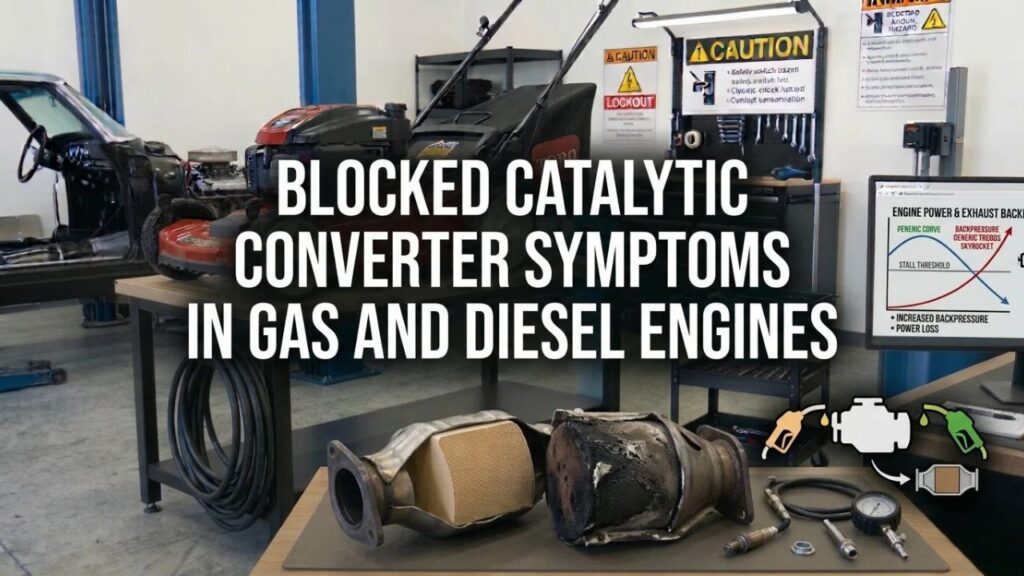
The severity of the symptoms usually follows the degree of restriction.
A converter that is only partly blocked may affect the engine under heavy load. A converter with badly melted or collapsed passages may cause problems at nearly every engine speed.
Loss of Engine Power
Loss of power is one of the strongest clues.
The vehicle may feel as though the engine cannot breathe.
You may notice the problem during:
- Highway merging
- Hard acceleration
- Passing
- Hill climbing
- Higher-RPM driving
- Carrying or towing extra weight
Walker lists loss of power, delayed acceleration, hard starts, misfires, and stalling among drivability problems linked with a clogged converter.
Slow Acceleration
A restricted converter may allow enough exhaust flow for gentle driving but not enough for rapid acceleration.
Pressing the accelerator farther may produce more engine noise without the expected increase in vehicle speed.
In some cases, easing off the throttle makes the engine feel temporarily better because exhaust volume falls.
Engine Will Not Rev Normally
Some vehicles develop what feels like an RPM ceiling.
The engine may pull normally at low speed and then become increasingly weak above a certain RPM.
There is no universal RPM where this occurs. The point changes with engine size, exhaust design, converter condition, and load.
Rough Idle
A severe blockage can affect idle quality.
The engine may:
- Shake
- Surge
- Drop below normal idle speed
- Misfire
- Stall
A slight restriction may leave the idle completely smooth.
Vacuum leaks, spark plugs, ignition coils, injectors, and throttle problems are more common rough-idle causes, so this symptom alone does not confirm converter blockage.
Hard Starting
An extensively restricted exhaust can make an engine harder to start.
Possible signs include:
- Long cranking
- Starting and immediately dying
- Starting after several attempts
- Rough running immediately after startup
Fuel-pressure, ignition, crankshaft-sensor, battery, and compression problems can produce the same complaint.
Engine Stalling
A heavily blocked exhaust may eventually prevent the engine from maintaining stable operation.
Stalling can occur:
- At idle
- After hard acceleration
- Once the engine gets hot
- When returning to a stop
- During hill climbing
A restriction severe enough to cause repeated stalling needs prompt diagnosis.
Engine Misfires
Excess exhaust backpressure can interfere with cylinder clearing and combustion.
The engine may develop random or multiple-cylinder misfires.
The reverse failure sequence is also very common: an existing misfire sends unburned fuel into the converter, the fuel burns there, the converter overheats, and the substrate melts into a restriction. Walker identifies misfires and rich operation as common causes of melted converter material.
Poor Fuel Economy
Fuel use can rise because the engine is struggling to produce normal power.
The original engine fault that damaged the converter may also increase consumption.
Poor MPG alone is weak evidence of blockage.
Rattling From Under the Vehicle
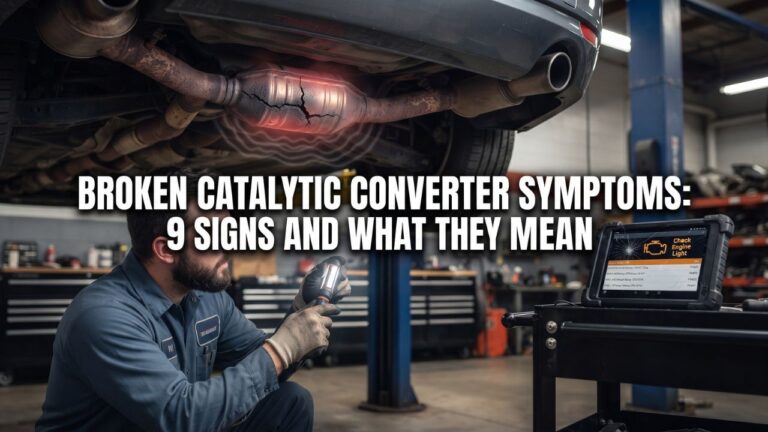
A damaged converter substrate can crack and break apart.
Loose pieces may rattle inside the metal shell, often during startup, acceleration, or road vibration.
Those pieces can shift and obstruct the outlet.
A loose heat shield can make a similar noise, so the source should be confirmed.
Key Takeaway: The symptoms of a blocked catalytic converter commonly include weak acceleration, loss of high-RPM power, rough idle, hard starting, stalling, misfires, poor fuel economy, and possible internal rattling.
Why Does a Blocked Catalytic Converter Cause Loss of Power?
A combustion engine has to move exhaust gases out before it can fill the cylinders with another fresh charge.
A blocked converter interferes with that process.
Backpressure Builds Ahead of the Blockage
The converter contains a honeycomb substrate with many small exhaust passages.
If heat melts those passages or debris blocks them, exhaust pressure rises upstream.
The pistons then have to work against that pressure during the exhaust stroke.
Walker states that high backpressure measured ahead of the converter points toward a restricted converter.
Residual Exhaust Remains in the Cylinders
A cylinder should expel most burned gases before the next intake stroke.
Excess backpressure can reduce that clearing.
Residual exhaust occupies volume that would otherwise contain a fresh air-fuel charge.
Less fresh charge means less potential combustion output.
Symptoms Grow Stronger With RPM
At idle, exhaust volume is relatively low.
At high RPM under load, the engine must move much more gas through the same converter.
That explains why a partially restricted vehicle may:
- Start normally.
- Idle smoothly.
- Cruise gently without obvious trouble.
- Lose substantial power when accelerating.
- Struggle even more as RPM rises.
Key Takeaway: A blocked converter raises exhaust backpressure and interferes with cylinder clearing, so the engine often loses more power as RPM and load increase.
How to Tell if Catalytic Converter Is Blocked
Several tests can separate converter restriction from ignition, fuel, transmission, and intake problems.
Scan the Vehicle for Trouble Codes
Start with an OBD-II scan.
Possible codes include:
- P0420
- P0430
- P0300
- Cylinder-specific misfire codes
- Rich mixture codes
- Lean mixture codes
- Oxygen-sensor codes
- MAF-related codes
P0420 and P0430 do not mean the converter is physically plugged.
They relate to catalyst efficiency.
A converter can be blocked without either code.
Inspect the Exhaust System
Before blaming the converter, inspect for other restrictions such as:
- Crushed exhaust pipe
- Bent pipe
- Damaged muffler
- Broken resonator
- Impacted converter housing
Walker recommends visually checking for crushed or bent exhaust pipes before performing backpressure diagnosis.
Perform an Exhaust Backpressure Test
Backpressure testing is one of the most direct ways to locate an exhaust restriction.
Pressure can be measured through an oxygen-sensor port.
Walker gives general reference values of less than about 1 PSI at idle and 3 PSI at 2,500 RPM on many vehicles, while vehicle-specific specifications should take priority. High pressure ahead of the converter with acceptable pressure behind it points toward converter restriction.
Check Engine Vacuum
A manifold vacuum gauge can provide another clue.
During an exhaust-restriction test, vacuum is observed at idle and at elevated RPM.
Walker notes that a large vacuum drop during a sustained higher-RPM test can indicate an exhaust restriction, though valve timing and ignition timing can also change readings.
Check Misfire and Fuel-Trim Data
Live scan data can identify the problem that damaged the converter or imitate its symptoms.
Check:
- Cylinder misfire counts
- Short-term fuel trim
- Long-term fuel trim
- MAF readings
- Oxygen-sensor data
A single-cylinder misfire points more strongly toward a plug, coil, injector, wiring fault, or compression problem than a blocked converter.
Do Not Rely Only on Temperature
Converter inlet and outlet temperature can add information, but temperature alone does not confirm restriction.
Catalyst activity, fuel mixture, engine load, and test conditions all affect heat.
Backpressure measurement gives a more direct indication of exhaust blockage.
Key Takeaway: To tell if a catalytic converter is blocked, combine the driving symptoms with scan data, exhaust inspection, vacuum behavior, and preferably an exhaust backpressure test.
What Causes a Catalytic Converter to Become Blocked?
Converters often become plugged after another engine fault damages the internal substrate.
Misfires
A misfiring cylinder may send unburned fuel and oxygen into the exhaust.
That fuel can ignite in the converter.
Extreme heat may melt the substrate until small exhaust passages collapse.
Rich Fuel Mixture
Excessive fuel can reach the exhaust because of:
- Leaking injectors
- Incorrect fuel pressure
- Ignition failure
- Sensor faults
- Fuel-control problems
Walker notes that rich operation can overheat and melt converter material.
Oil Burning
Oil entering the combustion chamber leaves deposits after combustion.
Oil contamination can coat catalyst surfaces and contribute to converter damage.
Common engine causes include worn piston rings, valve-seal problems, and other oil-consumption faults.
Coolant Entering the Exhaust
An internal coolant leak may contaminate the converter.
Walker identifies internal cooling-system leaks as a cause of catalyst poisoning and recommends checking for coolant loss during converter diagnosis.
Broken Upstream Converter
Some vehicles use several catalysts.
If an upstream converter breaks apart, pieces can travel downstream and plug another converter.
Walker specifically lists upstream catalyst debris as one cause of a plugged downstream converter.
Physical Damage
Road impact can crack or collapse internal ceramic material.
A converter may have substantial internal damage even if the outer shell only shows a dent.
Key Takeaway: Misfires, rich running, oil contamination, coolant leaks, overheated catalyst material, debris from another converter, and impact damage can all create a physical blockage.
Blocked Diesel Catalytic Converter Symptoms
Diesel exhaust diagnosis is more complicated because modern diesel systems commonly contain several aftertreatment components.
A driver may refer to all of them as the catalytic converter, but the exact blocked component matters.
Loss of Diesel Engine Power
A restricted diesel exhaust system can reduce acceleration and engine output.
The diesel may feel weak during:
- Heavy acceleration
- Towing
- Hill climbing
- Highway operation
Some electronically controlled diesel vehicles may also reduce engine output when the aftertreatment system reaches a fault or soot-load threshold.
Increased Exhaust Backpressure
A restriction anywhere in the aftertreatment system can increase exhaust pressure.
That can affect engine breathing and turbocharger operation.
Actual diagnosis needs to identify the specific restricted component rather than assuming the DOC is clogged.
Warning Lights
Diesel vehicles may display:
- Check engine light
- DPF warning light
- Aftertreatment warning message
- Reduced-power warning
- Regeneration request
Cummins guidance states that an illuminated DPF lamp indicates regeneration is needed, while a flashing lamp means particulate loading has increased. If the condition progresses far enough, a stop-engine warning may be triggered on applicable engines.
Frequent Regeneration
An abnormal increase in regeneration frequency can indicate that the diesel aftertreatment system is having trouble controlling soot loading or maintaining the required conditions.
Cummins service material lists frequent regeneration among complaints associated with DOC/DPF aftertreatment faults.
Poor Fuel Economy
Repeated regeneration can consume additional fuel.
A diesel engine struggling against an exhaust restriction may also require more throttle for the same work.
Hard Starting or Stalling in Severe Cases
Extreme exhaust blockage can affect basic engine operation.
The engine may become difficult to start, fail to produce normal power, or stall under certain conditions.
These severe symptoms should trigger prompt diagnosis rather than repeated forced regeneration attempts.
Key Takeaway: Blocked diesel catalytic converter symptoms can include low power, increased exhaust pressure, warning lights, repeated regeneration, poor fuel economy, and severe drivability problems, but the actual restriction may be in the DOC or DPF.
Symptoms of a Blocked Catalytic Converter on a Diesel
The phrase is often used for any restriction in a diesel aftertreatment assembly.
It helps to understand what each component does.
Diesel Oxidation Catalyst
A diesel oxidation catalyst, or DOC, is a flow-through catalyst.
EPA describes it as a precious-metal-coated honeycomb that lets exhaust flow through while catalyzing reactions that reduce pollutants.
Unlike a DPF, its primary job is not to trap soot.
A damaged or contaminated DOC can still become restrictive, but soot accumulation points more strongly toward the filter section.
Diesel Particulate Filter
The DPF physically traps particulate matter.
EPA explains that soot collected in the DPF must be burned during regeneration, while noncombustible ash gradually remains in the filter.
If regeneration does not occur often enough, soot loading increases.
If ash loading becomes excessive, the filter may require professional cleaning or replacement according to the manufacturer’s procedure.
SCR Catalyst
Many newer diesel vehicles also use selective catalytic reduction to reduce nitrogen oxides.
This section uses diesel exhaust fluid on systems designed for SCR.
SCR trouble can create warning lights or reduced-power strategies, but it is not the same failure as a physically clogged DPF.
Symptoms Can Overlap
The driver may only experience:
- Weak acceleration
- Warning light
- Reduced power
- Frequent regeneration
- Poor fuel economy
A scan tool capable of reading diesel aftertreatment data is usually needed to identify the exact component.
Key Takeaway: On a diesel, similar symptoms may come from the DOC, DPF, or another aftertreatment component, so identify the actual source of restriction before replacing a catalytic converter.
Blocked Gasoline Converter vs. Blocked Diesel Aftertreatment
| Symptom | Gasoline Converter | Diesel DOC/DPF System |
| Loss of power | Common | Common |
| Poor high-RPM acceleration | Common | Common |
| Increased exhaust backpressure | Common when blocked | Common when restricted |
| Rough idle | Possible | Possible |
| Stalling | Possible | Possible in severe cases |
| P0420/P0430 | Possible | System-specific codes differ |
| DPF warning light | No | Possible |
| Regeneration request | No | Possible |
| Frequent regeneration | No | Possible |
| Soot accumulation | Not typical cause | Major DPF concern |
The engine type changes the diagnostic path.
On a gasoline vehicle, a melted catalyst substrate is a common source of blockage.
On a modern diesel, the DPF deserves close attention when soot loading, regeneration warnings, and reduced power occur together.
Are Block Catalytic Converter Symptoms Different From a Clogged Converter?
The search phrase block catalytic converter symptoms usually refers to the same condition described as a blocked, clogged, plugged, or stopped-up catalytic converter.
All of these terms generally describe restricted exhaust flow through the converter.
The strongest symptoms remain:
- Loss of power
- Sluggish acceleration
- Limited RPM
- Rough running
- Stalling
- Hard starting in severe cases
- Excessive exhaust heat
The exact terminology matters less than proving where the restriction is located.
Can a Blocked Catalytic Converter Cause a Check Engine Light?
Yes, but a check engine light is not guaranteed.
A blocked converter may also have poor catalyst performance and set P0420 or P0430.
Other codes may involve:
- Misfires
- Rich or lean mixture
- Oxygen sensors
- Airflow measurement
P0420 is not a direct blockage code.
A converter may be physically open but chemically weak, or physically restricted without immediately setting P0420.
Can a Blocked Catalytic Converter Cause No Start?
A severe blockage can contribute to a crank-no-start or start-and-stall condition.
The engine may have so much exhaust restriction that normal gas exchange becomes difficult.
A complete no-start also requires checks for:
- Fuel pressure
- Ignition spark
- Crankshaft position signal
- Injector operation
- Compression
- Mechanical timing
A blocked converter should not be the first assumption without supporting symptoms.
Can a Blocked Catalytic Converter Damage the Engine?
Severe restriction can place extra load on the engine and raise exhaust pressure.
Possible results include:
- Reduced cylinder filling
- Loss of power
- Higher exhaust temperatures
- Misfire
- Stalling
The engine fault that damaged the converter may be an even larger concern.
A rich mixture or active misfire can keep overheating the catalyst until the underlying problem is corrected.
Can You Drive With a Blocked Catalytic Converter?
Driving should be limited once strong restriction symptoms appear.
Stop driving and arrange repair if the vehicle develops:
- Severe power loss
- Repeated stalling
- Flashing check engine light
- Heavy misfire
- Smoke
- Strong burning odor
- Glowing converter
- Inability to maintain normal traffic speed
A mild restriction may allow the vehicle to move, but damaged internal material can shift and make the blockage worse.
Can You Clean a Blocked Catalytic Converter?
Cleaning cannot repair a physically melted or collapsed catalyst.
A converter with:
- Melted passages
- Broken ceramic material
- Collapsed honeycomb
- Severe internal blockage
normally needs replacement.
Diesel DPF service is different.
A soot-loaded DPF may sometimes be regenerated, while ash-loaded filters can require professional cleaning or replacement according to the vehicle or engine manufacturer’s procedures. EPA describes regeneration as the process used to burn collected particulate matter from a DPF.
Do not drill, hollow out, or remove emissions material as a repair method.
How Do You Fix a Blocked Catalytic Converter?
The first repair is identifying why the converter became blocked.
Check for:
- Misfires
- Rich running
- Leaking injectors
- Oil burning
- Coolant consumption
- Sensor faults
- Exhaust impact damage
A gasoline converter with a melted or collapsed substrate normally needs replacement.
A diesel vehicle may require a different repair if the actual restriction is the DPF rather than the DOC.
After repair, confirm that:
- Engine codes are resolved
- Fuel mixture is correct
- Misfires are gone
- Exhaust backpressure is normal
- No coolant or oil is entering the exhaust
Replacing a blocked converter without repairing the original fault can lead to another failure.
Conclusion
The main blocked catalytic converter symptoms are loss of power, slow acceleration, inability to reach normal RPM, rough idle, hard starting, stalling, misfires, excessive exhaust heat, and possible rattling from broken internal material.
The symptoms of a blocked catalytic converter often become much more noticeable as engine speed and load rise. A vehicle that idles well but feels severely choked during highway acceleration is a strong candidate for exhaust-restriction testing.
For diesel owners, blocked diesel catalytic converter symptoms and symptoms of a blocked catalytic converter on a diesel need a slightly different diagnostic approach. Modern diesels may contain a DOC, DPF, and SCR catalyst, and the DPF is specifically designed to trap particulate matter. A DPF blockage can therefore imitate what many drivers call a clogged diesel catalytic converter.
Confirm the restriction before buying parts. Scan data, physical inspection, vacuum testing, and exhaust backpressure measurement can separate a blocked converter from fuel, ignition, intake, transmission, and engine mechanical problems.
FAQs About Blocked Catalytic Converter Symptoms
What is the most common symptom of a blocked catalytic converter?
Loss of power under load is one of the strongest signs. The vehicle may idle normally but accelerate poorly, struggle on hills, or stop gaining RPM as exhaust flow increases.
How do I know if my catalytic converter is physically blocked?
A backpressure test is one of the most direct checks. Excessive pressure measured ahead of the converter, combined with normal pressure farther downstream, supports a converter restriction diagnosis.
Can a blocked catalytic converter cause rough idle?
Yes, especially when the restriction becomes severe. A partly blocked converter may only affect higher-RPM performance. Vacuum leaks, ignition faults, injectors, and throttle problems should also be checked when rough idle is the main complaint.
Can a blocked catalytic converter cause stalling?
Yes. Severe exhaust restriction can interfere with cylinder breathing enough to make the engine stall, especially under load or after the exhaust system becomes hot.
What are blocked diesel catalytic converter symptoms?
Common signs include reduced engine power, warning lights, increased exhaust backpressure, poor fuel economy, and aftertreatment faults. If a DPF is fitted, frequent regeneration or a DPF warning lamp can point toward particulate-filter loading rather than a blocked DOC.
Can a diesel particulate filter be mistaken for a blocked catalytic converter?
Yes. A DPF physically traps soot and can become heavily loaded, while a diesel oxidation catalyst is mainly a flow-through catalytic device. Drivers often use “catalytic converter” as a general term for diesel aftertreatment parts even though they perform different jobs.
Does P0420 mean the catalytic converter is blocked?
No. P0420 indicates catalyst efficiency below the expected threshold on Bank 1. It does not directly measure exhaust flow. A backpressure test is better for determining if the converter is physically restricted.
Will replacing a blocked catalytic converter fix the problem permanently?
Only if the converter is the restriction and the original cause of failure is repaired. Misfires, rich fueling, oil consumption, coolant leaks, or other faults can quickly damage a replacement converter.