Clogged Catalytic Converter Symptoms: Signs, Sounds, and Tests
A clogged catalytic converter can make a vehicle feel weak, slow to accelerate, unable to reach higher RPM, or prone to rough idle and stalling. Severe restriction can also cause hard starting, misfires, excessive exhaust heat, and a feeling that the engine is being held back whenever you press the accelerator.
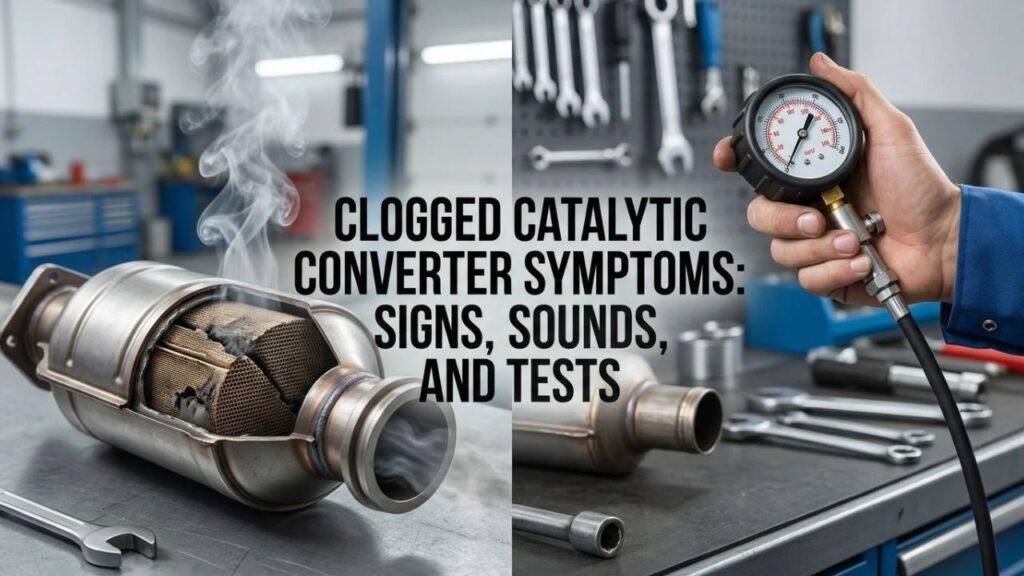
A catalytic converter contains a honeycomb-like core with many small exhaust passages. When those passages melt, collapse, break apart, or become heavily contaminated, exhaust gases cannot leave the engine normally. Pressure then builds ahead of the restriction.
Clogged catalytic converter symptoms are often easiest to notice during highway acceleration, hill climbing, towing, or other high-load conditions. A partly restricted converter may let the engine idle normally because exhaust flow is relatively low at idle.
A catalyst-efficiency problem is not automatically the same as a clog. A converter can lose its ability to clean exhaust and trigger a P0420 or P0430 code while still allowing exhaust to pass through freely.
For qualifying U.S. light-duty vehicles, the catalytic converter is one of the major emissions components covered under federal emissions warranty provisions for 8 years or 80,000 miles. Checking warranty eligibility can be worthwhile when a converter fails unusually early.
The sections below cover the main warning signs, sounds, visual clues, performance changes, diagnostic tests, and what a physically restricted converter actually does to an engine.
What Are Symptoms of a Clogged Catalytic Converter?
A physical exhaust restriction usually produces several symptoms together.
The severity depends on how much of the converter’s internal flow area is blocked.
Loss of Engine Power
Loss of power is one of the strongest signs.
The engine may feel normal at very light throttle but weak once more power is requested.
You may notice difficulty during:
- Highway merging
- Passing
- Hill climbing
- Hard acceleration
- Higher-RPM driving
- Towing or carrying heavy loads
As engine speed rises, more exhaust has to pass through the restricted converter.
The blockage then becomes much more noticeable.
Slow Acceleration
A clogged converter can make the accelerator feel less responsive.
You may press the pedal farther, yet vehicle speed increases slowly.
Some drivers describe the engine as feeling:
- Choked
- Restricted
- Heavy
- Flat
- Unable to breathe
The car may even feel slightly better after you ease off the accelerator because the engine produces less exhaust at reduced load.
Engine Will Not Rev Normally
A partially blocked converter can create an apparent RPM ceiling.
The engine may accelerate normally until it reaches a certain speed, then struggle to climb farther.
There is no universal RPM at which this happens.
The point changes with:
- Engine size
- Converter design
- Severity of blockage
- Exhaust layout
- Engine load
An engine that revs freely in Park can still have a restriction because unloaded revving produces far less exhaust than full-load driving.
Rough Idle
A severe restriction can eventually disturb idle quality.
The engine may:
- Shake
- Surge
- Drop below normal idle speed
- Misfire
- Stall
A mild blockage may cause no idle problem at all.
Vacuum leaks, ignition problems, fuel injectors, throttle-body deposits, and low compression can also cause rough idle.
Engine Stalling
A heavily clogged converter can make the engine stall because spent gases cannot leave the cylinders freely.
Stalling may occur:
- At idle
- During acceleration
- After the engine warms up
- When returning to a stop
- After a long uphill drive
Repeated stalling combined with severe power loss deserves prompt diagnosis.
Hard Starting
An extreme exhaust restriction may cause longer cranking or a start-and-stall condition.
The engine may:
- Crank longer than usual
- Start briefly and die
- Need several attempts
- Run poorly immediately after starting
Fuel pressure, spark, crankshaft-position data, injector operation, and compression should also be checked because they commonly cause hard-start problems.
Engine Misfires
High exhaust backpressure can interfere with normal cylinder clearing.
That can contribute to unstable combustion and random or multiple-cylinder misfires.
The reverse sequence is common too.
An existing misfire can send unburned fuel into the converter. That fuel burns inside the catalyst, creates extreme heat, and may melt the honeycomb until it becomes restricted.
Poor Fuel Economy
Fuel economy can fall when the engine has to work harder to overcome exhaust restriction.
The driver may also use more throttle to maintain normal speed.
The engine problem that damaged the converter may be contributing to poor mileage at the same time.
Excessive Exhaust Heat
A converter damaged by excess fuel can become extremely hot.
Possible warning signs include:
- Strong burning smell
- Unusual heat beneath the floor
- Heat discoloration
- Smoke
- A visibly glowing converter
A red-hot catalytic converter is not normal. Stop driving and have the vehicle diagnosed.
Key Takeaway: What are symptoms of a clogged catalytic converter? The strongest pattern is weak acceleration, reduced high-RPM power, rough running, stalling, hard starting, and excessive exhaust heat that becomes more noticeable as engine load rises.
Signs of a Clogged Catalytic Converter
Some warning signs are more useful than others when trying to separate converter restriction from common ignition or fuel problems.
Power Gets Worse as RPM Rises
This is one of the better clues.
A weak ignition coil may produce a misfire at many engine speeds.
A clogged exhaust often creates a more progressive restriction pattern.
The vehicle may:
- Start normally.
- Idle normally.
- Drive reasonably well at low speed.
- Feel weak under stronger acceleration.
- Become increasingly restricted as RPM rises.
This pattern fits an exhaust path that can handle a small volume of gas but not a large one.
The Engine Feels Better at Light Throttle
Reducing throttle lowers exhaust volume.
If the car feels less restricted after you back off the accelerator, exhaust blockage becomes more plausible.
Low fuel pressure can produce a similar pattern, so testing is still needed.
The Converter Rattles
A cracked ceramic substrate can break into loose pieces.
Those pieces may rattle during:
- Cold startup
- Acceleration
- Deceleration
- Road vibration
Broken pieces can also shift and partly block the converter outlet.
A loose heat shield can produce a similar rattle, so the source should be identified before replacing the converter.
The Converter Has Been Overheated
Severe overheating may discolor the housing or damage nearby heat shields.
An overheating history can point toward internal melting.
Common causes include:
- Ignition misfire
- Leaking fuel injector
- Rich fuel mixture
- Spark failure
- Fuel-control fault
A melted substrate can look fine from outside while being badly restricted internally.
The Vehicle Has a History of Misfires
Repeated misfires are a major warning sign because raw fuel can enter the exhaust.
If the car had a flashing check engine light before the power loss began, converter damage becomes more believable.
Multiple Cylinders Seem Affected
One-cylinder misfire points more strongly toward a spark plug, coil, injector, wiring fault, or compression problem.
A converter serving an entire bank or engine can affect several cylinders sharing that exhaust route.
Key Takeaway: Signs of a clogged catalytic converter become more convincing when high-RPM power loss, previous misfires, abnormal converter heat, rattling, and broad engine-performance problems appear together.
What Does a Clogged Catalytic Converter Do?
A clogged converter restricts exhaust flow.
That simple mechanical problem can affect several parts of the combustion cycle.
It Creates Excess Exhaust Backpressure
During the exhaust stroke, a piston pushes burned gases out of the cylinder.
Those gases normally move through:
- Exhaust valves
- Exhaust manifold
- Catalytic converter
- Muffler
- Tailpipe
A clogged converter narrows the flow path.
Pressure begins building between the engine and the restriction.
It Makes the Engine Work Harder
The piston now has to push exhaust against greater resistance.
Part of the engine’s output is wasted fighting that pressure.
The driver experiences this as reduced power.
It Interferes With Cylinder Clearing
A cylinder needs to remove burned gases before drawing in a fresh charge.
A restricted exhaust can leave more residual gas behind.
That reduces the space available for fresh air and fuel.
The next combustion cycle may produce less torque.
It Restricts Airflow Through the Entire Engine
An engine cannot keep pulling fresh air through the intake if it cannot push burned gases out the exhaust.
This is why an exhaust blockage can eventually reduce overall engine airflow.
The problem becomes stronger as RPM increases.
It Can Increase Heat
Restriction and the engine fault that caused it can raise exhaust-system temperatures.
If the converter is being fed unburned fuel, internal temperature can become high enough to melt the substrate further.
That creates a damaging cycle:
Misfire → excess fuel → converter overheating → melted substrate → greater restriction → poorer engine operation.
Key Takeaway: What does a clogged catalytic converter do? It traps exhaust pressure, makes the engine work against that pressure, interferes with cylinder breathing, reduces airflow, and can lead to major power loss.
What Does a Clogged Catalytic Converter Sound Like?
A clogged converter does not always make a distinctive sound.
Many severely restricted converters remain surprisingly quiet.
Rattling
Rattling is the sound most often associated with physical converter damage.
It may sound like:
- Small rocks inside a metal can
- Loose ceramic pieces
- Metallic vibration beneath the vehicle
The noise may be strongest at startup or when engine speed changes.
Hissing or Restricted Exhaust Sound
Severe blockage can alter exhaust tone.
You may hear:
- Hissing
- Muted exhaust flow
- Unusual pressure sounds
- A strained engine note during acceleration
The sound by itself does not identify the converter.
A crushed pipe or damaged muffler can make similar noises.
Popping or Misfire Sounds
If restriction is contributing to unstable combustion, the engine may stumble or pop.
Misfires that originally damaged the converter can also create irregular exhaust sounds.
A Clogged Converter Can Be Silent
This is an important point.
A melted honeycomb may restrict exhaust badly without rattling.
Do not rule out a clog just because the exhaust sounds normal.
Key Takeaway: What does a clogged catalytic converter sound like? It may rattle, hiss, or change the exhaust tone, but many blocked converters make no distinctive sound at all.
What Does a Clogged Catalytic Converter Look Like?
A clogged converter can look completely normal from the outside.
The restriction is usually inside the metal housing.
Melted Honeycomb
If the converter is removed and inspected internally, severe heat damage may appear as:
- Melted passages
- Fused ceramic material
- Distorted honeycomb
- Collapsed channels
These changes drastically reduce the amount of space available for exhaust flow.
Broken Ceramic Material
A damaged substrate may:
- Crack
- Crumble
- Break into chunks
- Shift toward the outlet
Loose pieces can block the remaining open passages.
Heavy Deposits
Oil burning, coolant contamination, and prolonged engine problems can leave deposits on the substrate.
The internal surface may appear:
- Dark
- Ash-covered
- Oily
- Contaminated
The exact appearance depends on what caused the failure.
External Heat Discoloration
The outer housing may show:
- Blue or purple heat marks
- Burned paint nearby
- Damaged heat shields
- Heat-stressed metal
External discoloration supports an overheating history but does not prove blockage.
Dents or Impact Damage
Road impact can crush the shell and break the ceramic material inside.
A dented converter deserves inspection if power loss began after hitting road debris or another object.
Normal Exterior Appearance
Many clogged converters show no visible external damage.
A clean-looking metal housing does not tell you what the internal honeycomb looks like.
Key Takeaway: What does a clogged catalytic converter look like? Internal damage may include melted, collapsed, broken, or contaminated honeycomb, while the outside can still appear normal.
How to Tell if Catalytic Converter Is Clogged
Symptoms can raise suspicion, but direct testing gives a stronger answer.
Check All Diagnostic Trouble Codes
Use an OBD-II scanner before clearing any codes.
Look for:
- P0420
- P0430
- P0300
- Cylinder-specific misfire codes
- Rich mixture codes
- Lean mixture codes
- Oxygen-sensor codes
- MAF-related faults
A catalyst code does not automatically mean the converter is physically clogged.
P0420 and P0430 relate to catalyst efficiency rather than direct exhaust-flow measurement.
Review the Symptom Pattern
Restriction becomes more likely when the car:
- Runs acceptably at low load
- Loses power during acceleration
- Struggles on hills
- Stops gaining RPM normally
- Feels better after reducing throttle
That pattern fits rising backpressure.
Inspect the Exhaust
A converter is not the only exhaust component that can become restricted.
Check for:
- Crushed exhaust pipes
- Impact damage
- Collapsed muffler
- Broken internal components
- Severe corrosion
A damaged muffler can imitate many converter symptoms.
Perform an Exhaust Backpressure Test
A backpressure test is one of the most useful checks for physical restriction.
A technician can install a pressure gauge at an oxygen-sensor port or another approved test point.
Pressure is then checked at idle and elevated RPM.
Many gasoline engines normally show low exhaust backpressure, often around or below 1 PSI at idle and remaining only a few PSI at approximately 2,500 RPM, but the vehicle manufacturer’s specifications should take priority.
Pressure that rises excessively ahead of the converter supports an exhaust restriction.
Testing farther downstream can help identify the blocked component.
Perform a Vacuum Test
Engine manifold vacuum can provide another clue.
A typical restriction pattern is:
- Vacuum appears reasonable at idle.
- Engine speed is raised and held.
- Vacuum gradually drops instead of stabilizing.
This can indicate that exhaust pressure is building.
Valve-timing problems and other engine faults can affect vacuum readings, so the test is best used alongside other evidence.
Check Fuel Pressure
Low fuel pressure can imitate a blocked converter.
Both problems may cause:
- Weak acceleration
- Power loss under load
- Hesitation
- Stalling
Testing fuel pressure prevents replacing an expensive converter for a weak fuel pump.
Key Takeaway: How to tell if catalytic converter is clogged comes down to confirming the driving pattern and measuring exhaust restriction, with a backpressure test providing stronger evidence than a catalyst code alone.
How to Know if Your Catalytic Converter Is Clogged at Home
Some basic checks can be performed without removing the converter.
Avoid unsafe shortcuts.
Pay Attention to Load-Related Power Loss
Drive the vehicle only if it can be operated safely.
Notice if performance becomes much worse during:
- Uphill driving
- Highway acceleration
- Higher RPM
- Heavy throttle
A growing loss of power under load fits a restriction pattern.
Listen for Internal Rattling
With the exhaust cold, listen near the converter area while the engine is started.
Do not crawl underneath a running vehicle or touch hot exhaust parts.
A rattling sound can indicate broken internal ceramic material.
Read OBD-II Data
A basic scanner can show trouble codes.
A more capable tool may display:
- Misfire counts
- Fuel trims
- MAF airflow
- Oxygen-sensor data
- Engine load
This information can reveal problems that caused the converter damage or point toward another fault.
Do Not Drill or Remove the Converter to Test It
Drilling holes, punching out the catalyst, or removing emissions components is not a proper diagnostic method.
It can create:
- Exhaust leaks
- Excessive noise
- Unsafe fumes
- Emissions-law problems
Use proper pressure testing or professional diagnosis.
Do Not Touch a Hot Converter
Catalytic converters operate at very high temperatures and stay hot long after the engine stops.
Allow the exhaust to cool fully before inspection.
Key Takeaway: How to know if your catalytic converter is clogged at home starts with observing load-related power loss, checking codes and scan data, listening for internal damage, and avoiding unsafe modifications.
Clogged Catalytic Converter vs. Bad Fuel Pump
These faults often feel similar.
| Symptom | Clogged Converter | Weak Fuel Pump |
| Slow acceleration | Common | Common |
| Power loss under load | Common | Common |
| High exhaust backpressure | Common | No |
| Low fuel pressure | No | Common |
| Rattling converter | Possible | No |
| Limited high-RPM power | Common | Common |
| Stalling | Possible | Possible |
| Backpressure test abnormal | Yes | No |
Testing pressure on both systems is much more reliable than guessing from acceleration alone.
Clogged Catalytic Converter vs. Bad MAF Sensor
A faulty MAF can also create weak acceleration and poor throttle response.
MAF trouble may produce:
- P0100-series codes
- Rich or lean fuel trims
- Rough idle
- Hesitation
- Poor fuel economy
- Abnormal airflow readings
A clogged converter points more strongly toward:
- Increasing power loss with RPM
- High exhaust backpressure
- Converter overheating history
- Broken-substrate rattling
- Exhaust restriction test failure
A bad MAF can indirectly damage the converter if incorrect airflow data causes severe rich running.
Clogged Catalytic Converter vs. Bad Ignition Coil
An ignition coil usually affects one cylinder.
Common signs include:
- P0301-P0308
- Rough idle
- Engine shaking
- Misfire under load
A clogged converter may affect several cylinders sharing the same exhaust route and create broader power loss.
If a misfire follows a coil when it is moved to another cylinder, the ignition coil becomes a much stronger suspect.
Why Does a Catalytic Converter Become Clogged?
Physical converter blockage usually develops after another fault damages the substrate.
Engine Misfires
A misfire may send raw fuel into the exhaust.
That fuel can burn inside the converter and create extreme heat.
Continued overheating may melt the internal ceramic passages.
Rich Fuel Mixture
Too much fuel can enter the exhaust because of:
- Leaking fuel injectors
- Excessive fuel pressure
- Ignition problems
- Airflow-sensor errors
- Fuel-control faults
This can produce the same overheating problem.
Oil Burning
Engine oil entering the combustion chambers leaves deposits in the exhaust.
Possible sources include:
- Worn piston rings
- Worn valve seals
- PCV-system faults
- Internal engine wear
Deposits can contaminate the catalyst and contribute to flow restriction.
Coolant Contamination
Internal coolant leakage can send coolant through the combustion chamber and into the exhaust.
Possible clues include:
- Unexplained coolant loss
- Persistent white exhaust after warm-up
- Overheating
- Internal engine leakage
Coolant contamination can damage the catalyst coating and substrate.
Physical Impact
Rocks, curbs, road debris, or collision damage can break the internal ceramic core.
Loose pieces may later block the converter outlet.
Key Takeaway: Misfires, rich running, oil burning, coolant contamination, extreme heat, and physical impact are common reasons the converter’s internal passages become damaged or obstructed.
Can You Drive With a Clogged Catalytic Converter?
A mildly restricted converter may still allow the vehicle to move, but symptoms can worsen.
Avoid continued driving if the vehicle has:
- Severe loss of power
- Repeated stalling
- Flashing check engine light
- Heavy misfire
- Smoke
- Strong burning smell
- Glowing converter
- Trouble maintaining normal traffic speed
A broken substrate can move inside the housing and make the restriction suddenly worse.
A flashing check engine light also raises concern that an active misfire is sending fuel into the converter.
If the vehicle cannot accelerate safely, towing is the better option.
Can You Clean a Clogged Catalytic Converter?
A physically melted or collapsed converter cannot be restored with a chemical cleaner.
Cleaner cannot rebuild:
- Melted honeycomb
- Broken ceramic
- Collapsed passages
- Loose internal pieces
If deposits are mild and the substrate is still intact, repairing the engine fault may prevent further damage.
A converter that has already developed significant physical restriction generally needs replacement.
Do not hollow out or remove the catalyst material.
How Do You Fix a Clogged Catalytic Converter?
Start with the cause of failure.
Inspect for:
- Active misfires
- Rich fuel mixture
- Leaking fuel injectors
- Oil consumption
- Coolant loss
- Sensor faults
- Fuel-pressure problems
Once the underlying problem has been repaired, replace the converter if testing confirms that its substrate is physically restricted.
Match the replacement to the vehicle’s:
- Model year
- Make and model
- Engine
- Emissions certification
- Converter position
- State requirements
A replacement installed behind an engine that is still misfiring or running rich can fail again.
Conclusion
The most common clogged catalytic converter symptoms are loss of power, slow acceleration, limited high-RPM performance, rough idle, hard starting, stalling, misfires, excessive exhaust heat, and possible internal rattling.
The strongest signs of a clogged catalytic converter usually appear under load. A vehicle may idle smoothly yet feel badly restricted while accelerating because exhaust volume rises as engine speed and power demand increase.
For how to tell if catalytic converter is clogged or how to know if your catalytic converter is clogged, scan codes are only the starting point. Inspect the exhaust system and confirm the restriction with a backpressure test or another manufacturer-approved diagnostic method.
A clogged converter may look melted or broken internally, yet the outside can appear completely normal. It may rattle, hiss, or make no unusual sound at all. Testing matters more than appearance or noise alone.
FAQs About Clogged Catalytic Converter Symptoms
What are symptoms of a clogged catalytic converter?
Typical symptoms include poor acceleration, weak high-RPM power, rough idle, hard starting, stalling, misfires, reduced fuel economy, excess exhaust heat, and possible rattling. Severe restriction can eventually make the engine difficult to run.
What does a clogged catalytic converter sound like?
It may produce rattling from broken ceramic material, hissing, or an unusual restricted exhaust tone. Some clogged converters remain quiet, so the absence of noise does not rule out a blockage.
What does a clogged catalytic converter look like?
Inside, the honeycomb may be melted, collapsed, broken, or heavily contaminated. The outer housing may show heat discoloration or impact damage, but many restricted converters look completely normal externally.
What does a clogged catalytic converter do to an engine?
It restricts exhaust flow and raises backpressure. That makes it harder for cylinders to expel burned gases and draw in fresh air, reducing engine power and sometimes causing rough running, misfires, or stalling.
Does P0420 mean the catalytic converter is clogged?
No. P0420 indicates that catalyst efficiency on Bank 1 is below the computer’s expected threshold. It does not directly measure exhaust restriction. A converter can set P0420 without being clogged.
Can a clogged catalytic converter cause a no-start?
A severe blockage can contribute to hard starting or a start-and-stall condition. A complete no-start can also come from fuel-pressure problems, ignition faults, crankshaft sensors, compression loss, or timing problems.
Can a clogged catalytic converter cause rough idle?
Yes, if the restriction is severe enough. A partial blockage may only affect high-load performance. Vacuum leaks, ignition problems, injectors, and throttle faults should also be checked when rough idle is the main symptom.
What is the best test for a clogged catalytic converter?
An exhaust backpressure test is one of the most direct ways to confirm physical restriction. Pressure that rises abnormally ahead of the converter, especially as RPM increases, supports a clogged exhaust diagnosis.