How to Start a Car With a Clogged Catalytic Converter: Safe Steps
If a severely restricted converter is stopping the engine from running, there usually is no safe starting trick that fixes the blockage. Let the vehicle cool, check for signs of overheating or misfire, then make one normal start attempt using the vehicle’s standard procedure. If it repeatedly starts and stalls, stop cranking and arrange diagnosis.
A partially blocked converter may allow the engine to start but leave it weak, rough, or unable to rev. A nearly complete blockage creates so much exhaust restriction that burned gases cannot leave the cylinders normally, which may cause extended cranking, immediate stalling, or a no-start condition.
Repeatedly trying to start the engine is not a repair. If an active misfire or rich fuel mixture caused the converter to overheat, continued starting attempts may send more unburned fuel into an already hot catalyst and make the damage worse.
For U.S. vehicles, the EPA classifies catalytic converters as specified major emission-control components. Eligible light-duty vehicles receive federal emissions warranty coverage for 8 years or 80,000 miles, whichever comes first, under applicable warranty conditions.
The safest answer to how to start a car with a clogged catalytic converter is to make only a normal start attempt after checking for serious warning signs. If exhaust flow is restricted enough to prevent the engine from running, the converter needs diagnosis and usually replacement rather than a starting shortcut.
I would not drill the converter, break the internal catalyst, remove it, or drive with an improvised exhaust bypass. EPA rules prohibit removing or rendering a required catalytic converter inoperative, and those shortcuts do not repair the engine fault that caused the clog.
The steps below explain what you can safely try, how to tell a clogged converter from a battery or fuel problem, why the engine may start and immediately stall, which temporary tricks to avoid, and when towing is the safer choice.
How to Start a Car With a Clogged Catalytic Converter Safely
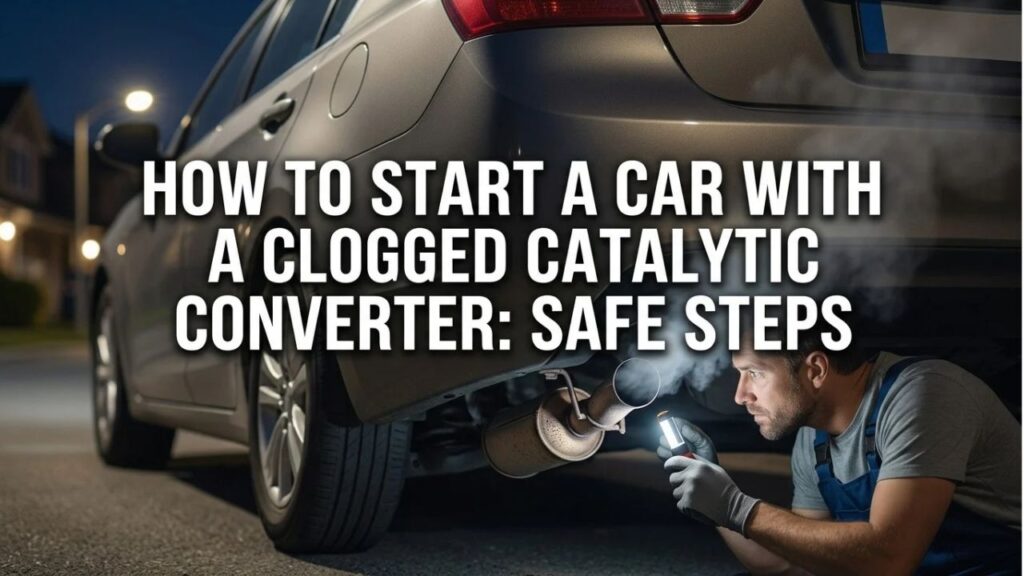
If the converter is only partly restricted, the engine may still start. If it is almost completely blocked, normal combustion may not continue because exhaust cannot escape.
1. Confirm That the Engine Actually Cranks
Turn the key or press the start button and pay attention to what happens.
If the engine does not crank at all, a clogged catalytic converter is unlikely to be the first problem to investigate. A weak battery, starter circuit fault, starter motor problem, immobilizer issue, or poor electrical connection is more likely.
A clogged converter generally affects what happens after the engine begins turning. The engine may crank normally but fail to fire, start briefly and stall, or run with severe power loss.
2. Check for Overheating, Smoke, or a Flashing Warning Light
Before another start attempt, look for serious warning signs.
Do not keep trying to run the engine if you notice:
- A converter or exhaust section glowing red
- Smoke from underneath the vehicle
- A strong burning smell
- A flashing Check Engine light before it stalled
- Severe misfiring
- Extreme heat beneath the floor
- Fuel smell combined with rough running
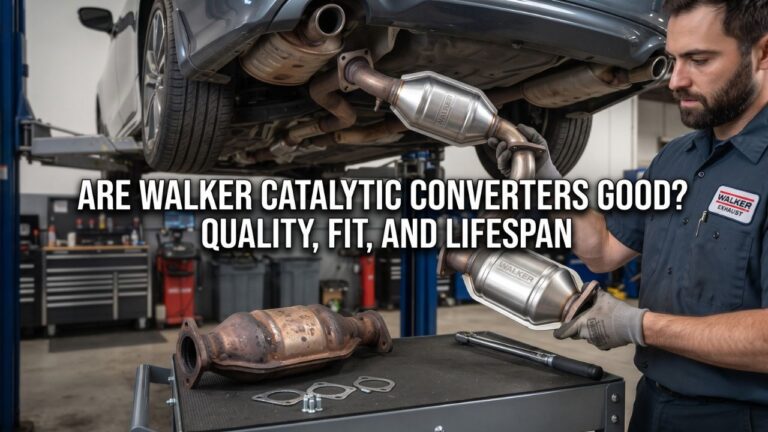
Walker states that excessive converter temperatures can damage the catalyst coating and that sufficiently high temperatures can destroy or melt the internal substrate. Misfires and overly rich operation are common causes.
Let the vehicle cool in a safe location away from dry grass, leaves, or other combustible material.
3. Make One Normal Start Attempt
Use the normal starting procedure listed in the owner’s manual.
For most modern fuel-injected vehicles, there is no reason to pump the accelerator repeatedly. Let the engine-management system control starting fuel and airflow unless the manufacturer specifies another procedure.
If the engine starts, listen to how it runs before moving the vehicle.
A partly restricted converter may produce:
- Rough idle
- Weak throttle response
- Hesitation
- A feeling that the engine cannot rev
- Sulfur odor
- Excess exhaust heat
Do not immediately rev the engine hard to “push” exhaust through the blockage.
4. Stop if It Starts and Immediately Stalls
A severely restricted converter may let the engine fire for a moment, then stall as exhaust pressure builds.
AutoZone lists difficulty starting, poor acceleration, heat buildup, and reduced engine performance among symptoms associated with a clogged converter.
Repeated start-stall cycles are a reason to stop trying.
The car needs testing to confirm that exhaust restriction is actually the cause.
Key Takeaway: If the engine cranks, check for severe heat or misfire first, then make one normal starting attempt. Repeated starting and stalling points toward a fault that needs diagnosis, not more cranking.
Why a Clogged Catalytic Converter Can Stop a Car From Starting
An engine has to move air into the cylinders and exhaust gases back out.
A severe blockage interferes with the exhaust side of that process.
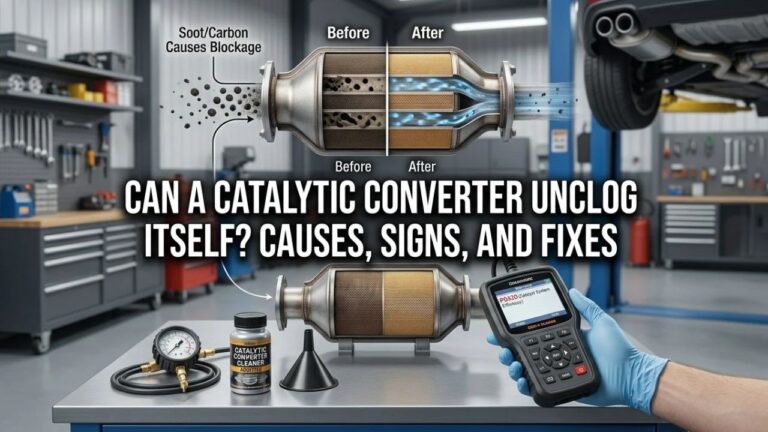
Exhaust Backpressure Builds Up
During the exhaust stroke, the piston pushes burned gases out of the cylinder and into the exhaust system.
A healthy converter has many small passages that let those gases flow through while the catalyst treats pollutants.
If those passages become melted, collapsed, or heavily obstructed, exhaust pressure builds upstream.
Walker notes that excessive backpressure ahead of the converter can indicate a restricted converter. Its diagnostic guidance lists typical backpressure targets below about 1.5 PSI at idle and 3 PSI at 2,000 RPM, though actual specifications vary by vehicle.
A Partial Clog May Let the Engine Start
A partial blockage often leaves enough exhaust flow for idle.
The problem becomes more obvious when you press the accelerator because the engine produces a larger volume of exhaust.
Typical symptoms include:
- Engine starts normally
- Idle may be acceptable
- Acceleration is very weak
- RPM rises slowly
- Vehicle struggles uphill
- Power drops as load increases
Walker lists hard starts, delayed acceleration, loss of power, and stalling among drivability problems associated with a failing or clogged converter.
A Severe Blockage Can Cause a No-Start
If the exhaust path is almost closed, the engine may be unable to clear enough burned gas to support the next combustion cycle.
It may crank normally but:
- Never fully start
- Fire only briefly
- Start and die after a few seconds
- Stall when the throttle is opened
A converter-related no-start is less common than battery, ignition, fuel-delivery, or sensor problems, so diagnosis matters before buying an expensive converter.
Key Takeaway: Partial restriction usually causes weak performance first. A near-total blockage can create enough exhaust backpressure to cause repeated stalling or prevent the engine from staying running.
How to Tell a Clogged Converter From Another No-Start Problem
A car that will not start can have dozens of causes. The behavior during the start attempt gives useful clues.
| What the car does | More likely direction |
| No crank, dash lights weak | Battery or electrical supply |
| One click or no crank | Starter circuit or battery |
| Cranks normally but never fires | Fuel, ignition, sensors, compression, or severe exhaust restriction |
| Starts then quickly stalls | Fuel, airflow, electronics, or exhaust restriction |
| Starts but has almost no acceleration | Exhaust restriction becomes more likely |
| Severe power loss plus sulfur smell | Converter or engine-fueling fault deserves inspection |
| Flashing Check Engine light | Active misfire needs prompt attention |
| Converter glows red | Extreme exhaust temperature; stop driving |
Clues That Support a Clogged Converter
A blocked converter becomes more likely if the no-start follows a period of:
- Gradually worsening acceleration
- Loss of high-RPM power
- Stalling under load
- Rotten-egg exhaust smell
- Excessive converter heat
- Rattling from inside the converter
- P0420 or P0430 along with drivability symptoms
- Long-term misfire or rich-running problem
A P0420 or P0430 code alone does not prove the converter is physically clogged. Those codes relate to catalyst efficiency and can appear without severe exhaust restriction.
Clues That Point Somewhere Else
If the engine never cranks, look at the starting and electrical systems first.
If it cranks normally but there was no previous power loss, no exhaust heat, no converter noise, and no catalyst-related symptoms, check more common no-start causes such as:
- Fuel delivery
- Ignition spark
- Crankshaft or camshaft sensor signal
- Immobilizer system
- Engine compression
- Battery voltage during cranking
A clogged converter should be confirmed rather than guessed.
Key Takeaway: A converter blockage is more convincing when a cranking or stalling problem appears after progressive power loss, heat, sulfur odor, or exhaust restriction symptoms.
Can You Bypass a Clogged Catalytic Converter to Start the Car?
Do not treat converter removal or destruction as a roadside starting method.
Some online advice recommends punching out the catalyst, cutting the converter open, installing a straight pipe, or creating a permanent exhaust bypass. Those approaches create legal, emissions, noise, and repair problems.
Do Not Break the Honeycomb Out
The ceramic or metallic substrate inside the converter is the working catalyst structure.
Breaking it apart may temporarily reduce restriction if the converter is physically blocked, but it destroys the emissions device and can send loose debris farther into the exhaust.
EPA states that removing or rendering a required emissions-control device inoperative is prohibited under the Clean Air Act.
Do Not Remove the Converter and Drive Without It
Removing the converter is not a legitimate repair for a clogged unit.
The correct repair is to diagnose why it failed, correct that cause, and install a compliant replacement when the converter is physically damaged or restricted.
EPA specifically identifies removal of a catalytic converter without an approved replacement as emissions tampering.
A Technician May Use an O2 Sensor Port for Testing
A repair technician may measure exhaust backpressure through an oxygen-sensor port.
Walker describes backpressure testing through O2-sensor ports to locate exhaust restrictions. High pressure ahead of the converter supports a diagnosis of converter blockage.
That is a controlled diagnostic procedure, not a method for driving the car with the sensor removed.
Hot exhaust gases leaving an open sensor port can damage nearby wiring or components and create an exhaust-fume hazard.
Key Takeaway: Do not drill, gut, remove, or permanently bypass a clogged converter. Use proper backpressure testing to confirm restriction and replace a damaged converter with a compliant part.
Will Catalytic Converter Cleaner Make the Car Start?
Not if the converter has melted or collapsed internally.
Chemical cleaners have limited use and should not be confused with a repair for severe physical blockage.
Light Deposits Are Different From Melted Material
A converter may sometimes have deposits on an otherwise intact substrate.
A cleaner marketed for catalytic systems may be used according to its instructions in selected cases, but it cannot rebuild melted ceramic passages or reconnect broken catalyst material.
CarParts notes that cleaning products may work in some contamination cases, while a clogged or physically damaged converter often needs replacement.
A No-Start Usually Means Cleaning Is Too Late
If restriction is severe enough that the engine cannot remain running, you cannot rely on a fuel-tank cleaner that requires normal engine operation and exhaust temperature.
Do not keep cranking the engine in an attempt to circulate cleaner.
Fix the Cause Before the Converter
A converter often becomes damaged because something else is wrong.
Walker lists misfires, rich fuel mixtures, oil contamination, coolant contamination, and excessive temperature among common causes of converter failure.
A new or cleaned converter may fail again if that cause remains.
Key Takeaway: Cleaner cannot repair a melted or collapsed catalyst. A converter restricted enough to cause a no-start usually needs testing and, if physical damage is confirmed, replacement.
What to Do if the Car Starts With a Clogged Converter
Getting the engine running does not mean the vehicle is ready for normal driving.
Pay attention to how it behaves during the first moments after startup.
Let It Idle Instead of Revving It Hard
If the engine starts, keep it at normal idle while checking for abnormal signs.
Do not repeatedly race the engine to test if the blockage will clear.
A severe restriction usually becomes worse as exhaust volume rises.
Stop for a Flashing Check Engine Light
A flashing Check Engine light commonly accompanies a serious misfire.
Misfires can send unburned fuel into the converter, creating extreme heat and further catalyst damage.
Walker identifies engine misfire as a major cause of converter meltdown.
Stop for Severe Power Loss
If the vehicle cannot accelerate normally or maintain a safe road speed, do not try to drive it through traffic.
A converter that is heavily restricted can leave you unable to accelerate when merging, crossing traffic, or climbing a grade.
Tow the Vehicle if Symptoms Are Severe
Towing makes more sense when the vehicle has:
- Repeated stalling
- Extreme loss of power
- Flashing Check Engine light
- Severe misfire
- Smoke
- Glowing exhaust
- Strong burning smell
- Exhaust fumes entering the cabin
A short drive to a repair shop may be reasonable when the engine runs smoothly, there is no overheating, and performance remains normal, but the converter still needs diagnosis.
Key Takeaway: If the engine starts, do not assume the problem is solved. Severe power loss, misfire, stalling, or excess heat are reasons to shut it down and arrange towing.
What Causes a Catalytic Converter to Become Clogged?
Converters rarely become restricted without another problem contributing to the damage.
Finding that original fault protects the replacement converter.
Engine Misfire
A cylinder that fails to burn its air-fuel mixture can send fuel and oxygen into the exhaust.
That mixture may burn inside the converter and drive its temperature far above normal operation.
The substrate can eventually melt and block its own passages.
Rich Air-Fuel Mixture
Too much fuel can also overheat the catalyst.
Possible causes include:
- Leaking injector
- Incorrect fuel pressure
- Faulty sensor input
- Ignition problem
- Poor spark
- Engine-control fault
Oil or Coolant Contamination
Oil entering the combustion chambers can coat the catalyst.
Coolant from an internal engine leak can do the same.
Walker states that internal coolant leaks and oil contamination can poison converter surfaces and contribute to failure.
Broken Internal Substrate
Impact damage or long-term thermal stress can break the catalyst structure.
Loose pieces may shift and block the outlet, producing intermittent power loss or rattling before the restriction becomes severe.
Key Takeaway: Misfires, rich fueling, oil consumption, coolant leaks, and internal breakage should be corrected before or during converter replacement.
How a Mechanic Confirms the Converter Is Clogged
Good diagnosis prevents an expensive part from being replaced for the wrong reason.
Scan the Engine Computer
A technician normally starts by reading stored and pending trouble codes.
Relevant codes may include:
- P0420 or P0430 catalyst-efficiency codes
- P0300-series misfire codes
- Fuel-mixture codes
- Oxygen-sensor codes
- Airflow or sensor codes
Other engine codes should be diagnosed rather than assuming the converter caused all of them.
Perform an Exhaust Backpressure Test
Backpressure testing directly checks how freely exhaust moves through the system.
Walker advises measuring pressure at different O2-sensor locations to identify where the restriction sits. Elevated pressure ahead of the converter with acceptable pressure after it points toward a restricted converter.
Check Engine Vacuum
A vacuum gauge can also provide evidence of exhaust restriction.
Walker notes that a large vacuum drop as engine speed is held higher can indicate a blocked exhaust, though ignition timing, valve timing, and other engine conditions can affect the reading.
Inspect for Heat and Internal Damage
A technician may look for:
- Heat discoloration
- Melted catalyst material
- Collapsed passages
- Rattling substrate
- Impact damage
- Exhaust leaks
- Oil or coolant contamination
Finding the cause matters as much as proving the blockage.
Key Takeaway: A scan, backpressure test, vacuum test, and physical inspection can separate a truly clogged converter from fuel, ignition, sensor, or engine problems that produce similar symptoms.
Conclusion
The safest answer to how to start a car with a clogged catalytic converter is to make one normal starting attempt only after checking for severe heat, smoke, or misfire. If the engine starts and immediately stalls repeatedly, a heavily restricted exhaust may prevent it from running.
Do not keep cranking, rev the engine aggressively, punch out the catalyst, or remove the converter as a shortcut. A physically melted or collapsed converter normally needs replacement, and U.S. federal law prohibits tampering with required emissions-control equipment.
The next job is finding out why the converter became restricted. Misfires, rich fueling, oil burning, coolant leaks, and other engine faults can destroy a replacement if they remain.
If the vehicle has severe power loss, a flashing Check Engine light, smoke, repeated stalling, or a glowing exhaust system, I would have it towed. Getting the engine to fire once is less important than preventing more converter damage or becoming stranded in traffic.
FAQs About Starting a Car With a Clogged Catalytic Converter
Can a Completely Clogged Catalytic Converter Stop a Car From Starting?
Yes. A severe restriction can create enough exhaust backpressure that the engine cannot clear burned gases and sustain combustion.
The engine may still crank normally because the starter system is separate. It may fail to fire, start for a moment and stall, or run only at very low load.
Will a Car Start if the Catalytic Converter Is Only Partly Clogged?
Usually, yes.
A partly restricted converter often causes weak acceleration, poor high-RPM performance, hesitation, and increased heat before it causes a complete no-start. The engine may idle normally because exhaust flow is relatively low at idle.
Can I Rev the Engine to Clear a Clogged Catalytic Converter?
Do not aggressively rev an engine that may have a severe converter restriction.
Higher RPM creates more exhaust flow and heat. If the substrate is already melted or blocked, revving will not restore the passages and may place more stress on the exhaust system.
Can I Remove the O2 Sensor to Start the Car?
A technician may temporarily use an O2-sensor port during controlled exhaust backpressure diagnosis, but driving with the sensor removed is not a repair.
Hot exhaust will leave through the open port, and nearby components can be exposed to heat and fumes. Have the restriction tested properly instead.
Can a Catalytic Converter Cleaner Fix a No-Start?
Usually not when the converter is blocked badly enough to prevent the engine from running.
Chemical cleaners cannot rebuild a melted, collapsed, or broken catalyst. A severely restricted converter normally needs physical inspection and replacement after the original cause is corrected.
Will Disconnecting the Battery Unclog a Catalytic Converter?
No.
Disconnecting the battery may erase learned settings or diagnostic information on some vehicles, but it cannot remove a physical exhaust blockage. It may also erase useful fault data that a technician needs for diagnosis.
Should I Tow a Car That Will Not Start Because of a Clogged Converter?
Yes, if the engine repeatedly stalls, has severe restriction symptoms, shows a flashing Check Engine light, overheats the exhaust, smokes, or cannot run normally.
Towing avoids repeated starting attempts and lets the converter, engine-management system, and original cause of the failure be tested safely.