Are Aftermarket Catalytic Converters Good? Quality, Cost, and Fit
Yes, a quality aftermarket catalytic converter can be a good replacement for an older vehicle when it is correctly cataloged for that exact emissions system. The biggest differences appear in catalyst capacity, durability, fit, warranty, and emissions certification. Very cheap or incorrectly matched units are more likely to cause repeat P0420/P0430 problems.
The lower purchase price is the main attraction, but price alone should not control the decision. A converter that bolts into the exhaust but cannot satisfy the vehicle’s catalyst monitor may turn the check engine light back on and leave you paying for labor twice.
A properly matched unit can restore emissions performance at far less cost than some dealer-installed original equipment parts. The best candidates are older vehicles outside factory emissions coverage where the engine is healthy and the converter failure has been properly diagnosed.
U.S. EPA aftermarket-converter guidance requires qualifying new federal aftermarket units to meet defined performance requirements. It also calls for a 5-year/50,000-mile warranty on the shell and end pipes and 25,000 miles of emissions-performance coverage under the federal aftermarket converter policy.
The answer to are aftermarket catalytic converters good is therefore yes, with one major condition: the part must match the vehicle, engine, emissions certification, converter location, and OBD system. California applies stricter rules and requires an approved Executive Order for aftermarket converters installed on covered vehicles.
A good buying decision comes from separating reputable application-specific converters from generic low-cost parts. The sections below compare aftermarket and OEM units, explain EPA versus CARB compliance, cover P0420 risks, direct-fit versus universal designs, expected lifespan, and the checks worth making before installation.
Are Aftermarket Catalytic Converters Good for Most Cars?
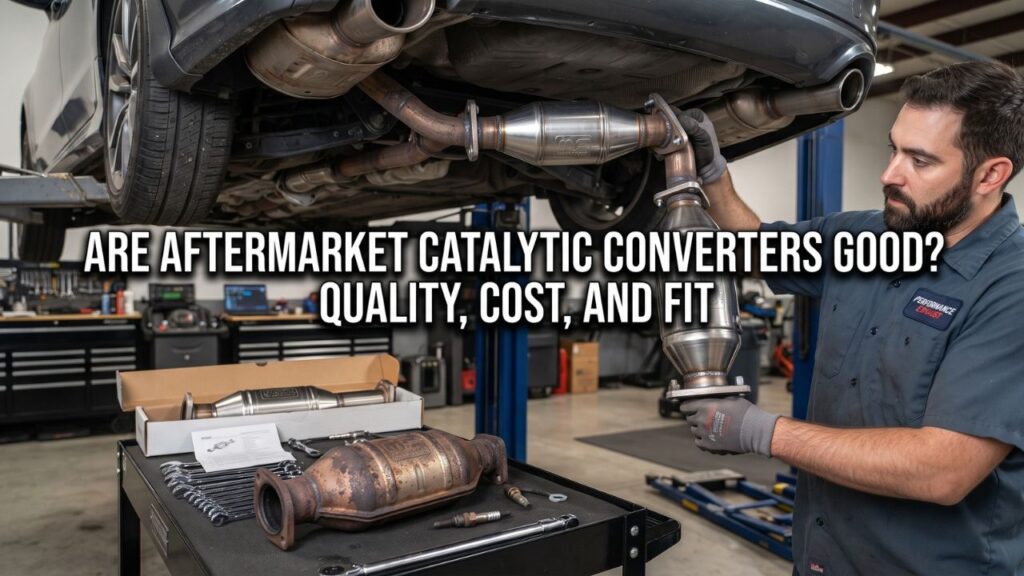
A reputable aftermarket converter can work well on many vehicles, especially older cars and trucks whose original converter has failed after the factory warranty period.
EPA guidance recognizes aftermarket converters as a lower-cost replacement path when a legitimate need for replacement exists. The same guidance stresses correct application because vehicle size, engine displacement, exhaust configuration, backpressure, and OBD compatibility affect converter operation.
Quality Varies Between Product Lines
“Aftermarket” covers a large group of parts.
It can describe:
- An application-specific direct-fit converter from a major exhaust manufacturer
- A CARB-approved converter tested for listed vehicles
- A federal EPA-compliant replacement
- A weld-in universal converter
- A very low-cost generic unit with limited vehicle coverage
Those products should not be judged as if they are identical.
A well-cataloged converter from an established manufacturer has a much better chance of satisfying the vehicle’s emissions system than a generic part selected mainly by pipe diameter.
Correct Application Matters More Than Brand Name Alone
A converter has to process the exhaust volume produced by the engine while maintaining the characteristics expected by the OBD system.
EPA guidance specifically warns that newer OBD-equipped vehicles may not operate properly with some aftermarket converter applications and directs installers to use the manufacturer’s application catalog.
That means a physically similar converter is not automatically a correct converter.
They Make the Most Sense on Older Vehicles
An aftermarket unit can be an attractive repair when:
- The original converter has genuinely failed
- The vehicle is outside emissions warranty coverage
- OEM pricing is difficult to justify
- A reputable direct-fit part is cataloged
- The engine fault that damaged the first converter has been repaired
- The selected converter meets the legal requirements for the registration state
I would usually favor a recognized direct-fit unit over the cheapest universal converter on an OBD-II car. The extra cost can buy easier installation and a part selected around that vehicle’s exhaust and monitor requirements.
Key Takeaway: Good aftermarket converters can work well, but correct application and emissions approval matter far more than simply finding a part that fits the exhaust pipe.
OEM vs Aftermarket Catalytic Converter
OEM means original equipment manufacturer. An OEM converter is built to the vehicle manufacturer’s original emissions specification or supplied as the factory replacement.
An aftermarket converter is produced by another manufacturer for replacement use.
| Factor | OEM converter | Quality aftermarket converter |
| Vehicle matching | Built for exact factory application | Must be selected from application catalog |
| Purchase price | Usually higher | Usually lower |
| Fit | Usually direct factory fit | Direct-fit or universal |
| Catalyst capacity | Factory specification | Varies by product and approval |
| OBD compatibility | Factory matched | Good when correctly cataloged |
| Warranty | Vehicle/manufacturer specific | Varies; federal rules set minimum coverage for qualifying EPA units |
| CARB options | Factory replacement generally accepted for its application | Must have correct CARB approval where required |
| Best use | Newer vehicle, strict emissions needs, hard-to-match applications | Older vehicle, cost-conscious repair, supported application |
OEM Converters Usually Have the Strongest Factory Match
The original converter was developed alongside the engine, fuel-control system, oxygen sensors, and emissions calibration.
That gives OEM parts an advantage on vehicles with sensitive catalyst monitoring or unusual exhaust layouts.
EPA guidance states that original equipment converters are designed as integral parts of the vehicle’s emissions and engine system. It also notes that aftermarket units are generally built to cover broader groups of vehicles and may not match original equipment performance in every case.
Aftermarket Converters Can Cost Much Less
Cost is where aftermarket parts become attractive.
An older car with a high-priced factory converter may not justify an OEM exhaust repair if a compliant aftermarket replacement is available for far less.
Paying less is reasonable if the part is properly cataloged and the vehicle does not require a more restrictive replacement standard.
OEM Is Not Always Required
Many U.S. vehicles can legally use a qualifying aftermarket converter once the replacement conditions are met.
California is different because approved aftermarket converters need a CARB Executive Order for the listed application. CARB states that the converter must be approved for the specific vehicle configuration.
Key Takeaway: OEM gives the closest factory match, while a good aftermarket converter can lower repair cost substantially when its application and legal certification are correct.
EPA vs CARB Aftermarket Catalytic Converters
This distinction is one of the biggest points buyers need to check before ordering.
EPA-Compliant Converters
Federal aftermarket converters are sold for applications governed by EPA replacement rules.
A federal converter must be properly labeled and matched to an approved application under the manufacturer’s catalog.
Federal units are commonly less expensive than CARB-certified versions.
A vehicle registered in a state that follows federal replacement requirements may be able to use one if the application is correct.
CARB-Compliant Converters
California uses a separate approval process.
CARB requires aftermarket catalytic converters sold for covered California applications to receive an Executive Order, commonly called an EO. Approval applies to specific vehicle applications rather than every vehicle that shares the same pipe size.
CARB identifies details such as:
- Vehicle make
- Model
- Model year
- Engine size
- Engine family or test group
- Converter location
- Specific part number
Current CARB labeling rules also tie approved part numbers to the vehicle’s exhaust configuration and oxygen-sensor placement.
Do Not Buy by State Alone
First identify the vehicle’s emissions certification.
Two versions of the same model can have different exhaust layouts or certification requirements.
The underhood emissions label often identifies Federal, California, or 50-state certification.
Then check the current replacement rules where the vehicle is registered.
Key Takeaway: EPA and CARB converters are not interchangeable categories; match the converter to both the vehicle’s emissions configuration and the rules that apply where it is registered.
Why Cheap Aftermarket Catalytic Converters Sometimes Cause P0420
A common complaint is that a low-cost replacement works for a short period and then P0420 or P0430 returns.
That does not always mean the converter was poorly manufactured, but several factors can cause the problem.
The Converter May Not Match the OBD Calibration
Modern engine computers monitor catalyst behavior using upstream and downstream oxygen-sensor data.
If the replacement catalyst does not store and process exhaust gases within the expected range, the computer may judge its performance below threshold.
That can produce:
- P0420 on Bank 1
- P0430 on Bank 2
- Check engine light
- Failed OBD emissions inspection
A converter can physically fit and still be a poor match for the monitor strategy.
Less Expensive Designs May Have Less Margin
Catalytic converters use precious-metal catalyst materials such as platinum, palladium, and rhodium in varying combinations.
Converter design also includes substrate volume, cell structure, washcoat, and catalyst formulation.
A lower-cost replacement may be engineered to meet its required replacement standard without carrying the same reserve capacity as the original converter.
That does not make every affordable converter bad. It does mean there may be less margin if the engine is burning oil, running rich, misfiring, or operating near the edge of its emissions calibration.
The Engine May Have Killed the First Converter
A replacement converter should not be blamed until the reason for the original failure has been checked.
Repeat failure can come from:
- Engine misfires
- Rich air-fuel mixture
- Leaking fuel injector
- Burning engine oil
- Coolant entering the cylinders
- Exhaust leaks
- Damaged oxygen sensors
If the engine is still sending raw fuel, oil ash, or coolant contamination into the exhaust, a new OEM converter can fail too.
Key Takeaway: A returning P0420 can come from a mismatched converter, limited catalyst margin, or an unresolved engine problem that is damaging the replacement.
Direct-Fit vs Universal Aftermarket Converters
Direct-Fit Converter
A direct-fit converter is built with the flanges, pipes, bends, hangers, and sensor locations needed for a specific group of vehicles.
Its advantages include:
- Easier installation
- Less fabrication
- Correct pipe routing
- Better sensor placement
- Lower chance of welding-related fit problems
For a modern OBD-II vehicle, direct-fit is usually my preferred approach if the price difference is reasonable.
Universal Converter
A universal converter normally provides the catalyst body and short pipe sections.
Installation may require:
- Cutting
- Welding
- Pipe adapters
- Custom positioning
- Fabrication
A universal unit can work well when it is explicitly cataloged for the vehicle and installed correctly.
The mistake is selecting one only from inlet and outlet pipe diameter.
Position Matters
Some vehicles use multiple converters.
A vehicle may have:
- Manifold-mounted converters
- Close-coupled converters
- Underfloor converters
- Separate Bank 1 and Bank 2 units
- More than one catalyst in series
EPA guidance requires the correct converter type and location and says required converters originally fitted to the vehicle should remain unless the replacement manufacturer specifically approves another configuration.
Key Takeaway: Direct-fit units reduce installation variables, while universal converters can work when they are cataloged correctly and positioned exactly as required.
How Long Do Aftermarket Catalytic Converters Last?
There is no single lifespan for every aftermarket converter.
Service life changes with:
- Converter construction
- Catalyst formulation
- Engine condition
- Driving conditions
- Oil consumption
- Fuel mixture
- Misfire history
- Physical damage
- Installation quality
A properly matched converter on a healthy engine can provide years of service.
A converter on an engine with repeated misfires may be damaged in a much shorter period.
Warranty Is Not the Same as Expected Lifespan
Federal EPA aftermarket guidance calls for qualifying new converters to carry 5-year/50,000-mile shell and end-pipe coverage and 25,000-mile emissions-performance coverage.
Those figures describe required warranty protection, not a prediction that the converter will fail at that mileage.
CARB-approved products can carry different requirements under California’s approval system. A recent CARB Executive Order, for example, specifies 50,000-mile coverage for the substrate and five years or 50,000 miles for the shell and end pipes for that approved product.
Engine Condition Has a Huge Effect
A cheaper converter on a healthy engine may last longer than an expensive converter installed behind an engine with a severe fueling problem.
Before installation, correct:
- Flashing check engine light
- Active misfires
- Excessive fuel trims
- Oil burning
- Coolant loss
- Exhaust leaks affecting sensor readings
Key Takeaway: Converter life cannot be judged from purchase price alone; engine condition and correct application have a major influence on how long the replacement survives.
When an Aftermarket Converter Is a Good Choice
An aftermarket converter often makes sense when the car is older and the factory part is disproportionately expensive.
Good situations include:
- The converter failure has been confirmed
- The car is outside applicable converter warranty coverage
- A known manufacturer lists an exact replacement
- The engine runs correctly
- The vehicle is not consuming abnormal amounts of oil or coolant
- The selected converter meets local emissions requirements
- Keeping repair cost under control matters
For a 10- or 15-year-old daily driver, paying dealer pricing may offer little advantage if a reputable compliant direct-fit converter is available.
The money saved can be substantial, especially on vehicles with more than one converter.
When OEM or CARB-Approved Parts Make More Sense
Sensitive OBD-II Applications
Some vehicles are more difficult to satisfy with lower-cost replacement catalysts.
If a model has a history of aftermarket converters triggering repeat catalyst-efficiency codes, OEM may be worth the extra cost.
California-Regulated Applications
If the vehicle requires a CARB-approved converter, use the exact approved part.
CARB states that aftermarket converters must receive an exemption before legal sale and installation on the approved California application.
Newer or Higher-Value Vehicles
An OEM converter may make more sense on a newer vehicle that you plan to keep for many years.
The stronger factory match can justify the higher price when long ownership and emissions reliability matter more than minimizing the immediate repair bill.
Complex Manifold Converters
Some converters are built directly into the exhaust manifold and may have oxygen sensors, heat shields, brackets, and complex pipe connections.
A direct factory replacement can reduce fit and sealing problems on these systems.
Key Takeaway: OEM is attractive for sensitive, newer, or complex applications, while a correctly approved aftermarket part often suits older vehicles where repair cost matters more.
How to Choose a Good Aftermarket Catalytic Converter
Verify the Exact Vehicle Application
Do not shop from engine size alone.
Match:
- Year
- Make
- Model
- Engine
- Drive configuration where required
- Emissions certification
- Engine family or test group where applicable
- Converter position
Check EPA or CARB Status
For a federal application, confirm that the converter is listed for the vehicle and carries the required markings and warranty.
For a CARB application, verify the Executive Order and exact part number.
CARB maintains a database for approved replacement converters.
Prefer Established Manufacturers
A recognized manufacturer is easier to verify for:
- Catalog fitment
- Technical support
- Warranty
- Replacement availability
- Emissions approval
- Installation instructions
Extremely cheap marketplace parts with unclear certification deserve caution.
Check the Warranty Before Buying
Read both emissions and structural warranty terms.
Find out what documentation is required for a claim.
Some warranties can be affected if the vehicle has an unresolved engine condition that damages the converter.
Fix the Original Failure Cause
This is the step I would never skip.
If the previous converter melted from a misfire, replacing it before repairing the ignition fault puts the new part in the same damaging environment.
Scan the car, inspect fuel trims, check misfires, look for oil or coolant consumption, and repair relevant exhaust leaks before installing the replacement.
Key Takeaway: A good aftermarket purchase starts with exact fitment, legal approval, a recognized manufacturer, clear warranty terms, and correction of the fault that damaged the old converter.
Signs an Aftermarket Converter May Be a Poor Match
A replacement deserves further diagnosis if you notice:
- P0420 or P0430 returning soon after installation
- Check engine light after catalyst monitor completion
- Exhaust leaks around new welds or flanges
- Poor fit against hangers or nearby components
- New rattling
- Unusual restriction
- Failed emissions inspection
- Sensor wiring stretched or repositioned incorrectly
Do not assume the converter is defective solely because P0420 returns.
Check for exhaust leaks, oxygen-sensor problems, fuel mixture faults, and misfires first.
If those checks are good and the replacement is correctly installed, verify that its part number is truly cataloged for the vehicle’s emissions family.
Conclusion
Are aftermarket catalytic converters good? Yes, reputable units can be a sensible replacement for many older vehicles, especially when OEM pricing is high. The best results come from an application-specific converter that meets the vehicle’s emissions requirements and is installed on an engine that is running correctly.
The biggest risks are buying a generic part that is not matched to the OBD system, using the wrong EPA or CARB category, or replacing the converter without fixing the fault that ruined the original one.
I would spend more for a recognized direct-fit converter before choosing the cheapest listing available. On a sensitive newer vehicle or a difficult emissions application, OEM can still be the safer long-term route.
FAQs About Aftermarket Catalytic Converters
Are Aftermarket Catalytic Converters as Good as OEM?
Some are very good replacements, but an OEM converter has the advantage of being developed specifically for that vehicle’s factory emissions system. Aftermarket products vary in catalyst capacity, fit, construction, approval, and warranty. A reputable application-specific unit is far different from a generic low-cost converter.
Will an Aftermarket Catalytic Converter Cause P0420?
It can if the converter is incorrectly matched, cannot satisfy the vehicle’s catalyst monitor, has been damaged, or the engine has another fault affecting catalyst readings. Exhaust leaks and oxygen-sensor problems can also cause P0420 after replacement.
Are Cheap Catalytic Converters Worth Buying?
The cheapest converter can be risky on an OBD-II vehicle. A low purchase price offers little savings if the check engine light returns and the converter needs to be replaced again. I would prioritize correct certification, application listing, warranty, and manufacturer reputation before price.
How Long Will an Aftermarket Catalytic Converter Last?
There is no fixed lifespan. A quality converter on a healthy engine can last for years, while an active misfire or rich mixture can damage a new converter quickly. Warranty length should not be treated as a predicted service life.
Is a CARB Catalytic Converter Better Than an EPA Converter?
A CARB-approved converter meets California’s separate approval requirements for its listed applications. That does not mean every federal vehicle needs a CARB unit. Use the converter category required by the vehicle and registration location.
Can I Use a Universal Aftermarket Catalytic Converter?
Yes, if the converter manufacturer lists that universal unit for the exact vehicle application and local emissions rules permit it. Proper positioning, welding, pipe size, and oxygen-sensor layout still matter. Do not select a universal converter from pipe diameter alone.
Should I Buy OEM if My Aftermarket Converter Keeps Failing?
First find out why the replacements are failing. Misfires, oil burning, coolant contamination, rich fueling, exhaust leaks, and incorrect part selection can ruin repeated converters. If the engine is healthy and correctly cataloged aftermarket units continue causing catalyst-monitor problems, OEM becomes a stronger option.
How Do I Know if an Aftermarket Catalytic Converter Is Legal?
Check the manufacturer’s application catalog and required converter markings. For California-regulated applications, verify the CARB Executive Order and exact part number for the vehicle. For federal applications, use an EPA-compliant converter listed for that specific vehicle and emissions configuration.