Dirty Catalytic Converter Symptoms: Signs, Causes, and Fixes
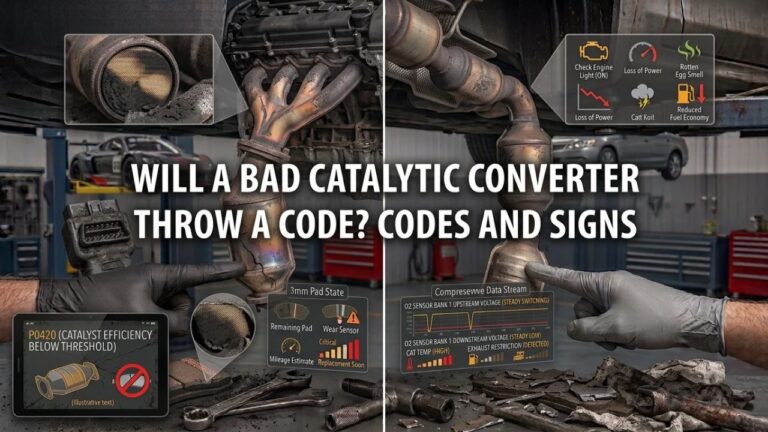
A dirty or contaminated catalytic converter may cause weak acceleration, reduced engine power, poor fuel economy, hard starting, unusual exhaust smells, excessive heat, a check-engine light, or stalling. Symptoms become more severe if deposits or damaged catalyst material begin restricting exhaust flow through the converter.
The term “dirty converter” can describe more than ordinary surface dirt. Oil residue, carbon deposits, coolant contamination, unburned fuel, and damaged internal catalyst material can coat or restrict the honeycomb passages inside the converter.
Catching the problem before the passages become badly restricted can prevent a car from losing most of its power or repeatedly stalling. It also gives you a chance to find the engine problem contaminating the converter before replacing an expensive emissions component.
For U.S. vehicles, the Environmental Protection Agency identifies the catalytic converter as one of the major emissions components covered by the federal emissions warranty for 8 years or 80,000 miles, whichever occurs first, when applicable warranty conditions are met.
The most useful dirty catalytic converter symptoms are those that appear together. Poor acceleration combined with high exhaust heat and increasing difficulty reaching higher RPM points more strongly toward converter restriction than a check-engine light by itself.
A dirty converter can also be confused with a bad fuel pump, worn oxygen sensor, ignition fault, misfire, intake problem, or damaged muffler. Proper testing matters because replacing the converter will not fix a drivability problem caused somewhere else.
The sections below cover the main warning signs, why contamination develops, the difference between dirty and clogged converters, useful diagnostic tests, cleaning limits, and the conditions that call for replacement.
Dirty Catalytic Converter Symptoms to Watch For
A contaminated converter may still allow enough exhaust flow for the engine to idle normally.
Symptoms often become easier to notice as engine load and exhaust volume increase.
Sluggish Acceleration
Poor acceleration is one of the more common signs of converter restriction.
The engine produces more exhaust when you press the accelerator. If the catalyst passages are coated or partly blocked, exhaust pressure can rise upstream of the converter.
The vehicle may feel unusually slow when:
- Entering a highway
- Passing another vehicle
- Driving uphill
- Carrying heavy cargo
- Accelerating from a stop
Walker lists delayed acceleration and loss of power among common symptoms of a restricted converter.
Loss of Power at Higher RPM
A partially restricted converter may allow adequate exhaust flow at idle while becoming a bottleneck as RPM rises.
The engine may rev normally to a certain point, then feel flat or struggle to climb farther.
Some drivers describe the sensation as if the engine cannot breathe.
This RPM-related pattern is useful because a serious exhaust restriction often becomes worse as the engine tries to move a larger volume of exhaust gases.
Poor Fuel Economy
Gas mileage may fall when exhaust flow is restricted or when the engine problem contaminating the converter also affects combustion.
The driver may press the throttle farther to compensate for weak acceleration.
Walker and MagnaFlow both list reduced fuel economy among possible converter-failure symptoms.
Poor mileage by itself does not confirm a converter problem. Low tire pressure, fuel-system faults, ignition problems, sensor errors, and driving conditions can create the same symptom.
Hard Starting
A badly restricted converter can make starting more difficult because the engine cannot move gases through the exhaust normally.
The engine may crank for longer than usual, start weakly, or start and then stall.
MagnaFlow lists hard-start and no-start behavior among symptoms associated with severe exhaust restriction.
A fuel-pressure test, ignition checks, scan data, and exhaust testing may be needed because many other faults can cause hard starting.
Check Engine Light
A dirty or failing converter may trigger the check-engine light.
Common catalyst-related trouble codes include:
- P0420 — Catalyst System Efficiency Below Threshold, Bank 1
- P0430 — Catalyst System Efficiency Below Threshold, Bank 2
These codes indicate that the vehicle’s computer sees catalyst performance below its expected level.
They do not prove that the converter is physically clogged.
A converter can lose its ability to clean exhaust gases without restricting flow enough to affect acceleration.
Excessive Heat Under the Vehicle
A contaminated converter may run unusually hot if unburned fuel reaches the catalyst or if internal passages become damaged.
Walker states that converter temperatures on a properly running engine typically stay below about 1,200°F. Repeated temperatures above roughly 1,600°F can damage catalyst material, while temperatures above about 1,700°F can damage or melt the internal substrate.
Signs of excess heat can include:
- Hot-metal smell
- Heat felt beneath the vehicle
- Blue or bronze discoloration on the converter shell
- A converter glowing red in a severe case
A glowing converter calls for stopping the vehicle in a safe place rather than continuing to drive.
Rotten-Egg or Sulfur Smell
Some converter and fuel-mixture problems produce a sulfur-like or rotten-egg odor.
The smell can appear when sulfur compounds in the exhaust are not being processed normally or when the engine is running excessively rich.
Odor alone cannot separate a converter problem from a fuel-control fault.
Pair it with scan data, fuel-trim readings, power-loss symptoms, and exhaust testing.
Rattling From Under the Vehicle
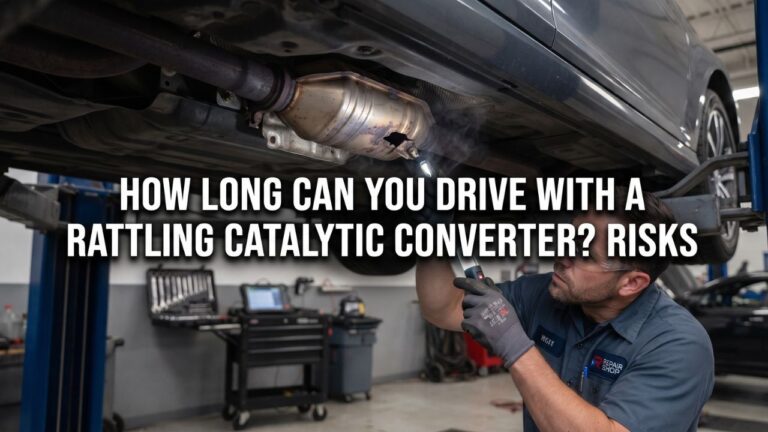
A dirty converter does not always rattle.
Rattling usually raises more concern about a physically damaged internal substrate.
The ceramic honeycomb can crack after overheating or impact. Broken pieces may move inside the housing and sometimes block exhaust flow.
A rattle combined with poor acceleration or intermittent power loss deserves prompt inspection.
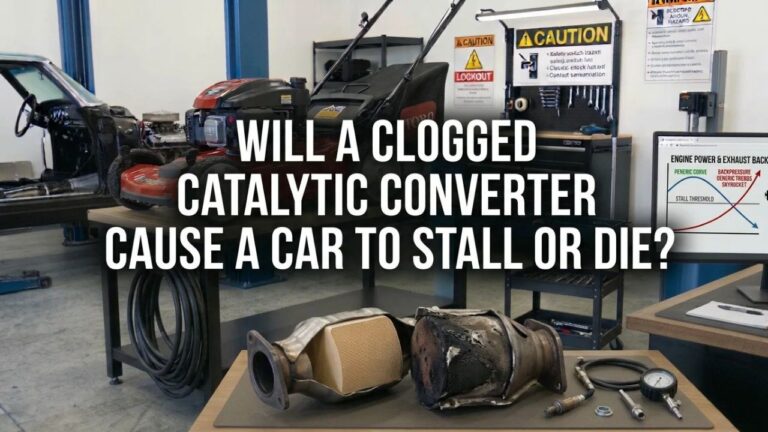
Engine Stalling
A severely restricted converter can cause the engine to stall.
Excessive backpressure prevents burned gases from leaving the cylinders normally. The engine eventually struggles to maintain combustion.
Walker lists stalling among the possible drivability symptoms of a blocked converter.
Key Takeaway: Power loss, high-RPM restriction, hard starting, poor fuel economy, excess heat, odors, rattling, and stalling become more meaningful when several appear together.
Dirty vs. Clogged Catalytic Converter
A dirty converter and a clogged converter are related but not identical descriptions.
Understanding the difference can change the repair decision.
A Dirty Converter May Be Contaminated
Contamination can coat the internal catalyst surfaces without completely blocking the honeycomb passages.
Possible contaminants include:
- Carbon
- Engine oil residue
- Coolant residue
- Excess fuel byproducts
- Combustion deposits
The converter may lose emissions-cleaning ability before it produces severe exhaust restriction.
A vehicle in this condition may turn on the check-engine light while still accelerating fairly normally.
A Clogged Converter Restricts Exhaust Flow
A clogged converter has enough blockage to reduce the amount of exhaust that can pass through it.
The restriction may come from heavy deposits, a melted substrate, collapsed passages, or broken internal material.
Power loss tends to become more obvious as blockage increases.
A Melted Converter Is More Than Dirty
Extreme temperatures can melt the ceramic honeycomb.
Walker identifies overheated, melted, broken, and oil-fouled converters as major converter-failure categories.
Once internal passages have physically melted together, cleaning cannot restore their original shape.
Replacement is normally required after the source of the overheating is corrected.
Key Takeaway: A dirty converter may still pass exhaust normally, while a clogged or melted converter physically restricts flow and creates stronger drivability symptoms.
What Causes a Catalytic Converter to Get Dirty?
Converters usually become contaminated because of another engine or fuel-system problem.
Finding that cause protects the replacement converter from suffering the same damage.
Engine Misfires
A misfire means a cylinder does not burn its air-fuel charge correctly.
Unburned fuel and oxygen can then enter the exhaust and react inside the converter.
This reaction creates extra heat.
Repeated severe misfires can damage or melt the catalyst structure. Walker lists misfires and weak or absent ignition among causes that can overheat converters.
Rich Air-Fuel Mixture
A rich mixture contains more fuel than the engine can burn properly.
Extra fuel may reach the converter and create intense heat.
Possible rich-running causes include:
- Leaking fuel injector
- Excessive fuel pressure
- Faulty airflow measurement
- Ignition faults
- Engine-temperature sensor problems
- Fuel-control errors
Fix the rich condition before installing another converter.
Engine Oil Burning
An engine that burns oil sends oil-related deposits into the exhaust.
Over time, these deposits can coat catalyst surfaces.
Oil consumption may come from:
- Worn piston rings
- Valve-guide or valve-seal wear
- Turbocharger seal problems
- PCV-system faults
- Internal engine wear
A replacement converter cannot correct oil consumption.
Coolant Entering the Exhaust
An internal coolant leak can also contaminate catalyst material.
Possible sources include a damaged head gasket, cracked cylinder head, or other internal cooling-system fault.
Walker lists coolant contamination among conditions that can poison or damage the converter substrate.
Unexplained coolant loss should be diagnosed before converter replacement.
Repeated Short Trips
Frequent short drives may prevent some vehicles from reaching full operating temperature for long periods.
That does not usually destroy a healthy converter by itself.
It can contribute to deposit buildup when combined with poor combustion, oil consumption, rich operation, or other engine faults.
Physical Damage
A road impact can damage the converter shell or crack the ceramic structure inside.
Broken material can then shift inside the housing.
What appears to be a dirty or clogged converter may actually be a mechanically broken converter.
Key Takeaway: Misfires, excess fuel, oil burning, coolant contamination, and physical damage are stronger causes of converter trouble than ordinary exterior dirt.
How a Dirty Catalytic Converter Affects Engine Performance
The internal honeycomb contains many small passages that allow exhaust gases to contact catalyst material.
When those passages become restricted, exhaust flow changes throughout the engine.
Exhaust Backpressure Increases
A blockage creates resistance in the exhaust system.
The pistons must push against greater pressure during the exhaust stroke.
This reduces the engine’s ability to clear burned gases before the next combustion cycle.
Less Fresh Air Enters the Cylinders
Exhaust gases left behind occupy space that could otherwise hold fresh air.
That limits how much fuel can be burned cleanly during the next cycle.
The result can be weaker torque and poor acceleration.
The Problem Becomes Worse Under Load
At idle, exhaust volume is relatively low.
During hard acceleration, much more gas must pass through the converter.
A restriction that is barely noticeable at idle can become severe at 2,000–4,000 RPM.
This is why some clogged-converter complaints begin as “the car idles fine but has no power.”
How to Test a Dirty or Clogged Catalytic Converter
Do not replace a converter based on smell or a P0420 code alone.
Testing can show if exhaust flow is actually restricted.
Scan for Trouble Codes
Connect an OBD-II scanner and check stored and pending codes.
Look beyond P0420 or P0430.
Codes related to the following systems can reveal what damaged the converter:
- Misfires
- Fuel mixture
- Oxygen sensors
- Airflow sensors
- Fuel delivery
- Coolant temperature
- Ignition
Repairing these faults first can prevent another converter failure.
Check Exhaust Backpressure
A backpressure test directly checks exhaust restriction.
A technician can connect a pressure gauge through an oxygen-sensor port.
Walker gives a general reference of less than 1.5 psi at idle and less than 3 psi at 2,000 RPM, while noting that readings differ between applications.
High pressure ahead of the converter points toward a restricted converter.
High pressure measured farther downstream may indicate a blocked muffler or resonator instead.
Perform a Vacuum Test
An intake-manifold vacuum gauge can also provide clues.
Vacuum may initially appear normal, then slowly fall when the engine is held at higher RPM if the exhaust is restricted.
This test should be interpreted alongside other results because valve-timing and engine-condition problems can alter vacuum too.
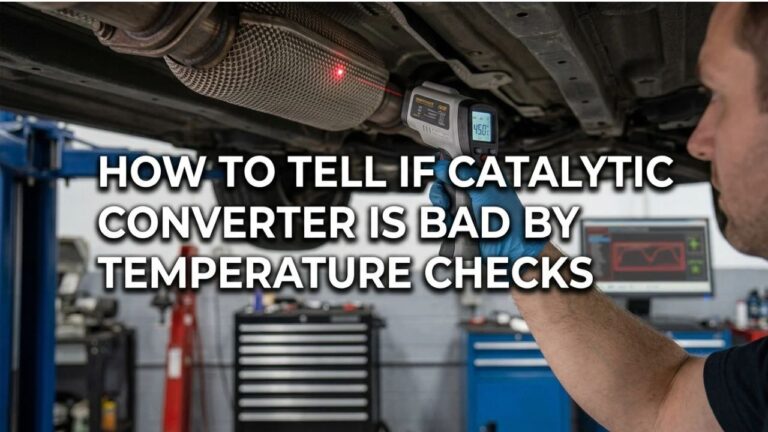
Inspect Converter Temperature
An infrared thermometer can compare temperatures before and after the converter.
Temperature results can support diagnosis, but they should not be used as the only test.
Engine load, fuel mixture, converter design, and operating conditions all affect exhaust temperature.
Listen for Internal Damage
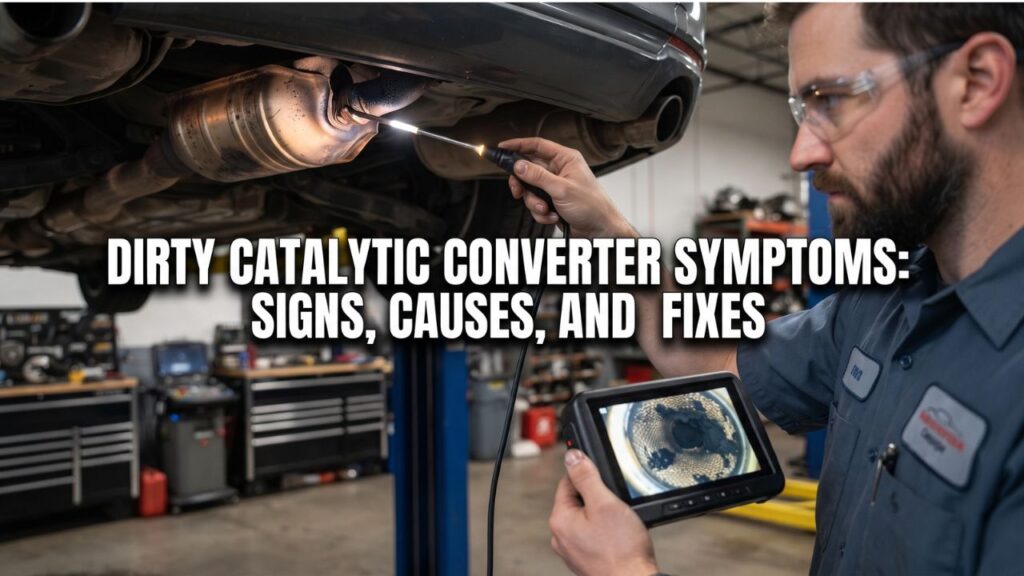
A loose catalyst substrate may rattle inside the converter housing.
Do not hit a hot converter or crawl beneath a vehicle supported only by a jack.
A shop can inspect safely after the exhaust cools and the vehicle is correctly supported.
Key Takeaway: Scan data identifies related faults, while backpressure testing gives much stronger evidence that the converter passages are physically restricted.
Can You Clean a Dirty Catalytic Converter?
Sometimes contamination may improve after the engine problem causing it is repaired, but not every converter can be cleaned.
The internal condition sets the limit.
Light Deposits May Improve
If contamination is minor and the substrate remains intact, normal operation after repairing the engine fault may reduce some combustible deposits.
This should not be confused with repairing a melted converter.
A car that regains some power still needs testing if restriction symptoms return.
Fuel Additives Cannot Repair Structural Damage
A cleaner poured into the fuel tank cannot:
- Rebuild broken ceramic
- Reopen melted passages
- Repair a collapsed substrate
- Fix an oil-burning engine
- Repair a coolant leak
- Correct a severe misfire
A product may influence certain deposits or fuel-system conditions, but it cannot reverse physical catalyst damage.
Do Not Remove the Converter to Wash It Casually
Catalytic converters contain delicate internal structures and regulated emissions materials.
Removing, modifying, hollowing, or bypassing a converter also raises emissions-law issues for road vehicles in the United States.
A confirmed damaged converter should be repaired through the proper replacement procedure.
Key Takeaway: Minor contamination may change after the root engine fault is corrected, but cleaners cannot rebuild melted, cracked, or collapsed catalyst material.
When Does a Dirty Catalytic Converter Need Replacement?
Replacement makes sense when testing shows the converter can no longer perform its job or pass exhaust normally.
Backpressure Is Excessive
A confirmed restriction that cannot be traced to another exhaust component is a strong reason for converter replacement.
The cause of the restriction should still be identified.
The Substrate Is Melted
Melted passages cannot regenerate.
Extreme heat permanently changes the ceramic structure.
Once exhaust cannot pass normally through the honeycomb, replacement is the practical repair.
The Internal Material Is Broken
A converter that rattles from loose substrate may develop intermittent restriction.
Broken material cannot be bonded back together inside the housing.
Catalyst Efficiency Remains Below Specification
A converter may need replacement even if it is not clogged.
If proper diagnosis confirms that the catalyst has lost its emissions-cleaning ability and other causes have been ruled out, replacement may be required to restore emissions compliance.
The Converter Is Still Under Federal Warranty
Before paying for an expensive replacement, check the vehicle’s age and mileage.
EPA states that catalytic converters are among the specified major emissions components covered for 8 years or 80,000 miles under the applicable federal emissions warranties.
Used vehicles can also retain applicable federal coverage because the warranty follows the vehicle.
Key Takeaway: Excessive restriction, melted or broken catalyst material, or confirmed loss of catalyst function can justify replacement; check warranty coverage first.
Can You Drive With a Dirty Catalytic Converter?
A vehicle with a mildly contaminated converter may still drive normally, but clear restriction symptoms should not be ignored.
A small problem can become more severe if the root engine fault continues.
Stop normal driving if you notice:
- Severe loss of acceleration
- Repeated stalling
- A flashing check-engine light
- A glowing converter
- Strong burning smell
- Difficulty keeping the engine running
Continued driving with an active misfire or overheating converter can cause more catalyst damage.
If the car can barely maintain traffic speed, towing is safer than trying to force it to the repair shop.
Conclusion
The main dirty catalytic converter symptoms include weak acceleration, loss of higher-RPM power, poor fuel economy, hard starting, sulfur odors, excessive heat, a check-engine light, rattling, and stalling.
A contaminated converter does not always mean the exhaust is clogged. Oil, coolant, carbon, or fuel-related deposits may reduce catalyst function, while a melted or collapsed honeycomb creates a physical restriction that directly affects engine breathing.
The best diagnosis combines scan data with exhaust backpressure testing and checks for misfires, rich operation, oil consumption, coolant leakage, and exhaust damage. Replacing the converter before correcting those faults can lead to another failure.
I would treat severe power loss, a glowing converter, repeated stalling, or a flashing check-engine light as reasons to stop driving and have the vehicle inspected. If replacement is required, check the federal 8-year/80,000-mile emissions warranty before paying out of pocket.
FAQs About Dirty Catalytic Converter Symptoms
What Are the First Signs of a Dirty Catalytic Converter?
Early signs may include a check-engine light, slightly weaker acceleration, declining fuel economy, or unusual exhaust odor. Severe power loss usually appears after restriction becomes more advanced. These symptoms overlap with many engine faults, so diagnosis should come before converter replacement.
Can a Dirty Catalytic Converter Cause Loss of Power?
Yes. If contamination restricts the internal passages, exhaust backpressure rises and the engine cannot expel gases normally. Power loss often becomes more noticeable at higher RPM, during hard acceleration, or while climbing hills.
Can a Dirty Catalytic Converter Cause Rough Idle?
It can if exhaust restriction becomes severe, but rough idle has many other common causes. Vacuum leaks, ignition faults, dirty injectors, throttle problems, misfires, and sensor errors should also be checked.
Can a Dirty Catalytic Converter Cause Poor Gas Mileage?
Yes. Restricted exhaust flow can hurt engine operation and cause the driver to use more throttle. The fuel or ignition fault contaminating the converter may also reduce gas mileage before the converter itself becomes restricted.
Can a Dirty Catalytic Converter Cause a Car to Stall?
Yes. A badly clogged converter can raise exhaust backpressure enough to make the engine lose power and stall. Walker includes stalling among the possible symptoms of a restricted converter.
Will a Dirty Catalytic Converter Trigger a Check Engine Light?
It can. P0420 and P0430 are common catalyst-performance codes. These codes show that catalyst efficiency is below the expected threshold; they do not automatically prove the converter is clogged.
Can a Dirty Catalytic Converter Be Cleaned Without Replacement?
Minor deposit contamination may improve after the engine fault causing it is repaired. Melted, collapsed, or broken catalyst material cannot be cleaned back into its original form. Confirm the type of failure before spending money on cleaners.
How Do I Know if My Catalytic Converter Is Dirty or Clogged?
A dirty converter may mainly cause emissions-related symptoms, while a clogged converter commonly causes power loss that becomes worse as RPM and engine load increase. Exhaust backpressure testing is one of the strongest ways to confirm a physical restriction.