Can a Dirty Throttle Body Cause Stalling? Symptoms and Fixes
Yes, a dirty throttle body can cause your car to stall, especially when idling, slowing down, or stopping at a traffic light. Carbon and oily deposits can restrict airflow around the throttle plate, making it difficult for the engine to maintain a steady idle speed. Severe buildup may cause the engine to shut off.
The throttle body controls how much air enters your engine. When its inner surfaces become coated with sticky deposits, the engine may struggle to get the airflow it needs at low speeds. You might notice shaking, fluctuating RPM, hesitation, or sudden stalling when you take your foot off the gas pedal.
The frustrating part is that these symptoms don’t always mean the throttle body is dirty. Vacuum leaks, faulty sensors, fuel delivery problems, and ignition misfires can produce similar behavior. Cleaning the throttle body may fix the issue, but only when deposits are responsible.
This guide explains why throttle buildup causes stalling, when the problem usually appears, how to identify the warning signs, and what you can do to fix it safely without replacing unnecessary parts.
Why Does a Dirty Throttle Body Cause an Engine to Stall?
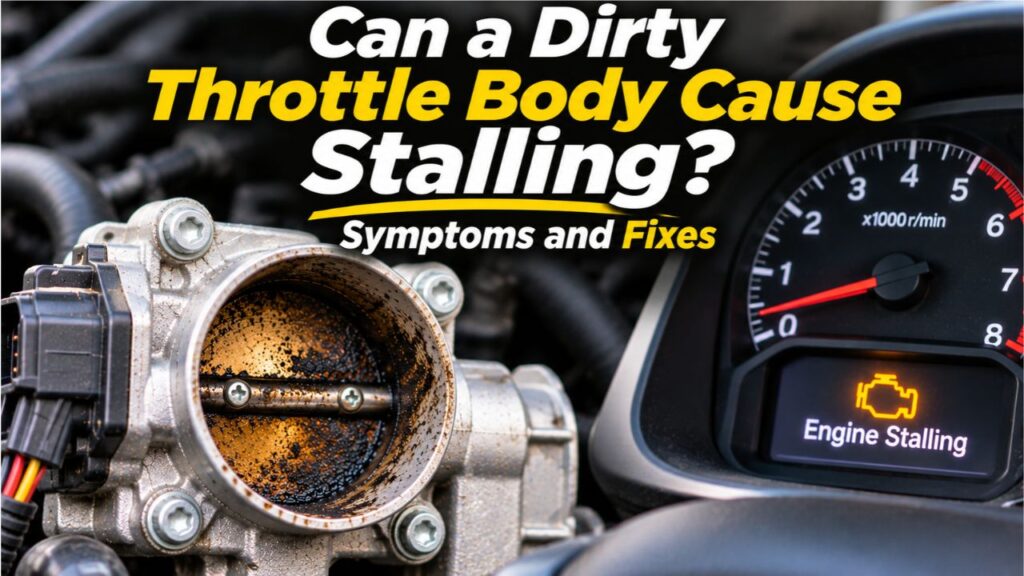
A dirty throttle body causes stalling when carbon and oily deposits restrict the airflow needed to keep the engine running at idle. As airflow decreases, engine speed may drop below the level required for stable combustion. The engine computer tries to compensate, but heavy buildup can overwhelm its adjustments.
The throttle body contains a round metal plate called the throttle plate or butterfly valve.
This plate opens when you press the accelerator and closes toward its idle position when you release the pedal.
At higher engine speeds, the throttle opening is generally larger. Small deposits around the plate may have little noticeable effect.
At idle, the situation changes.
Carbon Buildup Restricts Idle Airflow
When your foot is off the accelerator, the engine needs a relatively small amount of air to keep running.
Even a narrow ring of carbon around the throttle plate can affect airflow through that small opening.
Think of a door that barely opens because dirt has collected around its edges. It may still open wide when pushed, but small movements become difficult.
A dirty throttle body can behave similarly.
For example, your engine may run normally at 45 mph but struggle to maintain idle while waiting at a red light.
The Engine Computer Tries to Compensate
Modern gasoline engines use an engine control module (ECM) to manage idle speed.
The computer adjusts the electronic throttle plate or a separate idle air control valve, depending on the vehicle.
As deposits accumulate, the computer may compensate by allowing more airflow.
Eventually, the available adjustments may not be enough to maintain stable idle speed.
An automotive engineering assessment of throttle deposits and idle control describes how buildup can reduce idle airflow and lead to unstable engine speed.
The result can be rough idling, falling RPM, or complete engine stalling.
When Is a Dirty Throttle Body Most Likely to Cause Stalling?
A dirty throttle body is most likely to cause stalling when the engine operates at low RPM and needs precise airflow control. Common situations include stopping at traffic lights, shifting into Drive, starting a cold engine, or running accessories that increase engine load.
The timing of the stall can help identify the problem.
Stalling When Coming to a Stop
This is one of the more common patterns associated with throttle body deposits.
As you slow down, you release the accelerator and the throttle plate moves toward its idle position.
The engine computer must maintain enough airflow to keep the engine running.
If deposits interfere with that airflow, RPM may drop too far.
For example, your car might drive normally on the highway but stall as you approach a stop sign.
That pattern puts throttle body contamination on the list of possible causes.
Stalling When Shifting Into Drive or Reverse
When you shift an automatic transmission into Drive or Reverse, the engine experiences an additional load.
The idle control system normally compensates for that load.
A dirty throttle body may reduce its ability to respond.
You might notice the engine shaking briefly before shutting off.
Still, transmission-related problems and other idle control faults can cause similar symptoms.
Stalling With the Air Conditioner Running
The air conditioning compressor places an additional load on the engine.
Normally, the engine computer adjusts idle operation to compensate.
If throttle deposits are already restricting airflow, the extra demand may cause engine speed to dip.
For example, your car may idle smoothly with the air conditioner off but stall shortly after the compressor engages.
This is a useful clue, not proof of a dirty throttle body.
Stalling After a Battery Replacement
Some vehicles develop rough idle or stalling after the battery has been disconnected.
The engine computer may lose learned idle settings that previously compensated for throttle body deposits.
Once those settings reset, the engine may struggle to maintain idle.
This situation is especially relevant on certain electronic throttle systems.
Cleaning the throttle body and completing the correct idle relearn procedure may solve the problem.
What Are the Symptoms of a Dirty Throttle Body That Causes Stalling?
A dirty throttle body often produces rough idle, fluctuating RPM, hesitation, or stalling when the vehicle slows down. Symptoms typically become more noticeable as deposits accumulate around the throttle plate. A check engine light may also appear, although these signs aren’t exclusive to throttle contamination.
Watch for the following patterns.
| Symptom | What You May Notice | Possible Explanation |
| Rough idle | Engine shakes while stopped | Irregular idle airflow |
| RPM drops | Tachometer falls before stalling | Engine can’t maintain idle speed |
| Fluctuating RPM | Engine speed rises and falls | Idle control system keeps correcting airflow |
| Stalling at stops | Engine shuts off when braking | Airflow becomes insufficient at idle |
| Hesitation | Delayed response to light acceleration | Deposits may affect airflow or throttle movement |
| Check engine light | Engine warning stays on | Idle or throttle control fault may be present |
RPM Drops Before the Engine Stalls
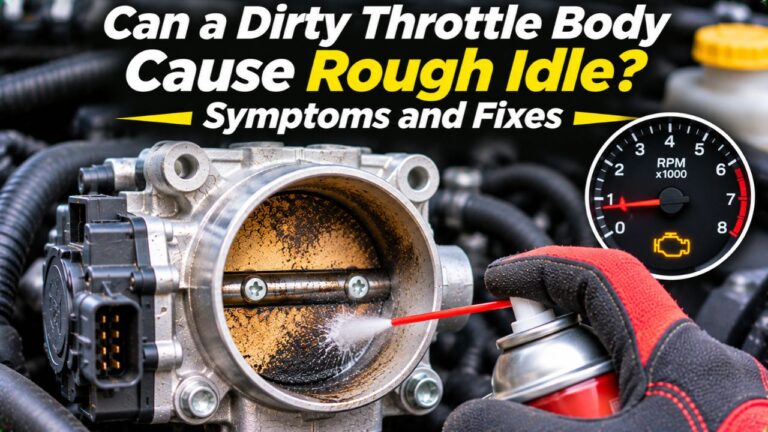
One useful clue is the tachometer.
The tachometer displays engine speed in revolutions per minute (RPM).
For example, while stopped, you might notice the needle dipping sharply before the engine shakes or shuts off.
This behavior can indicate an idle control problem.
But it can also result from fuel, ignition, or mechanical faults.
Rough Idle That Gradually Gets Worse
Throttle deposits generally accumulate over time.
That means the symptoms may begin as occasional rough idling and become more noticeable later.
For instance, your car might shake slightly at stoplights for several weeks before it begins stalling.
A gradual change supports checking for deposits, although it doesn’t establish the cause by itself.
Check Engine Light and Trouble Codes
A dirty throttle body may contribute to diagnostic trouble codes related to idle control.
Examples include:
| Trouble Code | Meaning |
| P0506 | Idle control system RPM lower than expected |
| P0507 | Idle control system RPM higher than expected |
| P0121 | Throttle position sensor circuit range or performance problem |
| P2119 | Throttle actuator control throttle body range or performance problem |
These codes don’t automatically identify dirt as the cause.
For example, P2119 may involve a throttle actuator fault rather than simple carbon buildup.
Read the codes before replacing or cleaning components.
What Makes a Throttle Body Dirty Enough to Cause Stalling?
Throttle body deposits develop when oil mist, airborne particles, and other residue accumulate around the throttle plate and bore. Normal engine operation can create some buildup, but crankcase ventilation problems, poor air filtration, and excessive oil carryover may increase contamination.
Several factors can contribute.
Oil Vapors From the PCV System
The positive crankcase ventilation (PCV) system manages gases that escape past the piston rings into the crankcase.
Depending on the engine layout, these gases may carry oil mist into the intake.
Over time, the oil can leave a sticky film on nearby surfaces.
Dust and other particles can then stick to that film.
For example, a small oil deposit may gradually turn into a thick dark ring around the throttle plate.
Poor Air Filtration
The engine air filter helps prevent dirt from entering the intake system.
A damaged filter, poorly sealed housing, or torn intake duct may allow unwanted particles to pass through.
Those particles can collect on oily throttle surfaces.
A dirty but properly sealed filter doesn’t necessarily allow extra dirt through. Its condition and fit both matter.
Excessive Engine Blow-By
As an engine wears, more combustion gases may escape past the piston rings.
This is called blow-by.
Excessive blow-by can increase the amount of vapor and contamination entering the crankcase ventilation system.
An older engine with high oil consumption and repeated heavy intake deposits may need further mechanical inspection.
How Can You Tell if a Dirty Throttle Body Is Causing the Stall?
To determine whether throttle deposits are causing stalling, check when the engine shuts off, read diagnostic trouble codes, inspect the air intake system, and look for visible buildup. If the throttle body is reasonably clean, other engine problems become more likely. No single symptom confirms the diagnosis.
Follow this process.
Step 1: Identify When the Engine Stalls
Start by paying attention to the operating conditions.
Does the engine shut off:
- When stopping at traffic lights?
- Immediately after releasing the accelerator?
- When shifting into Drive?
- During cold starts?
- When the air conditioner turns on?
- While cruising at a steady speed?
Stalling at idle or during deceleration can be consistent with restricted throttle airflow.
Sudden stalling at highway speeds without prior idle problems deserves broader electrical, fuel, and sensor testing.
Don’t attempt repeated road tests if the vehicle stalls unpredictably.
Step 2: Read the Engine Trouble Codes
Use an OBD-II scanner to check for stored and pending trouble codes.
Record the codes before clearing them.
For example, a P0506 code combined with rough idle and visible throttle deposits may support investigating restricted airflow.
A crankshaft sensor code or several cylinder misfire codes may lead the diagnosis in another direction.
The scanner provides clues, not a final verdict.
Step 3: Inspect the Air Intake Hose
Turn off the engine and allow it to cool.
Locate the air intake duct that connects the air filter housing to the throttle body.
Check for cracked rubber, loose clamps, disconnected hoses, or obvious damage.
An air leak can cause unstable idle even when the throttle body is clean.
Step 4: Look for Carbon Deposits
If the manufacturer’s procedure permits it, remove or move the intake hose to inspect the throttle opening.
Use a flashlight to check the accessible throttle plate and inner bore.
Look for:
- Thick black deposits around the plate edge
- Sticky brown or oily residue
- Heavy buildup near the plate-to-bore contact area
- Unusual oil accumulation
A thin dark film may be normal.
Heavy deposits accompanied by idle problems deserve attention.
Safety Note: Electronic throttle plates can move unexpectedly. Never place your fingers inside an energized throttle opening or force the plate with tools.
Step 5: Rule Out Other Common Causes
Don’t assume visible deposits explain every stalling problem.
Other causes include vacuum leaks, failing ignition coils, damaged spark plugs, fuel pressure problems, dirty mass airflow sensors, and faulty crankshaft position sensors.
For example, a car that stalls suddenly and won’t restart may have lost its crankshaft position signal.
Throttle cleaning won’t repair that fault.
Can Cleaning a Dirty Throttle Body Stop the Engine From Stalling?
Yes. Cleaning a dirty throttle body can stop engine stalling when carbon deposits are interfering with idle airflow or throttle movement. Removing the buildup may restore normal air delivery and allow the engine computer to maintain idle speed. The repair won’t help if another component causes the problem.
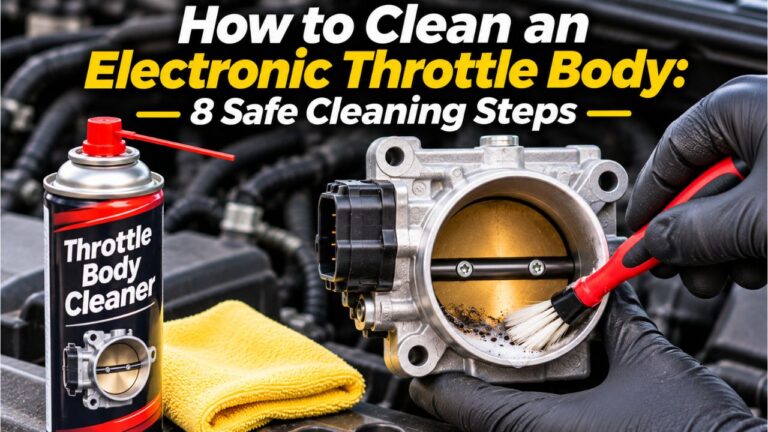
How to Clean the Throttle Body Safely
For vehicles that permit in-place cleaning, the basic process is straightforward.
- Park safely, turn off the engine, and allow it to cool.
- Locate the throttle body and remove the intake hose according to the service procedure.
- Inspect the throttle plate and accessible bore for deposits.
- Apply an approved throttle body cleaner to a lint-free cloth.
- Gently wipe accessible deposits without forcing the throttle plate.
- Allow the solvent to evaporate according to its instructions.
- Reinstall the intake hose and secure every connection.
- Start the engine and follow any required idle relearn procedure.
Some electronic throttle assemblies have special coatings or restrictions on moving the plate.
Follow the service manual for your vehicle rather than applying one method to every engine.
Why You Shouldn’t Spray Excessive Cleaner Into the Throttle Body
Spraying large amounts of solvent directly into an electronic throttle assembly can damage sensitive components.
One manufacturer-issued throttle cleaning procedure recommends applying cleaner to a cloth instead of spraying it directly into the throttle body.
This helps prevent contamination from reaching the throttle shaft, motor, or position sensor.
Use a compatible cleaner and avoid abrasive brushes or metal scrapers.
Will the Engine Run Better Immediately After Cleaning?
Sometimes.
If carbon buildup caused the stalling, the engine may idle more smoothly after cleaning.
But certain vehicles need time or a specific procedure to adjust to the changed airflow.
For example, the idle speed may temporarily fluctuate because the computer previously compensated for the dirty throttle plate.
Don’t assume that every unstable idle after cleaning means the repair failed.
Why Does My Car Still Stall After Cleaning the Throttle Body?
A car may continue stalling after throttle body cleaning because the engine computer needs an idle relearn, the intake hose has an air leak, or another component is faulty. Cleaning only removes deposits. It cannot repair a defective throttle motor, damaged sensor, ignition fault, or fuel delivery problem.
The Engine May Need an Idle Relearn
Modern engine computers can learn adjustments that help maintain stable idle as the engine ages.
When you clean the throttle body, airflow may change.
The previous learned settings may no longer match the clean throttle opening.
Some vehicles adapt automatically. Others require a scan tool or a manufacturer-specific reset procedure.
A technical service procedure for throttle cleaning and idle relearning describes checking deposits, cleaning the throttle body, and performing an idle learn reset on certain vehicles.
Don’t use a generic pedal sequence without confirming that it applies to your car.
The Intake Hose May Be Loose
A loose intake clamp or disconnected vacuum hose can create an air leak.
For example, a hose that isn’t fully seated after cleaning may let extra air enter the engine.
This can cause rough idle, hesitation, or stalling.
Check every hose and connector disturbed during cleaning.
The Idle Air Control Valve May Be Faulty
Some older engines use a separate idle air control (IAC) valve.
This valve regulates airflow around the throttle plate to maintain idle speed.
If the valve sticks or its air passages become blocked, the engine may stall even after the throttle plate is cleaned.
Not every vehicle has a separate IAC valve. Modern electronic throttle systems often manage idle through the throttle plate itself.
Another Engine Problem May Be Responsible
A weak fuel pump, vacuum leak, defective ignition coil, or faulty sensor can produce similar symptoms.
If cleaning makes no difference, returning to the original diagnostic information is the right move.
Repeatedly cleaning an already clean throttle body can leave you back to square one.
Is It Safe to Drive With a Dirty Throttle Body That Causes Stalling?
Driving a car that stalls unexpectedly is unsafe because the engine can shut off while you’re moving through traffic. Depending on the vehicle, you may lose some power steering or braking assistance. Even if the engine restarts, the problem can return without warning.
If your engine stalls while driving:
- Maintain a firm grip on the steering wheel.
- Turn on your hazard lights when safe.
- Steer toward a safe shoulder or parking area.
- Apply the brakes firmly and smoothly, recognizing that assistance may be reduced.
- Secure the vehicle after stopping and arrange roadside help.
Don’t turn a conventional ignition key to the LOCK position while the vehicle is moving.
If the car stalls repeatedly, towing is safer than driving it to a repair shop.
Play it safe: Fix the underlying cause before returning the vehicle to normal driving.
How Can You Prevent Throttle Body Buildup and Repeated Stalling?
You can reduce avoidable throttle deposits by maintaining the air filtration and crankcase ventilation systems, changing engine oil on schedule, and repairing intake leaks promptly. Some buildup is normal, but routine inspections can help identify contamination before it contributes to idle problems.
Useful maintenance habits include:
- Replace the engine air filter according to the service schedule.
- Check intake ducts and clamps for damage or poor sealing.
- Maintain the PCV system and repair abnormal oil carryover.
- Use engine oil that meets the manufacturer’s specifications.
- Investigate excessive oil consumption or repeated heavy deposits.
- Address rough idle and related trouble codes promptly.
Should You Clean the Throttle Body on a Schedule?
There’s no universal cleaning interval for every vehicle.
Some manufacturers recommend inspection or cleaning under specific conditions, while others don’t list throttle body cleaning as routine maintenance.
For example, a vehicle with heavy deposits and persistent idle problems may benefit from cleaning.
A vehicle that runs normally with only light staining may not need attention.
As a rule of thumb, inspect first and clean when the condition and service instructions justify it.
Frequently Asked Questions
Can a Dirty Throttle Body Cause a Car to Stall While Driving?
Yes. A dirty throttle body can cause stalling while driving, especially when slowing down, releasing the accelerator, or approaching a stop. Deposits can interfere with the airflow needed to maintain idle. Sudden stalling at higher speeds may indicate another problem involving fuel delivery, sensors, or electrical systems.
Can a Dirty Throttle Body Cause Stalling Without a Check Engine Light?
Yes. A dirty throttle body can contribute to stalling without immediately triggering a check engine light. Mild airflow problems may cause unstable idle before the engine computer records a fault. Some vehicles may store pending codes without illuminating the warning light. The absence of a light doesn’t rule out a problem.
Can a Dirty Throttle Body Cause Stalling When Cold?
Yes. A dirty throttle body can contribute to cold-start stalling when deposits affect the airflow needed during engine warm-up. Cold engines require different fuel and idle control settings. Faulty temperature sensors, vacuum leaks, and fuel problems can cause similar symptoms, so visible deposits alone don’t confirm the cause.
Will Cleaning the Throttle Body Fix Rough Idle and Stalling?
Cleaning can correct rough idle and stalling when heavy throttle deposits are responsible. The improvement may appear immediately or after the correct idle relearn procedure. If the symptoms come from a damaged throttle actuator, vacuum leak, ignition misfire, or fuel problem, cleaning alone won’t solve them.
Can a Dirty Throttle Body Cause Stalling After Battery Replacement?
Yes. On some vehicles, disconnecting the battery resets learned idle settings. If the computer previously adjusted for throttle deposits, losing those settings may cause rough idle or stalling. Cleaning the throttle body and completing the manufacturer-approved idle relearn may restore normal operation. Not every vehicle requires the same procedure.
Can a Dirty Throttle Body Cause a Car Not to Start?
Severe throttle contamination can contribute to difficult starting or immediate stalling after the engine fires. But a completely blocked or failed throttle assembly is less common than other no-start causes. Battery problems, missing ignition spark, and fuel delivery faults should also be checked before assuming the throttle body is responsible.
Stop Throttle Body Stalling Before It Gets Worse
A dirty throttle body can cause stalling when carbon and oily deposits interfere with the airflow needed to maintain idle speed.
The problem often appears when slowing down, stopping at traffic lights, shifting into gear, or running accessories that place extra load on the engine. Rough idle, fluctuating RPM, and hesitation may appear before the engine starts shutting off.
Cleaning the throttle body can restore normal operation if deposits are the actual cause. Some vehicles also require an idle relearn afterward.
But don’t overlook other possibilities. Vacuum leaks, faulty sensors, ignition problems, and fuel delivery faults can cause the same symptoms.
A vehicle that stalls unexpectedly needs prompt attention because losing engine power in traffic creates a safety risk.
Your next step: Check for diagnostic trouble codes and inspect the throttle opening for heavy deposits. If cleaning is appropriate, follow your vehicle’s service procedure and confirm that the stalling problem is fully resolved before driving normally.