Does My Car Have a Catalytic Converter? Easy Ways to Check It
Most gasoline cars, hybrids, and many diesel vehicles on U.S. roads have some form of catalytic exhaust treatment. A battery-electric vehicle does not need a catalytic converter because it has no internal-combustion engine or tailpipe exhaust. Older vehicles built before converters became common are another possible exception.
Vehicle age gives a useful first clue. The U.S. Environmental Protection Agency says catalytic converters have been installed on most 1975 and newer passenger cars and light-duty trucks to reduce exhaust emissions.
Fuel type matters too. Gasoline vehicles usually use a three-way catalytic converter, many diesel vehicles use a diesel oxidation catalyst along with other exhaust-aftertreatment parts, and hybrids with gasoline engines still need exhaust-emissions equipment when the engine runs. Ford emissions documentation, for example, lists catalytic converters, diesel oxidation catalysts, diesel particulate filters, and selective catalytic reduction components among covered emissions parts.
If you are asking does my car have a catalytic converter, the fastest checks are the model year, fuel type, underhood emissions label, VIN-based parts information, and the exhaust system itself. A missing converter is also possible on a vehicle that originally had one, especially after theft or an improper exhaust modification.
I’d start with the emissions label or VIN rather than crawling under the car. Some converters sit visibly beneath the floor, while others are tucked close to the engine or built into the exhaust manifold, making them difficult to identify from underneath.
The sections below explain which vehicle types normally have converters, how to confirm yours, where to look, why some cars have several converters, and what it means if the converter appears to be missing.
Does My Car Have a Catalytic Converter?
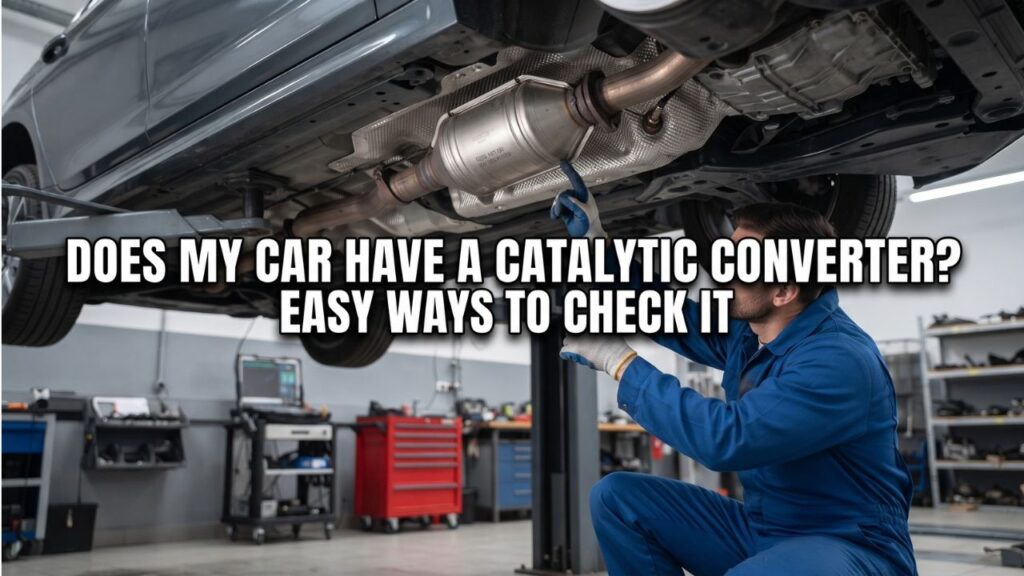
For most modern gasoline-powered passenger vehicles in the United States, the answer is yes. The main exceptions involve very old vehicles, full battery-electric vehicles, and vehicles whose exhaust systems have been altered.
Gasoline Cars Usually Have One or More Catalytic Converters
Catalytic converters became widespread in U.S. passenger vehicles starting with the 1975 model year as emissions requirements tightened. EPA material states that most cars and light-duty trucks manufactured since that period have used converters.
A modern gasoline engine commonly uses a three-way catalyst that reduces hydrocarbons, carbon monoxide, and nitrogen oxides.
Some cars have one converter. Others use a smaller close-coupled converter near the engine plus another catalyst farther downstream.
V6 and V8 engines may have separate exhaust paths for each cylinder bank, producing two or more converter assemblies.
Hybrid Cars Usually Have Catalytic Converters
A hybrid still has an internal-combustion engine unless it is operating solely as a battery-electric vehicle, so it needs emissions treatment for the periods when that engine runs.
Toyota’s 2024 Prius Prime warranty documentation, for example, identifies both a front exhaust pipe containing a catalytic converter and an exhaust manifold containing a manifold converter.
The hybrid battery and electric motor do not replace the catalytic converter. They simply reduce how often and how heavily the gasoline engine may need to operate.
Diesel Vehicles Can Have Catalytic Exhaust Components
Modern diesel exhaust systems may use several different treatment devices.
Common components include:
- Diesel oxidation catalyst, or DOC
- Diesel particulate filter, or DPF
- Selective catalytic reduction, or SCR
- Diesel exhaust fluid dosing equipment
- NOx sensors
- Temperature sensors
A diesel oxidation catalyst is a catalytic converter designed for diesel exhaust chemistry.
GM emissions documentation lists a diesel oxidation catalyst, DPF, and SCR system as separate parts of a diesel aftertreatment system.
Battery-Electric Cars Do Not Need Catalytic Converters
A full battery-electric vehicle has no gasoline or diesel engine and produces no tailpipe exhaust during operation.
The U.S. Department of Energy states that all-electric vehicles use an electric motor instead of an internal-combustion engine and have no tailpipe exhaust.
With no combustion exhaust to treat, there is no conventional catalytic converter.
Examples include full battery-electric models rather than hybrids or plug-in hybrids with gasoline engines.
Key Takeaway: Most gasoline cars, hybrids, and many diesels use catalytic exhaust treatment; full battery-electric vehicles do not.
How to Check if Your Car Has a Catalytic Converter
You do not need to identify the converter solely by looking underneath the vehicle.
Documentation often gives a faster and more reliable answer.
Check the Underhood Emissions Label
Open the hood and locate the Vehicle Emission Control Information label.
It is commonly attached to the underside of the hood, radiator support, engine compartment, or another visible location.
Older EPA guidance notes that catalyst-equipped vehicles may identify the catalyst on the emissions label.
The wording varies by manufacturer and model year.
You may see references such as:
- TWC
- Three-way catalyst
- CAT
- Catalyst
- Catalytic converter
- DOC on some diesels
Modern labels may use emissions-system abbreviations rather than writing out every component name.
Look Up the Vehicle by VIN
The 17-character VIN gives the most direct route to vehicle-specific parts information.
A dealer parts department, manufacturer catalog, repair database, or reputable emissions-parts catalog can use the VIN to identify the factory exhaust configuration.
This method is useful because one vehicle model may have several engine and emissions packages.
The same model year can sometimes use:
- Different engines
- Federal emissions equipment
- California emissions equipment
- Hybrid and non-hybrid powertrains
- Different converter quantities
I’d use the VIN before buying any converter because matching by model name alone can lead to the wrong part.
Inspect the Exhaust System
If the vehicle is safely lifted and supported, the converter may be visible in the exhaust path.
It normally looks like an enlarged stainless-steel housing installed between the engine and muffler. Cars.com describes the converter as located upstream of the muffler and relatively close to the engine.
Common visual clues include:
- A bulged metal housing in the exhaust
- Heat shields above or around it
- Oxygen sensors installed before or after it
- Flanges or welded exhaust joints
- A location ahead of the muffler
Do not crawl beneath a vehicle supported only by a jack.
Check a Parts Diagram or Repair Manual
An OEM parts diagram can show each converter by position.
Toyota, for example, sells some converter assemblies integrated directly into the exhaust manifold, which explains why a quick glance under the middle of the car may not reveal an obvious converter.
Service diagrams may label units as:
- Front catalyst
- Rear catalyst
- Manifold converter
- Warm-up catalyst
- Underfloor catalyst
- Bank 1 converter
- Bank 2 converter
These labels can also reveal that the car has more than one.
Key Takeaway: Check the emissions label and VIN first, then use a parts diagram or physical inspection to confirm the converter’s location and quantity.
Where Is the Catalytic Converter Located on a Car?
The converter is always positioned in the exhaust-gas path, but manufacturers can place it in several locations.
Close to the Exhaust Manifold
Many newer vehicles place the first converter very close to the engine.
Hot exhaust reaches the catalyst quickly in this position, helping it reach operating temperature soon after startup.
Some units bolt directly to the manifold.
Others are built into a combined exhaust manifold and converter assembly. Toyota currently lists multiple factory parts using this integrated design.
Under the Vehicle
Another common location is farther downstream underneath the passenger compartment.
The converter may resemble a small muffler or metal canister in the exhaust pipe.
Cars.com describes typical converters as positioned between the engine and muffler.
Heat shields are common because catalyst housings operate at high temperatures.
More Than One Location
Some vehicles use multiple catalyst stages.
A system might have:
Engine → Manifold catalyst → Front pipe → Underfloor catalyst → Resonator → Muffler → Tailpipe
A V-type engine may instead have a separate converter serving each cylinder bank.
That means finding one converter does not prove it is the vehicle’s only converter.
Key Takeaway: Look close to the engine as well as underneath the floor; many modern cars use multiple converter locations.
Which Cars May Not Have a Catalytic Converter?
A few vehicle categories can legitimately lack a conventional converter.
Others may be missing one even though the factory originally installed it.
Full Battery-Electric Vehicles
Battery-electric vehicles have no combustion exhaust system.
The Department of Energy states that BEVs have no tailpipe exhaust, so a conventional exhaust catalyst is unnecessary.
Do not confuse a battery-electric car with a plug-in hybrid.
A plug-in hybrid may travel significant distances using electricity, but its gasoline engine still produces exhaust when operating.
Some Vehicles From Before the Mid-1970s
Catalytic converters were not standard equipment on the earliest cars.
EPA records show widespread U.S. adoption beginning with the 1975 model year, though not every 1975 vehicle used one.
A classic car from before this period may have no factory converter.
It may also have been modified during restoration, so factory documentation remains useful.
A Vehicle With a Stolen Converter
Catalytic-converter theft can leave a vehicle that should have a converter with an obvious gap in the exhaust.
Common clues include:
- Sudden extremely loud exhaust
- Freshly cut exhaust pipes
- Exhaust smell
- Check-engine light
- Wiring damage near oxygen sensors
- An empty section where the converter should sit
Do not assume a loud exhaust means the car never had a converter.
A Vehicle With an Illegally Removed Converter
A previous owner may have removed or hollowed the converter.
The vehicle may still run, but removing a required emissions device from a road-going vehicle violates federal anti-tampering requirements.
EPA treats the catalytic converter as a required pollution-control device on vehicles originally certified with one.
Key Takeaway: Full EVs and some older vehicles may legitimately have no converter; a newer combustion vehicle with no converter may have been modified or had the part stolen.
How Many Catalytic Converters Does My Car Have?
There is no universal number.
Some cars have one, while others use two, three, four, or more catalyst elements depending on the engine and emissions design.
Inline Four-Cylinder Cars Often Use a Simple Layout
Many four-cylinder gasoline cars use one main exhaust path.
The vehicle may have one close-coupled converter, one downstream converter, or both.
A single exhaust pipe does not always mean a single catalyst because several converter sections can be installed in series.
V6 and V8 Engines Often Use Separate Banks
A V6 or V8 has two cylinder banks.
Manufacturers often route each bank through its own exhaust manifold and catalyst before the exhaust paths join.
That can produce:
- Bank 1 converter
- Bank 2 converter
- One or more downstream converters
The exact layout changes by model and year.
Hybrids Can Still Use Several Catalysts
Hybrid power does not imply a simple exhaust system.
Toyota’s Prius Prime warranty documentation, for example, identifies a converter in the front pipe and another converter integrated with the exhaust manifold.
A VIN-based parts diagram is the fastest way to count them accurately.
Key Takeaway: Converter count depends on engine layout and emissions design; a VIN lookup is more reliable than guessing from cylinder count.
Can a Car Run Without a Catalytic Converter?
A gasoline or diesel engine may physically run with a missing converter, but that does not mean the vehicle is operating as intended.
The consequences depend on what was removed and how the exhaust was altered.
A missing converter can cause:
- Very loud exhaust if pipes were cut
- Exhaust leaks
- Check-engine lights
- P0420 or P0430 catalyst codes
- Oxygen-sensor faults
- Increased harmful tailpipe emissions
- Failed emissions inspection
- Heat or wiring damage after theft
Federal law also restricts removing or disabling emissions-control devices originally installed on a vehicle.
If the converter was stolen, the correct repair is to install the proper compliant replacement and repair damaged wiring or exhaust sections.
How Can I Tell if My Catalytic Converter Was Stolen?
Converter theft often produces an abrupt change rather than a gradual symptom.
The engine may suddenly sound far louder than it did the previous day.
Look for signs such as:
- Loud roaring immediately after startup
- Exhaust noise from underneath the cabin
- Fresh saw cuts in exhaust tubing
- Hanging oxygen-sensor wiring
- A missing section ahead of the muffler
- Exhaust odor beneath or inside the vehicle
Do not run the vehicle inside a garage while inspecting an exhaust problem.
Exhaust gases contain carbon monoxide, which is colorless and odorless and can enter the cabin through leaks.
Does a Catalytic Converter Look Like a Muffler?
They can look similar from a distance.
Both may appear as enlarged metal housings attached to exhaust pipe.
Their location usually gives the easiest clue.
The converter sits closer to the engine and before the muffler in the exhaust path. Cars.com describes it as upstream of the muffler.
Converters also often have heat shields and oxygen sensors nearby.
A muffler is normally farther toward the rear of the vehicle and is mainly responsible for reducing exhaust noise.
Why Your Car Needs a Catalytic Converter
The converter reduces pollutants created by combustion before exhaust leaves the tailpipe.
EPA identifies carbon monoxide, hydrocarbons, and nitrogen oxides among the pollutants addressed by catalytic emissions systems.
A gasoline three-way catalyst promotes reactions that change these pollutants into gases such as:
- Carbon dioxide
- Water vapor
- Nitrogen
- Oxygen
The catalyst itself does not work like a simple filter that catches all pollutants.
Exhaust flows through small passages in a ceramic or metallic substrate coated with catalyst materials.
That design explains why a physically melted or collapsed converter can also restrict engine exhaust flow.
Conclusion
For does my car have a catalytic converter, the answer is probably yes if the vehicle is a gasoline-powered car, hybrid, or modern diesel sold in the United States. EPA records show converters have been fitted to most U.S. passenger cars and light-duty trucks since the 1975 model year.
A full battery-electric vehicle is the main modern exception because it has no combustion engine or tailpipe exhaust. Older pre-catalyst vehicles can also lack a factory converter.
The quickest confirmation comes from the underhood emissions label, VIN-specific parts information, or an OEM exhaust diagram. Physical inspection works too, but some converters sit close to the engine or inside the exhaust manifold and may be hard to see.
I’d use the VIN if there is any uncertainty, especially before buying a replacement. It can confirm the number of converters, the emissions package, engine configuration, and the correct position of each unit without relying on appearance alone.
FAQs About Cars and Catalytic Converters
Do All Gasoline Cars Have Catalytic Converters?
Most modern gasoline cars in the United States do. EPA says catalytic converters have been installed on most passenger cars and light-duty trucks manufactured since 1975. Some early vehicles around the transition period and much older classic cars can be exceptions.
Do Hybrid Cars Have Catalytic Converters?
Yes. A hybrid that includes a gasoline engine needs exhaust treatment when that engine runs. Toyota Prius Prime documentation, for example, lists both a manifold converter and a converter in the front exhaust pipe.
Do Electric Cars Have Catalytic Converters?
Full battery-electric vehicles do not. The U.S. Department of Energy states that all-electric vehicles have no tailpipe exhaust, so there is no combustion exhaust requiring a conventional catalytic converter.
Do Diesel Cars Have Catalytic Converters?
Many modern diesels use a diesel oxidation catalyst, which performs catalytic exhaust treatment. Their aftertreatment systems may also include a DPF and SCR system. Exact equipment changes with model, engine, and emissions certification.
Where Can I Find the Catalytic Converter on My Car?
Look in the exhaust path between the engine and muffler. It may be under the vehicle, immediately behind the exhaust manifold, or integrated into the manifold. Some vehicles have several converters in different locations.
How Do I Know How Many Catalytic Converters My Car Has?
Use the VIN with an OEM parts catalog, dealer system, or repair database. Engine layout offers clues, but it is not definitive. Some four-cylinder cars have multiple catalyst stages, while V6 and V8 vehicles can have several units across two exhaust banks.
What Does a Missing Catalytic Converter Sound Like?
A converter removed by theft often leaves a large opening in the exhaust, producing a very loud roaring or rumbling sound immediately after startup. Cut pipes, hanging sensor wires, and exhaust odor are other clues.
Can I Check for a Catalytic Converter Without Getting Under the Car?
Yes. Start with the underhood emissions label, owner’s emissions information, VIN-based factory parts catalog, or dealer parts lookup. These methods are often easier because some converters are hidden close to the engine.