How Much Is a Old Catalytic Converter Worth? Scrap Value Guide
An old catalytic converter may be worth only a few dollars or more than $1,000 as scrap. OEM units from certain vehicles tend to bring the highest offers, while many aftermarket converters are worth very little. The exact price comes from the converter code, precious-metal loading, condition, and current platinum-group-metal market.
Age by itself does not determine the price. A 20-year-old OEM converter can be worth far more than a recently installed aftermarket unit because manufacturers used different amounts of platinum, palladium, and rhodium in different converter designs.
Catalytic-converter recycling is a large source of recovered precious metals in the United States. The U.S. Geological Survey reported that about 50,000 kilograms of palladium and 8,600 kilograms of platinum were recovered from U.S. automobile catalytic converters during 2025.
For how much is a old catalytic converter worth, a current U.S. scrap-price snapshot gives a useful starting point. On October 15, 2026, one major converter recycler reported a national average of about $93.52 per converter, while its individual categories ranged from around $5 for many aftermarket units to more than $1,000 for selected high-grade converters.
Those numbers should not be treated as a guaranteed offer. Converter prices can change frequently because platinum, palladium, and rhodium prices move, and each converter contains a different amount of recoverable material.
The most accurate way to price an old converter is to find its stamped serial or reference number, confirm if it is OEM or aftermarket, leave the unit intact, and request quotes from established catalytic-converter recyclers.
How Much Is a Old Catalytic Converter Worth in Scrap?
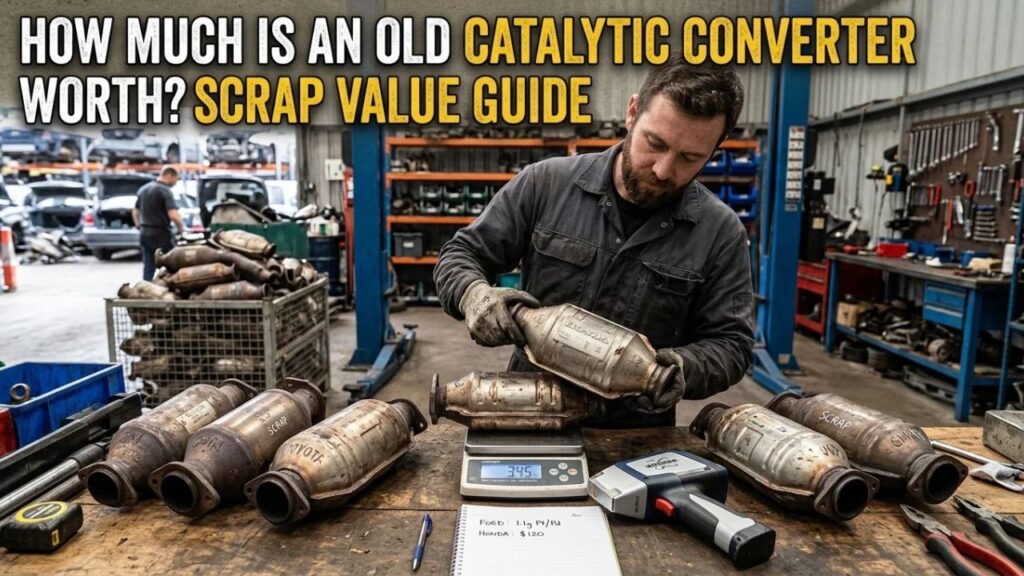
Most ordinary used converters are not worth thousands of dollars. Many fall somewhere from $20 to a few hundred dollars, while certain OEM designs can bring considerably more.
Current Catalytic Converter Scrap Price Ranges
On October 15, 2026, RRCats listed these buyer-specific guideline ranges:
| Converter category | Listed scrap range |
| Aftermarket converter | About $5 |
| Regular domestic | 20-133 |
| Small domestic | 30-184 |
| Large GM | 80-283 |
| Small foreign | 30-225 |
| Medium foreign | 40-450 |
| Large foreign | 90-454 |
| High-grade domestic | 68-618 |
| Diesel converter | 15-508 |
| DPF/catalyst unit | 30-801 |
| Torpedo converter | 110-1,150 |
| Exotic converter | 200-587 |
The same buyer listed a national catalytic-converter average of $93.52 each. These are recycling quotes from one buyer rather than fixed nationwide market prices.
A converter outside those categories can fall below or above the listed ranges.
Why the Range Is So Large
Two catalytic converters that look almost identical from the outside can contain very different amounts of recoverable platinum-group metals.
Their value changes with:
- Vehicle make and model
- Engine size
- Model year
- Federal or California emissions specification
- OEM or aftermarket construction
- Converter location
- Precious-metal loading
- Serial number
- Missing or damaged catalyst material
- Current metal prices
- Recycler processing costs
A price based only on the converter’s physical size is therefore a rough guess.
Key Takeaway: Many old converters bring tens or hundreds of dollars, while selected OEM units can exceed $1,000. The exact converter code matters far more than age alone.
Why OEM Catalytic Converters Are Usually Worth More
OEM means the converter was supplied as original equipment for the vehicle rather than installed later as a generic replacement.
OEM Converters Often Have Higher Precious-Metal Loading
Original converters are engineered to meet the vehicle manufacturer’s emissions requirements over a long service life.
Scrap buyers commonly value OEM converters above aftermarket units because OEM units tend to contain more recoverable catalyst material. RRCats reports that OEM units can sometimes bring several times the value of aftermarket converters.
That does not mean every factory converter is expensive.
Some OEM units may still have modest scrap values, while certain converter codes are sought after because of their metal content.
Aftermarket Converters Can Be Worth Very Little
Aftermarket converters are built to meet applicable replacement-emissions requirements, but their catalyst loading may differ from an original factory unit.
In the October 15, 2026 pricing snapshot, RRCats listed its generic aftermarket-converter price at only $5 each, while many OEM-style categories were priced much higher.
A large aftermarket converter can therefore be worth less than a physically smaller OEM unit.
How to Spot an OEM Converter
OEM converters often have:
- Manufacturer markings
- Stamped serial numbers
- Vehicle-specific part numbers
- Recognizable factory welds
- Brand-specific reference formats
Aftermarket units may carry generic branding, an aftermarket manufacturer’s number, EPA-related markings, or replacement labels.
Do not rely only on appearance. Serial-number lookup gives a stronger identification.
Key Takeaway: Factory OEM converters tend to command higher scrap prices because their catalyst loading can exceed many replacement units; aftermarket units may have very low recycling value.
What Makes an Old Catalytic Converter Worth Money?
Most of the scrap value comes from platinum-group metals deposited inside the converter.
Platinum
Platinum is used as a catalyst in automotive emissions systems.
As of October 17, 2026, Kitco showed platinum around $1,626 per troy ounce on the bid side of the spot market.
Palladium
Palladium is heavily associated with gasoline-vehicle catalysts.
Kitco’s October 17, 2026 quote showed palladium around $1,096 per troy ounce bid.
Rhodium
Rhodium is used for nitrogen-oxide control in many automotive catalyst formulations and can be much more expensive per ounce than platinum or palladium.
Kitco showed a rhodium bid near $8,500 per troy ounce in its latest October 2026 quotation.
The Converter Is Not Solid Precious Metal
A catalytic converter does not contain a large block of platinum, palladium, or rhodium.
The metals exist in small quantities across the washcoat covering the ceramic or metallic substrate.
The recycler must process, sample, refine, and recover those metals. A converter’s scrap offer therefore cannot be calculated simply by multiplying today’s metal price by the converter’s total weight.
Key Takeaway: Scrap value mainly comes from recoverable platinum, palladium, and rhodium, but each converter contains its own metal loading and requires processing before those metals can be recovered.
How to Find the Value of Your Old Catalytic Converter
Getting a real quote usually starts with identification rather than weighing the converter.
Find the Serial or Reference Number
Look over the converter shell for stamped, engraved, or printed characters.
The code may sit:
- On the main shell
- Close to an inlet or outlet
- Under a heat shield
- Near a weld
- On a flat stamped area
- Along the attached pipe
Ecotrade maintains a converter-reference database and notes that manufacturers use different numbering styles. Ford units, for example, may have long codes separated by hyphens, while Toyota uses several shorter reference formats.
Clean surface dirt gently if the number is difficult to see. Avoid grinding away metal or markings.
Photograph the Entire Converter
Take clear photos of:
- Both sides
- Top and bottom
- Inlet and outlet
- Serial number
- Manufacturer stamp
- Remaining pipe sections
Some converters are identified partly by shape when the number is missing or difficult to decode.
Search a Converter Database
Specialized recycling databases contain thousands of sampled OEM converter codes.
Ecotrade states that its catalogue includes more than 20,000 individually sampled converters identified by codes and photos.
Such databases are more useful than generic statements such as “Toyota cats are expensive” because converter values can differ widely within the same brand.
Get More Than One Quote
A recycler’s offer reflects its current purchasing schedule, processing method, metal assumptions, freight costs, and business margin.
If the unit appears to be an OEM converter with a recognizable serial number, comparing quotes can reveal a meaningful difference.
Key Takeaway: Find the converter code first, photograph the complete unit, then compare quotes based on that exact reference rather than accepting a price based only on size or vehicle brand.
Does the Age of a Catalytic Converter Affect Its Value?
Not in a simple old-equals-more or old-equals-less pattern.
Older OEM Converters Can Be Worth More
Some older factory converters contain strong precious-metal loadings.
That can make them sought after by recyclers even after years of vehicle use.
A unit’s code and original application tell a buyer much more than its age.
A New Aftermarket Converter May Be Worth Less
A replacement converter that has only been used for a short period may still have low scrap value if its precious-metal loading is low.
That creates a situation where an old original converter can bring far more money than a newer replacement.
Normal Use Does Not Automatically Remove All the Metal
The platinum-group metals act as catalysts rather than being burned as fuel.
A used converter can therefore retain recoverable metal after the converter no longer functions correctly on a vehicle.
Contamination, missing substrate, or previous processing can still lower what a recycler will pay.
Key Takeaway: Converter age is a weak pricing factor by itself; original application, OEM status, catalyst loading, code, and remaining material carry much more weight.
Does Converter Condition Change the Scrap Price?
Yes, mainly when catalyst material is missing.
A Complete Converter Is Easier to Price
An intact converter with its shell, identifying marks, and internal substrate gives the buyer the best chance of matching it to known assay data.
Leaving the converter whole also reduces uncertainty about how much catalyst material remains.
A Hollow Converter May Be Worth Almost Nothing
If someone has removed the honeycomb, most of the material that contains the platinum-group metals is gone.
The remaining steel housing has little relation to the normal converter quote.
Broken Internal Material Can Reduce the Offer
A converter with cracked catalyst material may still have recycling value if the material remains inside.
If pieces have fallen out, the buyer may reduce the offer because less recoverable material remains.
Do Not Cut It Open to Check
Cutting a converter apart can:
- Remove identifying evidence
- Lose catalyst dust and fragments
- Reduce buyer confidence
- Expose you to fine ceramic and exhaust-contaminant dust
- Make accurate identification harder
Send photos and serial numbers to the recycler instead.
Key Takeaway: An intact, identifiable converter usually receives the clearest quote; missing honeycomb or lost catalyst material can reduce its scrap value sharply.
Can You Calculate Converter Value From Metal Prices?
Not accurately from public spot prices alone.
Knowing that rhodium trades at thousands of dollars per ounce does not tell you how much rhodium is inside a specific converter.
Metal Loading Is Converter-Specific
Manufacturers change catalyst recipes according to:
- Emissions standard
- Engine type
- Vehicle weight
- Exhaust temperature
- Catalyst location
- Certification requirements
Even two converters fitted to the same vehicle can have different jobs and different metal loadings.
Refiners Use Sampling and Assay Data
Professional recyclers build databases from converter samples and material assays.
That lets them estimate the recoverable metal value associated with a particular code.
This is why a serial number can be more useful than knowing the converter weighs 12 pounds.
Spot Prices Still Matter
Metal prices change the underlying recycling market.
On October 17, 2026, Kitco showed platinum around $1,626 per ounce, palladium around $1,096, and rhodium around $8,500 bid. Changes in these markets can move converter offers over time.
The relationship is not one-to-one because recovery costs, refining losses, buyer margin, and converter composition also enter the quote.
Key Takeaway: Precious-metal prices influence converter scrap values, but you need converter-specific loading or assay data to estimate an individual unit accurately.
Is an Old Catalytic Converter Worth More Than Scrap Metal?
Usually, yes, if the catalyst material remains inside.
Selling the converter as ordinary steel scrap can overlook most of its potential value.
A specialist catalytic-converter recycler prices the unit for its recoverable platinum-group metals rather than treating it as a piece of stainless or exhaust steel.
For perspective, the USGS reported that U.S. automobile catalytic converters supplied about 50 metric tons of recycled palladium and 8.6 metric tons of recycled platinum in 2025.
That recovery stream explains why specialist pricing can differ so much from normal mixed-metal scrap pricing.
Can You Sell Any Old Catalytic Converter?
You should be able to establish lawful ownership, and state or local rules can place restrictions on catalytic-converter transactions.
Proof of Ownership May Be Required
Catalytic-converter theft has led recyclers and governments to use stricter purchasing procedures.
For example, RRCats currently requires sellers requesting a converter quote to submit proof such as a vehicle registration, title, or bill of sale under its purchasing process.
Rules differ by jurisdiction, so check the requirements where the transaction occurs.
Selling for Scrap Is Different From Selling for Reinstallation
A spent converter being sold to a recycler for material recovery is different from selling a used converter as a replacement exhaust component.
EPA’s aftermarket-converter policy places restrictions on the installation and sale for reuse of untested used catalytic converters. EPA states that an untested converter from a salvage vehicle cannot simply be installed as a replacement under that policy.
Do Not Remove a Working Converter Just for Scrap Value
Federal law prohibits removing or rendering required emissions equipment inoperative on a road vehicle simply to sell the component.
EPA states that Clean Air Act anti-tampering rules apply broadly, including to vehicle owners.
Scrap a converter that has already been legitimately removed during a lawful repair or from an end-of-life vehicle rather than removing a functioning emissions device for its metal value.
Key Takeaway: Keep ownership records, follow local scrap-purchase rules, and separate legitimate recycling from removing or reselling emissions equipment in ways that violate emissions requirements.
How to Get the Best Price for an Old Catalytic Converter
A few steps can keep you from accepting a generic low quote.
Keep the Converter Intact
Do not gut, crush, cut, or grind the unit.
The complete shell and internal substrate give the buyer more information.
Preserve the Serial Number
Avoid damaging stamped numbers when removing rust or dirt.
The code may be the most useful pricing detail on the entire part.
Confirm OEM vs Aftermarket
If the converter is original equipment, say so only when you can support that identification through markings, vehicle history, or part numbers.
An OEM unit can fall into a very different price category from an aftermarket replacement.
Request a Code-Based Quote
Give the recycler:
- Converter serial number
- Vehicle make
- Vehicle model
- Approximate year
- Engine if available
- Clear photographs
A code-based quote is stronger than asking, “How much for a Honda catalytic converter?”
Compare the Same Day
Converter values can move with precious-metal markets.
If you compare buyers, request quotes within a similar time window so one quote is not being compared with another from a much different metal market.
Key Takeaway: Leave the converter intact, preserve its numbers, identify OEM status, and request several code-based quotes close together in time.
Conclusion
For how much is a old catalytic converter worth, a realistic answer ranges from only a few dollars for some aftermarket units to several hundred dollars for many OEM converters, with selected high-grade units reaching $1,000 or more.
A current October 15, 2026 buyer snapshot placed the U.S. national average near $93.52 per converter, while category prices ranged from about $5 to $1,150. Those figures change and should be used as reference points rather than guaranteed payouts.
The fastest route to a realistic price is to locate the serial number, identify the converter as OEM or aftermarket, leave the catalyst intact, and request an exact-code quote from more than one legitimate recycler.
Do not estimate the price from weight alone. A small OEM converter with high catalyst loading can be worth much more than a large aftermarket unit, and the same converter’s value can move as platinum, palladium, and rhodium markets change.
FAQs About Old Catalytic Converter Value
How much is an average old catalytic converter worth?
One major U.S. recycler listed a national average of about $93.52 per converter on October 15, 2026. Individual units can be worth much less or far more, so the average should not be used as an exact quote for a specific part.
Can an old catalytic converter be worth $1,000?
Yes. Certain high-value OEM converter categories can reach or exceed $1,000 in some markets. A recent recycler price list showed selected torpedo-style converters reaching about $1,150. Most ordinary converters are worth much less.
Are aftermarket catalytic converters worth anything as scrap?
Yes, but many have very low scrap prices compared with OEM units. RRCats listed its generic aftermarket converter price at about $5 each on October 15, 2026. Exact value can vary by brand, design, and catalyst content.
How do I find the scrap value from the catalytic converter number?
Find the stamped or engraved code on the shell and enter it into a specialist converter database or send it to a recycler. Ecotrade states that converter reference numbers are used to identify individual catalyst designs and maintains a catalogue containing more than 20,000 sampled units.
Which catalytic converters are worth the most money?
Selected OEM converters with higher recoverable platinum-group-metal content tend to bring the strongest prices. Vehicle make alone does not determine value; the exact converter code, emissions specification, engine application, catalyst loading, and current metal market are more useful.
Is a 20-year-old catalytic converter still worth money?
Yes. Age does not eliminate scrap value if the catalyst material remains inside. Some older OEM units can be worth more than recent aftermarket replacements because their original catalyst loading is higher.
Should I cut open my old catalytic converter before selling it?
No. Keep it intact. Cutting the converter can remove identifying information, spill catalyst material, expose you to fine dust, and make the unit harder for a recycler to identify and price accurately.