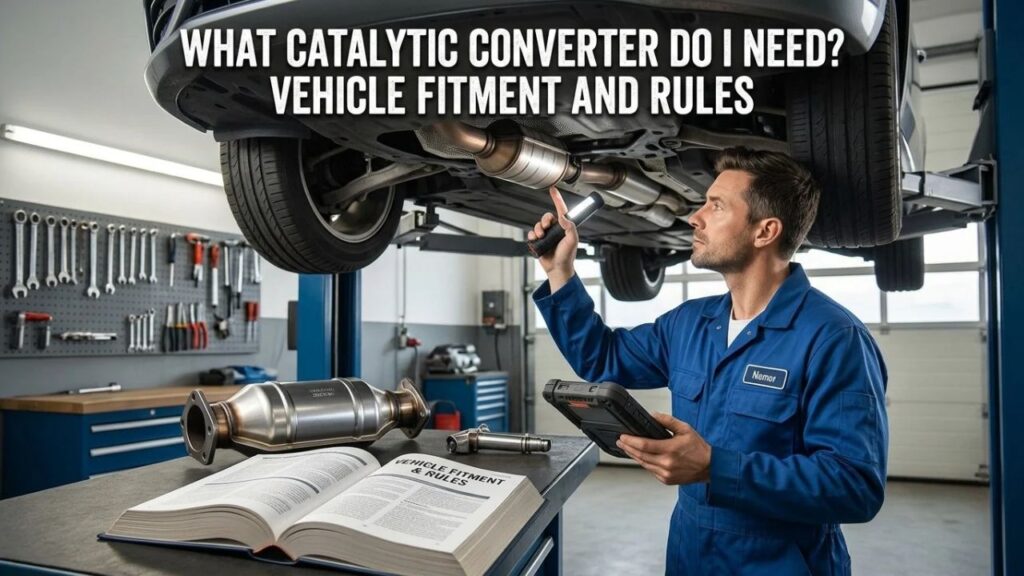
What Catalytic Converter Do I Need? Vehicle Fitment and Rules
The correct replacement catalytic converter is the one cataloged for your exact vehicle, engine, emissions certification, converter position, and state of registration. Do not buy by pipe diameter or physical size alone. A part can fit the exhaust and still be wrong for the vehicle’s emissions system, oxygen-sensor layout, or legal requirements.
Choosing the correct unit matters because modern OBD-II vehicles monitor catalyst operation closely. A poorly matched converter may fit mechanically yet trigger a catalyst-efficiency code, fail an emissions inspection, or place the oxygen sensors in the wrong position.
For U.S. owners, warranty status is worth checking before paying for a replacement. EPA says the catalytic converter is one of the specified major emissions components covered by the federal emissions warranty for 8 years or 80,000 miles on qualifying light-duty vehicles, subject to the warranty terms.
If you are asking what catalytic converter do i need, start with the vehicle year, make, model, engine size, VIN, state of registration, and the emissions label under the hood. On vehicles subject to CARB aftermarket rules, the engine family or test group can also determine the exact approved part. CARB identifies approved applications by make, model, model year, engine size, and test group or engine family.
I’d choose a direct-fit converter first when a correctly cataloged part is available and the goal is a straightforward replacement. A universal converter can cost less, but it must still match the vehicle’s emissions requirements, engine capacity, pipe size, oxygen-sensor fittings, and installation position.
The sections below explain how to identify the required emissions standard, read the Vehicle Emissions Control Information label, choose between OEM, direct-fit, and universal units, match Bank 1 or Bank 2 position, and avoid buying a converter that fits physically but is wrong for the car.
What Catalytic Converter Do I Need for My Car?
You need a converter listed for the exact vehicle application and legal emissions standard where the vehicle is registered. For many newer vehicles, that means matching more than year, make, and model.
What Information Do You Need Before Shopping?
Write down these details before looking at parts:
- Model year
- Make and model
- Engine displacement
- VIN
- Federal or California emissions certification
- Engine Family Number or test group when required
- Converter position
- Number of converters on the vehicle
- State where the vehicle is registered and operated
CARB says its approved aftermarket converter applications are identified by make, model, model year, engine size, and test group or engine family. That is why two cars with the same model name and engine size can still require different converter part numbers.
Why the VIN Alone May Not Be Enough
A VIN identifies the vehicle configuration, but a catalog may still ask for the emissions family, build information, drive type, or converter position.
Cars built in the same model year can use different exhaust layouts. A manufacturer may also have federal-emissions and California-emissions versions of the same vehicle.
Use the VIN as one piece of the fitment check, not as a reason to ignore the emissions label or part-catalog notes.
Why Engine Size Matters
Converter catalyst loading and flow capacity are matched to an engine’s emissions output and exhaust volume.
Walker’s EPA guidance for universal converters says the selected unit must be rated for the engine size and vehicle weight. Its listed engine displacement is a maximum capacity, not a suggestion that any smaller-looking converter will work.
Key Takeaway: Match the converter to the full vehicle application—year, engine, emissions family, position, and state rules—not just the exhaust-pipe diameter.
Check Federal vs CARB Emissions Requirements First
The emissions category is one of the biggest selection points in the United States.
A Federal/EPA aftermarket converter and a CARB-approved converter are not automatically interchangeable.
Federal/EPA Replacement Converters
Many vehicles registered in states that follow federal aftermarket converter rules can use a properly cataloged EPA-compliant converter.
EPA guidance says the replacement should be the same converter type as the original, installed in the same location, and specified by the converter manufacturer for the vehicle. Engine size, vehicle weight, air-injection connections, and original converter count also matter.
Do not remove one of several original converters unless the replacement manufacturer specifically states that one approved assembly replaces multiple original units.
CARB-Approved Replacement Converters
California requires aftermarket converters to have a CARB exemption for the specific vehicle application. CARB assigns an Executive Order, or EO, to approved parts and provides a database for checking approved vehicle applications.
CARB says the correct part is tied to the vehicle’s make, model, model year, engine size, and test group or engine family.
Colorado also has CARB-based aftermarket converter rules for covered spark-ignition vehicles under 14,001 pounds GVWR. New York and Maine have their own application rules that can require CARB-approved converters based on model year and emissions certification. State requirements can change, so check the current rule and the converter maker’s state-specific catalog before purchase.
What If the Car Has California Emissions but Lives in Another State?
The vehicle’s emissions certification still matters.
Some converter manufacturers list higher-loading or OEM-grade federal products for California-certified vehicles operated in states that permit federal aftermarket converters. The correct selection should come from the application catalog for the car and registration state.
Do not assume a federal converter is suitable simply because the car is no longer in California.
Key Takeaway: Identify both the vehicle’s emissions certification and the state installation rule before choosing between an EPA-compliant and CARB-approved replacement.
How to Read the Emissions Label
The under-hood emissions label is one of the best sources of fitment data when converter catalogs list several parts for the same vehicle.
The label is often called the Vehicle Emissions Control Information, or VECI, label.
Where to Find the VECI Label
Common locations include:
- Underside of the hood
- Radiator support
- Strut tower area
- Engine compartment panel
The exact location changes by manufacturer.
If the label is missing or unreadable, CARB advises contacting the vehicle manufacturer or dealer for the engine-family information rather than guessing.
Find the Engine Family Number or Test Group
CARB describes the Engine Family Name as a 10- to 12-character alphanumeric code used to identify a certified engine group.
On newer vehicles it may also be called the test group, emission family, or engine family number.
This code is a major fitment check for CARB-approved OBD-II converters. Two otherwise similar vehicles may appear under separate engine families and require different approved part numbers.
Look for Federal or California Certification Wording
The label normally identifies the emissions standards the vehicle was certified to meet.
A California-certified or 50-state vehicle may have different converter choices from a federal-only version.
Photograph the label before shopping. That prevents repeated trips back to the vehicle when a catalog asks for a code or certification detail.
Key Takeaway: The VECI label identifies emissions certification and the engine family or test group that may be required to choose the exact legal converter.
Direct-Fit vs Universal Catalytic Converter
Both can work when they are properly cataloged for the vehicle. The main difference is installation.
Direct-Fit Converter
A direct-fit converter is built around a specific vehicle exhaust layout.
It can include:
- Correct pipe routing
- Matching flanges
- Hangers
- Brackets
- Heat shields
- Oxygen-sensor bungs
- Correct converter position
Walker describes direct-fit converters as bolt-on replacements built to match the original size, shape, hanger locations, and exhaust routing. MagnaFlow likewise states that direct-fit units need little or no fabrication.
For a home repair, this is usually the simpler path if the old fasteners and surrounding exhaust are serviceable.
Universal Converter
A universal converter is a catalyst body intended to cover multiple applications, but it still must be approved or cataloged for the specific vehicle and emissions requirement.
Installation can require:
- Cutting exhaust pipe
- Welding
- Pipe adapters
- Fabricated hangers
- Correct placement of oxygen-sensor fittings
- Precise converter positioning
Walker says universal converters require custom fabrication and gives engine size, GVWR, converter type, pipe size, and oxygen-sensor fittings as selection points.
A universal unit should not be chosen from inlet and outlet diameter alone.
Which One Should You Buy?
I’d choose direct-fit when the price difference is reasonable and a correct application exists. It reduces fabrication, makes sensor and flange placement more predictable, and lowers the chance of a fitment mistake.
A universal converter makes sense when a catalog lists it for the vehicle and a competent exhaust shop can place and weld it correctly.
Key Takeaway: Direct-fit is easier to install; universal is more fabrication-heavy. Both still need the correct emissions application and catalyst capacity.
OEM vs Aftermarket Catalytic Converter
An OEM converter comes from the vehicle manufacturer or its original supply chain. An aftermarket converter is made by another manufacturer for approved replacement use.
OEM Converter
OEM is often the simplest reference point for fit, catalyst loading, heat shielding, and OBD compatibility.
It may also be required when no approved aftermarket converter exists for a specific application.
Before buying an OEM unit, check federal and manufacturer warranty coverage. EPA states that catalytic converters are specified major emissions components under the 8-year/80,000-mile federal warranty on qualifying vehicles.
Aftermarket Converter
A properly selected aftermarket converter can be a legitimate replacement after the original part is outside applicable warranty coverage and replacement is allowed under the relevant rules.
The part still needs to match:
- Vehicle application
- Emissions standard
- Converter position
- Engine size
- OBD requirements
- State rules
CARB-approved aftermarket converters also carry an EO marking tied to approved applications.
Cheapest Is Not the Best Selection Method
A low price does not tell you if the catalyst loading, OBD compatibility, mounting position, or legal approval matches the vehicle.
Use the manufacturer’s application listing first. Price comes after fitment and emissions compliance have been confirmed.
Key Takeaway: OEM is often the simplest match, while aftermarket can be a proper replacement when it is specifically approved or cataloged for the vehicle and state.
What Converter Position Do You Need?
A vehicle can have one, two, three, or more catalyst sections, and catalogs often list them by position.
Bank 1 vs Bank 2
On a V-type engine, Bank 1 is the cylinder bank containing cylinder No. 1. Bank 2 is the opposite bank.
P0420 generally refers to catalyst efficiency on Bank 1. P0430 refers to Bank 2 when the vehicle monitors two banks separately.
Do not identify Bank 1 by assuming it is always the driver or passenger side. Cylinder numbering changes among manufacturers.
Front, Rear, and Underfloor Converters
A close-coupled or manifold converter sits near the engine so it heats quickly.
A secondary or underfloor converter sits farther downstream.
A parts catalog may use terms such as:
- Front
- Rear
- Left
- Right
- Bank 1
- Bank 2
- Manifold
- Underfloor
Match the physical position as well as the vehicle application.
Manifold Catalytic Converter
Some converters are built directly into the exhaust manifold.
A replacement may come as a complete manifold-and-converter assembly rather than a simple canister and pipe.
Buying a universal underfloor unit will not replace a manifold converter when the vehicle’s approved configuration requires the catalyst near the engine.
Key Takeaway: Confirm the exact converter position—bank, side, front, rear, manifold, or underfloor—before ordering a part.
What to Check Before Buying a Universal Converter
Universal converters need more detailed measurement and application checks than direct-fit units.
Pipe Diameter and Body Size
Measure the exhaust pipe only after confirming the cataloged converter application.
The body also needs enough space around the floor, heat shields, suspension, and nearby components.
Walker recommends first determining required body size and pipe size for a universal installation.
Oxygen-Sensor Fittings
A replacement may need one or more sensor bungs in specific positions.
Do not relocate oxygen sensors casually. Their position relative to the catalyst can affect OBD monitoring and emissions operation.
Some universal installations require the shop to retain or fabricate the correct sensor locations.
Engine Displacement and GVWR
Walker states that a universal converter’s listed engine displacement is the maximum engine size it is approved to support. The vehicle also must not exceed the converter’s listed gross vehicle weight rating.
GVWR can be found on the vehicle certification label, commonly on the driver-side door or pillar.
Converter Type and Air Injection
Older vehicles may use oxidation, three-way, or three-way-plus-oxidation catalyst systems.
EPA replacement guidance calls for the same converter type as the original and proper connection of any existing air-injection equipment.
This is one reason older pre-OBD vehicles should still be matched through an application catalog instead of receiving any canister that can be welded into the pipe.
Key Takeaway: Universal converter selection needs pipe size, body clearance, oxygen-sensor fittings, engine capacity, GVWR, catalyst type, and correct installation location.
Do Not Replace the Converter Until the Failure Cause Is Fixed
A new converter can fail again if the engine fault that damaged the old one remains.
Common Converter-Killing Problems
Check for:
- Persistent misfires
- Rich air-fuel mixture
- Leaking fuel injectors
- Oil burning
- Coolant entering the cylinders
- Ignition faults
- Excessive exhaust heat
- Physical impact damage
Walker states that converter failure is commonly a symptom of another vehicle problem and advises repairing the root cause before the replacement is installed.
A flashing check-engine light or active misfire deserves attention before a new catalyst goes into the exhaust.
P0420 or P0430 Does Not Identify the Part Number
These codes report catalyst-efficiency trouble for a monitored bank. They do not tell you which replacement converter to buy.
The repair still needs a vehicle-specific parts lookup and diagnosis.
An exhaust leak, oxygen-sensor problem, fuel issue, or misfire can also affect catalyst-monitor results.
Check Warranty Before Paying
If the car is still within applicable federal emissions warranty coverage, contact an authorized manufacturer representative before approving an aftermarket replacement.
EPA says the specified major emissions components, including catalytic converters, receive 8 years or 80,000 miles of federal defect-warranty coverage on qualifying light-duty vehicles, with conditions set by the warranty rules.
Key Takeaway: Diagnose and repair the cause of converter failure first, then verify warranty status before spending money on a replacement.
Simple Catalytic Converter Buying Checklist
Use this order before placing an order:
- Confirm that the converter actually needs replacement.
- Record the year, make, model, engine, and VIN.
- Read or photograph the VECI emissions label.
- Identify the Engine Family Number or test group if the catalog asks for it.
- Check the current converter rule for the registration state.
- Identify Federal/EPA or CARB-approved requirements.
- Confirm converter position and bank.
- Choose OEM, direct-fit, or an approved universal application.
- For universal units, verify pipe diameter, engine capacity, GVWR, sensor fittings, and catalyst type.
- Confirm the part number in the manufacturer’s current application catalog.
- Check warranty coverage before purchase.
- Repair the engine fault that damaged the original converter.
If any application detail conflicts between a marketplace listing and the manufacturer’s catalog, I’d trust the manufacturer’s current catalog and official emissions database rather than the marketplace title.
Conclusion
The answer to what catalytic converter do i need is the converter specifically cataloged for your vehicle’s year, make, model, engine, emissions certification, state requirements, and catalyst position. A converter should never be selected by size or price alone.
Start with the VIN and VECI label, then identify the engine family or test group when required. Check if the car needs an EPA-compliant or CARB-approved replacement and confirm Bank 1, Bank 2, front, rear, manifold, or underfloor position.
Direct-fit converters are usually simpler for replacement because the flanges, routing, sensor positions, and mounts are built around the vehicle. Universal units can work when specifically listed for the application, but pipe size, engine capacity, GVWR, converter type, and fabrication all need to match.
My final step would be checking warranty coverage and fixing the condition that killed the old converter. A correct new catalyst can still fail early if an active misfire, rich mixture, oil-burning problem, or coolant leak remains.
FAQs About Choosing the Right Catalytic Converter
Can I use any catalytic converter that fits my exhaust pipe?
No. Physical fit does not prove that the converter has the correct catalyst loading, engine capacity, emissions certification, oxygen-sensor arrangement, or legal approval. Choose a part that the converter manufacturer specifically lists for the vehicle and registration state.
How do I know if I need a CARB or federal catalytic converter?
Check the vehicle’s emissions label and the current rules in the state where the vehicle is registered and operated. California and Colorado use CARB-based aftermarket converter requirements for covered vehicles. Maine and New York have vehicle-specific rules that also require CARB-approved parts in many cases.
Can I use a universal catalytic converter on my car?
Yes, if the converter manufacturer lists or approves the universal unit for the vehicle and emissions application. The installer also needs to match engine size, GVWR, pipe diameter, catalyst type, sensor fittings, and converter position. Universal installation usually involves cutting or welding.
Is a direct-fit catalytic converter better than a universal one?
Direct-fit is usually simpler to install because it is built around the vehicle’s original flanges, hangers, routing, and often sensor locations. A properly matched universal converter can perform the same emissions job but may need fabrication and professional welding.
How do I find my Engine Family Number?
Look at the Vehicle Emissions Control Information label under the hood. CARB says the Engine Family Name is generally a 10- to 12-character code. If the label is missing or unreadable, contact the vehicle manufacturer or dealer rather than guessing.
Do I need an OEM catalytic converter?
Not always. A properly approved aftermarket converter may be available after applicable warranty coverage has ended. OEM may be required when no legal aftermarket application exists, and it can also be the preferred fitment option for some vehicles.
Does P0420 tell me which catalytic converter to buy?
No. P0420 identifies a Bank 1 catalyst-efficiency fault, not a replacement part number. Diagnose the fault first, then use vehicle and emissions information to identify the correct converter. On a two-bank engine, Bank 1 is the bank containing cylinder No. 1.
Should I replace both catalytic converters if only one is bad?
Not automatically. Diagnose each converter and the engine fault that caused the failure. If one bank has failed and the other converter still passes its tests, the vehicle may only require the failed unit. The approved exhaust configuration and service information should guide the repair.