How to Clean EGR Valve Without Removing It: Safe Steps and Tips
You can sometimes clean an EGR valve without removing it by treating light carbon deposits in accessible passages or using an intake cleaning product approved for your engine. However, this method has limits. Heavy carbon buildup inside the valve usually requires removal, and cleaning cannot repair a failed electrical actuator.
The exhaust gas recirculation (EGR) valve controls how much exhaust gas returns to the engine’s intake system. Over time, soot and oily deposits can collect around the valve and its passages. This buildup may restrict exhaust flow or prevent the valve from closing properly.
If your car idles roughly, hesitates during acceleration, or displays an EGR-related trouble code, cleaning may help. But spraying chemicals into the intake without checking the vehicle’s requirements can damage sensors, seals, or other engine components.
This guide explains how to approach EGR cleaning while leaving the valve installed, which products are suitable, how to check for carbon-related problems, and when a more thorough repair becomes necessary. The goal is to fix the actual problem without creating another one.
Can You Clean an EGR Valve Without Taking It Off?
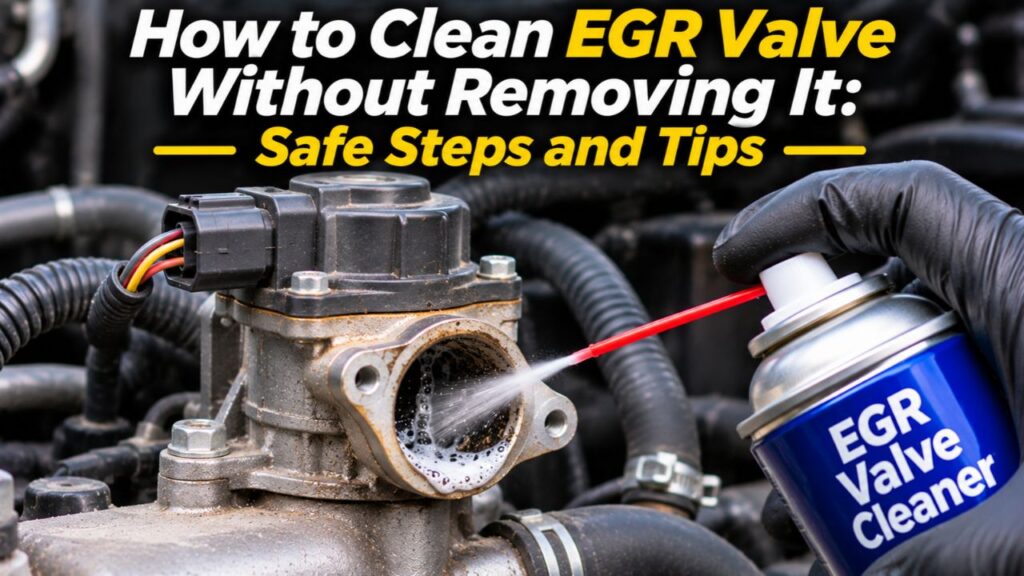
Yes, some EGR systems can receive limited cleaning while the valve remains attached to the engine. Accessible passages may be cleaned directly, and certain vehicles permit specially formulated intake cleaning treatments. These methods work best on light deposits and cannot reliably remove heavy carbon trapped inside the valve.
The EGR valve is part of the engine’s emissions control system.
It redirects a controlled amount of exhaust gas into the intake, helping reduce combustion temperatures and nitrogen oxide (NOx) emissions.
Carbon deposits can interfere with this process.
For example, an EGR valve that cannot close fully may allow too much exhaust gas into the engine during operating conditions when the flow should be reduced.
That can cause rough idling or stalling.
What Can Cleaning Without Removal Actually Accomplish?
Depending on the system design, in-place cleaning may:
- Reduce light deposits in reachable EGR passages.
- Remove dirt around accessible external connections.
- Improve airflow through mildly restricted passages.
- Reduce some carbon-related sticking when the correct treatment reaches the affected area.
It cannot reliably clean hidden surfaces behind a closed valve or repair broken internal parts.
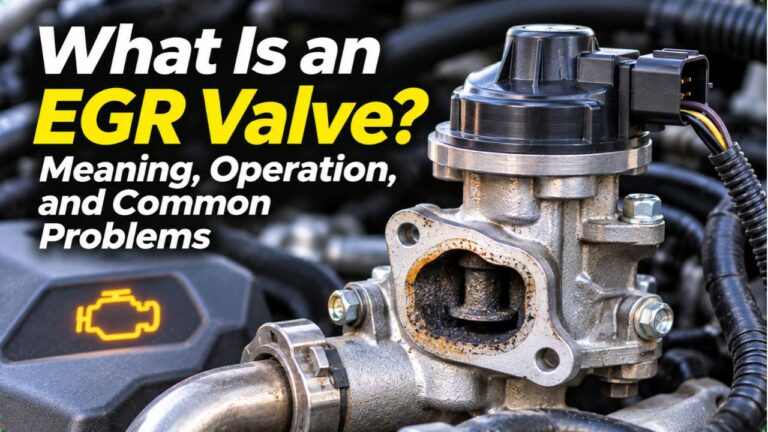
The technical explanation of EGR operation and common faults describes how soot buildup can restrict valve movement and exhaust flow.
The biggest limitation is access. If you cannot reach the affected deposits, spraying more cleaner isn’t a dependable solution.
What Should You Check Before Cleaning the EGR System?
Before cleaning, identify the EGR valve type, check stored engine trouble codes, and inspect the surrounding hoses and electrical connections. Rough idle and hesitation don’t automatically mean carbon buildup. A damaged vacuum hose, faulty sensor, or electronic actuator can produce similar symptoms and won’t be repaired by cleaning.
Identify Your EGR Valve Type
Vehicles commonly use two types of external EGR valves.
| EGR Valve Type | How It Works | Cleaning Consideration |
| Vacuum-operated EGR valve | Engine vacuum moves a diaphragm to operate the valve | Check vacuum hoses and diaphragm condition |
| Electronic EGR valve | An electric motor or solenoid controls valve movement | Protect sensors, motor housing, and electrical connections |
Many diesel engines also use an EGR cooler and additional control components.
The cooler transfers heat away from the recirculated exhaust gas.
These systems can contain several passages where soot collects.
Some engines use internal exhaust gas recirculation through valve timing instead of a separate external EGR valve. There may be no standalone valve to clean.
Read the Trouble Codes First
An OBD-II scanner can help identify EGR-related faults.
| Trouble Code | General Meaning |
| P0400 | Exhaust gas recirculation flow malfunction |
| P0401 | Insufficient EGR flow detected |
| P0402 | Excessive EGR flow detected |
| P0403 | EGR control circuit malfunction |
| P0404 | EGR control circuit range or performance problem |
| P0405 | EGR sensor circuit low input |
For example, P0401 may indicate restricted EGR flow, but it can also involve a sensor or control problem.
A P0403 electrical circuit fault is unlikely to disappear because you sprayed cleaner into the intake.
Don’t replace or clean parts based on a code alone.
What Can You Use to Clean an EGR Valve in Place?
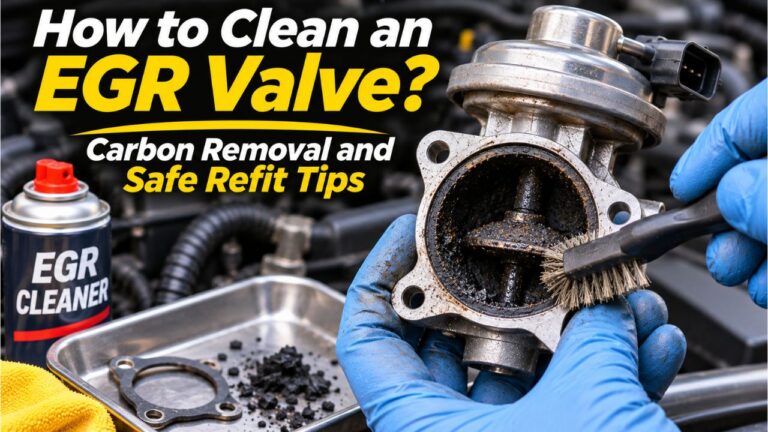
An EGR or intake-system cleaner specifically approved for your vehicle is the most suitable chemical option for in-place treatment. The product must match the engine type and application method. A soft cloth and basic inspection tools can help with accessible surfaces, but harsh household solvents and unapproved sprays should be avoided.
| Cleaning Product or Tool | Suitable Use | Main Limitation |
| Approved EGR cleaning spray | Light deposits in specified EGR or intake passages | May not reach the valve seat |
| Approved intake cleaner | Certain vehicle-specific intake cleaning procedures | Doesn’t guarantee direct EGR cleaning |
| Soft lint-free cloth | Accessible surface dirt | Cannot reach internal passages |
| Soft nylon brush | Approved accessible metal surfaces | Avoid damaging coatings or seals |
| Carburetor cleaner | Only when specified by the manufacturer | Some formulas may damage components |
| Brake cleaner | Not recommended | Material and electronic compatibility concerns |
| Household degreaser | Not recommended | May leave residue or damage materials |
Is EGR Cleaner the Same as Throttle Body Cleaner?
Not necessarily.
Both may remove carbon or oily deposits, but the chemicals and approved applications can differ.
An EGR cleaning product may be formulated for soot-heavy exhaust gas passages.
Throttle body cleaners are designed for deposits around the throttle plate and intake surfaces.
Don’t substitute one for the other unless the product and vehicle instructions permit it.
Can You Use a Fuel Additive?
A fuel additive isn’t a direct replacement for cleaning a blocked EGR valve.
Some products claim to reduce deposits, but adding a chemical to the fuel tank doesn’t reliably dissolve hard carbon attached to an external EGR valve.
For example, if a valve pintle is mechanically stuck because of thick soot, a fuel additive may never reach the affected surface in a useful form.
Buy the correct cleaner for the job rather than relying on a quick fix.
How to Clean an EGR Valve Without Removing It Step by Step
The safest in-place cleaning process begins with checking the vehicle’s service instructions, inspecting the EGR components, and cleaning only the surfaces or passages the manufacturer permits you to access. If an approved chemical treatment is available, follow its exact application procedure. Don’t force the valve or spray unknown solvents into the engine.
Step 1: Park Safely and Allow the Engine to Cool
Park on level ground and apply the parking brake.
Switch the engine off and remove the key or move the key fob away.
Allow the engine and exhaust components to cool fully.
EGR valves carry hot exhaust gases, so the connected metal pipes can remain hot after the engine stops.
Wear safety glasses and gloves.
Work in a well-ventilated area away from ignition sources.
Step 2: Locate the EGR Valve
Open the hood and consult the service information for your exact engine.
On many vehicles, the EGR valve sits near the intake manifold and connects to an exhaust passage or metal pipe.
Look for a component with an electrical connector or vacuum hose, depending on the design.
Some modern engines place the EGR valve behind other components, making access difficult.
Don’t assume every round metal component near the intake is the EGR valve.
Step 3: Inspect the Hoses and Electrical Connections
Before using chemicals, inspect the EGR system for obvious problems.
Check accessible vacuum hoses for cracking, disconnection, or damage.
Look for broken connector clips, damaged wiring, and signs of leakage around the EGR assembly.
For example, a split vacuum hose may prevent a vacuum-operated EGR valve from opening properly.
Cleaning the valve won’t repair that hose.
If you find damaged wiring or a failed actuator, correct that fault before considering carbon cleaning.
Step 4: Check for Accessible EGR Passages
Some engines have removable EGR pipes or service access points that allow cleaning while the valve remains installed.
If the manufacturer’s procedure permits access through one of these openings, you may be able to clean light deposits from reachable surfaces.
Use an approved cleaner and a soft tool suitable for the material.
Keep loosened carbon and solvent out of the intake manifold, cylinders, electrical components, and other sensitive areas.
Do not blindly scrape inside a passage or allow carbon fragments to fall into the engine.
Heads Up: If reaching the carbon requires removing the EGR valve itself, the job is no longer an in-place cleaning procedure. Use the proper removal instructions instead.
Step 5: Use an Approved In-Place Cleaning Treatment
Some EGR cleaning products are designed for treatment through a specified intake access point.
These procedures vary widely by engine.
Some require special adapters, controlled engine operation, or professional equipment.
Before using one, confirm that:
- The product is approved for your gasoline or diesel engine.
- The manufacturer permits the specific cleaning method.
- You know the correct application location.
- The procedure won’t expose sensitive sensors or other components to unsuitable chemicals.
- You have the required equipment and can follow every safety instruction.
Don’t spray cleaner directly into the air filter housing, mass airflow sensor, turbocharger, or an unknown intake opening.
Avoid improvised spraying into a running engine. Excessive solvent can cause uncontrolled engine speed, misfires, or engine damage.
If the approved procedure requires applying chemicals while the engine runs, professional service is the safer choice.
Step 6: Reassemble and Inspect Everything
If you disconnected an approved access pipe or hose, reinstall it according to the service instructions.
Replace any seals or gaskets that the manufacturer requires you to renew.
Check that electrical connectors and vacuum hoses are securely attached.
Remove all tools and cleaning materials from the engine compartment.
Don’t start the engine until the required drying, reassembly, and safety checks are complete.
How Do EGR Cleaning Sprays Work Without Removal?
In-place EGR cleaning sprays use solvents to soften and loosen deposits in areas the chemical can reach. Depending on the product and engine layout, they may help with light contamination in intake passages or parts of the EGR flow path. They cannot reliably dissolve thick deposits throughout the entire valve assembly.
Why Chemical Cleaning Has Limits
Carbon inside an EGR valve isn’t always soft.
Some deposits become hard and tightly attached to the valve seat, shaft, or surrounding passage.
The valve seat is the surface against which the valve closes to stop gas flow.
If carbon prevents that seal from closing, the engine may idle roughly.
A spray entering the intake from another location may never contact that exact area.
That’s the catch with many advertised no-removal treatments.
What About Professional Intake Cleaning?
A qualified technician may use approved equipment to clean certain EGR and intake systems without fully removing the valve.
The process depends on the engine design and cleaning product.
For example, a professional may have access to a specified service port that a vehicle owner cannot easily identify.
Even professional chemical cleaning has limits.
A valve with severe mechanical sticking may still need removal or replacement.
What Are the Signs That an EGR Valve Needs Cleaning?
A dirty EGR valve may cause rough idling, hesitation, stalling, reduced performance, or a check engine light. Deposits can prevent the valve from closing properly or restrict the amount of exhaust gas flowing through the system. These symptoms overlap with other engine faults, so diagnosis should come first.
Common Symptoms
| Symptom | Possible EGR-Related Cause |
| Rough idle | Valve allows too much exhaust flow |
| Engine stalling | Valve stuck open under certain conditions |
| Hesitation | Incorrect EGR flow affecting combustion |
| Check engine light | EGR flow or control fault detected |
| Reduced performance | Restricted passages or incorrect valve operation |
| Increased emissions | EGR system no longer controls flow correctly |
| Diesel engine smoke | Possible EGR or related air-system fault |
For example, a gasoline engine that repeatedly stalls when coming to a stop may have an EGR valve that fails to close when required.
The diagnostic information on carbon-related EGR problems describes how a stuck valve can affect idle quality and engine performance.
Still, a rough idle alone isn’t proof of EGR contamination.
How Can You Tell if the EGR Valve Is Stuck Open or Closed?
An EGR valve stuck open may allow excessive exhaust gas into the intake, often causing rough idle, hesitation, or stalling. A valve stuck closed prevents the intended exhaust recirculation and may produce an insufficient-flow code or increased combustion temperatures under certain conditions. Testing is needed to confirm either fault.
| Condition | Possible Symptoms | Likely Cleaning Result |
| Valve stuck partly open from carbon | Rough idle, stalling, excessive-flow fault | Cleaning may help if deposits are reachable |
| Valve stuck closed from deposits | Insufficient-flow fault, possible knock under some conditions | Deep cleaning may be required |
| EGR passage blocked | Insufficient EGR flow | Accessible passages may be cleaned |
| Electronic actuator failed | Valve-control fault or abnormal position | Cleaning won’t repair the electronics |
| Vacuum control problem | Valve fails to respond correctly | Repair hose or control problem |
Can Driving at Highway Speed Clean the EGR Valve?
Normal engine operation may affect deposit formation, but a highway drive isn’t a reliable way to clean a valve already stuck with carbon.
Some diesel vehicles have operating strategies that manage exhaust aftertreatment temperatures. That doesn’t mean ordinary driving will remove hardened EGR deposits.
Don’t drive aggressively or exceed speed limits hoping to burn off a blockage.
How Do You Know if the EGR Cleaning Worked?
Successful EGR cleaning should be followed by normal engine operation, improved symptoms where carbon was the cause, and diagnostic results showing that the system responds correctly. A smoother idle alone isn’t conclusive. The engine computer may need a specified drive cycle or diagnostic test before confirming that EGR flow has returned to normal.
Check the Engine’s Behavior
After approved cleaning and complete reassembly, start the engine according to the service procedure.
Pay attention to idle quality, hesitation, unusual noises, and warning lights.
For example, if the engine previously stalled at every stoplight and now runs normally, that’s encouraging.
But it doesn’t prove the EGR system meets its operating specifications.
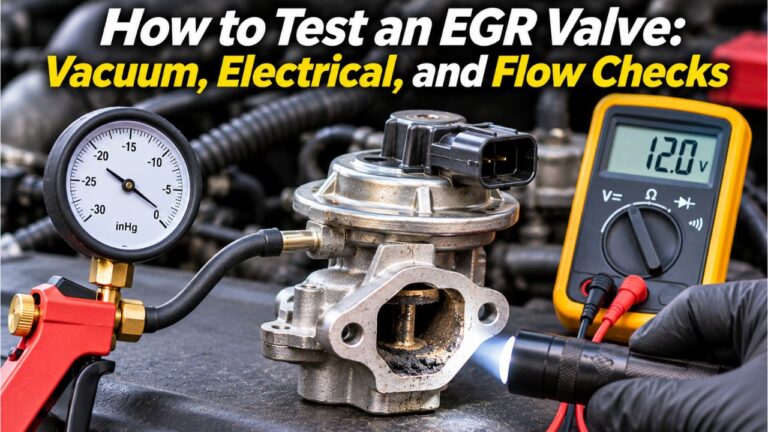
Use a Diagnostic Scanner
Read stored and pending trouble codes.
Some advanced scan tools can command an EGR actuator test or display EGR position and flow-related data.
The available functions depend on the vehicle.
A technician can compare the results with manufacturer specifications to confirm whether the system is working properly.
Don’t clear trouble codes before recording them.
When Should You Remove or Replace the EGR Valve Instead?
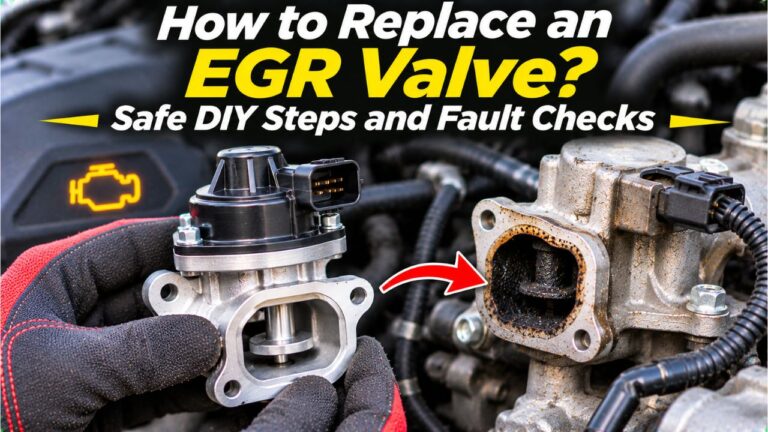
EGR valve removal becomes necessary when carbon deposits are too heavy to reach, the valve remains stuck after approved cleaning, or direct inspection is required. Replacement may be needed for damaged internal parts or failed electronics. Repeated chemical treatments won’t correct a broken actuator, worn valve mechanism, or severe blockage.
Heavy Carbon Buildup
Thick deposits can block the valve seat or connecting passages.
A cleaner applied from the intake side may not reach these areas.
For example, a diesel engine with a heavily restricted EGR passage may need the valve and nearby components removed for thorough cleaning.
Failed Electronic Components
Modern EGR valves may contain motors, position sensors, and internal electrical parts.
If testing confirms an electrical failure, removing soot won’t restore the damaged component.
A correctly matched replacement may be required.
Repeated EGR Trouble Codes
If the same code returns after cleaning, investigate the underlying fault.
The issue might involve a blocked EGR cooler, damaged wiring, incorrect sensor readings, or an intake-system problem.
Repeated spraying without diagnosis can leave you back to square one.
What Mistakes Should You Avoid During EGR Cleaning?
The most serious cleaning mistakes involve spraying unapproved chemicals into a running engine, damaging electrical components, forcing the valve mechanism, or allowing loosened carbon into the intake. These errors can create new engine problems without removing the original blockage. Use only manufacturer-approved access points and cleaning procedures.
Avoid these shortcuts:
- Don’t spray brake cleaner or random solvents into the intake.
- Don’t force an electronic EGR valve open.
- Don’t scrape blindly inside a hidden passage.
- Don’t use compressed air to blow carbon toward the engine.
- Don’t soak electrical connectors or actuator housings.
- Don’t assume an EGR-related trouble code proves the valve is dirty.
- Don’t leave hoses or connectors disconnected after servicing.
Safety Note: EGR is an emissions-control system. Permanently blocking, disconnecting, or disabling it can violate US emissions laws. The vehicle emissions tampering guidance identifies disabling EGR components as an example of prohibited tampering.
Cleaning and restoring the system to proper operation is different from intentionally defeating it.
Frequently Asked Questions
Can You Clean an EGR Valve Without Taking It Off the Engine?
Yes, light deposits may respond to an approved in-place EGR or intake cleaning treatment. Some engines also provide access to EGR passages without removing the valve itself. However, heavy carbon on the valve seat or internal mechanism usually requires direct cleaning after removal.
Can You Spray EGR Cleaner Directly Into the Air Intake?
Only when the cleaning product and vehicle manufacturer specifically permit that procedure. The correct entry point varies by engine, and spraying into the wrong location can damage sensors or other components. Applying cleaner while the engine runs also carries additional risks and may require professional equipment.
Will EGR Cleaner Fix a Stuck Valve?
It may help when light carbon deposits cause sticking and the cleaner reaches the affected surfaces. Thick deposits or mechanical damage usually require removal or replacement. Cleaner cannot repair a failed electrical motor, broken sensor, or defective vacuum diaphragm. Confirm the cause before repeating treatments.
Can You Clean an EGR Valve With WD-40?
Regular WD-40 Multi-Use Product isn’t a suitable substitute for dedicated EGR cleaner. It isn’t designed to remove hardened soot from exhaust gas passages and may leave residue. Use a cleaning product specifically approved for the EGR components and materials involved, following the vehicle manufacturer’s instructions.
How Often Should an EGR Valve Be Cleaned?
There is no universal cleaning interval for every EGR valve. Some vehicles operate for many miles without needing the valve cleaned, while others develop deposits earlier. Engine design, driving conditions, and mechanical condition affect buildup. Follow the manufacturer’s maintenance guidance and clean only when inspection or diagnosis supports it.
Can a Dirty EGR Valve Cause a Check Engine Light?
Yes. Restricted EGR passages, excessive flow, or a valve that doesn’t respond correctly can trigger diagnostic trouble codes and illuminate the check engine light. Common examples include P0401 and P0402. However, wiring faults, sensors, and control problems can produce EGR-related codes without carbon being the main cause.
What to Do After Cleaning Your EGR Valve in Place
Cleaning an EGR valve without removal can be useful when deposits are light and the engine has a manufacturer-approved cleaning method. It may reduce contamination in accessible passages and improve operation when carbon buildup is responsible.
But chemical cleaning has limits. A heavily blocked valve, damaged actuator, or faulty sensor won’t necessarily respond to spray treatments. Repeatedly applying cleaner without diagnosing the cause can waste money and create additional problems.
Start with a trouble-code scan and a careful inspection of the EGR hoses, connectors, and accessible passages. Use only cleaning products approved for your engine. Protect electronic components and avoid spraying chemicals into a running engine without the correct professional procedure.
If cleaning doesn’t restore normal operation, the valve may need removal for direct inspection or replacement.
Your next step is to identify the EGR valve design and approved service procedure for your exact vehicle before applying any cleaner.