Testing Fuel Injectors Fast: Quick Diagnostic Guide
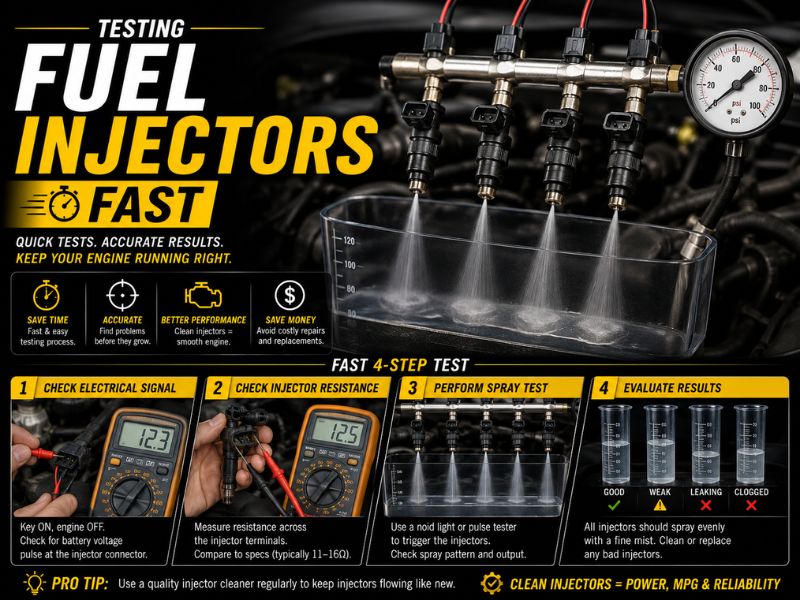
To test fuel injectors quickly, start by listening for consistent injector clicking, check the electrical connector and injector pulse, compare injector resistance where applicable, and use scan data or a fuel-pressure balance test if you need to confirm whether an injector is clogged, leaking, or not flowing correctly.
Fuel-injector problems can cause rough idle, hesitation, misfires, hard starting, poor acceleration, and excessive fuel consumption. However, those symptoms do not automatically mean an injector is bad. Ignition problems, vacuum leaks, compression loss, fuel-pressure issues, and wiring faults can produce very similar symptoms.
The fastest reliable diagnosis comes from combining several simple tests rather than replacing an injector based on one trouble code or one symptom.
Common Signs of a Bad Fuel Injector
A failing or restricted injector may cause:
- Rough idle
- Cylinder misfire
- Hesitation
- Hard starting
- Poor acceleration
- Uneven engine operation
- Fuel smell
- Increased fuel consumption
- Check-engine light
- Rich or lean running
You may also notice that one cylinder behaves differently from the others.
However, the same symptoms can be caused by:
- Bad spark plug
- Weak ignition coil
- Vacuum leak
- Low compression
- Fuel-pressure problem
- Sensor fault
Injector symptoms should lead to testing, not immediate replacement.
What Can Go Wrong With a Fuel Injector?
Fuel injectors can fail electrically or mechanically.
Electrical Failure
Possible electrical problems include:
- Open injector coil
- Shorted coil
- Corroded connector
- Broken wiring
- Missing power supply
- Missing ECU control pulse
An injector with an electrical failure may not open at all.
Mechanical or Flow Failure
An injector can also have a mechanical problem while its electrical circuit appears normal.
Possible issues include:
- Clogged nozzle
- Restricted fuel flow
- Stuck injector
- Poor spray pattern
- Internal leak
- Injector stuck partially open
This distinction is important because an injector can click and show normal resistance while still delivering the wrong amount of fuel.
What You Need to Test Fuel Injectors
Depending on how far you want to diagnose the problem, useful tools include:
- Mechanic’s stethoscope
- Long screwdriver for basic listening
- Digital multimeter
- Noid light
- Scan tool
- Fuel-pressure gauge
- Injector balance-test equipment
Advanced testing may use:
- Oscilloscope
- Current probe
- Professional injector flow bench
Start with the simplest tests first.
Safety Before Testing Fuel Injectors
Fuel systems require extra caution.
Before working:
- Keep sparks and open flames away
- Work in a ventilated area
- Keep loose clothing away from belts and fans
- Avoid touching hot exhaust components
- Relieve fuel pressure before opening a pressurized fuel system
- Clean spilled fuel promptly and safely
Modern gasoline direct-injection and common-rail diesel systems can operate at extremely high pressure.
Do not loosen high-pressure fuel lines simply to check whether fuel is present.
Those systems require vehicle-specific procedures and specialized equipment.
Fast Test #1: Listen for Injector Clicking
One of the quickest injector checks is simply listening to each injector while the engine is running.
A mechanic’s stethoscope works best.
Place the probe against the injector body and listen for a regular clicking sound.
Compare each injector.
What a Normal Injector Sounds Like
A functioning injector commonly produces a consistent rhythmic click as it opens and closes.
If all injectors sound similar except one, that cylinder deserves closer inspection.
What a Silent Injector Can Mean
A silent injector may indicate:
- Failed injector coil
- Stuck injector
- No electrical power
- Missing ECU command
- Wiring problem
However, silence alone does not prove the injector itself is bad.
Important Limitation
A clicking injector can still be clogged or leaking.
The click only tells you that mechanical movement or electrical actuation appears to be occurring. It does not confirm the correct amount of fuel is being delivered.
Can You Test an Injector With a Screwdriver?
Yes, as a simple listening method.
Place the metal tip of a long screwdriver carefully against the injector body and hold the handle near your ear.
You may hear the injector clicking through the screwdriver.
Compare several injectors rather than judging one by itself.
Be extremely careful around:
- Serpentine belts
- Cooling fans
- Pulleys
- Moving linkages
A mechanic’s stethoscope provides better control, but the screwdriver method can be useful for a quick comparison.
Fast Test #2: Inspect the Injector Connector
Before replacing anything, look closely at the electrical connector.
Check for:
- Loose connector
- Broken locking tab
- Bent terminals
- Corrosion
- Damaged insulation
- Pulled or broken wires
A perfectly good injector can stop working if its connector is loose or damaged.
If the problem began after recent repair work, connector seating should be one of the first things you inspect.
Fast Test #3: Check Injector Pulse With a Noid Light
A noid light can help determine whether the injector connector is receiving an electrical control signal.
The basic process is:
- Turn the engine off.
- Disconnect the injector connector.
- Plug in the correct noid light.
- Crank or run the engine as appropriate.
- Watch for flashing.
If the Noid Light Flashes
A flashing noid light indicates that an injector-control signal is reaching the connector.
If the injector remains inactive despite a proper command, the injector itself becomes a stronger suspect.
If the Noid Light Does Not Flash
Possible causes include:
- Wiring fault
- Missing injector power
- ECU driver problem
- Crank/cam synchronization issue
- Other engine-management fault
A noid light confirms command activity, but it still does not prove fuel flow.
Fast Test #4: Measure Injector Resistance
On injector types where resistance testing is appropriate, a multimeter can check the electrical coil.
With the ignition off:
- Disconnect the injector.
- Set the multimeter to resistance.
- Measure across the injector terminals.
- Compare the reading with specifications or equivalent injectors.
Possible Results
An open-circuit reading can indicate a broken injector coil.
A resistance reading very different from the other matching injectors can also indicate an electrical problem.
However, there is no universal resistance value for all fuel injectors.
Different injector designs use different electrical characteristics.
Use the specification for the exact injector or vehicle.
Why Comparing Injectors Helps
If all injectors are the same design, comparing them can reveal an abnormal unit.
You can compare:
- Clicking sound
- Resistance
- Scan-tool data
- Injector balance results
For example, if five injectors measure similarly and one is dramatically different, that one deserves investigation.
Still, matching resistance does not prove matching fuel flow.
Fast Test #5: Check Scan-Tool Misfire Data
A scan tool can significantly speed up injector diagnosis.
Look for:
- Cylinder-specific misfire counters
- Injector circuit codes
- Rich or lean codes
- Fuel trims
- Cylinder contribution information
A code such as a cylinder misfire tells you where the problem is occurring, but not necessarily why.
The cause could still be:
- Injector
- Coil
- Spark plug
- Compression
- Vacuum leak
Treat trouble codes as diagnostic clues rather than replacement instructions.
Can Fuel Trims Help Diagnose an Injector?
Yes, but indirectly.
Fuel trims show how much the engine computer is adjusting fueling based on feedback.
A restricted injector may contribute to a lean condition.
A leaking injector may contribute to a rich condition.
However, fuel trims are also affected by:
- Vacuum leaks
- MAF sensor problems
- Fuel-pressure faults
- Exhaust leaks
- Multiple injector problems
Use fuel trims as supporting evidence rather than proof of one bad injector.
Fast Test #6: Perform a Cylinder Contribution Test
Some scan tools can disable or compare cylinders electronically.
A cylinder that contributes very little when compared with the others is clearly weak.
However, the test still does not tell you whether the weakness comes from:
- Fuel
- Spark
- Compression
Use the result to identify the problem cylinder, then continue testing.
Fast Test #7: Perform an Injector Balance Test
A fuel-injector balance test is one of the more useful ways to evaluate actual fuel delivery.
The basic concept is simple:
- Fuel pressure is established.
- Each injector is commanded for the same controlled amount of time.
- The resulting fuel-pressure drop is measured.
- The drops are compared.
Similar Pressure Drops
If all injectors create similar pressure drops, their flow is likely reasonably balanced.
Smaller Pressure Drop
One injector producing significantly less pressure drop may be restricted.
Abnormal Larger Drop
An injector producing a noticeably different larger drop may be delivering excessive fuel, depending on the test design.
The exact procedure varies by vehicle.
Only perform this test on a system where the method is supported and where the fuel-pressure procedure is understood.
Can You Test an Injector by Unplugging It?
A traditional quick test is to disconnect one injector at a time while the engine idles.
If unplugging an injector causes a noticeable RPM drop, that cylinder was contributing.
If disconnecting one injector produces little or no change, that cylinder may already be weak.
However, this does not prove the injector itself is bad.
A weak cylinder could have:
- Bad spark plug
- Bad coil
- Low compression
- Injector problem
Disconnecting injectors can also set trouble codes or cause undesirable behavior on some vehicles.
A scan-tool cylinder contribution test is preferable when available.
How to Tell a Clogged Injector From a Dead Injector
A clogged injector often behaves differently from one with an electrical failure.
Possible Clogged Injector
You may find:
- Normal clicking
- Normal resistance
- Injector pulse present
- Weak or lean cylinder
- Reduced pressure drop during balance testing
This suggests the injector is operating electrically but not flowing correctly.
Possible Electrically Dead Injector
You may find:
- No click
- Open or abnormal resistance
- Proper command present at connector
- Cylinder not contributing
That makes the injector itself a stronger suspect.
Possible Wiring or Control Failure
If the injector tests normally but no command reaches the connector, focus on:
- Wiring
- Power supply
- ECU control
before replacing the injector.
How to Tell if a Fuel Injector Is Leaking
A leaking injector may allow fuel into a cylinder when it should be closed.
Possible clues include:
- Fuel smell
- Rich misfire
- Hard hot starting
- Wet or fuel-fouled spark plug
- Excessive fuel consumption
- Fuel pressure dropping after shutdown
However, falling fuel pressure after shutdown can have other causes, including:
- Fuel-pump check valve
- Pressure regulator
- Another leaking injector
Further testing may be necessary before identifying the exact leak source.
Can You Test Fuel Injectors With a Multimeter Only?
Only partially.
A multimeter can help test:
- Injector resistance
- Electrical power
- Some circuit voltage problems
It cannot directly confirm:
- Correct spray pattern
- Actual fuel volume
- Atomization quality
- Mechanical leakage in every condition
An injector can pass electrical testing and still have a mechanical fuel-flow problem.
How to Check Injector Power
Many conventional port-fuel-injection systems provide electrical power to one side of the injector while the ECU controls the other side.
However, circuit designs vary significantly.
Direct-injection systems can be especially different.
Use:
- Correct wiring diagram
- Appropriate meter
- Vehicle-specific test procedure
Do not randomly probe injector-driver circuits without knowing how the system is designed.
Can You Use a Regular Test Light?
Sometimes a conventional test light can be used for basic power-supply checks on appropriate circuits.
However, it is not a universal substitute for a noid light or oscilloscope.
Some ECU-controlled circuits are sensitive to loading.
A noid light is specifically designed to indicate injector pulse, while an oscilloscope provides much more detailed information.
Using an Oscilloscope for Injector Testing
An oscilloscope is an advanced but powerful diagnostic tool.
It can display:
- Injector command waveform
- Voltage changes
- Current ramp
- Coil behavior
- Electrical abnormalities
Comparing waveforms between cylinders can help identify subtle or intermittent faults that simpler tools may miss.
For most basic DIY diagnosis, however, a stethoscope, multimeter, noid light, and scan tool are usually enough to narrow down the problem.
Port Injection vs. Direct Injection
Not all gasoline injectors should be tested the same way.
Port Fuel Injection
Port injectors are often relatively accessible and may be suitable for:
- Listening tests
- Resistance checks
- Noid-light testing
- Balance testing
Gasoline Direct Injection
GDI systems can use:
- Much higher fuel pressure
- Specialized injectors
- High-pressure pumps
- Different electrical drivers
Do not assume a test procedure intended for a conventional port injector is safe or meaningful on a GDI system.
Diesel Fuel Injector Testing
Common-rail diesel systems require even more caution.
Diesel diagnosis may involve:
- Scan-tool correction values
- Injector return-flow testing
- Leak-off testing
- Specialized electrical analysis
The fuel rail can operate at extremely high pressure.
Never loosen a common-rail diesel injector line simply to see whether fuel is coming out.
Professional diagnosis is appropriate when high-pressure system testing is required.
Should You Clean or Replace a Bad Injector?
That depends on the failure.
Cleaning May Help When:
- Injector is restricted
- Deposits are affecting flow
- Electrical operation is normal
- Injector is mechanically intact
Replacement Is More Appropriate When:
- Coil is open
- Electrical winding is damaged
- Injector leaks internally
- Housing is physically damaged
- Cleaning does not restore flow
Cleaning cannot repair an electrically failed injector.
Can Fuel Injector Cleaner Fix a Bad Injector?
Fuel-injector cleaner may help some mild deposit-related restrictions.
It cannot repair:
- Broken coil
- Damaged connector
- Cracked injector
- Shorted winding
- Failed ECU driver
- Mechanical breakage
Do not use bottled cleaner as proof that an injector diagnosis is complete.
If one cylinder is consistently misfiring, test the system rather than repeatedly adding cleaner.
Quick Fuel Injector Diagnosis
| Test Result | Possible Meaning |
| Injector clicks normally | Actuating, but fuel flow still unconfirmed |
| One injector is silent | Injector, wiring, power, or control problem |
| Noid light flashes | Injector command is reaching connector |
| No noid-light pulse | Wiring, power, ECU, or synchronization issue |
| Open resistance reading | Possible failed injector coil |
| Electrical tests normal but cylinder weak | Flow restriction or non-injector problem |
| Smaller balance-test pressure drop | Possible restricted injector |
| Rich cylinder and fuel smell | Possible leaking injector |
Common Fuel Injector Testing Mistakes
Avoid these mistakes:
- Replacing an injector based only on a misfire code
- Assuming clicking means the injector is good
- Assuming silence means the injector itself failed
- Using one resistance specification for every injector
- Ignoring connector corrosion
- Ignoring fuel-pressure problems
- Ignoring spark and compression
- Probing ECU circuits carelessly
- Opening pressurized GDI fuel lines
- Loosening common-rail diesel lines
- Assuming injector cleaner repairs electrical failure
Frequently Asked Questions
How Do You Test Fuel Injectors Fast?
Start by listening for injector clicking, inspect the connector, test injector pulse, compare electrical resistance where applicable, and then use scan data or a balance test if more confirmation is needed.
How Can You Tell if a Fuel Injector Is Bad?
A bad injector may have abnormal resistance, no mechanical clicking despite proper command, incorrect fuel flow, leakage, or cylinder-specific performance problems.
Should Fuel Injectors Make a Clicking Sound?
Many conventional injectors produce a regular clicking sound while operating.
Can an Injector Click and Still Be Bad?
Yes. A clogged or leaking injector can still click normally.
How Do You Test a Fuel Injector With a Multimeter?
Disconnect it according to the appropriate procedure and measure coil resistance where resistance testing is applicable. Compare the result with the correct specification.
What Resistance Should a Fuel Injector Have?
There is no universal resistance. Use the specification for the exact injector or vehicle.
How Do You Test Injector Pulse?
A suitable noid light or oscilloscope can be connected to the injector circuit according to the correct test procedure to verify command activity.
Can You Test Fuel Injectors With a Noid Light?
Yes. A noid light can show whether an injector control pulse is reaching the connector, but it cannot confirm actual fuel flow.
How Do You Tell if an Injector Is Clogged?
A clogged injector may click and test electrically normal but show weak cylinder performance or reduced flow during an injector balance test.
How Do You Know if a Fuel Injector Is Leaking?
Possible clues include fuel smell, rich misfire, wet spark plug, hard hot starting, and abnormal pressure loss after shutdown.
Can Fuel Injector Cleaner Fix a Bad Injector?
It may help mild deposit-related restriction, but it cannot repair electrical or physical injector failure.
Can You Test GDI or Diesel Injectors the Same Way?
No. Direct-injection gasoline and common-rail diesel systems use different pressures, drivers, and procedures and require additional caution.
Conclusion
Testing fuel injectors fast starts with simple comparisons: listen for injector operation, inspect the connector, check for injector pulse, and compare electrical resistance where the injector design allows it. If those checks look normal but the cylinder still has a fueling problem, move to scan data or an injector balance test.
The biggest mistake is trusting one test. A clicking injector can still be clogged, and a silent injector may be perfectly functional if its power or ECU command is missing.
Electrical testing and flow testing answer different questions. Resistance and noid-light checks help determine whether the injector circuit is functioning, while balance testing provides stronger evidence about actual fuel delivery.
Always rule out ignition and compression problems before condemning an injector based solely on a misfire.
Direct-injection gasoline and common-rail diesel systems deserve additional caution because their high-pressure fuel systems are fundamentally different from conventional port injection.
The fastest reliable injector diagnosis comes from combining tests rather than trusting one symptom. Confirm the injector is being commanded, verify its electrical condition, and then evaluate actual fuel delivery before replacing it.