What Size Throttle Body Is on a 5.7 HEMI? Stock Size and Fit
The stock throttle body on most 5.7 HEMI engines measures 80mm, or approximately 3.15 inches, in bore diameter. This size is common across factory-equipped Dodge, Ram, Chrysler, and Jeep vehicles with the 5.7L HEMI V8. The measurement refers to the main airflow opening, not the outside diameter of the throttle body housing.
An 80mm throttle body allows the engine to receive the airflow it needs during normal operation. Chrysler designed the factory electronic throttle system to work with the engine’s intake manifold, computer controls, and operating requirements.
If you’re planning a replacement or performance upgrade, the size matters. Aftermarket throttle bodies commonly come in 85mm, 90mm, and larger configurations, but installing a bigger unit doesn’t automatically produce more horsepower.
The right choice depends on your vehicle’s model year, intake design, and engine modifications. This guide covers factory throttle body sizes, differences between HEMI applications, measurement methods, upgrade options, and the fitment details you should check before purchasing a replacement.
What Is the Stock Throttle Body Size on a 5.7 HEMI?
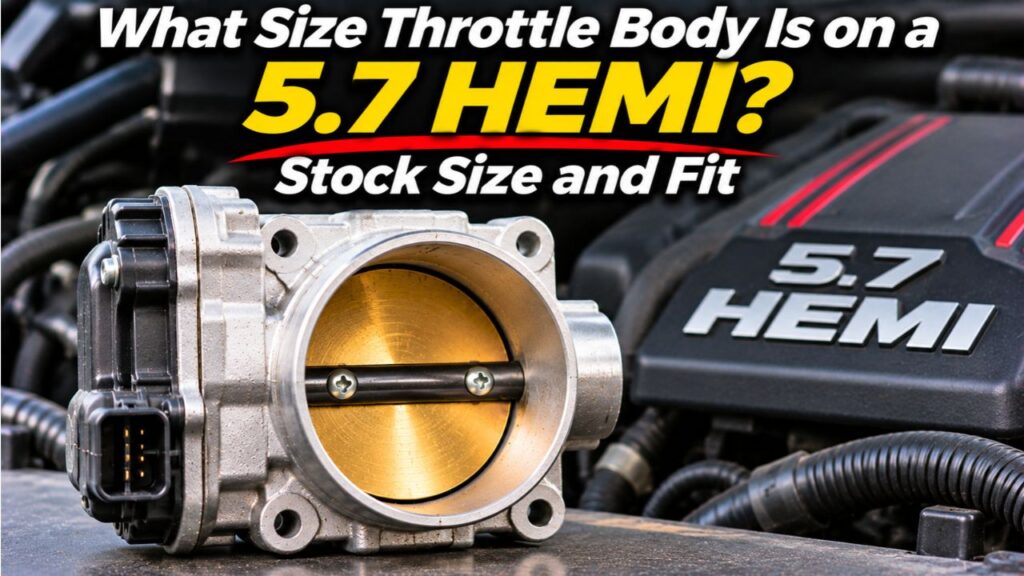
The factory throttle body on most naturally aspirated 5.7L HEMI V8 engines has an 80mm bore diameter, approximately 3.15 inches. This applies to many Dodge Charger, Challenger, Ram 1500, Chrysler 300, and Jeep applications. Exact replacement parts and mounting details can differ by model year.
The third-generation HEMI uses an electronically controlled throttle body rather than a traditional accelerator cable.
Its throttle plate opens and closes through an electric motor commanded by the engine computer.
The Gen III HEMI engine specifications identify the factory throttle body diameter as 80mm for naturally aspirated 5.7L applications.
What Does 80mm Mean?
The 80mm measurement describes the diameter of the throttle body’s main airflow passage at the specified measuring location.
Inside the opening, a round metal throttle plate regulates airflow into the intake manifold.
When the plate opens, air passes through the throttle body toward the engine cylinders.
An 80mm bore is approximately 3.15 inches across.
The outside housing is larger because it contains the plate shaft, actuator motor, electronic components, and mounting flange.
For example, measuring the outside of the throttle body with a tape measure won’t tell you its actual airflow diameter.
The correct measurement is the internal bore, not the external housing size.
Do All 5.7 HEMI Engines Use the Same Throttle Body?
Most factory 5.7 HEMI engines use an approximately 80mm throttle body, but that doesn’t mean every vehicle uses an interchangeable assembly. Different model years can have different electronic connectors, housings, mounting arrangements, and factory part numbers. The engine’s displacement alone cannot confirm replacement compatibility.
Factory Throttle Body Size by Vehicle
| Vehicle with 5.7 HEMI | Common factory bore | Throttle control |
| Ram 1500 | 80mm | Electronic |
| Dodge Charger R/T | 80mm | Electronic |
| Dodge Challenger R/T | 80mm | Electronic |
| Chrysler 300 5.7L | 80mm | Electronic |
| Jeep Grand Cherokee 5.7L | 80mm | Electronic |
| Dodge Durango 5.7L | 80mm | Electronic |
These are common factory configurations, not a guarantee for every production year or previously modified vehicle.
Does the Model Year Make a Difference?
Yes. The 5.7 HEMI went through engine and intake-system revisions during its production history.
Early third-generation HEMI engines used different intake manifold arrangements from later versions.
The 2009 model year introduced significant revisions to the 5.7L HEMI engine family, including variable valve timing in applicable vehicles.
Although the commonly listed throttle bore remained 80mm, the engine revisions and later parts updates affected component compatibility.
For example, a throttle body removed from an older Ram 1500 shouldn’t be assumed to fit a newer Charger simply because both engines measure 5.7 liters.
The practical rule of thumb is to match the factory part number, not just the bore diameter.
Where Is the Throttle Body Located on a 5.7 HEMI?
The throttle body sits at the entrance to the intake manifold, where it controls air entering the 5.7 HEMI engine. Its exact position depends on the vehicle’s intake arrangement. Some truck installations have a more upright configuration, while many passenger cars use a forward-facing throttle opening.
You can usually identify the throttle body by following the large air intake tube from the air filter housing toward the engine.
The throttle body is connected at the intake manifold entrance.
You’ll normally find an electrical connector attached to its housing.
How to Identify the Factory Unit
Check these features:
- Aluminum throttle body housing.
- Round internal throttle plate.
- Electrical connector for the electronic throttle control system.
- Mounting flange attached to the intake manifold.
- Large intake tube connected to the inlet.
For instance, on a typical 5.7 HEMI-powered Ram, the intake tube leads directly toward the throttle body near the upper portion of the engine.
The factory unit uses electronic throttle control, sometimes called drive-by-wire.
That means the accelerator pedal sends an electrical request to the engine computer rather than pulling a mechanical throttle cable.
Don’t disconnect or force the throttle plate while the ignition is active. Electronic throttle mechanisms can move unexpectedly.
How Do You Measure a 5.7 HEMI Throttle Body?
You can check a 5.7 HEMI throttle body’s bore size using a digital caliper or an accurate inside-diameter measuring tool. Measure the internal airflow passage at the manufacturer’s specified location, not the outer flange. The throttle body may have a tapered opening, so measurements can differ depending on where you place the tool.
Step 1: Turn Off the Engine
Park on level ground and apply the parking brake.
Switch the ignition completely OFF.
Allow the engine and intake components to cool before working around them.
If the vehicle’s service instructions require additional electrical precautions, follow those steps.
Step 2: Locate the Throttle Body
Follow the intake tube from the air filter housing to the throttle body.
You may need to remove the intake tube to access the opening.
Loosen the appropriate clamp and disconnect the tube according to the service procedure.
Avoid damaging any sensors, hoses, or wiring attached to the intake assembly.
Step 3: Measure the Internal Bore
Use a digital caliper suitable for measuring internal diameters.
Place the measuring jaws against opposite sides of the appropriate bore surface.
Don’t force the caliper against the throttle plate or internal shaft.
The factory 80mm bore should measure close to 3.15 inches at its nominal measuring location.
An aftermarket throttle body may have a larger inlet, tapered passage, or modified throttle plate.
That’s why a measurement taken only at the front opening may not match its advertised bore size.
Step 4: Check the Part Number
Look for identifying numbers on the throttle body housing.
Use those numbers to confirm the intended application in the manufacturer’s parts catalog.
A factory throttle body parts listing identifies part number 53034251AD for certain 5.7L HEMI applications.
That number is an example, not the correct part for every model year.
If your vehicle has been modified, check both its original equipment information and the installed component.
What Size Aftermarket Throttle Body Can You Put on a 5.7 HEMI?
Common aftermarket throttle body sizes for the 5.7 HEMI include 85mm, 90mm, and larger performance designs. The correct choice depends on the intake manifold opening, electronic compatibility, and engine modifications. A larger bore can provide more potential airflow, but it won’t necessarily increase power on a stock engine.
80mm vs. 85mm vs. 90mm Throttle Bodies
| Throttle body size | Approximate diameter | General application |
| 80mm | 3.15 inches | Common factory size |
| 85mm | 3.35 inches | Mild performance upgrade |
| 90mm | 3.54 inches | Performance-oriented applications |
| 92mm | 3.62 inches | Selected modified engine setups |
| 95mm | 3.74 inches | More extensive performance builds |
These are nominal aftermarket size categories. Actual fitment and internal bore designs vary by manufacturer.
Is an 85mm Throttle Body Worth It?
An 85mm throttle body offers a modest increase in bore diameter compared with the factory 80mm unit.
It may suit an engine that has intake or other airflow improvements.
On a completely stock 5.7 HEMI, the improvement may be small or difficult to notice.
A larger opening alone doesn’t mean the engine will use more air.
The intake manifold, cylinder heads, camshaft, and engine speed also affect airflow demand.
What About a 90mm Throttle Body?
A 90mm throttle body has a larger opening than the factory unit.
It may become more useful when the engine has modifications that increase airflow requirements.
For example, a modified HEMI with suitable intake changes and a performance camshaft may benefit more from additional throttle capacity than an otherwise stock daily driver.
The performance intake manifold specifications identify factory-style 80mm throttle body compatibility and larger performance throttle options for certain HEMI intake applications.
But don’t assume a 90mm replacement bolts directly onto every factory manifold.
Electronic compatibility and physical mounting still need confirmation.
Does a Bigger Throttle Body Increase Horsepower on a 5.7 HEMI?
A larger throttle body can increase available airflow when the original unit restricts an engine’s demand, but it doesn’t guarantee more horsepower. A mostly stock 5.7 HEMI may gain little from a larger bore. Modified engines that require greater airflow may respond better when the intake system and calibration are matched.
Why Bigger Isn’t Always Better
The throttle body is only one part of the engine’s intake system.
Air must also pass through the intake manifold and cylinder head ports before entering the combustion chambers.
If those components already limit airflow, installing a bigger throttle body may accomplish very little.
Think of replacing a short section of a narrow pipe with a larger pipe while leaving the rest of the system unchanged.
The larger section doesn’t remove restrictions farther along the path.
The same principle applies to engine airflow.
What Performance Changes Might You Notice?
Depending on the vehicle and modifications, a larger throttle body may affect:
- Throttle response.
- Airflow capacity at wide-open throttle.
- High-RPM engine performance.
- Accelerator pedal feel.
- Idle and low-speed drivability.
A more sensitive accelerator response doesn’t necessarily mean the engine makes more horsepower.
Some aftermarket throttle bodies change airflow characteristics at smaller openings, which can make the pedal feel more aggressive.
That’s a different result from a measured increase in engine output.
For a stock daily driver, keeping the correctly functioning 80mm throttle body is often the sensible choice.
Will a 90mm Throttle Body Fit a Stock 5.7 HEMI Intake?
Some 90mm aftermarket throttle bodies are designed for stock 5.7 HEMI intake manifolds, but others require additional parts or modifications. A matching bolt pattern alone doesn’t guarantee fit. You must check flange dimensions, bore clearance, electronic connectors, throttle control compatibility, and available space around the intake.
What Should You Check Before Buying?
Use this fitment checklist:
- Vehicle application: Confirm the exact year, model, and engine.
- Mounting flange: Check bolt-hole spacing and gasket requirements.
- Intake opening: Confirm enough clearance for the larger throttle plate.
- Electrical connector: Match the throttle actuator and wiring specifications.
- Intake tube: Check whether the existing tube fits the new inlet.
- Computer calibration: Confirm whether the manufacturer requires tuning or relearn procedures.
- Emissions requirements: Verify that the part is approved for your vehicle’s intended road use.
One common mistake is buying a throttle body advertised for a 5.7 HEMI without checking the model year.
Two assemblies may have the same nominal diameter but different electronic control requirements.
Another issue is the intake manifold itself.
A larger throttle plate needs enough room to move through its intended range without contacting the manifold opening.
Never grind or modify a throttle mounting surface without an approved installation procedure.
Incorrect modifications can create air leaks, throttle sticking, or electronic control faults.
Should You Keep the Stock Throttle Body or Upgrade?
Keeping the factory 80mm throttle body is usually reasonable for a stock 5.7 HEMI that runs properly. A larger aftermarket unit makes more sense when a specific engine modification requires increased airflow and the replacement has confirmed fitment. Replacement decisions should reflect actual engine needs rather than bore diameter alone.
| Your situation | Practical recommendation |
| Stock engine, no problems | Keep the factory 80mm unit |
| Dirty factory throttle body | Inspect and clean if permitted |
| Failed factory throttle body | Install a compatible OE-spec replacement |
| Mild intake modifications | Evaluate whether an 85mm upgrade offers a measurable benefit |
| More extensive engine modifications | Consider a properly matched larger unit |
| Supercharged or custom engine build | Choose size according to airflow requirements and tuning |
When Replacement Is Better Than an Upgrade
If your throttle body is causing rough idle, hesitation, or an electronic throttle warning, diagnose the fault before choosing an oversized replacement.
Carbon buildup around the throttle plate may be responsible.
Cleaning can help when deposits interfere with plate movement or idle airflow, provided the manufacturer permits cleaning.
A failed internal motor or non-serviceable position sensor may require replacing the complete assembly.
Installing a larger throttle body won’t automatically repair a wiring problem.
Will a New Throttle Body Need a Relearn?
Some 5.7 HEMI applications may require a manufacturer-specified throttle or idle relearn after replacement or related service.
The procedure depends on the vehicle and electronic control system.
Don’t follow a random accelerator-pedal sequence without checking the correct service instructions.
An incorrect setup can cause idle problems or throttle-related warning codes.
Cutting corners during installation can leave you back to square one.
Frequently Asked Questions
What Size Throttle Body Is on a 2019 Ram 1500 5.7 HEMI?
The factory throttle body on a typical 2019 Ram 1500 with the 5.7L HEMI has an approximately 80mm bore. The correct replacement assembly depends on the vehicle’s exact configuration. Confirm the factory part number using its VIN before purchasing, especially because Ram offered different vehicle and engine configurations.
What Size Throttle Body Is on a Dodge Charger 5.7 HEMI?
Most factory Dodge Charger models equipped with the 5.7L HEMI use an 80mm electronic throttle body. The bore size is common across several model years, but replacement part numbers and electronic connections may differ. Check the specific year and engine application before ordering a replacement or performance upgrade.
Is an 85mm Throttle Body Better Than an 80mm on a 5.7 HEMI?
An 85mm throttle body offers a larger airflow opening than an 80mm unit, but it isn’t automatically better for every 5.7 HEMI. A stock engine may show little measurable improvement. Engines with airflow-related modifications may benefit more, depending on the intake setup and actual restrictions.
Can You Put a 92mm Throttle Body on a 5.7 HEMI?
A 92mm throttle body can be used on certain modified 5.7 HEMI engines when the intake manifold, mounting arrangement, and electronic controls support it. It isn’t a universal direct replacement for the factory 80mm unit. Some installations require different hardware, intake modifications, or engine calibration.
Does a 5.7 HEMI Have an Electronic Throttle Body?
Yes. Factory third-generation 5.7L HEMI applications use electronic throttle control, also called drive-by-wire. An electric actuator moves the throttle plate based on commands from the engine computer. The accelerator pedal uses electronic sensors rather than a traditional mechanical throttle cable to request engine power.
Can a Bigger Throttle Body Hurt Performance?
An incorrectly sized or incompatible throttle body can cause poor throttle response, unstable idle, or electronic control faults. A larger bore doesn’t automatically improve power if the engine cannot use the extra airflow. Proper physical fitment, control compatibility, and calibration matter more than choosing the biggest available opening.
Choose the Right Throttle Body for Your 5.7 HEMI
The factory throttle body on most 5.7 HEMI engines measures 80mm, approximately 3.15 inches. This is the common stock bore size across many Ram, Dodge, Chrysler, and Jeep applications.
Although the diameter is similar across these vehicles, throttle bodies aren’t always interchangeable. Model-year changes, electrical connectors, mounting designs, and factory part numbers can affect fitment.
For a stock 5.7 HEMI that runs properly, the original 80mm throttle body is generally a sensible choice. Larger 85mm or 90mm units may suit modified engines, but they don’t guarantee horsepower gains by themselves.
If you’re replacing a damaged throttle body, focus on matching the correct factory specifications rather than automatically moving to a larger size.
Your next step is to check the vehicle’s year, model, and original throttle body part number. Those details will help you choose a compatible replacement or determine whether a performance upgrade is worthwhile.