Are MagnaFlow Catalytic Converters Good? Quality, Fit, and Value
Yes. MagnaFlow is generally a solid aftermarket catalytic converter brand, especially if you choose the exact converter grade and vehicle application required for your emissions system. Its better models use stainless-steel construction, vehicle-specific O2 sensor locations, and EPA- or CARB-compliant designs, making MagnaFlow a strong alternative when an original-equipment converter is too expensive or unavailable.
That does not mean every MagnaFlow converter is equal to the factory catalyst. MagnaFlow sells Standard Grade, HM Grade, OEM Grade, CARB-compliant, direct-fit, and universal converters. Choosing the wrong grade can lead to fitment trouble, catalyst-efficiency codes, or a part that is not legal for your registration state.
Warranty coverage is also worth checking. MagnaFlow currently lists 5-year/50,000-mile construction coverage on its Federal/EPA converters and 25,000 miles of emissions coverage. Its CARB converters carry 5-year/50,000-mile construction and emissions coverage. Those Federal figures align with EPA requirements for new aftermarket converters.
For anyone asking are MagnaFlow catalytic converters good, my answer is yes for the correct application. MagnaFlow has a broad catalog, offers stainless-steel direct-fit assemblies, and sells converter grades intended for different emissions systems rather than treating every vehicle the same.
The main drawbacks are price, occasional vehicle-specific fitment complaints, and the fact that even a quality aftermarket converter can fail early if the engine is misfiring, burning oil, leaking coolant, or running rich.
The sections below cover construction quality, converter grades, fitment, lifespan, emissions legality, MagnaFlow versus OEM and cheaper aftermarket choices, and the situations where I would buy one.
Are MagnaFlow Catalytic Converters Good Quality?
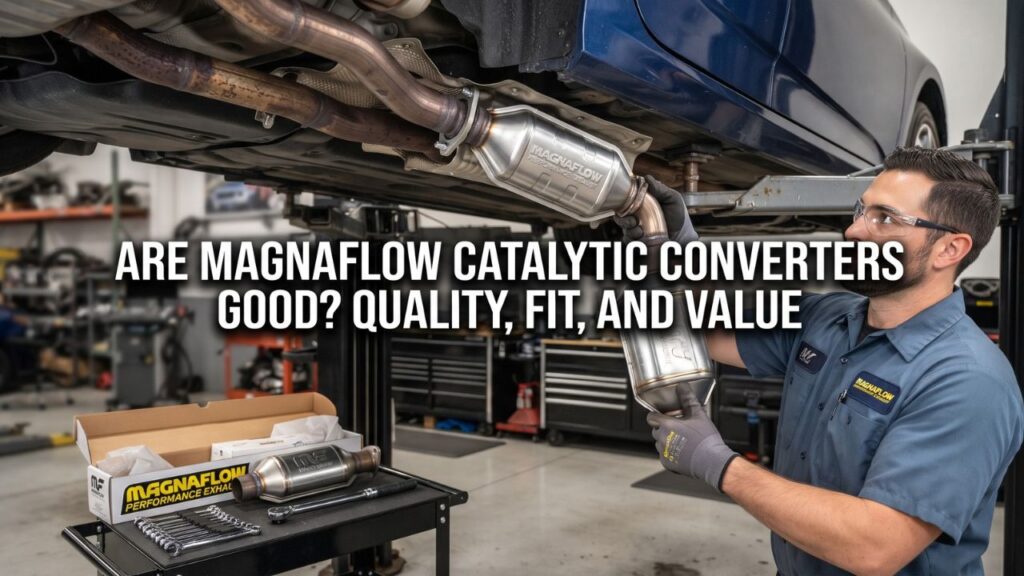
MagnaFlow sits above many generic low-cost aftermarket converters in terms of product range, materials, emissions-specific applications, and fitment engineering.
Its strongest products are the vehicle-specific direct-fit and OEM Grade converters.
Stainless-Steel Construction Is Common
Many MagnaFlow converters use stainless-steel bodies and stainless tubing.
For example, current OEM Grade and HM Grade direct-fit listings specify stainless-steel bodies, stainless tubing, ceramic catalyst substrates, and vehicle-specific inlet, outlet, and sensor configurations.
Stainless steel helps the housing resist external corrosion better than basic mild-steel exhaust construction.
It does not make the catalyst immune to failure.
The internal substrate can still be damaged by:
- Severe misfires
- Rich air-fuel mixtures
- Oil burning
- Coolant contamination
- Physical impact
- Excessive exhaust temperature
A strong outer shell cannot protect the catalyst from an unhealthy engine.
Direct-Fit Models Are Engineered Around Specific Vehicles
MagnaFlow states that its direct-fit converters use 3D scanning, vehicle-specific piping, flared receivers, and OEM-style oxygen-sensor locations.
That approach can reduce fabrication compared with a universal converter.
A direct-fit assembly may include:
- Correct flange positions
- Proper pipe routing
- O2 sensor ports
- Hangers
- Heat shields
- Gaskets on some applications
The included hardware varies by part number, so check the exact listing rather than assuming every component comes in the box.
Catalyst Loading Varies by Grade
One reason MagnaFlow offers several converter grades is that different vehicles need different catalyst capacity.
MagnaFlow says its HM and OEM Grade converters use greater precious-metal loading than Standard Grade designs in applications that require it.
That matters on OBD-II vehicles because the engine computer monitors catalyst behavior.
An extremely cheap generic converter may physically fit the exhaust yet still struggle to meet the catalyst monitor’s expectations.
Key Takeaway: MagnaFlow’s better converters use stainless construction, vehicle-specific designs, and catalyst loading matched to the emissions application, placing the brand above many bargain universal options.
What Are the Different MagnaFlow Catalytic Converter Grades?
Buying the correct MagnaFlow series matters more than simply buying the MagnaFlow name.
Standard Grade
MagnaFlow currently positions Standard Grade Federal converters mainly for pre-1996 vehicles outside CARB-regulated states.
These are generally suited to older pre-OBD-II applications.
A Standard Grade converter may be a reasonable choice for:
- Older vehicles
- Simpler emissions systems
- Pre-OBD-II applications
- Federal emissions areas
It should not automatically be used on a newer OBD-II vehicle simply because the pipe diameter matches.
HM Grade
HM stands for High-Metal or Heavy Metal Grade in MagnaFlow’s product descriptions.
These converters are intended for many OBD-II vehicles with Federal/EPA emissions systems.
MagnaFlow says HM products use increased precious-metal loading compared with Standard Grade converters and are intended to work with the vehicle’s engine-management system.
This is often the range I would examine for a newer federal-emissions vehicle when OEM Grade is unnecessary or unavailable.
OEM Grade
OEM Grade is MagnaFlow’s higher-spec Federal aftermarket line for many OBD-II applications.
MagnaFlow describes these converters as using OE-inspired design parameters and higher catalyst loading for OE-like emissions behavior.
OEM Grade usually makes more sense when:
- The vehicle is sensitive to catalyst efficiency
- Cheaper converters have triggered P0420/P0430 before
- You want the closest MagnaFlow option to factory-style performance
- The OEM converter is very expensive
- The car will remain in service for several more years
OEM Grade can cost substantially more than a basic universal converter.
CARB-Compliant Converters
Vehicles registered in states following California replacement-converter rules need a converter approved for the exact application.
MagnaFlow sells CARB-compliant converters and currently identifies California, Colorado, and New York as CARB-regulated states for converter selection.
A Federal/EPA-only MagnaFlow converter should not be substituted in a CARB application where state rules require an approved converter.
Key Takeaway: Standard Grade suits many older vehicles, HM Grade covers many Federal OBD-II applications, OEM Grade targets higher catalyst demands, and CARB models are required for specific regulated applications.
Are MagnaFlow Direct-Fit Catalytic Converters Good?
Direct-fit MagnaFlow converters are usually the most appealing option for drivers who want an aftermarket part without custom exhaust fabrication.
Installation Is Usually Simpler
A direct-fit unit is shaped for a specific vehicle.
It may bolt to factory flanges and use the original hanger and sensor positions.
This can save labor compared with cutting and welding a universal converter.
MagnaFlow specifically markets its direct-fit designs around vehicle-specific dimensions and factory-style sensor placement.
Fitment Can Still Vary
“Direct fit” does not guarantee that every part will line up perfectly on every vehicle.
Exhaust systems move with:
- Engine mounts
- Previous repairs
- Collision damage
- Rust
- Bent pipes
- Replacement exhaust parts
There are also owner reports of MagnaFlow direct-fit assemblies needing adjustment on certain applications. For example, some Reddit owners have reported flange alignment or clearance issues on specific BMW and Lexus installations, while others describe the brand itself as one of the better aftermarket choices.
Those reports are vehicle-specific rather than proof of a brand-wide fitment problem.
Old Exhaust Hardware Can Create Installation Trouble
A perfectly manufactured converter can still be difficult to install when the original exhaust is 15 years old.
Expect possible problems with:
- Rusted flange bolts
- Broken studs
- Seized O2 sensors
- Distorted flanges
- Weak hangers
- Corroded downstream pipes
Inspect the full exhaust before blaming the replacement converter for every alignment issue.
Key Takeaway: MagnaFlow direct-fit converters are often easier to install than universal units, but rust, prior exhaust repairs, and occasional application-specific alignment issues can still affect fit.
Are MagnaFlow Universal Catalytic Converters Good?
Yes, if the correct unit is chosen and installed properly.
Universal converters trade bolt-on convenience for lower part cost and fabrication flexibility.
Universal Models Require Cutting and Welding
A universal converter typically has plain pipe connections rather than vehicle-specific flanges.
Installation may require:
- Cutting the original exhaust
- Measuring converter position
- Welding
- Adding reducers
- Repositioning sensor bungs
- Fabricating pipe sections
MagnaFlow itself recommends professional installation for many universal models.
Performance Can Be Comparable When Correctly Sized
MagnaFlow states that its universal and direct-fit converters can perform the same emissions function when the correct application is selected; the main difference is installation style.
The installer still has to choose a converter approved for:
- Engine size
- Vehicle weight
- Emissions certification
- Model year
- Exhaust layout
EPA guidance also stresses installing the converter specified for the vehicle rather than choosing only by pipe diameter.
Universal Is Best When Fabrication Is Already Expected
A universal MagnaFlow unit makes the most sense when:
- Factory pipe sections are already damaged
- An exhaust shop is doing the work
- A direct-fit assembly is unavailable
- The car has a custom exhaust
- Cost matters more than bolt-on installation
For a driveway repair without welding equipment, direct-fit is usually easier.
Key Takeaway: MagnaFlow universal converters can work well, but correct sizing and professional fabrication matter far more than with a bolt-on direct-fit assembly.
How Long Do MagnaFlow Catalytic Converters Last?
There is no single mileage number that applies to every MagnaFlow converter.
Engine condition has a major influence on catalyst life.
Federal Warranty Gives a Minimum Reference Point
MagnaFlow’s Federal/EPA warranty currently lists:
- 5 years/50,000 miles for construction
- 25,000 miles for emissions performance
Its CARB converter warranty lists:
- 5 years/50,000 miles construction
- 5 years/50,000 miles emissions coverage
These figures match the different regulatory warranty structures MagnaFlow sells under.
Warranty length should not be treated as expected failure mileage.
A properly operating converter can last far beyond its emissions-warranty period.
Engine Problems Shorten Converter Life
A new MagnaFlow converter can fail quickly if the vehicle has:
- P0300-series misfires
- Leaking fuel injectors
- Excessive oil consumption
- Coolant entering the cylinders
- Incorrect fuel pressure
- Rich fuel trims
The replacement converter should not be installed until the cause of the old converter’s failure is addressed.
Cheap Converter vs. Healthy Engine Matters
An expensive converter on an unhealthy engine can die faster than a less costly converter on a properly running engine.
That is why repeat catalyst failure should trigger engine diagnosis instead of another automatic converter replacement.
Key Takeaway: MagnaFlow converters can last many years, but the engine’s combustion condition has more influence on premature failure than the logo stamped on the converter housing.
Will a MagnaFlow Catalytic Converter Clear a P0420 Code?
It can, if the original converter is actually the reason P0420 is being set and the replacement part matches the vehicle correctly.
It is not guaranteed.
P0420 Does Not Always Mean the Converter Is Bad
P0420 means the catalyst monitor has determined that Bank 1 catalyst performance is below the expected threshold.
Possible contributing faults include:
- Exhaust leaks
- Misfires
- Rich mixture
- Oil contamination
- Oxygen-sensor problems
- Wiring problems
- Actual catalyst deterioration
Installing a MagnaFlow converter will not repair a vacuum leak or failed ignition coil.
Converter Grade Matters
A newer OBD-II vehicle may be more sensitive to catalyst behavior than an older pre-OBD-II car.
That is one reason MagnaFlow offers HM and OEM Grade products rather than one universal catalyst for every application.
If a vehicle has a history of rejecting lower-cost aftermarket converters with repeat P0420 codes, I would favor the closest vehicle-specific MagnaFlow grade or OEM part rather than the cheapest universal option.
Monitor Readiness After Repair
After replacement, the catalyst monitor may need several normal drive cycles before it completes.
Do not assume a repair failed simply because all readiness monitors have not reset immediately.
At the same time, a code returning quickly deserves further diagnosis.
MagnaFlow vs. OEM Catalytic Converter
OEM remains the safest choice when budget is not a concern and the factory converter is still available.
MagnaFlow becomes attractive when OEM pricing is difficult to justify.
| Feature | MagnaFlow | OEM |
| Purchase price | Usually lower | Usually higher |
| Vehicle-specific direct fit | Available | Yes |
| Federal options | Yes | Factory specification |
| CARB options | Yes, application-specific | Yes where applicable |
| Stainless construction | Common | Vehicle-dependent |
| Factory catalyst loading | Depends on grade | Yes |
| Exact original fit | Usually close on direct-fit models | Best chance |
| Universal options | Yes | Usually no |
| Warranty | Product-specific aftermarket coverage | Vehicle/parts warranty dependent |
OEM Has the Fitment Advantage
The original converter was designed around the exact vehicle.
Flanges, sensors, shields, and pipe angles should match without aftermarket interpretation.
That reduces installation uncertainty.
MagnaFlow Usually Has the Cost Advantage
OEM converter assemblies can cost thousands of dollars.
A MagnaFlow replacement may deliver legal emissions compliance for considerably less, especially on older vehicles where spending several thousand dollars on an OEM exhaust assembly is difficult to justify.
OEM May Be Better for Very Sensitive Applications
Some vehicles are especially sensitive to catalyst efficiency.
If the price difference is manageable and the car has a history of aftermarket P0420 issues, OEM may still be the safer long-term choice.
Key Takeaway: OEM gives the strongest fit and factory-spec confidence, while MagnaFlow often provides a much more affordable path without dropping to an unknown budget converter.
MagnaFlow vs. Cheap Aftermarket Catalytic Converters
This is where MagnaFlow makes more sense to me.
Ultra-cheap converters can be tempting because the price difference may be hundreds of dollars.
Low Price Can Mean Less Catalyst Capacity
Precious metals are among the most expensive materials inside a converter.
Reducing catalyst loading can cut manufacturing cost.
A converter may still physically fit yet struggle to maintain catalyst efficiency on a demanding OBD-II application.
MagnaFlow’s use of different catalyst grades is an advantage here because it recognizes that newer applications may need more catalyst material.
Fit and Hardware Matter Too
A cheap direct-fit assembly can become expensive if a shop has to:
- Cut and reweld flanges
- Reposition pipes
- Repair sensor bungs
- Correct hanger alignment
- Fix leaks after installation
Buying solely on the lowest online price can therefore backfire.
Brand Support Has Value
A known manufacturer with published warranty terms, application catalogs, and technical support is easier to deal with than an unknown marketplace seller if fitment or emissions problems appear.
That does not make every MagnaFlow part perfect.
It does reduce some of the uncertainty that comes with generic converters.
Key Takeaway: MagnaFlow usually costs more than no-name converters, but its vehicle catalog, converter grades, warranty structure, and established product support make the added cost easier to justify.
Are MagnaFlow Catalytic Converters Legal in Every State?
Not every MagnaFlow converter is legal for every vehicle or state.
You need the correct certification.
Federal/EPA Models
Federal MagnaFlow converters are designed for applications operating under Federal EPA requirements.
They should be selected from MagnaFlow’s approved application information for the vehicle.
CARB-Regulated Applications
MagnaFlow currently directs buyers in California, Colorado, and New York toward CARB-approved converters for applicable vehicles.
CARB converters are approved for specific vehicle applications.
A converter being physically able to fit is not enough.
Check the Emissions Label Before Buying
Look under the hood for the vehicle emissions label.
It may identify the vehicle as:
- Federal
- California
- CARB
- 50-state emissions
Then match:
- Model year
- Make
- Model
- Engine
- Engine family
- Registration state
- Converter position
Do this before ordering.
Key Takeaway: MagnaFlow makes both Federal and CARB converters, so legality depends on selecting the exact approved unit for the vehicle and registration state.
Common MagnaFlow Catalytic Converter Complaints
MagnaFlow has a solid reputation, but there are still issues worth expecting.
Fitment Complaints
Some owners report:
- Flanges slightly out of alignment
- Pipes touching crossmembers
- Extra adjustment during installation
- Hanger alignment issues
Recent owner discussions include both fitment complaints and reports of successful warranty support.
Application-specific reviews are more useful than broad brand ratings.
Higher Price Than Budget Brands
MagnaFlow is rarely the cheapest converter.
OEM Grade and CARB models can become expensive.
The price makes the most sense when compared with OEM rather than compared with the lowest-cost universal catalyst online.
Converter Failure From Existing Engine Problems
Owners sometimes blame a replacement converter after it fails again.
The actual issue may be:
- Oil consumption
- Rich running
- Coolant burning
- Persistent misfire
A 2024 mechanic discussion about a failed MagnaFlow replacement made this exact point: replacing the converter does not correct the condition that killed the first one.
Key Takeaway: The main complaints are application-specific fitment, higher cost than bargain brands, and repeat failures where the engine problem was never corrected.
When I Would Buy a MagnaFlow Catalytic Converter
MagnaFlow makes the most sense when the vehicle is worth repairing but OEM converter pricing is excessive.
I would consider one when:
- The factory converter has been properly diagnosed as failed
- The engine has no unresolved misfire or rich-running problem
- The correct MagnaFlow application is available
- OEM cost is much higher
- The vehicle needs an emissions-compliant replacement
- A reputable exhaust shop is doing the installation
- I want something above an unknown bargain brand
I would lean toward OEM Grade for a newer OBD-II vehicle that is sensitive to catalyst monitoring.
I would consider HM Grade where MagnaFlow specifies it for the Federal emissions application.
I would use Standard Grade only where MagnaFlow’s catalog calls for it, mainly older applications.
For California, Colorado, or New York applications requiring CARB approval, I would select the exact CARB-listed converter rather than a Federal substitute.
When I Would Skip MagnaFlow
There are situations where another option makes more sense.
I would consider OEM instead if:
- The OEM price difference is small
- The vehicle has a known history of rejecting aftermarket catalysts
- Exact factory fit matters more than price
- The vehicle is still under an emissions warranty
I would also delay buying any converter if:
- The engine is misfiring
- It burns significant oil
- Coolant is entering the cylinders
- Fuel trims show a serious rich condition
- The catalyst has not actually been diagnosed
A new converter should be the final part of the repair, not the first guess.
Conclusion
So, are MagnaFlow catalytic converters good? Yes. MagnaFlow is one of the aftermarket brands I would consider when a factory catalytic converter is too costly or no longer available. Its stainless-steel construction, direct-fit options, multiple catalyst grades, EPA-compliant products, and CARB-approved applications give buyers more vehicle-specific choices than many generic brands.
The best MagnaFlow converter is not automatically the most expensive one. It is the model matched to the vehicle’s year, engine, emissions certification, registration state, and converter position.
OEM still has the advantage for exact factory fit and original catalyst specifications. MagnaFlow’s advantage is offering a reputable aftermarket option that can cost considerably less while still meeting the applicable emissions requirements.
Before buying one, diagnose why the original converter failed. A MagnaFlow converter installed on an engine that is still misfiring, running rich, burning oil, or leaking coolant may fail just as an OEM converter would.
FAQs About MagnaFlow Catalytic Converters
Is MagnaFlow a reputable catalytic converter brand?
Yes. MagnaFlow is an established exhaust and emissions-parts manufacturer with Federal/EPA and CARB converter lines, direct-fit assemblies, universal converters, and published warranty coverage. Its product range makes it a more predictable choice than many unknown low-cost brands.
Are MagnaFlow converters as good as OEM?
Some MagnaFlow OEM Grade converters are designed to provide OE-like emissions performance, but they are still aftermarket parts. OEM generally has the strongest advantage for exact fit and factory catalyst specification. MagnaFlow can offer a better cost-to-quality balance on older vehicles.
How long does a MagnaFlow catalytic converter last?
There is no fixed lifespan. A properly installed converter on a healthy engine can last many years. MagnaFlow’s current Federal/EPA warranty covers construction for 5 years/50,000 miles and emissions performance for 25,000 miles. Engine problems can shorten converter life drastically.
Will a MagnaFlow converter get rid of P0420?
It may if the old converter is truly below efficiency and the correct MagnaFlow unit is installed. P0420 can also come from exhaust leaks, misfires, fuel-control faults, sensor problems, or contamination, so diagnosis should come before replacement.
Is MagnaFlow better than a cheap universal catalytic converter?
For many OBD-II vehicles, I would prefer the correct MagnaFlow application. MagnaFlow provides defined converter grades, vehicle application data, warranty coverage, and direct-fit models. A very cheap universal converter may not have enough catalyst capacity for a demanding vehicle.
Are MagnaFlow direct-fit converters really bolt-on?
Many are designed to bolt into the factory exhaust position, but real vehicles may have corrosion, bent exhaust parts, previous repairs, or alignment differences. Some owners also report application-specific fitment adjustments. Check reviews for the exact part number and vehicle.
Are MagnaFlow catalytic converters CARB legal?
MagnaFlow sells CARB-approved converters for specific applications. Not every MagnaFlow converter is CARB compliant. Buyers in states requiring CARB converters must use the exact approved part specified for their vehicle.
Is MagnaFlow OEM Grade worth the extra money?
It can be on newer OBD-II vehicles, especially when the vehicle is sensitive to catalyst-efficiency monitoring or a cheaper converter has already failed to keep P0420/P0430 away. For an older, simpler vehicle, HM or Standard Grade may be sufficient if MagnaFlow lists it for that application.