Are Walker Catalytic Converters Good? Quality, Fit, and Lifespan
Walker catalytic converters are generally a solid aftermarket choice, especially when you want a name-brand replacement at a lower price than an OEM converter. Their direct-fit models use application-specific brackets, flanges, heat shields, and catalyst designs, but durability and fit can still vary by vehicle and engine condition.
Walker offers both federal EPA-compliant and CARB-compliant converter lines, so choosing the correct part number matters as much as choosing the brand. A converter intended for a federal-emissions vehicle may not be legal for a vehicle or state that requires an approved CARB application.
Warranty coverage also differs between Walker’s main converter lines. Walker currently lists its Ultra EPA converters with a 25,000-mile emissions warranty and 5-year/50,000-mile structural warranty, while CalCat converters carry 5-year/50,000-mile emissions and structural coverage.
For are Walker catalytic converters good, my overall answer is yes for many daily-driver repairs, provided the exact converter matches the vehicle and the engine problem that damaged the original converter has already been repaired. They are a more established aftermarket option than many unknown low-cost converters, though OEM can still be the safer choice for vehicles that are highly sensitive to catalyst efficiency.
Real owner feedback is mixed rather than universally positive. Some users report years of normal service, while others describe fitment issues or early catalyst failure. Those reports are anecdotal, but they reinforce a practical point: the vehicle application and engine condition can matter nearly as much as the logo stamped on the converter.
The sections below cover Walker Ultra versus CalCat, construction quality, fitment, emissions-code performance, lifespan, warranty, common complaints, OEM comparison, and situations where I would or would not choose Walker.
Are Walker Catalytic Converters Good Overall?
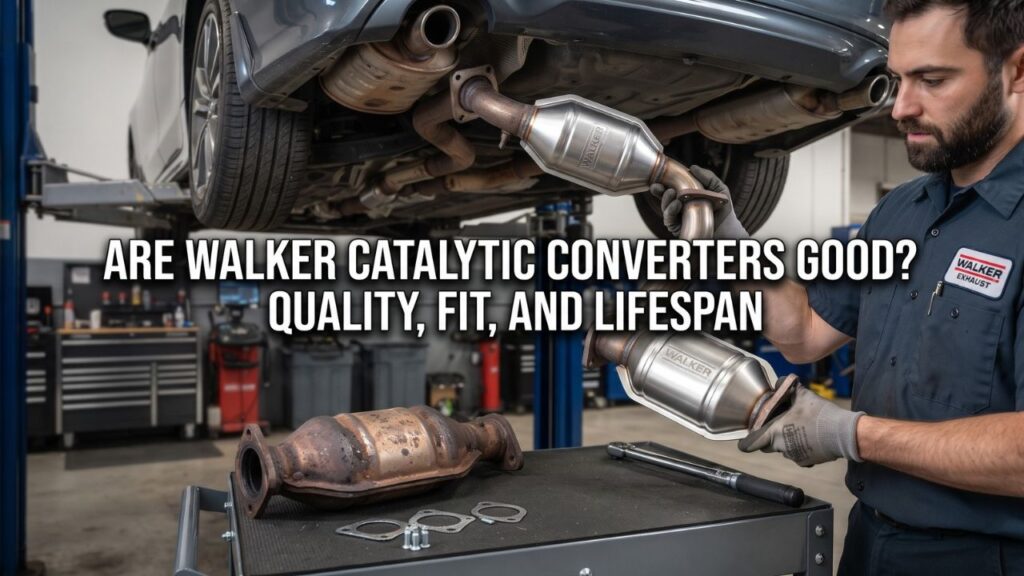
Walker is one of the established names in aftermarket exhaust parts, and its catalytic converter range covers many domestic and import vehicles.
For an older daily driver where an OEM converter costs far more than the vehicle justifies, Walker can make sense.
Walker Uses Application-Specific Catalyst Designs
A catalytic converter cannot be selected only by pipe diameter or physical size.
The catalyst must have enough substrate volume and catalyst loading for the engine and emissions certification it is designed to serve.
Walker states that its Ultra converters use application-specific substrate material, washcoat, and precious-metal loading to meet federal EPA replacement requirements.
That gives Walker an advantage over generic converters sold mainly by inlet and outlet diameter.
Direct-Fit Models Reduce Fabrication
Walker offers direct-fit converters with vehicle-specific:
- Flanges
- Hangers
- Brackets
- Pipe routing
- Heat shields
- Oxygen-sensor locations
Walker describes these units as bolt-on replacements that normally do not require fabrication or welding.
That can reduce installation labor compared with a universal converter.
Quality Is Not the Same as OEM
A Walker converter should not automatically be treated as identical to the original factory converter.
OEM units can use different substrate volume, catalyst loading, shell construction, and calibration margins.
This difference matters most on vehicles that monitor catalyst efficiency very closely or have a history of aftermarket converters setting P0420 or P0430.
Key Takeaway: Walker is a credible aftermarket converter brand with vehicle-specific designs and direct-fit options, but it should be viewed as an aftermarket alternative rather than an automatic OEM equivalent.
Walker Ultra vs Walker CalCat Catalytic Converters
Walker currently separates its replacement converters mainly into EPA-compliant Ultra products and CARB-compliant CalCat products.
Choosing between them depends on the vehicle’s emissions certification and the rules where the vehicle is registered.
Walker Ultra
Walker Ultra converters are designed for applications where an EPA-compliant aftermarket converter is permitted.
Walker lists Ultra converters for OBD-II vehicles from 1996 and newer and says the line uses an OE-style washcoat and application-specific precious-metal loading.
Many Ultra products are available as direct-fit units.
Current Walker warranty information lists:
- Emissions warranty: 25,000 miles
- Structural warranty: 5 years/50,000 miles
Those warranty terms are worth comparing with other aftermarket options before buying.
Walker CalCat
CalCat is Walker’s CARB-focused converter line.
These converters are designed for applications that require converters approved under stricter California-style aftermarket catalyst rules.
Walker states that CalCat products use application-specific catalyst materials and catalyst loading and are offered in direct-fit and universal configurations.
Walker currently lists a 5-year/50,000-mile emissions warranty and 5-year/50,000-mile structural warranty for CalCat converters.
Do Not Substitute One Line for the Other
An Ultra converter should not be installed simply because it physically fits if the vehicle requires a CARB-approved converter.
CARB replacement rules require the approved converter to match the listed vehicle application and Executive Order requirements.
Check the underhood emissions label, registration state, engine, model year, and exact Walker application before ordering.
Key Takeaway: Ultra is Walker’s federal EPA-focused line, while CalCat covers approved CARB applications; legality and vehicle matching should decide which line you buy.
How Good Is Walker Catalytic Converter Build Quality?
Walker markets its direct-fit converters as using stainless-steel bodies, aluminized tubing, OE-style hangers, thick flanges, brackets, and heat shields.
Those construction choices are reasonable for a mainstream replacement exhaust part.
Stainless-Steel Converter Shell
The converter body is exposed to road water, salt, temperature cycling, and exhaust heat.
A stainless shell provides stronger corrosion resistance than untreated mild steel.
The adjoining pipe sections and hardware can still age differently depending on climate and road salt.
OE-Style Mounting Hardware
Direct-fit versions are designed around the original exhaust routing.
This can make installation far simpler than buying a universal shell and paying an exhaust shop to fabricate pipe sections.
Bracket placement is especially useful on converters mounted close to the engine, where incorrect support can place stress on exhaust manifolds or flanges.
Fitment Is Usually Good but Not Perfect
Walker calls its direct-fit converters application engineered and design validated for fit.
Real-world reports show that fit is not perfect on every vehicle.
One Miata owner reported needing to pull the exhaust slightly to close roughly a half-inch gap, while still reporting no operational problem after installation. Other owners describe straightforward installation.
Manufacturing tolerance, previous exhaust repairs, aftermarket cat-back systems, bent pipes, worn hangers, and incorrect part selection can all affect final alignment.
Key Takeaway: Walker direct-fit converters use sensible materials and OE-style mounting features, though real installation fit can still vary with the vehicle and existing exhaust system.
Do Walker Catalytic Converters Keep P0420 Away?
This is one of the biggest concerns with aftermarket converters.
A cheap converter may physically fit and still lack enough catalyst capacity to satisfy the vehicle’s catalyst monitor for long.
Walker Designs Ultra for OBD-II Catalyst Monitoring
Walker states that Ultra converters use application-specific washcoat and catalyst loading intended to meet EPA requirements and maintain proper emissions performance on the listed vehicle.
That makes an application-specific Walker converter a stronger bet than a no-name universal converter selected only by pipe size.
No Aftermarket Converter Can Fix an Engine Problem
A new converter may quickly set P0420 again if the engine has:
- Misfires
- Rich fuel mixture
- Burning oil
- Internal coolant leaks
- Exhaust leaks
- Faulty fuel control
- Damaged oxygen-sensor wiring
Walker itself stresses that converters normally fail because of another problem and recommends correcting that root cause before installing the replacement.
Some Engines Are Harder on Aftermarket Converters
Certain vehicles appear more sensitive to aftermarket catalyst efficiency than others.
One Infiniti discussion includes a technician describing aftermarket converters on that engine family as inconsistent, with some lasting years and others returning catalyst codes much sooner. That is an owner-community report rather than controlled test data, but it reflects why model-specific feedback matters.
For a vehicle known to reject aftermarket catalysts, the higher price of OEM may make more sense.
Key Takeaway: Walker designs its converters around OBD emissions requirements, but persistent engine faults or a catalyst-sensitive vehicle can still produce P0420 after replacement.
How Long Do Walker Catalytic Converters Last?
There is no single mileage that every Walker converter will reach.
Converter life depends heavily on the health of the engine.
Healthy Engines Give the Converter a Better Chance
A converter lasts longer when combustion is correct and the engine is not sending excess fuel, oil, or coolant into the exhaust.
A vehicle with proper fuel trims, good ignition, and low oil consumption places far less stress on the catalyst.
Misfires Can Destroy a New Converter Quickly
A misfire can send unburned fuel into the exhaust.
Walker explains that this fuel can burn inside the converter and overheat or melt the substrate.
A premium converter cannot survive indefinitely under those conditions.
Oil Consumption Also Matters
An engine that burns significant oil sends ash and contaminants through the exhaust.
Those deposits can coat catalyst surfaces and reduce converter performance.
Replacing the converter without dealing with severe oil consumption may only reset the clock on another failure.
Owner Experiences Vary Widely
Anecdotal reports range from Walker converters surviving tens of thousands of miles without trouble to units that failed much sooner.
One user reported roughly 35,000–40,000 miles without trouble before selling the vehicle. Another more recent owner described an internal Walker converter failure after only months.
Neither experience predicts what will happen on another vehicle.
Key Takeaway: Walker converter lifespan depends strongly on engine health; misfires, rich mixtures, oil burning, and coolant contamination can shorten the life of any replacement catalyst.
Common Walker Catalytic Converter Complaints
Walker is not free from complaints, and it is worth understanding the patterns before buying.
Fitment Differences
Some owners report that bolt holes, pipe angles, flanges, or overall length require more adjustment than expected.
This can also happen because the rest of the exhaust is aftermarket, bent, rusted, or previously repaired.
P0420 Returning
Some owners report catalyst-efficiency codes returning after installing aftermarket converters.
Possible explanations include:
- Converter efficiency
- Incorrect application
- Exhaust leak
- Failed oxygen sensor
- Rich mixture
- Oil contamination
- Original engine fault never repaired
A returning P0420 should be diagnosed rather than automatically blamed on the new converter.
Hardware Quality
Aftermarket converter kits may include hardware that does not match OEM hardware quality.
One technician in an owner discussion specifically raised concern about aftermarket hardware loosening and creating leaks.
Using good gaskets and correct hardware can be worth the extra cost.
Early Internal Failure
A small number of owner reports describe internal catalyst material breaking down earlier than expected.
Those reports deserve attention, but without checking the vehicle’s fuel trims, misfire history, oil consumption, and installation, they cannot establish that the converter alone caused the failure.
Key Takeaway: Reported Walker complaints mainly involve fitment, recurring catalyst codes, hardware, and occasional early failure, but many of those symptoms can also come from vehicle-specific problems.
Walker vs OEM Catalytic Converters
OEM is usually the benchmark for fit and catalyst calibration, but price can be dramatically higher.
That creates the main reason Walker exists as an alternative.
Reasons to Choose Walker
Walker makes sense when:
- The vehicle is older
- OEM cost is difficult to justify
- A correct direct-fit Walker application exists
- The engine is otherwise healthy
- The vehicle is not known for rejecting aftermarket catalysts
- You want a recognizable brand rather than an unknown converter
A direct-fit Walker can also reduce fabrication cost compared with a universal unit.
Reasons to Choose OEM
I would lean toward OEM when:
- The vehicle is fairly new
- You plan to keep it for many years
- Aftermarket catalysts have a poor reputation on that exact engine
- Labor is expensive enough that repeating the repair would erase the initial savings
- The OEM converter still has emissions-warranty coverage
- Catalyst-monitor sensitivity is known to be high
OEM is especially attractive when a warranty covers most of the cost.
Cost Should Include Labor Risk
A cheaper converter is not cheaper if it has to be replaced twice.
If the converter is buried near the cylinder head or requires substantial labor, I would give long-term reliability more weight than the purchase price alone.
For an easily accessible underbody converter, choosing a reputable aftermarket option carries less labor risk.
Key Takeaway: Walker often makes sense on older vehicles where OEM cost is high, while OEM is more attractive when catalyst sensitivity or replacement labor makes a second repair expensive.
Walker vs Cheap No-Name Catalytic Converters
This is where Walker becomes easier to recommend.
Extremely low-cost converters may use less catalyst material, generic shells, or less precise fabrication.
Vehicle-Specific Engineering Matters
Walker provides application catalogs and matches converters to specific vehicles and emissions requirements.
A generic converter listed mainly by inlet diameter cannot provide the same level of application matching.
Compliance Matters Too
Walker offers both EPA-compliant and CARB-compliant products with listed applications.
A cheap converter may physically install yet be illegal for the vehicle or unable to satisfy its OBD catalyst monitor.
Lower Price Can Mean More Risk
One mechanic in an owner discussion described a very cheap aftermarket converter that leaked at installation and soon triggered P0420, while another user in the same discussion reported good service from a Walker unit.
That does not prove every inexpensive converter is bad, but it shows why price alone is a poor way to select an emissions component.
How to Choose the Right Walker Catalytic Converter
Do not order only by vehicle model or visual similarity.
Verify the complete application.
Match Year, Make, Model, and Engine
The same vehicle name can use different engines and exhaust systems.
Use the exact engine displacement and drivetrain information when looking up the converter.
Check Federal or CARB Emissions Certification
Look at the emissions label under the hood.
A vehicle certified to California standards may require a different replacement than a federal-emissions version of the same model.
State rules also matter.
Walker notes that CalCat units are intended for states requiring CARB-compliant aftermarket converters, and the converter must be approved for the exact application.
Confirm Converter Position
Vehicles may have:
- Bank 1 converter
- Bank 2 converter
- Front converter
- Rear converter
- Manifold converter
- Underbody converter
Make sure the part number corresponds to the converter that actually failed.
Diagnose Before Ordering
Do not order a converter just because a scanner shows P0420.
Check for misfires, exhaust leaks, fuel-trim problems, oil consumption, coolant loss, and sensor faults first.
A replacement converter should be the final repair after the root cause is established.
Key Takeaway: Walker quality matters only after the correct converter is matched to the exact engine, emissions certification, converter position, and state requirements.
Is a Walker Catalytic Converter Worth Buying?
For many older daily drivers, yes.
Walker sits in a useful middle ground between high-priced OEM converters and unknown bargain products.
The company’s current direct-fit Ultra and CalCat products offer application-specific designs, recognizable warranty coverage, and emissions-compliant options for many vehicles.
I would be comfortable considering Walker when the engine has been properly diagnosed and the exact vehicle application is listed.
I would be more cautious on engines with repeated reports of aftermarket P0420 problems, vehicles with expensive installation labor, or cases where OEM warranty coverage is still available.
Conclusion
For are Walker catalytic converters good, the answer is generally yes: Walker is a reasonable mainstream aftermarket choice for many vehicles, especially when OEM pricing is hard to justify.
Its strengths include direct-fit designs, EPA and CARB product lines, vehicle-specific catalyst configurations, stainless converter bodies, OE-style brackets, and published warranty coverage. Fit and long-term results still vary by application.
The biggest mistake is installing any new converter without finding out why the old one failed. Misfires, rich operation, oil consumption, coolant leaks, and exhaust leaks can shorten the life of the replacement regardless of brand.
I would choose Walker over a no-name bargain converter in most cases. I would still compare it with OEM when the car is sensitive to catalyst efficiency, the installation is labor intensive, or long-term ownership makes repeat repair especially costly.
FAQs About Walker Catalytic Converters
Is Walker a Good Catalytic Converter Brand?
Yes, Walker is generally considered a reputable mainstream aftermarket exhaust brand.
Its converter range includes application-specific EPA-compliant Ultra units and CARB-compliant CalCat products. The correct fitment and a healthy engine are major factors in how well any replacement converter performs.
How Long Will a Walker Catalytic Converter Last?
There is no fixed mileage.
A healthy engine may allow a replacement converter to last for many years, while repeated misfires, rich running, oil consumption, or coolant contamination can damage it quickly.
The cause of the original converter failure should be repaired first.
Will a Walker Catalytic Converter Cause P0420?
A correctly selected Walker converter is designed to meet the emissions requirements of its listed application, but no aftermarket converter can guarantee that P0420 will never appear.
Incorrect fitment, exhaust leaks, engine faults, sensor problems, contamination, and catalyst-sensitive vehicle calibrations can all trigger the code.
Are Walker Converters Better Than Cheap Aftermarket Converters?
I would generally choose Walker over an unknown low-cost converter.
Walker publishes specific vehicle applications, compliance information, construction details, and warranty terms. Generic converters selected only by dimensions may carry a greater risk of poor fit or inadequate catalyst capacity.
Are Walker Catalytic Converters as Good as OEM?
Not necessarily.
OEM converters are built specifically for the original vehicle calibration and often have a larger margin for catalyst-monitor requirements. Walker can still be a practical replacement where OEM cost is too high.
Does Walker Make CARB-Compliant Catalytic Converters?
Yes. Walker’s CalCat line includes CARB-compliant converters for approved applications in jurisdictions that require them.
The exact part must be approved for the specific vehicle. Physical fit alone does not make a converter CARB legal.
What Warranty Does Walker Give on Catalytic Converters?
Walker currently lists its Ultra EPA converters with a 25,000-mile emissions warranty and 5-year/50,000-mile structural warranty.
Current CalCat listings show 5-year/50,000-mile emissions and structural warranties. Check the exact part and current warranty terms before purchasing.
Should I Buy Walker or OEM?
Walker makes sense for many older vehicles where OEM pricing is high and a correct application is available.
OEM may be worth the extra cost if the vehicle is known to be sensitive to aftermarket catalysts, the installation requires extensive labor, or you plan to keep the vehicle for a long time.