Are All Catalytic Converters the Same? Types and Key Differences
No. Catalytic converters can differ in emissions chemistry, catalyst loading, internal substrate, dimensions, pipe size, sensor locations, mounting style, engine capacity, and legal certification. A converter that physically fits an exhaust pipe may still be wrong for the engine or unable to satisfy the vehicle’s emissions-monitoring system.
That difference matters most during replacement. Installing the wrong unit can cause poor fit, exhaust leaks, P0420 or P0430 codes, failed emissions testing, or premature converter failure. Modern vehicles often need a converter selected for a specific engine and emissions configuration rather than a generic part chosen only by inlet diameter.
Gasoline engines commonly use three-way catalytic converters, while some older gasoline systems used two-way designs. Diesel vehicles can use diesel oxidation catalysts and other aftertreatment devices that operate differently from a gasoline three-way catalyst. Walker notes that three-way converters became the common North American gasoline design in the early 1980s and treat hydrocarbons, carbon monoxide, and nitrogen oxides.
So, are all catalytic converters the same? No. Even two converters that look almost identical can contain different catalyst formulations, substrate volumes, oxygen-sensor provisions, and emissions approvals. Converter location also matters because some vehicles use manifold-mounted catalysts, close-coupled units, underfloor converters, or several converters in one exhaust system.
Replacement choice should therefore start with the vehicle year, make, model, engine, emissions label, converter position, and registration requirements. The sections below explain the major converter types, size and material differences, direct-fit versus universal units, EPA versus CARB applications, and why converters should not be swapped solely because their dimensions appear similar.
Why Catalytic Converters Are Not All the Same
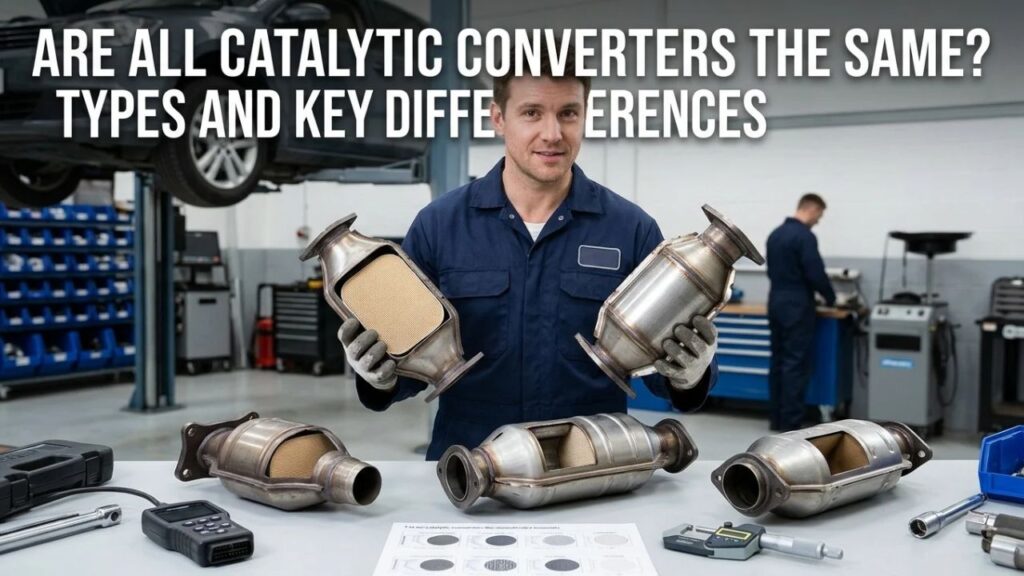
Catalytic converters perform the same broad job—reducing harmful exhaust pollutants—but manufacturers design them around specific engines and emissions systems.
A converter has to process the volume and composition of exhaust produced by the engine. It must also operate at the temperature range and flow level expected by the vehicle.
Differences can include:
- Catalyst chemistry
- Precious-metal loading
- Substrate volume
- Ceramic or metallic construction
- Cell density
- Pipe diameter
- Converter body size
- Oxygen-sensor ports
- Air-injection fittings
- Flanges and hangers
- Converter position
- Engine displacement rating
- Vehicle weight rating
- Federal or CARB certification
Walker’s replacement guidance specifically instructs installers to account for body size, pipe size, oxygen-sensor fittings, engine displacement, vehicle weight, and catalyst type when choosing a universal converter.
That is why matching only the inlet and outlet diameter is not enough.
What Are the Main Types of Catalytic Converters?
Two-Way Catalytic Converter
Two-way converters were used more commonly on older vehicles.
They mainly oxidize:
- Carbon monoxide (CO) into carbon dioxide
- Hydrocarbons (HC) into carbon dioxide and water
They do not provide the same control of nitrogen oxides as a modern three-way gasoline converter.
Walker explains that the inability of two-way systems to control NOx led to later three-way catalyst designs.
Three-Way Catalytic Converter
A three-way converter is the familiar design used on most modern gasoline vehicles.
It treats three pollutant groups:
- Hydrocarbons
- Carbon monoxide
- Nitrogen oxides
The engine-management system works with oxygen or air-fuel sensors to keep combustion close to the mixture range needed for the catalyst to perform correctly.
Walker states that three-way converters have been used widely in North American vehicle emissions systems since 1981 and now work alongside OBD-II monitoring on modern vehicles.
Three-Way Plus Oxidation Converter
Some older systems combined a three-way section with an oxidation section and secondary air injection.
These systems may use an air tube connected to an air pump or other air-injection source.
They should not be replaced casually with a converter lacking the required configuration.
Diesel Oxidation Catalyst
Diesel engines use a different exhaust chemistry from gasoline engines.
A diesel oxidation catalyst, or DOC, primarily oxidizes hydrocarbons and carbon monoxide in diesel exhaust. Modern diesel vehicles may also use a diesel particulate filter and selective catalytic reduction system.
A gasoline three-way converter is not a substitute for a diesel oxidation catalyst.
Key Takeaway: Catalytic converters use different chemical designs for different emissions systems, so a gasoline three-way catalyst, older two-way unit, and diesel oxidation catalyst are not interchangeable.
Are Catalytic Converters Different Sizes?
Yes. Converter body dimensions and internal catalyst volume can vary substantially.
A small four-cylinder engine does not necessarily use the same converter volume as a large V8 engine. Exhaust mass flow, engine displacement, emissions certification, converter position, and vehicle weight all affect selection.
Engine Size Matters
A converter has to handle the exhaust produced by its intended engine.
Walker instructs installers selecting universal converters to use a unit rated for the vehicle’s engine displacement. The vehicle engine must not exceed the maximum engine size specified for the converter.
A converter designed for a smaller engine may not contain enough catalyst capacity for a larger engine.
Vehicle Weight Can Matter
Gross Vehicle Weight Rating can also form part of universal-converter application selection.
A heavier vehicle can operate under different load conditions from a lighter passenger car, affecting emissions requirements and converter sizing.
Walker includes GVWR as one of its application-selection factors.
Pipe Diameter Is Only One Measurement
Two converters can share the same 2.5-inch pipe connection while having different:
- Body lengths
- Catalyst volumes
- Emissions ratings
- Sensor layouts
- Substrate designs
Matching pipe diameter does not prove compatibility.
Key Takeaway: Converter size depends on more than exhaust-pipe diameter; engine displacement, exhaust output, vehicle weight, catalyst volume, and application rating can all differ.
Do Catalytic Converters Use the Same Materials?
No. Their internal construction and catalyst formulations can differ.
Ceramic Substrate
Many converters use a ceramic honeycomb structure.
The honeycomb provides a large surface area while allowing exhaust to pass through thousands of small channels.
A catalyst washcoat covers this substrate.
Metallic Substrate
Some converters use a metallic substrate rather than ceramic.
Metallic substrates can be designed around different packaging, flow, and durability requirements.
The fact that two converters use different substrate materials does not automatically make one better for every vehicle.
Precious-Metal Catalyst
Converters commonly use precious metals such as:
- Platinum
- Palladium
- Rhodium
The amount and mixture vary according to converter design and the pollutants it needs to control.
Higher catalyst loading may be used in applications that need more conversion capacity or greater margin for a sensitive OBD system.
MagnaFlow notes that some of its higher-grade converter lines use additional precious-metal loading for applications with specific engine-family requirements.
Catalyst Formulation Is Application-Specific
Two units can contain the same broad precious-metal families and still perform differently.
Substrate size, washcoat chemistry, catalyst distribution, cell density, and operating temperature all influence converter behavior.
This is one reason a generic converter can physically fit yet still trigger a catalyst-efficiency code on some vehicles.
Key Takeaway: Converter internals can differ in substrate material, catalyst formulation, precious-metal loading, and internal volume, even when the exterior shape appears similar.
Direct-Fit vs Universal Catalytic Converters
Direct-Fit Converter
A direct-fit converter is designed around a specific vehicle or group of closely related applications.
It may include:
- Correct pipe bends
- Factory-style flanges
- Hangers
- Oxygen-sensor bungs
- Heat shields
- Manifold connections
MagnaFlow describes direct-fit converters as vehicle-specific units built to connect with little or no cutting or welding.
This makes installation simpler and reduces the number of fitment variables.
Universal Converter
A universal converter usually requires fabrication.
Installation can involve:
- Cutting exhaust pipe
- Welding
- Sleeves or adapters
- Custom positioning
Universal does not mean one converter is correct for every car.
It still has to meet the engine-size, emissions, and application requirements of the vehicle.
MagnaFlow states that universal converters fit a broader range of vehicles but still must be correct for the vehicle and emissions rules, and they commonly require professional fabrication.
Manifold Catalytic Converter
Some converters are built directly into or attached closely to the exhaust manifold.
These are common on vehicles that need the catalyst to heat quickly after a cold start.
A manifold converter cannot usually be replaced with a simple underfloor universal unit without changing the emissions-system design.
Key Takeaway: Direct-fit, universal, and manifold converters differ mainly in installation and packaging, but every replacement still has to match the vehicle’s emissions application.
Are Front and Rear Catalytic Converters the Same?
Not necessarily.
Some vehicles use more than one converter in sequence.
For example, a system may include:
- A close-coupled front catalyst
- A secondary underfloor catalyst
The front converter operates closer to the engine and reaches operating temperature quickly.
The rear unit may perform additional emissions treatment farther downstream.
Their internal catalyst formulations, dimensions, sensor positions, and temperature environments can differ.
Do not assume a rear converter can replace a front converter simply because both use similar pipe diameters.
The part number and catalog position should match the vehicle.
Are Bank 1 and Bank 2 Catalytic Converters the Same?
Sometimes they are similar, but often they are not interchangeable.
V6, V8, and other multi-bank engines can use separate converters for the left and right cylinder banks.
One may have:
- Different bends
- Different flange orientation
- Different sensor-bung position
- Different heat shields
- Different mounting brackets
Bank 1 refers to the side containing cylinder number one. Bank 2 is the opposite bank.
Even if both converters contain similar catalyst material, the physical assemblies can carry different part numbers.
Always identify the bank and converter position before ordering.
Are OEM and Aftermarket Catalytic Converters the Same?
No.
An OEM converter is designed as part of the vehicle manufacturer’s original emissions package.
An aftermarket converter is produced as a replacement by another company.
A quality aftermarket unit can work properly, but catalyst loading, construction, warranty, and application range can differ.
OEM Converters
OEM units normally offer:
- Exact factory fit
- Original sensor placement
- Factory catalyst capacity
- Vehicle-specific calibration match
They also tend to cost more.
Aftermarket Converters
Aftermarket products range from direct-fit premium parts to universal budget units.
Some are designed for broad groups of vehicles, while others target specific engine families.
Correct catalog selection matters because a converter that does not provide the expected catalyst performance may allow P0420 or P0430 to return.
MagnaFlow’s current selection guidance separates converter grades and emissions applications based on OBD generation and vehicle emissions certification.
Key Takeaway: OEM and aftermarket converters perform the same core emissions task, but they can differ in catalyst capacity, fitment, application range, warranty, and price.
Federal EPA vs CARB Catalytic Converters
Converters can also differ by legal emissions certification.
Federal EPA Converter
Federal aftermarket converters are intended for vehicles and registration situations covered by federal replacement requirements.
They must still be selected from the correct manufacturer application.
CARB-Approved Converter
California uses a more restrictive approval system for aftermarket catalytic converters.
CARB requires approved units to carry an Executive Order covering specific applications.
A converter approved for one engine family cannot simply be assumed legal for another.
CARB maintains application information for approved aftermarket converters and requires the proper approved part for covered vehicles.
Why the Difference Matters
Two converters can:
- Look the same
- Bolt into the same location
- Use the same pipe diameter
and still have different legal applications.
One may be a federal converter while the other carries CARB approval for a defined vehicle group.
Before buying, check the emissions label under the hood and the rules for the vehicle’s registration location.
Key Takeaway: Federal EPA and CARB converters may look alike but carry different approval requirements, so legal fitment must be checked alongside physical fitment.
Can You Put Any Catalytic Converter on Any Car?
No.
A replacement should match the vehicle’s:
- Model year
- Make
- Model
- Engine
- Emissions family
- Converter position
- Number of converters
- Exhaust layout
- OBD generation
- Applicable emissions standard
Using a random universal converter because the pipe fits can create several problems.
P0420 or P0430 May Return
The vehicle computer monitors catalyst behavior.
If the converter cannot store and process exhaust gases at the expected level, the catalyst monitor may set an efficiency code.
Exhaust Flow May Be Wrong
An undersized converter can create excess restriction.
A poorly selected oversized converter may create installation and warm-up issues.
Sensors May Be in the Wrong Place
Oxygen-sensor position matters.
Moving sensors significantly from their intended locations can change how the system monitors exhaust and catalyst activity.
Physical Fit Can Cause Problems
Incorrect converter length or flange position can place stress on:
- Exhaust manifolds
- Flex pipes
- Hangers
- Welds
- Sensor wiring
A proper replacement should fit the complete system rather than merely connect at both ends.
Key Takeaway: A converter should never be chosen from pipe diameter alone; engine size, OBD calibration, sensor location, exhaust layout, and emissions approval all matter.
Why Some Cars Have More Than One Catalytic Converter
Many vehicles use multiple catalysts.
The exact number depends on engine configuration and emissions design.
A V6 or V8 may have separate converters for each cylinder bank.
Another vehicle may have a close-coupled converter near the engine plus a secondary converter farther downstream.
Possible layouts include:
- One main converter
- One converter per cylinder bank
- Primary plus secondary converters
- Manifold converters plus underfloor units
More converters do not automatically mean the vehicle has stricter emissions problems. It can simply be the design chosen to heat the catalysts quickly and process exhaust from multiple banks.
Do not remove a secondary converter on the assumption that the first converter performs all emissions treatment.
How to Find the Right Catalytic Converter for Your Car
Check the Vehicle Information
Start with:
- VIN
- Model year
- Make
- Model
- Engine size
A VIN lookup can help separate engine and emissions variants that share the same model name.
Read the Underhood Emissions Label
The emissions label can identify:
- Federal certification
- California certification
- Engine family
- Catalyst type
- Emissions-system information
This label is especially useful when a model was sold with several emissions packages.
Identify the Converter Position
Determine if you need:
- Left or right bank
- Front or rear converter
- Manifold converter
- Underfloor converter
Ordering the correct engine but wrong position can still result in the wrong part.
Confirm Sensor and Flange Layout
Compare:
- Oxygen-sensor ports
- Flange pattern
- Inlet and outlet diameter
- Pipe bends
- Hangers
For a direct-fit unit, these features should match the intended vehicle.
Verify Emissions Approval
For an aftermarket part, confirm the manufacturer lists the exact vehicle application.
If a CARB-approved converter is required, verify the part number and Executive Order rather than relying on the seller’s general description.
Key Takeaway: VIN, emissions label, engine, converter position, sensor layout, and legal application should all agree before a replacement converter is purchased.
What Happens If You Install the Wrong Catalytic Converter?
The results depend on how badly the part mismatches the vehicle.
Possible problems include:
- P0420 or P0430
- Check engine light
- Failed emissions inspection
- Exhaust restriction
- Poor acceleration
- Exhaust leaks
- Rattling or vibration
- Sensor wiring problems
- Premature converter damage
An incorrect converter can also make diagnosis confusing.
A mechanic may replace oxygen sensors or search for engine faults when the actual problem is that the converter itself was never correct for the application.
If a catalyst code began soon after replacement, verify the converter part number before replacing more components.
Conclusion
Are all catalytic converters the same? No. Converters differ by emissions chemistry, catalyst material, internal capacity, pipe size, vehicle position, sensor layout, engine rating, installation style, and legal approval.
A converter that looks similar to the original should not automatically be treated as interchangeable. Modern OBD-II vehicles can be sensitive to catalyst capacity and application, while Federal and CARB replacement rules add another layer to part selection.
I would identify the exact engine, emissions certification, converter position, and manufacturer application before ordering a replacement. Matching those details is far more reliable than choosing a converter from size or price alone.
FAQs About Catalytic Converter Differences
Are All Three-Way Catalytic Converters the Same?
No. Two three-way converters can use different catalyst loading, substrate sizes, cell structures, pipe dimensions, and emissions applications. Both may control hydrocarbons, carbon monoxide, and nitrogen oxides but still be designed for different vehicles.
Are Universal Catalytic Converters Really Universal?
Not in the sense that one part fits every car. Universal converters fit a broader group of applications and usually require cutting or welding. The converter still needs the correct engine capacity, emissions rating, pipe size, and vehicle application.
Can I Use a Larger Catalytic Converter on My Car?
Only if the converter manufacturer approves it for the application. A physically larger unit is not automatically better. Catalyst chemistry, warm-up behavior, flow, sensor placement, and emissions-monitor expectations also matter.
Can I Use a Smaller Catalytic Converter?
An undersized converter may not contain enough catalyst capacity for the engine and could create excessive exhaust restriction. Use a converter rated for the engine and vehicle rather than downsizing to save space or money.
Are Bank 1 and Bank 2 Catalytic Converters Interchangeable?
Not always. They may use similar catalyst technology but have different pipe bends, flange positions, brackets, heat shields, or oxygen-sensor locations. Check the exact left/right or Bank 1/Bank 2 part number.
Are Front and Rear Catalytic Converters Interchangeable?
Usually not unless the manufacturer specifically lists the same part for both positions. Front and rear converters can operate at different temperatures and may use different sizes, catalyst formulations, or physical connections.
Is a CARB Catalytic Converter Different From a Federal Converter?
Yes in approval and application requirements, and sometimes in catalyst design or loading. A CARB aftermarket converter must have the correct Executive Order for its approved vehicle application. A federal converter should not automatically be substituted where CARB approval is required.
Can the Wrong Catalytic Converter Cause P0420?
Yes. If a replacement converter does not provide the catalyst performance expected by the vehicle’s OBD system, P0420 or P0430 may return. Exhaust leaks, oxygen-sensor faults, misfires, and fuel-control problems should also be checked before blaming the replacement.