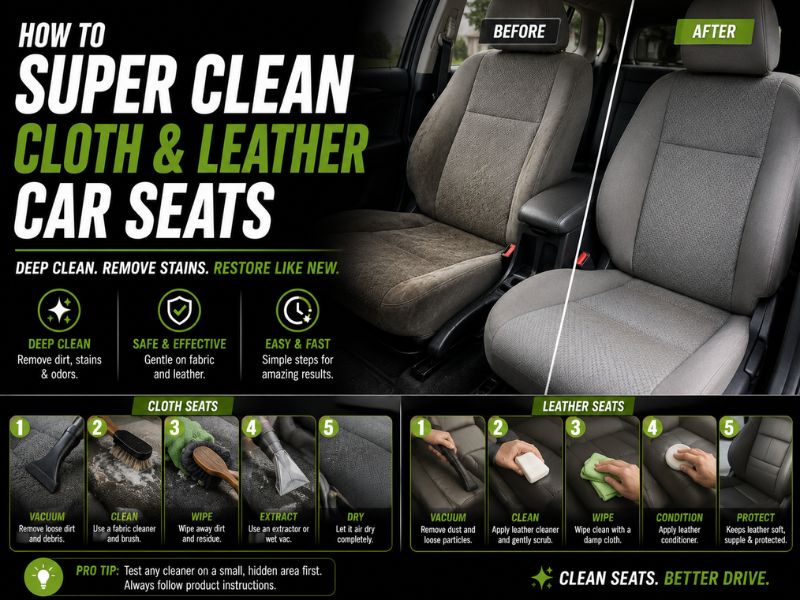
How to Super Clean Cloth and Leather Car Seats
To super clean cloth and leather car seats, vacuum thoroughly first, identify the upholstery type, use a cleaner designed for that material, work in small sections, remove dirt and residue without over-wetting, and let the seats dry completely before normal use.
Cloth and leather seats need different cleaning methods. Cloth can trap dirt deep inside the fibers and seat foam, while leather needs gentler cleaning to avoid damaging its protective finish. Using too much cleaner, scrubbing too aggressively, or soaking the upholstery can make the seats look worse instead of better.
A proper deep clean starts with dry dirt removal, then moves to stain treatment, controlled cleaning, residue removal, and complete drying.
First, Identify What Type of Seat Material You Have
Before choosing a cleaner, confirm what the seat is actually made from.
Vehicle seats may use:
- Cloth or woven fabric
- Coated automotive leather
- Synthetic leather
- Vinyl
- Suede-like microfiber
- Mixed-material upholstery
This matters because a cleaner that works well on cloth may be too aggressive for leather, while a leather product may not remove embedded dirt from fabric effectively.
Do not judge the material only by appearance. Some synthetic upholstery can look very similar to leather.
Use products that are compatible with the actual seat material.
What You Need to Clean Car Seats
A basic cleaning setup may include:
- Vacuum cleaner
- Crevice tool
- Microfiber towels
- Soft upholstery brush
- Fabric cleaner
- Leather-safe cleaner
- Spray bottle
- Small detailing brush
For cloth seats, a wet/dry vacuum or upholstery extractor can also be useful.
Optional tools include:
- Drill brush for durable cloth
- Blower or compressed air
- Leather protectant or conditioner when appropriate
You do not need every tool to get a good result. Technique matters more than using the largest possible collection of products.
Step 1: Vacuum the Seats Thoroughly
Always remove dry debris before applying liquid cleaner.
Vacuum:
- Seat surfaces
- Seams
- Creases
- Bolsters
- Under headrests
- Between seat and center console
- Area where seat back meets seat base
Use the crevice tool carefully around tight spaces.
Common debris includes:
- Dust
- Sand
- Crumbs
- Pet hair
- Fine dirt
If this material gets wet before being removed, it can turn into a dirty slurry and become harder to clean.
Step 2: Inspect the Seats for Stains and Damage
Look closely before general cleaning.
Possible stains include:
- Coffee
- Soda
- Grease
- Food
- Makeup
- Mud
- Pet messes
- Dye transfer
Also inspect for physical damage such as:
- Frayed cloth
- Cracked leather
- Worn color coating
- Loose stitching
- Torn perforations
Not every discoloration is removable dirt.
A worn leather finish, for example, may remain lighter or shinier even after cleaning.
How to Super Clean Cloth Car Seats
Cloth seats generally benefit from a combination of vacuuming, controlled moisture, agitation, and extraction.
Step 1: Pretreat Stains
Treat visible stains before cleaning the entire seat.
Apply a fabric-safe stain cleaner lightly.
Allow it to work according to the product instructions.
Avoid soaking the area.
For stubborn stains, several controlled treatments are often better than one heavy application.
Step 2: Apply Fabric Cleaner Lightly
Mist the cleaner across a manageable section.
Do not flood the seat.
The goal is to dampen the upholstery enough for the cleaner to loosen dirt without allowing large amounts of liquid to soak into the foam underneath.
Work one seat panel at a time.
Step 3: Agitate the Fabric
Use a soft or medium upholstery brush.
Brush gently in several directions to loosen embedded contamination.
Give extra attention to:
- Seat edges
- Driver seat base
- High-contact areas
- Stained sections
Avoid using excessive force. Aggressive brushing can roughen or damage some fabrics.
Step 4: Extract or Blot the Dirt
After agitation, remove the dirty solution.
You can use:
- Upholstery extractor
- Wet/dry vacuum
- Clean microfiber towels
If using towels, press and blot rather than rubbing dirty moisture around the seat.
Turn the towel frequently so a clean section is always contacting the fabric.
Step 5: Repeat if Needed
Very dirty cloth seats may need multiple passes.
Use several light cleaning cycles rather than saturating the seat during the first attempt.
This gives you better control over moisture and reduces drying time.
Can You Use a Drill Brush on Cloth Seats?
Yes, on some durable cloth upholstery.
A drill brush can speed up agitation, but it should be used carefully.
Choose a soft or medium brush intended for upholstery.
Use:
- Low to moderate speed
- Light pressure
- Short passes
Always test a hidden area first.
Avoid a drill brush when the fabric is:
- Delicate
- Frayed
- Loosely woven
- Textured in a way that may catch the bristles
Remember that the brush only loosens dirt.
You still need to remove the dirty solution afterward.
How to Clean Cloth Seats Without an Extractor
You can still deep-clean cloth seats without specialized extraction equipment.
Use this process:
- Vacuum thoroughly.
- Pretreat visible stains.
- Mist fabric cleaner lightly.
- Agitate with an upholstery brush.
- Blot with clean microfiber towels.
- Repeat until the towels stop picking up significant dirt.
- Allow the seat to dry completely.
Use less liquid than you would with an extractor because you do not have a machine to recover excess moisture.
How Wet Should Cloth Seats Get?
They should become damp, not saturated.
Too much moisture can soak into the seat foam.
That may cause:
- Long drying time
- Musty odor
- Water rings
- Cleaner residue
- Hidden moisture
Modern seats may also contain:
- Heating elements
- Ventilation components
- Occupancy sensors
- Airbag wiring
This is another reason to avoid flooding the upholstery.
Use the least moisture necessary to loosen and remove the dirt.
How to Remove Stains From Cloth Seats
Different stains respond best to different approaches.
Coffee and Soda
Blot fresh spills quickly.
Use a fabric-safe cleaner and work the area gradually.
Sugary drinks can leave sticky residue even after the visible stain fades, so residue removal is important.
Grease and Oil
Blot excess material before cleaning.
Use an upholstery-safe cleaner suitable for oily contamination.
Work from the edge of the stain toward the center to reduce spreading.
Mud
If the mud is thick, allow it to dry first when practical.
Then:
- Brush
- Vacuum
- Treat remaining discoloration
Adding cleaner directly to heavy wet mud can spread it deeper into the fabric.
Pet Messes
Remove the contamination itself before attempting to deodorize the seat.
Use a cleaner appropriate for automotive upholstery.
A fragrance spray alone will not remove the source of an odor.
How to Avoid Water Rings on Cloth Seats
Water rings can appear when one small area gets much wetter than the surrounding fabric.
They may also result from:
- Dirty solution spreading outward
- Excess cleaner
- Uneven extraction
- Residue remaining in the fabric
To reduce the risk:
- Use controlled moisture
- Blend the edges of the cleaned area
- Clean an entire seat panel when appropriate
- Extract or blot evenly
Avoid soaking one small circle while leaving the surrounding upholstery completely dry.
How to Dry Cloth Seats Properly
Drying is part of the cleaning process.
After cleaning:
- Extract as much moisture as possible
- Blot with dry microfiber towels
- Increase ventilation
- Use fans if available
- Leave doors or windows open only when conditions are safe and dry
Do not immediately sit on heavily damp seats.
Also avoid closing the vehicle tightly while the upholstery is still wet.
Trapped moisture can create musty odors.
How to Super Clean Leather Car Seats
Leather requires a gentler process than cloth.
Modern automotive leather often has a protective coating over the surface, so the goal is usually to clean that finish without aggressively stripping it.
Step 1: Vacuum Carefully
Remove loose debris from:
- Seams
- Perforations
- Bolsters
- Seat creases
Keep hard vacuum attachments from scratching the surface.
Step 2: Apply Leather Cleaner
For better control, apply the cleaner to a microfiber towel or soft brush instead of flooding the seat directly.
Work on a small section at a time.
Step 3: Agitate Gently
Use a soft detailing or leather brush.
Gently work the cleaner across the surface.
Pay extra attention to areas that collect:
- Body oils
- Dirt
- Dye transfer
These often include:
- Driver bolster
- Seat base
- Outer seat edge
Step 4: Wipe Away the Dirty Residue
Use a clean microfiber towel.
You may be surprised by how much dark residue comes off a seat that initially looked fairly clean.
Repeat gently if necessary.
Do not let excess cleaner sit and dry on the surface.
How Hard Should You Scrub Leather?
Not very hard.
Aggressive scrubbing can:
- Wear the protective finish
- Remove color
- Damage stitching
- Create shiny patches
If dirt does not come off immediately, allow the cleaner time to work and repeat gently.
Let the product and soft agitation do the cleaning rather than relying on heavy pressure.
Should You Condition Leather Seats After Cleaning?
Sometimes.
Whether conditioning is useful depends on:
- Leather type
- Protective coating
- Product instructions
- Seat condition
Many modern automotive leather surfaces are coated, so a heavy oil-based conditioner may not penetrate the material the way people expect.
If you use a conditioner or protectant, choose one designed for automotive leather.
Apply it thinly and evenly.
Avoid products that leave the seats:
- Greasy
- Oily
- Slippery
Conditioning also does not repair cracked or worn-through leather.
Can You Steam Clean Leather Seats?
Steam can be used carefully in some detailing situations, but it introduces both heat and moisture.
Potential problems include:
- Finish damage
- Excess moisture
- Adhesive issues
- Stress around seams
Do not hold concentrated steam against one area for long periods.
For most routine cleaning, leather-safe cleaner, a soft brush, and microfiber towels are easier to control.
Can You Use Household Cleaners on Leather?
Generally, it is safer to avoid strong household products unless they are specifically compatible with automotive leather.
Potentially harsh products include:
- Bleach
- Strong degreasers
- High-alkaline cleaners
- Strong solvents
- Alcohol-heavy mixtures
These can affect:
- Color
- Surface coating
- Flexibility
- Stitching
Use a cleaner designed for automotive leather or the exact seat material instead.
How to Clean Perforated Leather Seats
Perforated seats require extra moisture control.
The small holes may be part of:
- Heated seats
- Ventilated seats
- Cooled-seat systems
Apply cleaner to a towel or brush rather than heavily spraying the seat.
Use minimal liquid.
Avoid forcing cleaner down through the perforations.
Wipe residue promptly.
The goal is to clean the surface without flooding the openings underneath.
How to Clean White or Light-Colored Leather
Light leather can show staining more quickly.
Common problems include:
- Denim dye
- Makeup
- Body oils
- Dirt transfer
Clean these areas gently and repeatedly rather than using aggressive chemicals.
If dye has penetrated the finish or the surface coating is already worn, complete removal may not be possible through cleaning alone.
How to Remove Bad Odors From Car Seats
Odor removal starts with identifying the source.
For cloth seats:
- Clean the contamination
- Extract residue
- Dry thoroughly
For leather:
- Clean the surface
- Inspect seams
- Check nearby carpet and trim
Persistent smells may actually come from:
- Seat foam
- Carpet
- HVAC system
- Headliner
- Water leak
Do not assume the seat surface is always the source.
What About Heated, Cooled, or Powered Seats?
Modern seats can contain significant electrical and safety hardware.
This may include:
- Heating elements
- Cooling fans
- Motors
- Wiring
- Occupancy sensors
- Side airbags
Avoid excessive moisture around switches, seams, connectors, and perforations.
Do not disassemble seat electronics simply for routine cleaning.
Can You Remove Car Seats for Deep Cleaning?
It is possible, but it is usually unnecessary for normal detailing.
Modern seat assemblies may include:
- Airbag systems
- Pretensioner wiring
- Occupancy sensors
- Power controls
- Heating and ventilation systems
Removing and disconnecting seats can introduce safety-system and calibration issues.
For routine cleaning, leaving the seats installed is usually the simpler approach unless you understand the exact service procedure.
Cloth vs. Leather Seat Cleaning
| Task | Cloth Seats | Leather Seats |
| Vacuum first | Yes | Yes |
| Heavy water use | Avoid | Avoid |
| Extraction | Very useful | Usually unnecessary |
| Brush agitation | Moderate | Gentle |
| Drill brush | Sometimes | Generally avoid |
| Conditioner | Not needed | Sometimes useful |
| Drying concern | Higher | Lower with controlled cleaning |
The most important difference is how deeply dirt and moisture can move into the material.
Why Do My Seats Still Look Dirty After Cleaning?
There are several possibilities.
Dirt Is Still Embedded
Cloth may need another controlled cleaning pass.
Cleaner Residue Remains
Residue can leave fabric stiff, sticky, or uneven.
The Stain Is Permanent
Some dyes and spills permanently alter the material.
Leather Finish Is Worn
A shiny or discolored section may be wear rather than dirt.
The Seat Dried Unevenly
Cloth can temporarily look different while damp.
Allow it to dry fully before deciding whether another treatment is needed.
Common Seat-Cleaning Mistakes
Avoid these common errors:
- Skipping vacuuming
- Using one cleaner on every material
- Soaking cloth seats
- Scrubbing leather aggressively
- Using harsh household chemicals
- Using a stiff drill brush on delicate fabric
- Letting cleaner dry on leather
- Flooding perforated seats
- Ignoring seat electronics
- Closing the vehicle while upholstery is damp
- Covering odors instead of removing the source
How Often Should You Deep Clean Car Seats?
There is no universal schedule.
Seats may need cleaning more often in vehicles used by:
- Families with children
- Pet owners
- Work crews
- Frequent passengers
Light-colored interiors may also show dirt more quickly.
For normal use:
- Vacuum regularly
- Spot-clean spills quickly
- Deep-clean as needed
It is usually better to remove spills early than wait until they become deeply embedded stains.
How to Keep Car Seats Cleaner Longer
Good maintenance reduces the need for aggressive deep cleaning.
- Vacuum regularly
- Clean spills quickly
- Remove food debris
- Avoid harsh chemicals
- Keep leather protected appropriately
- Address water leaks promptly
- Do not allow mud and stains to sit for months
Frequent light maintenance is easier on the upholstery than repeated heavy restoration.
Frequently Asked Questions
How Do You Super Clean Cloth Car Seats?
Vacuum thoroughly, pretreat stains, apply a small amount of fabric cleaner, agitate gently, extract or blot the dirty solution, and allow the seat to dry completely.
How Do You Super Clean Leather Car Seats?
Vacuum carefully, apply leather-safe cleaner, agitate gently with a soft brush, wipe away the residue, and apply an appropriate protectant or conditioner if needed.
Can You Shampoo Cloth Car Seats?
Yes, but use controlled moisture and avoid soaking the seat foam.
Can You Clean Cloth Seats Without an Extractor?
Yes. Use light amounts of cleaner and repeatedly blot with clean microfiber towels.
Can You Use a Drill Brush on Car Seats?
It can be used on some durable cloth upholstery, but it should generally be avoided on leather and delicate fabrics.
How Do You Remove Water Stains From Cloth Seats?
Clean the area evenly with controlled moisture and extract or blot the dirty solution. Cleaning the full panel may help avoid visible rings.
How Do You Get Bad Smells Out of Car Seats?
Find and remove the source of the odor, then clean and dry the upholstery completely.
Should You Condition Leather After Cleaning?
Sometimes. Use a product appropriate for the leather type and avoid heavy, greasy treatments.
Can You Steam Clean Leather Car Seats?
It can be done cautiously, but excessive heat and moisture may damage the finish. Gentle conventional cleaning is easier to control.
Can You Use Household Cleaner on Leather Seats?
Strong household cleaners are generally a poor choice unless specifically labeled as compatible with the material.
How Do You Clean Perforated Leather Seats?
Use minimal liquid, apply cleaner to a brush or towel, agitate gently, and keep excess moisture out of the perforations.
How Long Do Cloth Car Seats Take to Dry?
Drying time varies with moisture level, airflow, temperature, humidity, fabric thickness, and how much water reached the seat foam.
Conclusion
To super clean cloth and leather car seats, start with thorough vacuuming, use a cleaning method designed for the specific upholstery, remove dirty residue rather than simply spreading it, and avoid using more moisture or pressure than necessary.
Cloth seats benefit from controlled agitation and extraction because dirt can settle deep into the fibers. Multiple light cleaning passes are usually safer and more effective than saturating the upholstery all at once.
Leather requires a different approach. Gentle cleaner, a soft brush, and clean microfiber towels are usually enough for routine deep cleaning. Aggressive scrubbing and harsh chemicals can damage the protective finish instead of improving it.
Moisture control matters for both materials, especially in modern seats containing heaters, ventilation systems, sensors, and airbags.
Finally, allow everything to dry completely before normal use.
The best seat-cleaning results come from matching the process to the material: lift dirt out of cloth without soaking the foam, clean leather gently without stripping its finish, and finish only when the upholstery is clean, residue-free, and completely dry.