How to Reset an Oxygen Sensor: What Actually Works
You cannot truly reset an oxygen sensor itself. After repairing or replacing a faulty O2 sensor, you can clear the diagnostic trouble codes and, when appropriate, reset learned fuel-trim data with a scan tool. If the underlying problem is still present, the check engine light will usually return.
If you are searching for how to reset an oxygen sensor, it helps to understand what actually needs resetting. An oxygen sensor is an electronic sensing component in the exhaust system. It does not normally contain a user-resettable memory or button. Instead, the vehicle’s Engine Control Module (ECM) or Powertrain Control Module (PCM) stores trouble codes and learned fuel adjustments based partly on oxygen-sensor feedback.
After replacing a failed O2 sensor or repairing the problem that caused an oxygen-sensor code, you may need to clear the stored code. On some vehicles, clearing diagnostic information also resets certain adaptive values, allowing the computer to relearn fuel control as you drive.
However, clearing the warning light without repairing the cause is not a real fix. A lean condition, exhaust leak, damaged wiring, misfire, or failing catalytic converter can trigger another oxygen-sensor-related code even if the sensor itself is perfectly good.
This guide explains what an O2 sensor reset really means, how to clear codes with a scan tool, whether disconnecting the battery works, what happens after a reset, and what to do when the check engine light returns.
How to Reset an Oxygen Sensor Correctly
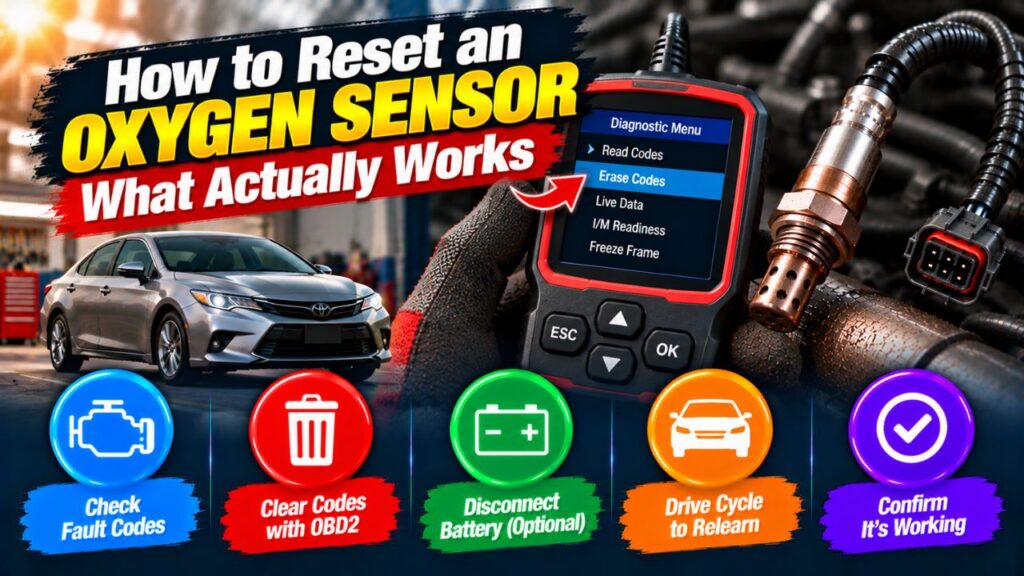
The correct way to reset an oxygen sensor is usually to repair the underlying fault first and then use an OBD-II scan tool to clear the stored diagnostic trouble codes.
The oxygen sensor itself normally does not require programming or a physical reset.
A typical process is:
- Diagnose the oxygen-sensor-related problem.
- Repair the actual cause or replace the confirmed faulty sensor.
- Connect an OBD-II scan tool.
- Read and record the stored codes before clearing them.
- Select the function to clear diagnostic trouble codes.
- Start the engine and verify that no immediate faults return.
- Drive the vehicle normally so the computer can complete its readiness monitors and relearn operating conditions.
Do not clear codes before recording them if you are still diagnosing the vehicle. Stored codes and freeze-frame data can provide valuable clues about when and why the fault occurred.
Can an Oxygen Sensor Actually Be Reset?
Normally, no.
An oxygen sensor measures oxygen content in the exhaust and sends an electrical signal to the engine computer.
Traditional narrowband sensors produce a changing voltage signal, while modern wideband or air-fuel ratio sensors use more complex circuitry to provide precise mixture information.
Neither type normally has a reset procedure built into the sensor itself.
What people often mean by “resetting the O2 sensor” is actually one of three things:
- Clearing an oxygen-sensor trouble code
- Turning off the check engine light after a repair
- Resetting learned fuel-trim or adaptive values
Those functions belong to the engine computer, not the oxygen sensor.
Use an OBD-II Scanner to Clear Oxygen Sensor Codes
For most vehicles sold in the United States from the 1996 model year onward, an OBD-II scanner is the easiest and most appropriate way to clear engine trouble codes.
Connect the Scanner
The OBD-II diagnostic connector is normally located under the dashboard near the driver’s side.
With the vehicle switched off or in the position specified by the scanner manufacturer, plug the scanner into the port.
Turn the Ignition On
Switch the ignition to the ON position without starting the engine if the scanner requests it.
Some tools communicate with the vehicle while the engine is running, but follow your scanner’s instructions.
Read the Codes First
Do not immediately press “Erase.”
Record the diagnostic trouble codes.
Common O2-related codes may indicate:
- Sensor circuit fault
- Heater circuit fault
- Slow response
- Signal stuck rich
- Signal stuck lean
The code may also identify a specific sensor such as Bank 1 Sensor 1 or Bank 2 Sensor 2.
Clear the Codes
After the repair is complete, choose the scanner’s Clear Codes, Erase Codes, or similar function.
The check engine light should go off if no active fault immediately triggers it again.
Why You Should Read the Code Before Clearing It
Clearing the code erases useful diagnostic information.
The PCM may store freeze-frame data, which captures operating conditions when the fault occurred.
That information can include:
- Engine RPM
- Vehicle speed
- Coolant temperature
- Fuel trims
- Engine load
If you erase everything first, diagnosing an intermittent problem may become harder.
Always record the original code before resetting the system.
Will Disconnecting the Battery Reset an Oxygen Sensor?
Disconnecting the battery may erase some stored engine-control information on certain vehicles, but it is not the best general method.
Modern vehicles can retain some data even when battery power is removed, and disconnecting the battery can also reset or affect unrelated systems.
You may lose:
- Clock settings
- Radio presets
- Idle adaptations
- Transmission adaptations on some vehicles
- Window initialization
- Other learned settings
Some vehicles can also require special battery-disconnection procedures.
Using a scan tool allows you to clear the relevant engine codes without unnecessarily disturbing other vehicle systems.
How Long Should the Battery Be Disconnected?
There is no universal time because vehicle electronics differ.
Advice such as “disconnect the battery for 10 minutes” or “leave it off overnight” does not reliably apply to every car.
More importantly, battery disconnection does not repair the problem that triggered the O2 code.
If the sensor, wiring, air-fuel mixture, or exhaust system still has a fault, the computer will detect it again after driving.
A scanner is the better approach.
Do You Need to Reset the Computer After Replacing an Oxygen Sensor?
Not always.
Many vehicles will recognize a properly functioning replacement oxygen sensor automatically.
If the check engine light remains on because a code is stored, you can clear it with a scan tool after completing the repair.
In some cases, the computer may eventually turn the light off automatically after enough successful drive cycles without detecting the fault again.
However, the stored code may remain in history for some time.
Clearing it after a confirmed repair makes it easier to see whether the fault returns.
What Happens After You Clear the O2 Sensor Code?
After clearing diagnostic trouble codes, several engine-computer monitors return to a not ready state.
The vehicle must then be driven through appropriate conditions so these self-tests can run again.
These tests are called readiness monitors.
They may include monitoring of:
- Oxygen sensors
- Oxygen-sensor heaters
- Catalytic converter
- EVAP system
- Misfire detection
- Fuel system
The monitors do not all complete immediately.
What Is a Drive Cycle?
A drive cycle is a combination of operating conditions the engine computer uses to run emissions-related self-tests.
A complete drive cycle may involve:
- Cold start
- Idle period
- Steady-speed driving
- Acceleration
- Deceleration
- Highway driving
- Engine cool-down
The exact requirements vary between manufacturers.
There is no single drive cycle that applies to every vehicle.
If you need the monitors ready for an emissions inspection, use the vehicle manufacturer’s drive-cycle procedure or monitor readiness with a scan tool.
Can the Check Engine Light Turn Off by Itself?
Yes.
If the condition that triggered the fault disappears and does not return, the engine computer may turn the check engine light off after a number of successful monitoring cycles.
The stored diagnostic code may remain in memory longer.
This means you do not always have to manually reset the system after every repair.
However, using a scanner provides immediate confirmation that the code has been cleared and allows you to watch for its return.
Why Does the O2 Sensor Code Come Back After Resetting?
If the code returns, the vehicle is detecting the same or a related problem again.
Common causes include an actually failed oxygen sensor, but they can also include:
- Damaged sensor wiring
- Poor electrical connector
- Blown heater-circuit fuse
- Vacuum leak
- Exhaust leak
- Fuel-delivery problem
- Engine misfire
- Oil or coolant contamination
- Catalytic-converter problem
Repeatedly clearing the code will not fix any of these conditions.
The returning code is useful diagnostic evidence.
An O2 Sensor Code Does Not Always Mean the Sensor Is Bad
This is one of the most important points to understand.
Suppose the upstream oxygen sensor reports that the engine is running lean.
The sensor may be working perfectly.
The real problem could be a vacuum leak allowing extra air into the engine.
Replacing the O2 sensor would not repair the vacuum leak, and the lean code would eventually return.
The same principle applies to rich readings.
A leaking injector or excessive fuel pressure can make a good oxygen sensor report a rich mixture.
Always diagnose the system rather than replacing whatever component appears in the code description.
Resetting Fuel Trims After an O2 Sensor Repair
The engine computer continuously learns how much fuel correction is needed during normal operation.
These corrections are known as fuel trims.
There are generally two forms:
Short-Term Fuel Trim (STFT) responds quickly to current oxygen-sensor feedback.
Long-Term Fuel Trim (LTFT) represents learned correction over a longer period.
If a faulty sensor or vacuum leak caused the computer to learn abnormal fuel corrections, some diagnostic tools can reset adaptive fuel data after the repair.
Whether that is necessary depends on the vehicle.
Many vehicles will gradually relearn correct values on their own.
Do not perform an adaptation reset casually unless you understand what your vehicle requires.
Can Clearing Codes Reset Fuel Trims?
On some vehicles, yes.
Clearing diagnostic trouble codes may also reset long-term fuel adjustments or other learned values.
On other vehicles, adaptive values may be handled differently.
This is one reason the engine may idle or respond slightly differently immediately after a reset.
The computer may need time to relearn normal operating conditions.
How Long Does It Take the Engine to Relearn?
There is no fixed amount of time.
Some basic adjustments happen quickly after startup.
Other adaptive values require multiple driving conditions or complete drive cycles.
During the relearning period, you might notice minor temporary changes in:
- Idle behavior
- Throttle response
- Transmission shifting on some vehicles
If major drivability problems appear after resetting, do not assume they are normal relearning. Recheck the repair and diagnostic codes.
Resetting an Upstream Oxygen Sensor
An upstream O2 sensor is located before the catalytic converter and is used heavily for fuel control.
After replacing a confirmed bad upstream sensor, you generally need only to clear any stored codes if desired and then allow the PCM to resume normal closed-loop operation.
The new sensor does not normally require manual calibration.
However, the correct replacement must match the vehicle.
Universal sensors that require wiring changes need especially careful installation.
Resetting a Downstream Oxygen Sensor
The downstream sensor is located after the catalytic converter and is mainly used to monitor catalyst performance.
It also generally requires no special programming after replacement.
Clear the code and monitor the system.
If a catalyst-efficiency code returns after replacing a downstream sensor, do not continue replacing sensors blindly. The catalytic converter or another exhaust issue may be the actual cause.
What Does Bank 1 Sensor 1 Mean?
Oxygen-sensor codes often use bank and sensor numbers.
Bank 1 is the cylinder bank that contains cylinder No. 1.
Sensor 1 is normally the sensor upstream of the catalytic converter.
So:
Bank 1 Sensor 1 usually means the upstream sensor on the cylinder bank containing cylinder No. 1.
On a V-engine, Bank 2 is the opposite cylinder bank.
On many inline engines, there is only Bank 1.
Always verify the exact exhaust layout for your vehicle.
Should You Clear Codes Immediately After Installing a New O2 Sensor?
You can clear them once you are confident the repair is complete.
Before clearing, however, make sure you have:
- Connected the sensor fully
- Routed the wiring away from hot exhaust parts
- Reinstalled any clips
- Repaired exhaust leaks
- Corrected related engine problems
Then clear the code and start the engine.
If the same code returns immediately, there may be an electrical or installation problem.
What If the Check Engine Light Stays On After Reset?
Scan the vehicle again.
The computer may have detected another fault.
If the same O2 sensor code reappears quickly, investigate:
- Connector not fully seated
- Damaged wiring
- Wrong replacement sensor
- Heater circuit fuse
- Exhaust leak
- Sensor ground or power problem
Do not assume the new sensor is defective until the circuit and installation are checked.
Can You Reset a Bad Oxygen Sensor and Keep Using It?
No reset can repair a physically or chemically failed sensor.
If the sensing element is contaminated, heater is burned out, wiring is internally damaged, or response is too slow, clearing the code only removes the warning temporarily.
Once the PCM runs its diagnostic test again, the fault is likely to return.
A genuine sensor failure requires replacement.
Can You Clean an O2 Sensor Instead of Resetting It?
Cleaning is generally not considered a reliable oxygen-sensor repair.
The sensing element is delicate.
Using carb cleaner, brake cleaner, fuel, or other chemicals can damage the sensor or fail to remove the contamination causing the problem.
If oil, coolant, silicone, or other contaminants have damaged the sensing element, replacement is normally more reliable.
The underlying contamination source should also be repaired.
Can You Reset an O2 Sensor Without a Scanner?
You may be able to wait for the computer to turn the check engine light off naturally after the fault is corrected.
Battery disconnection can also clear some information on certain vehicles, but it has disadvantages and does not work consistently across all modern vehicles.
For reliable diagnosis and code clearing, even an inexpensive OBD-II scan tool is preferable.
Will an Auto Parts Store Reset the O2 Sensor?
Some auto parts stores offer basic code reading, but policies regarding clearing codes vary.
Even when a code can be erased, code clearing should happen only after the underlying fault has been diagnosed and repaired.
A code reader cannot by itself prove that the oxygen sensor is defective.
Can You Pass Emissions Right After Resetting the O2 Sensor?
Often, no.
Clearing trouble codes also resets emissions readiness monitors.
An inspection system may reject the vehicle if too many monitors are still listed as “not ready,” even when the check engine light is off.
You usually need to drive the vehicle until the required monitors complete.
Do not clear codes immediately before an emissions inspection just to turn off the check engine light.
The inspection system can detect monitor readiness.
Common Mistakes When Resetting an Oxygen Sensor
A common mistake is clearing the check engine light before diagnosing the original code. Doing so can erase freeze-frame information that could have helped identify the problem.
Another mistake is assuming that code clearing repaired the vehicle. The warning may stay off until the PCM repeats its test, after which the same problem returns.
It is also common to replace an oxygen sensor based only on a lean or rich code. The sensor may simply be reporting an actual air-fuel problem caused elsewhere in the engine.
Finally, avoid disconnecting the battery unnecessarily. A scan tool is normally a cleaner way to erase engine codes without resetting unrelated electronic settings.
When Should You Have a Mechanic Diagnose the Problem?
Professional diagnosis makes sense when an oxygen-sensor code repeatedly returns after the sensor has been replaced or when several sensor-related codes appear together.
You may also need professional help if there are signs of:
- Damaged wiring near the exhaust
- Persistent lean or rich operation
- Multiple misfires
- Catalytic-converter problems
- Oil or coolant burning
- Complex wideband sensor faults
These conditions require more than simply resetting the computer.
FAQs About How to Reset an Oxygen Sensor
Can you reset an oxygen sensor?
Not the sensor itself.
You can clear the O2 sensor-related diagnostic trouble codes and, on some vehicles, reset learned fuel adaptations in the engine computer.
Do I need to reset the ECU after changing an O2 sensor?
Usually not.
The ECU normally recognizes the new sensor automatically. Clearing the stored trouble code with a scan tool is often all that is required.
How do I reset the check engine light after replacing an O2 sensor?
Connect an OBD-II scanner, read the existing codes, confirm the repair is complete, and use the scanner’s erase-code function.
Will disconnecting the battery reset an oxygen sensor?
It may clear some engine-control memory on certain vehicles, but it does not reset the physical sensor and is not the preferred method.
A scan tool provides better control.
How long does it take for an O2 sensor to reset?
The sensor itself does not need a reset period.
After clearing codes, the PCM may need one or more drive cycles to complete oxygen-sensor and emissions readiness tests.
Why does my oxygen sensor code keep coming back?
Either the sensor or circuit still has a fault, or another engine problem is causing the sensor to report abnormal exhaust conditions.
Check wiring, fuel trims, vacuum leaks, exhaust leaks, misfires, and fuel-delivery problems.
Can I clear an O2 sensor code without replacing the sensor?
Yes, technically, but if the fault is still present, the code will return.
Clearing a code should not be used as a substitute for diagnosis and repair.
Can I pass an emissions test after resetting an O2 sensor code?
Not necessarily.
Clearing codes resets emissions readiness monitors. The vehicle may need to complete its required drive cycles before it can pass an OBD-based inspection.
Conclusion
If you are trying to learn how to reset an oxygen sensor, the most important takeaway is that the oxygen sensor itself normally cannot and does not need to be reset. What you are actually resetting is the engine computer’s stored trouble-code information and, on some vehicles, learned adaptive values.
The best procedure is to diagnose the fault first, repair or replace the failed component, record the original diagnostic codes, and then use an OBD-II scan tool to clear them. Afterward, drive the vehicle normally so the PCM can relearn fuel corrections and complete its oxygen-sensor, catalyst, and other readiness monitors.
Disconnecting the battery may clear some memory on certain vehicles, but it is less precise and can reset unrelated settings. More importantly, neither battery disconnection nor code clearing can repair a bad O2 sensor, vacuum leak, wiring fault, exhaust leak, fuel problem, or failing catalytic converter.
The final verdict is simple: resetting should be the last step after a confirmed repair, not the repair itself. If the O2 sensor code returns, use that as evidence that an underlying problem still exists and diagnose the system rather than repeatedly erasing the warning light.