How Long Does a PCV Valve Last? Replacement Signs and Lifespan
The positive crankcase ventilation (PCV) valve is a small engine component, but it plays an important role in controlling crankcase pressure and routing blow-by gases back into the intake system. Because the PCV valve constantly handles oil vapor, moisture, and combustion gases, it can eventually become restricted, stuck, or worn.
A traditional PCV valve often lasts roughly 50,000 to 100,000 miles, but there is no universal replacement interval. Some valves last much longer, while others fail earlier because of oil contamination, sludge, short-trip driving, or engine wear.
If you are wondering how long does a PCV valve last, the best answer comes from your vehicle manufacturer’s maintenance schedule and the condition of the PCV system itself. Many modern vehicles no longer use a simple removable valve; instead, the PCV regulator or diaphragm may be built into the valve cover or oil-separator assembly.
This guide explains typical PCV valve lifespan, what makes one fail early, the symptoms of a worn valve, and when replacement makes more sense than waiting for a specific mileage.
How Long Does a PCV Valve Last?
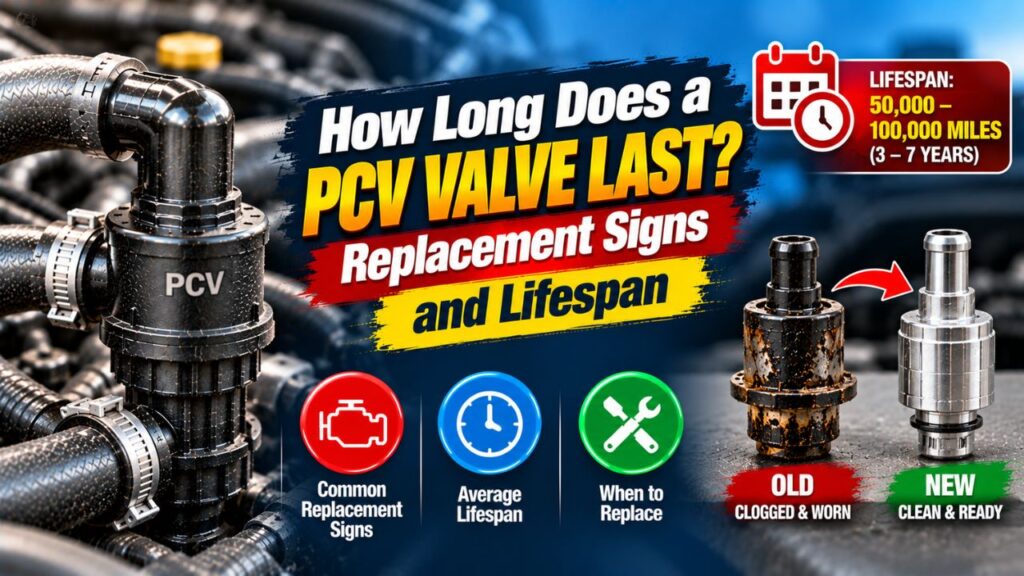
A conventional PCV valve can often last around 50,000 to 100,000 miles, although some continue working properly well beyond that range.
Mileage alone should not determine replacement. PCV lifespan depends heavily on engine condition, oil quality, maintenance history, operating temperature, and the design of the ventilation system.
Some vehicle manufacturers specify a PCV inspection or replacement interval. Others treat the valve as an inspect-and-replace-as-needed component.
That means a PCV valve with 120,000 miles may still function correctly, while another can become restricted at 60,000 miles.
The vehicle’s service information should always take priority over a generic mileage estimate.
What Does a PCV Valve Do?
The PCV system manages gases that enter the crankcase while the engine runs.
A small amount of combustion pressure escapes past the piston rings. These gases are called blow-by gases.
Instead of allowing blow-by to accumulate inside the crankcase, the PCV system routes it back into the intake manifold so the engine can burn it.
The PCV valve helps regulate that airflow.
A properly functioning PCV system helps:
- Control crankcase pressure
- Reduce harmful emissions
- Remove moisture and combustion gases
- Limit sludge formation
- Reduce pressure on engine seals and gaskets
Because oil mist and combustion contaminants continually pass through the system, deposits can eventually interfere with the valve.
Why There Is No Exact PCV Valve Lifespan
Unlike some maintenance items, a PCV valve does not wear according to one predictable schedule.
Two identical vehicles with the same mileage can have very different PCV conditions.
For example, an engine driven mainly on long highway trips may keep its crankcase relatively clean and warm. Another vehicle driven primarily on short trips may accumulate more moisture and deposits.
Engine condition also matters.
An older engine with increased piston-ring blow-by sends more vapor through the PCV system, potentially increasing contamination.
This is why the answer to how long does a PCV valve last should be treated as a range rather than a fixed number.
What Makes a PCV Valve Wear Out Faster?
Several operating conditions can shorten PCV valve life.
Infrequent Oil Changes
Old engine oil can contribute to varnish, carbon, and sludge formation.
Those deposits can enter the crankcase ventilation system and restrict the PCV valve.
Regular oil changes using the correct oil help keep the crankcase cleaner.
Frequent Short Trips
Short trips can prevent the engine from reaching full operating temperature for long enough to evaporate moisture.
Over time, moisture mixed with oil vapor can contribute to sludge and deposits in the PCV system.
Excessive Engine Blow-By
Worn piston rings or cylinder wear can allow more combustion gases into the crankcase.
The PCV system then has to handle a greater volume of vapor and contamination.
Poor-Quality or Incorrect Oil
Using oil that does not meet the engine manufacturer’s specifications can contribute to deposit formation and lubrication problems.
The correct oil grade and specification help protect both the engine and its ventilation system.
Engine Overheating
Repeated overheating can accelerate oil oxidation and deposit formation.
That contamination may eventually affect the PCV valve and related hoses.
Does a PCV Valve Wear Out or Just Get Clogged?
Both can happen.
Traditional PCV valves usually contain an internal plunger or similar regulating mechanism.
Over time, the valve may become:
- Restricted by deposits
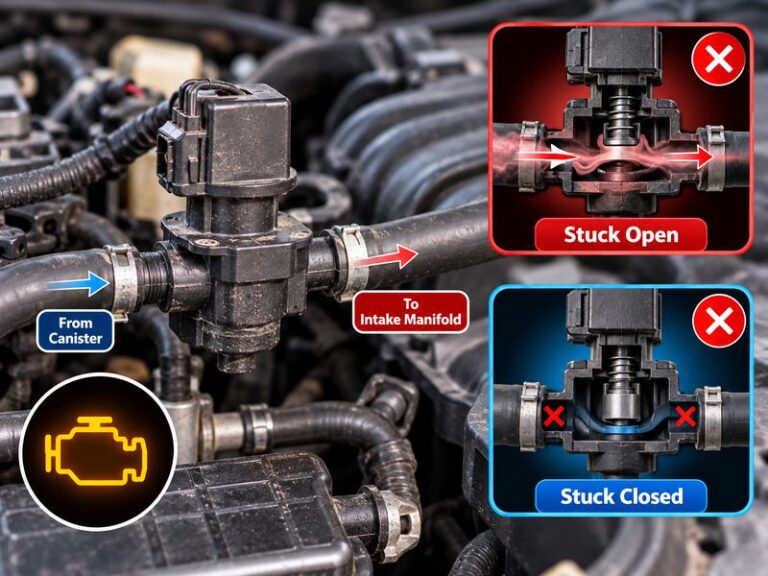
- Stuck open
- Stuck closed
- Worn internally
A clogged valve cannot ventilate the crankcase properly.
A valve stuck open can allow excessive intake airflow and act much like a vacuum leak.
Modern diaphragm-style PCV systems can fail differently. The rubber diaphragm may split, tear, or harden with age and heat.
Signs a PCV Valve May Be Near the End of Its Life
PCV problems can affect both engine operation and oil control.
Possible symptoms include rough idle, whistling noises, oil leaks, increased oil consumption, lean trouble codes, or unusual crankcase pressure.
One symptom by itself does not prove the PCV valve has failed.
For example, rough idle can also result from ignition, fuel, throttle, or vacuum problems.
The PCV system should be diagnosed rather than replaced only because the vehicle has reached a certain mileage.
Can a Bad PCV Valve Cause Rough Idle?
Yes.
A PCV valve stuck open can allow too much air into the intake manifold.
That additional airflow can behave like a vacuum leak, especially at idle when total engine airflow is relatively low.
The engine may then:
- Shake
- Surge
- Idle too high
- Stall
- Set lean-condition codes
A torn PCV diaphragm can produce similar symptoms.
Can an Old PCV Valve Cause Oil Leaks?
Yes, particularly if the valve becomes clogged or stuck closed.
When crankcase gases cannot escape normally, pressure can build inside the engine.
That pressure may force oil past:
- Valve-cover gaskets
- Crankshaft seals
- Camshaft seals
- Other engine seals
Replacing a restricted PCV valve can correct excessive crankcase pressure if the valve is truly the cause.
However, replacing the valve will not repair a seal that has already become physically damaged.
Can a PCV Valve Cause Oil Consumption?
Yes, certain PCV failures can increase oil consumption.
A PCV system that draws too much vacuum may pull excessive oil mist into the intake.
That oil can then be burned in the cylinders.
Possible clues include:
- Increased oil usage
- Oil in the intake
- Blue exhaust smoke in some cases
- Oily spark plugs
High oil consumption can also come from worn piston rings, valve seals, turbocharger problems, or external leaks, so PCV diagnosis should be part of the investigation rather than the only assumption.
Should You Replace a PCV Valve at 50,000 Miles?
Not automatically.
Some manufacturers may recommend inspection or replacement around that mileage, while others may not specify a routine interval.
If the valve is inexpensive and easily accessible, preventive replacement may be reasonable when the vehicle is already receiving related maintenance.
However, replacing a perfectly functioning PCV valve at an arbitrary mileage is not always necessary.
Consult the maintenance schedule for your specific:
- Year
- Make
- Model
- Engine
Engine-specific guidance is more useful than a universal interval.
Should You Replace a PCV Valve at 100,000 Miles?
At around 100,000 miles, checking the PCV system is sensible if it has never been inspected.
That does not mean every PCV valve must be replaced exactly at 100,000 miles.
By this mileage, however, age-related issues become more likely.
Inspect the valve, hoses, fittings, and any integrated diaphragm system for:
- Deposits
- Cracking
- Oil contamination
- Vacuum leaks
- Restricted airflow
If the PCV component is inexpensive and the manufacturer allows straightforward replacement, installing a new valve can be reasonable preventive maintenance.
How Long Does a PCV Hose Last?
PCV hoses may last many years, but heat and oil exposure can eventually damage them.
An old hose may become:
- Brittle
- Soft
- Cracked
- Collapsed
- Oil-soaked
A perfectly good PCV valve cannot function correctly if its hose leaks or collapses.
When servicing the valve, inspect the entire ventilation path rather than focusing only on the valve itself.
Modern PCV Systems May Not Have a Separate Valve
Many newer engines use an integrated crankcase ventilation system instead of a simple removable PCV valve.
The regulating mechanism may be built into the:
- Valve cover
- Oil separator
- Breather module
These systems often use a diaphragm to control crankcase pressure.
If the diaphragm fails, you may need to replace the complete assembly rather than a small 10–20-style traditional valve.
This is why looking up the exact vehicle design matters before purchasing parts.
How Do You Know When to Replace the PCV Valve?
The best time to replace a PCV valve is when testing, inspection, or the maintenance schedule indicates it is no longer operating correctly.
Replacement makes sense when the valve is confirmed to be:
- Stuck
- Restricted
- Internally damaged
- Causing incorrect crankcase vacuum
- Responsible for a vacuum leak
- Due under the manufacturer’s maintenance schedule
If the valve is part of an integrated assembly, follow the manufacturer’s diagnostic procedure.
Does the PCV Valve Rattle Test Show Whether It Is Good?
Not reliably.
Older PCV valves often contain an internal plunger that makes a rattling sound when shaken.
If there is no movement at all, the valve may be clogged.
However, a valve that rattles can still be faulty.
It could flow too much air, leak, or have a weakened internal spring.
The rattle test is therefore only a basic check for some traditional designs.
Can You Clean a PCV Valve Instead of Replacing It?
Sometimes an older removable PCV valve can be cleaned, but replacement is generally more dependable when the valve is inexpensive.
Cleaning may remove deposits but cannot repair:
- Worn internal parts
- Weak springs
- Damaged seals
- Cracked plastic
- Torn diaphragms
Modern integrated PCV components often are not designed to be cleaned internally.
Follow the manufacturer’s servicing instructions.
How Much Does It Cost to Replace a PCV Valve?
A traditional PCV valve is often inexpensive, but total repair cost varies considerably by vehicle.
On an older engine with an easily accessible valve, replacement may require only a small part and a few minutes of labor.
On a modern engine where the PCV system is built into the valve cover, the repair can be substantially more expensive because the entire assembly and gasket may need replacement.
The actual cost depends on:
- Vehicle design
- Parts price
- Accessibility
- Labor rate
- Whether hoses or related components need replacement
What Happens If You Never Replace a Bad PCV Valve?
A failed PCV valve may cause more than a minor drivability issue.
A restricted system can contribute to excessive crankcase pressure, sludge, and oil leaks.
An excessively open PCV system can create a vacuum leak, lean operation, rough idle, or increased oil consumption.
Ignoring the problem can therefore increase the chance of additional repairs.
A functioning PCV system also helps control moisture and combustion contaminants inside the crankcase, so maintaining it contributes to overall engine cleanliness.
Can You Drive With an Old PCV Valve?
Age alone does not make a PCV valve unsafe.
If the valve is functioning correctly, there is usually no reason to stop driving simply because it has high mileage.
If it has failed, the seriousness depends on the failure mode.
A mild ventilation issue may allow short-term operation, while severe rough running, excessive oil leakage, or major crankcase-pressure problems deserve prompt attention.
If the engine is misfiring severely or the check engine light is flashing, avoid continued driving until the cause is diagnosed.
PCV Valve Lifespan vs. Engine Lifespan
A PCV valve is generally not expected to last forever, but neither is it necessarily replaced several times during every engine’s life.
A well-maintained engine may allow the original PCV system to last for many years.
On the other hand, a sludge-prone or worn engine can contaminate replacement PCV valves more quickly.
The health of the engine and the PCV system are closely connected.
Maintaining clean oil and fixing excessive blow-by or oil-control problems can help the replacement PCV component last longer.
How to Help a PCV Valve Last Longer
The most effective way to support PCV life is through normal engine maintenance.
Use the correct motor oil and change it according to the vehicle manufacturer’s interval. Avoid repeatedly extending oil changes far beyond the recommended schedule.
Make sure the engine reaches normal operating temperature regularly, especially if the vehicle is usually used for very short trips.
Inspect the PCV hoses whenever other engine work exposes them. Replacing a cracked hose early can prevent vacuum leaks and keep the ventilation system working correctly.
FAQs About How Long Does a PCV Valve Last
How long does a PCV valve last on average?
A traditional PCV valve often lasts roughly 50,000 to 100,000 miles, although some last significantly longer.
The exact lifespan depends on engine design, maintenance, operating conditions, and contamination.
Can a PCV valve last 150,000 miles?
Yes, some PCV valves can remain functional for 150,000 miles or more.
Mileage alone does not confirm the valve’s condition.
If the vehicle has high mileage and the PCV system has never been inspected, checking it is reasonable.
How often should a PCV valve be replaced?
There is no universal replacement interval.
Follow the maintenance schedule for your specific vehicle. If no interval is specified, inspect the PCV system periodically and replace faulty components as needed.
Does a PCV valve go bad with age even at low mileage?
It can.
Heat, oil vapor, moisture, and material aging can affect PCV components even when annual mileage is low.
Rubber diaphragms and hoses can become brittle or cracked over time.
What are the first signs of a failing PCV valve?
Common signs can include rough idle, whistling, hissing, oil leaks, increased oil consumption, excessive crankcase pressure, or lean trouble codes.
These symptoms can have other causes, so diagnosis is important.
Can a bad PCV valve damage an engine?
A failed valve can contribute to sludge, oil leaks, excessive crankcase pressure, lean operation, and increased oil consumption.
Severe problems left unrepaired can contribute to additional engine issues.
Is a PCV valve expensive to replace?
A traditional standalone PCV valve is often inexpensive.
Integrated modern systems can cost much more because the valve may be built into the valve cover or oil-separator assembly.
Should I replace the PCV valve when changing spark plugs?
Not automatically.
However, if the engine is already at a mileage where the PCV system is due for inspection, combining the services may be convenient.
Replace the valve based on its condition and the manufacturer’s maintenance recommendations.
Conclusion
The practical answer to how long does a PCV valve last is that many traditional valves can remain functional for roughly 50,000 to 100,000 miles, and some last considerably longer. There is no universal mileage at which every PCV valve suddenly fails, so vehicle-specific maintenance guidance and actual system condition matter more than an arbitrary number.
A healthy PCV valve should regulate crankcase ventilation without creating excessive vacuum or allowing pressure to build inside the engine. If you notice rough idle, whistling, lean codes, unexplained oil leaks, abnormal crankcase pressure, or increased oil consumption, inspect the entire PCV system—including the valve, hoses, and any integrated diaphragm.
For a vehicle with no symptoms and no scheduled PCV replacement interval, routine inspection is usually more sensible than replacing the valve solely because of mileage. If testing shows that the valve is stuck, restricted, leaking, or otherwise faulty, replacing it promptly can help restore proper crankcase ventilation and prevent related drivability and oil-control problems.