Purge Valve Stuck Open vs Closed: Symptoms, Causes & Fixes
A purge valve stuck open vs closed can produce very different symptoms even though both failures involve the same EVAP component.
A purge valve that is stuck open can continuously allow fuel vapor or unwanted airflow into the engine, often causing rough idle, hard starting after refueling, fuel-trim problems, or a Check Engine light.
A valve that is stuck closed prevents stored fuel vapor from being properly purged from the charcoal canister and may cause EVAP codes, pressure-related problems, or few noticeable drivability symptoms.
The purge valve—also called the EVAP purge valve, canister purge valve, or purge solenoid—normally opens only when the engine control module wants stored gasoline vapor to enter the intake and be burned.
When the valve can no longer control that flow correctly, the entire evaporative emissions system can behave differently.
The important part is identifying which way the valve has failed. A stuck-open purge valve often affects the engine more directly, while a stuck-closed valve more often affects vapor management and EVAP monitoring.
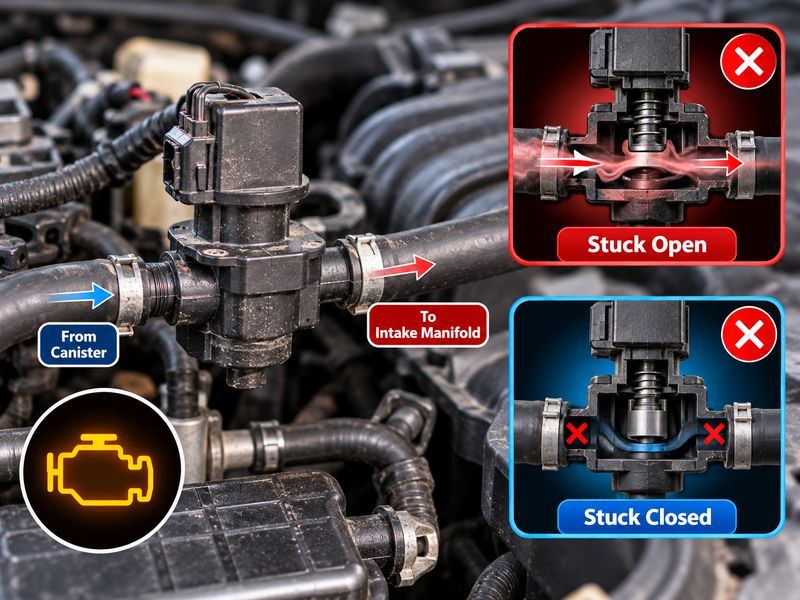
This guide explains the symptoms, causes, differences, testing clues, and common fixes for both conditions.
Purge Valve Stuck Open vs Closed: What’s the Difference?
The main difference is what happens to fuel vapor flow.
A stuck-open purge valve allows vapor or air to pass from the EVAP system toward the engine even when the valve should be closed.
A stuck-closed purge valve prevents vapor from flowing toward the engine even when the engine computer commands the valve to open.
In simple terms:
| Condition | What Happens |
| Purge valve stuck open | Vapor can enter the engine when it should not |
| Purge valve stuck closed | Stored vapor cannot enter the engine when it should |
| Common open-valve effect | Rough running or hard starting |
| Common closed-valve effect | EVAP system cannot purge properly |
| Check Engine light | Possible with both |
| Hard start after refueling | More associated with stuck open |
| Canister saturation | More possible with stuck closed |
| Vacuum leak-like behavior | More common with stuck open |
Both conditions need diagnosis, but their symptoms often point in different directions.
What Does the Purge Valve Normally Do?
The purge valve is part of the evaporative emission control system, or EVAP system.
Gasoline naturally produces vapor inside the fuel tank. Instead of letting that vapor escape into the atmosphere, the EVAP system routes it to a charcoal canister.
The charcoal temporarily stores the hydrocarbons.
When operating conditions are appropriate, the engine control module opens the purge valve. Intake vacuum then draws the stored vapor from the charcoal canister into the engine.
The basic flow is:
Fuel tank → charcoal canister → purge valve → intake manifold → engine
The engine burns the vapor during normal combustion.
When the engine computer does not want purge flow, the valve is normally commanded closed.
This controlled operation prevents too much vapor from entering the engine at the wrong time.
Purge Valve Stuck Open Symptoms
A purge valve stuck open can affect how the engine runs because it creates an uncontrolled path between the EVAP system and the intake.
The severity depends on how far the valve is stuck open and how much vapor or air is flowing through it.
Hard Starting After Refueling
One of the most recognizable purge valve stuck open symptoms is difficult starting immediately after filling the fuel tank.
You may notice:
- Longer cranking
- Engine starts and stalls
- Rough starting
- Need for a second starting attempt
- Engine stumbling immediately after startup
Refueling can increase vapor concentration inside the fuel tank and EVAP system.
If the purge valve is stuck open, those vapors may be drawn into the intake when the engine is starting.
That can temporarily make the air-fuel mixture too rich.
Hard starting after refueling does not automatically prove the purge valve is bad, but it is an important diagnostic clue.
Rough Idle
A stuck-open valve can allow vapor or extra air into the intake manifold when the engine does not expect it.
Idle is especially sensitive because the engine is consuming a relatively small amount of air.
Possible symptoms include:
- Uneven idle
- RPM fluctuations
- Engine shaking
- Occasional stumbling
- Stalling at idle
The engine computer may attempt to compensate by adjusting fuel delivery.
Engine Stalling
A severely leaking purge valve can contribute to stalling, especially:
- Immediately after starting
- Shortly after refueling
- While idling
- When slowing to a stop
The engine may recover at higher RPM because the unintended vapor or airflow represents a smaller percentage of total airflow.
Check Engine Light
A malfunctioning purge valve can trigger the Check Engine light.
The vehicle computer may detect:
- Incorrect purge flow
- Excessive purge flow
- EVAP system leakage
- Abnormal fuel tank pressure
- Purge-valve electrical faults
The exact diagnostic trouble code depends on the vehicle and failure.
A trouble code should be treated as a diagnostic starting point rather than automatic proof that the purge valve itself needs replacement.
Vacuum Leak-Like Symptoms
A purge valve that fails to seal can act somewhat like an intake vacuum leak.
One side of the purge valve may be exposed to engine vacuum.
If the valve leaks continuously, the intake can pull air through the EVAP plumbing.
Possible results include:
- Lean fuel trims
- Rough idle
- Hesitation
- Check Engine light
Whether the mixture actually becomes lean or rich depends on how much air and fuel vapor are entering the system.
Fuel Trim Changes
The engine computer uses oxygen-sensor feedback to adjust fuel delivery.
An uncontrolled purge leak can cause unusual short-term or long-term fuel trims.
A technician using a scan tool may notice fuel-trim behavior change when the purge line is temporarily isolated.
This can be a useful diagnostic clue.
Difficult Warm Restart
Some vehicles may be difficult to restart when warm if the stuck valve allows excessive fuel vapor into the intake.
The engine may:
- Crank longer
- Start roughly
- Smell fuel-rich
- Stabilize after several seconds
This is similar to the after-refueling problem but may happen at other times.
Possible Fuel Odor
A purge-system problem can sometimes be associated with a gasoline odor, especially when other EVAP components are also malfunctioning.
However, a fuel smell can also indicate:
- Fuel leak
- Damaged vapor line
- Saturated charcoal canister
- Loose filler cap
- Fuel-system leak
A strong raw-fuel odor should always be investigated promptly.
Poor Fuel Economy
A stuck-open purge valve can sometimes contribute to reduced fuel economy by disturbing fuel mixture control.
However, fuel economy alone is not a reliable purge-valve diagnostic symptom.
Many other problems affect MPG more strongly.
EVAP Purge Valve Stuck Open Symptoms at a Glance
The most common EVAP purge valve stuck open symptoms include:
- Hard starting after refueling
- Long cranking
- Rough idle
- Engine stumbling
- Occasional stalling
- Check Engine light
- Abnormal fuel trims
- Vacuum leak-like behavior
- Possible fuel odor
- Difficult warm restart
The combination of hard starting after refueling plus rough idle is particularly useful when investigating an open purge valve.
Why Does a Stuck-Open Purge Valve Cause Problems After Refueling?
Refueling changes the amount and concentration of vapor inside the EVAP system.
As gasoline enters the tank, vapors are displaced and managed through the charcoal canister.
If the purge valve seals properly, those vapors remain controlled until the PCM decides to purge them.
If the valve is stuck open, intake vacuum can pull a large concentration of vapor directly toward the engine.
During startup, that additional hydrocarbon vapor can disrupt the expected air-fuel mixture.
The engine may effectively receive more fuel vapor than the computer anticipated.
That is why some vehicles with an open purge valve crank normally but struggle to start immediately after the gas tank is filled.
Can a Stuck-Open Purge Valve Cause a Lean Condition?
Yes, depending on the system and operating conditions.
A leaking purge valve can create an unintended airflow path through the EVAP system.
If significant fresh air enters through that path, the engine may behave as though it has a vacuum leak, leading to positive fuel trims or lean-related symptoms.
However, if the EVAP system is supplying a high concentration of gasoline vapor, the mixture may temporarily become richer instead.
This explains why purge-valve failures do not always produce identical fuel-trim behavior.
The actual result depends on:
- Fuel vapor concentration
- Engine operating condition
- Purge flow
- EVAP venting
- Intake vacuum
- Vehicle calibration
Can a Stuck-Open Purge Valve Cause a Rich Condition?
It can.
This is particularly possible after refueling, when a large amount of gasoline vapor may be available in the EVAP system.
A stuck-open valve can allow those hydrocarbons into the intake before the PCM wants them.
Possible rich-related effects include:
- Hard starting
- Rough startup
- Fuel smell
- Stumbling
- Temporary poor combustion
Again, diagnosis matters because these symptoms can also come from leaking fuel injectors, fuel-pressure problems, sensors, or ignition faults.
Purge Valve Stuck Closed Symptoms
A purge valve stuck closed behaves differently because it blocks vapor flow toward the engine.
The engine may continue running normally because unwanted vapor is not entering the intake.
For that reason, stuck-closed failures can sometimes be less noticeable to the driver.
Check Engine Light
The most common obvious symptom may simply be a Check Engine light.
The PCM may command purge flow and expect a corresponding change in:
- Fuel tank pressure
- Engine operation
- Purge flow
- EVAP sensor readings
If the expected change does not occur, an EVAP-related fault may be stored.
EVAP Purge Flow Codes
A stuck-closed valve can trigger codes related to insufficient or missing purge flow.
The specific code varies by manufacturer.
Electrical failure of the solenoid circuit can also prevent the valve from opening.
Charcoal Canister Does Not Purge Properly
The charcoal canister is designed to temporarily store fuel vapors.
It needs regular purge airflow to release those hydrocarbons and regain storage capacity.
If the purge valve remains permanently closed, the canister may not be cleared normally.
Over time, the canister can become more heavily loaded with fuel vapor.
Fuel Vapor Management Problems
Because vapor cannot flow toward the engine through the normal purge route, the EVAP system may experience abnormal pressure or vapor behavior.
The effect depends on how the vent side of the system is designed and whether other components are operating correctly.
Possible Fuel Odor
If the EVAP system cannot manage vapors properly, a fuel odor may sometimes become noticeable.
However, a fuel smell is not specific enough to confirm a stuck-closed purge valve.
Leaks and canister problems should also be checked.
Emissions Inspection Problems
A stuck-closed purge valve can interfere with EVAP self-tests.
This may prevent the EVAP monitor from completing correctly or cause a stored fault that results in an emissions inspection failure where OBD readiness and Check Engine light status are checked.
Little or No Change in How the Engine Runs
One important clue is that a purge valve stuck closed may cause few noticeable drivability symptoms.
The vehicle might:
- Start normally
- Idle normally
- Accelerate normally
- Still illuminate the Check Engine light
This is different from a stuck-open valve, which is more likely to directly influence intake airflow and engine operation.
What Happens If Purge Valve Is Stuck Closed?
If the purge valve is stuck closed, the EVAP system cannot send stored fuel vapor from the charcoal canister into the engine through the normal purge path.
The immediate engine effect may be minor because no unwanted vapor is entering the intake.
The larger problem is that the EVAP system cannot complete its normal vapor-recycling process.
Possible consequences include:
- EVAP diagnostic trouble codes
- Check Engine light
- Insufficient purge flow
- Charcoal canister saturation over time
- Abnormal EVAP pressure behavior
- Increased evaporative emissions
- Failed emissions readiness tests
Depending on the vehicle, you may notice almost nothing beyond the warning light.
Can a Purge Valve Stuck Closed Cause Hard Starting?
It is generally less likely than a stuck-open purge valve.
A closed purge valve prevents vapor from entering the intake rather than allowing too much vapor in.
That usually does not create the same after-refueling hard-start condition associated with an open valve.
If a vehicle has difficult starting along with an apparently closed purge valve, other possible causes should be investigated rather than assuming the purge valve explains everything.
Can a Stuck-Closed Purge Valve Cause Rough Idle?
Usually not directly.
Since the valve is blocking unwanted airflow into the intake, a stuck-closed valve generally does not act like a vacuum leak.
If rough idle is present, consider other possibilities such as:
- Vacuum leaks
- Ignition problems
- Dirty throttle body
- Fuel delivery problems
- Sensor faults
- Purge valve actually leaking rather than remaining closed
A scan tool and proper testing can help separate these issues.
Stuck Open vs. Stuck Closed: Symptom Comparison
| Symptom | Stuck Open | Stuck Closed |
| Check Engine light | Common | Common |
| Hard start after refueling | More likely | Less likely |
| Rough idle | More likely | Less likely |
| Stalling | Possible | Uncommon |
| Vacuum leak-like symptoms | Possible | Usually no |
| Insufficient purge flow | Less typical | More likely |
| Canister not purging | Possible abnormal flow | Yes |
| Fuel-trim changes | More likely | Often minimal |
| Normal drivability | Less likely | More possible |
| EVAP monitor problems | Yes | Yes |
This comparison is useful, but symptoms overlap. Testing is still needed before replacing the valve.
What Causes a Purge Valve to Stick Open?
Several failures can prevent the valve from sealing.
Internal Mechanical Wear
The internal plunger and valve seat move repeatedly throughout the vehicle’s life.
Wear can eventually prevent a complete seal.
Dirt or Contamination
Contaminants entering the valve can prevent the internal sealing surface from closing properly.
Fuel or Vapor Contamination
Excessive fuel exposure can damage or contaminate parts of the EVAP system.
Repeatedly topping off the tank after the pump automatically shuts off can potentially increase the chance of liquid fuel entering areas primarily intended for vapor.
Weak or Broken Internal Spring
Many purge valves rely on spring pressure to return the valve to its default position.
A damaged or weakened spring may prevent proper closure.
Electrical Problem
An electrical fault or unintended command can sometimes keep a solenoid energized.
However, a valve can also remain physically open even when it has no electrical power.
That distinction is important during testing.
What Causes a Purge Valve to Stick Closed?
A valve may remain closed because the solenoid cannot move the internal plunger.
Possible causes include:
- Failed electrical coil
- Damaged wiring
- Bad electrical connector
- Corroded terminals
- Mechanically jammed plunger
- Contamination
- Internal wear
- PCM command or circuit problem
The valve itself should not automatically be blamed until both mechanical and electrical operation are checked.
How Can You Tell If the Purge Valve Is Stuck Open?
A technician may use several methods.
Check Whether the Valve Seals With No Command
Many purge valves are normally closed when not energized.
If air or vacuum passes through a valve that should be closed, it may be leaking internally.
The exact test method depends on the design.
Disconnect or Pinch the Purge Line During Diagnosis
If rough idle or fuel-trim problems improve significantly when the purge path is temporarily isolated, unwanted purge flow may be involved.
This is a diagnostic procedure rather than a permanent repair.
Use a Scan Tool
A bidirectional scan tool may allow the technician to command purge operation while watching:
- Fuel tank pressure
- Fuel trims
- Engine RPM
- Purge command percentage
If actual system behavior does not match the command, further testing can identify the cause.
Vacuum Test the Valve
A hand vacuum pump can sometimes determine whether the valve seals correctly when it should be closed.
Vehicle-specific procedures should be followed because purge-valve designs vary.
How Can You Tell If the Purge Valve Is Stuck Closed?
A stuck-closed valve may be identified when the PCM commands purge but no flow occurs.
Possible tests include:
- Commanding the valve with a scan tool
- Checking for electrical power and ground
- Measuring solenoid resistance where appropriate
- Applying the specified electrical activation during bench testing
- Checking whether vacuum or airflow passes when the valve is commanded open
Hearing a clicking sound does not necessarily prove the valve is functioning correctly.
The solenoid can click while the internal valve remains partly blocked or fails to seal properly.
Can You Test a Purge Valve by Blowing Through It?
A basic airflow test can provide limited information on some valve designs, but it should not be treated as a universal diagnostic method.
If a valve is supposed to be normally closed and you can easily blow through it with no electrical command, that can indicate leakage.
However:
- Some valves are designed differently.
- Human breath cannot measure exact leakage.
- Moisture should not be introduced unnecessarily.
- A valve can pass a crude test yet still fail under engine vacuum.
A proper vacuum test and scan-tool diagnosis are more reliable.
What Trouble Codes Can Be Related to a Purge Valve?
Several OBD-II codes can be associated with purge problems, though exact interpretation depends on the vehicle.
Common EVAP code categories include:
- Incorrect purge flow
- Purge control circuit faults
- EVAP leak codes
- System pressure problems
- Vent-control faults
A purge-related code does not always mean the purge valve itself has failed.
Other possibilities include:
- Broken EVAP hose
- Loose fuel cap
- Failed vent valve
- Wiring issue
- Charcoal canister problem
- Pressure sensor problem
Diagnosis should follow the actual code and manufacturer test procedure.
Can a Bad Purge Valve Damage the Charcoal Canister?
A stuck-closed valve can prevent normal canister purging.
If the canister cannot release stored hydrocarbons, it may eventually become heavily saturated.
A stuck-open valve can also create abnormal airflow through the canister.
However, charcoal canister damage may also result from liquid fuel contamination, particularly if fuel enters the vapor system.
Replacing a purge valve does not automatically mean the canister needs replacement. The canister should be evaluated based on symptoms and testing.
Can a Stuck Purge Valve Affect Fuel Tank Pressure?
Yes.
The purge valve participates in controlling vapor flow and pressure within the EVAP system.
A stuck-open valve may allow engine vacuum to influence the EVAP system when it should not.
A stuck-closed valve may prevent normal vapor removal.
However, the vent valve, fuel tank pressure sensor, charcoal canister, temperature, and fuel level also influence EVAP pressure.
Tank-pressure symptoms should therefore be diagnosed as a system rather than attributed to one valve automatically.
Can a Bad Purge Valve Cause the Gas Pump to Keep Clicking Off?
It is possible for EVAP problems to contribute to difficult refueling, but the purge valve is not always the primary cause.
Repeated pump shutoff is more commonly associated with problems involving the tank venting path, such as:
- Blocked charcoal canister
- Restricted vent line
- Failed vent valve
- Fuel filler problem
Because the purge valve is on the engine side of the EVAP system, a stuck purge valve may be involved in broader vapor-management problems but should not automatically be blamed.
Can You Drive With a Purge Valve Stuck Open?
A vehicle may remain drivable, but the problem should be repaired.
A stuck-open valve can cause:
- Rough idle
- Hard starting
- Stalling
- Mixture problems
If the engine is stalling in traffic, running very poorly, or the Check Engine light is flashing, driving should be minimized until the problem is diagnosed.
A steadily illuminated Check Engine light caused only by an EVAP fault is generally less urgent than a flashing light, but the underlying problem still needs attention.
Can You Drive With a Purge Valve Stuck Closed?
A stuck-closed purge valve may cause few drivability symptoms, so the vehicle may appear to operate normally.
However, continuing indefinitely is not ideal because the EVAP system cannot purge the canister normally and may fail emissions monitoring.
Have the problem diagnosed and repaired rather than ignoring the Check Engine light.
How Do You Fix a Purge Valve Stuck Open?
If testing confirms that the purge valve is mechanically leaking or permanently open, replacement is usually the normal repair.
A typical repair involves:
- Locating the purge valve.
- Disconnecting the electrical connector.
- Removing the EVAP vapor hoses.
- Removing the mounting fastener or clip.
- Installing the replacement valve.
- Reconnecting the hoses and connector.
- Clearing codes if appropriate.
- Confirming correct operation.
The valve should also be checked for why it failed.
Damaged vapor hoses, excessive contamination, or a saturated canister may need attention.
How Do You Fix a Purge Valve Stuck Closed?
The correct repair depends on why the valve is not opening.
If the valve itself is mechanically seized or the internal solenoid has failed, replacement is usually appropriate.
If the valve does not receive the proper electrical command, replacing it will not solve the problem.
The technician may need to inspect:
- Wiring
- Connector terminals
- Fuse or power supply where applicable
- Control circuit
- PCM command
- EVAP hoses
Correct diagnosis prevents replacing a good valve when the actual fault is electrical.
Can You Clean a Stuck Purge Valve?
Cleaning is generally not considered a reliable repair for a failed EVAP purge solenoid.
Many purge valves are sealed units that are not designed to be disassembled.
Solvents can potentially damage:
- Internal seals
- Plastics
- Electrical components
If the valve fails a sealing or operation test, replacement is normally more dependable.
Cleaning surrounding hoses or electrical connections is different from attempting to flush the internal valve.
Should You Replace the Purge Valve or the Whole EVAP System?
Normally, only the failed component should be replaced.
An EVAP system contains several independent parts, including:
- Purge valve
- Vent valve
- Charcoal canister
- Vapor hoses
- Pressure sensor
- Fuel tank sealing components
A bad purge valve does not automatically mean the entire system is defective.
Proper diagnosis can significantly reduce unnecessary repair costs.
Purge Valve Stuck Open vs. Vacuum Leak
A stuck-open purge valve can behave similarly to a conventional intake vacuum leak.
Both can introduce unmetered airflow and create:
- Rough idle
- Positive fuel trims
- Lean codes
- Hesitation
One difference is that purge flow may also contain gasoline vapor, making the mixture response more complex than a simple air leak.
If closing or isolating the purge path causes fuel trims and idle to improve, the EVAP purge circuit deserves closer inspection.
Purge Valve Stuck Open vs. Bad Fuel Injector
Both problems can sometimes cause rich starting symptoms, but their patterns can differ.
A leaking fuel injector allows liquid fuel into a cylinder or intake port.
A stuck-open purge valve allows EVAP vapor into the intake.
Hard starting that is particularly noticeable immediately after refueling can point more strongly toward EVAP purge problems, although testing is still required.
Injector problems may also cause cylinder-specific misfires, fuel-pressure loss, or persistent rich running.
Purge Valve Stuck Open vs. Vent Valve Failure
These two EVAP valves serve different purposes.
The purge valve controls vapor moving toward the engine.
The vent valve controls airflow on the atmospheric side of the charcoal canister and helps seal the system during EVAP tests.
A vent valve problem is more likely to produce:
- EVAP leak codes
- Refueling problems
- Difficulty venting the tank
A purge valve stuck open is more likely to produce:
- Hard starts after refueling
- Rough idle
- Vacuum leak-like symptoms
Both can trigger a Check Engine light.
When Should You Have the Vehicle Diagnosed?
Arrange diagnosis if you notice:
- Repeated hard starts after refueling
- Persistent rough idle
- Unexplained stalling
- EVAP-related trouble codes
- Check Engine light that returns after being cleared
- Strong gasoline odor
- Abnormal tank-pressure behavior
- Failed emissions inspection
If you smell strong raw gasoline outside the normal refueling area, check for an actual fuel leak rather than assuming the odor comes from the purge system.
FAQs About Purge Valve Stuck Open vs Closed
What are the most common purge valve stuck open symptoms?
Common symptoms of purge valve stuck open include hard starting after refueling, rough idle, long cranking, occasional stalling, abnormal fuel trims, and a Check Engine light.
What are the most common purge valve stuck closed symptoms?
A purge valve stuck closed may cause a Check Engine light, insufficient purge flow, EVAP monitor problems, and poor charcoal-canister purging. The engine may otherwise run normally.
What happens if purge valve is stuck closed?
Stored fuel vapor cannot move normally from the charcoal canister into the engine. This can interfere with EVAP operation, prevent normal canister purging, and trigger diagnostic codes.
What happens if the EVAP purge valve is stuck open?
Fuel vapor or air can flow toward the intake when the PCM does not want purge flow. This may cause hard starting, rough idle, stalling, or fuel-mixture problems.
Can a purge valve stuck open cause hard starting after filling the tank?
Yes. This is one of the more characteristic symptoms because concentrated fuel vapor can enter the intake during startup after refueling.
Can a stuck-closed purge valve cause a rough idle?
It is less likely. A closed valve does not normally create the unintended intake airflow associated with rough idle. Other engine problems should be considered if roughness is present.
Is a stuck-open purge valve the same as a vacuum leak?
Not exactly, but it can behave similarly. A valve that does not seal may allow unmetered air through the EVAP system into the intake.
Should a purge valve allow air through when unplugged?
Many purge valves are normally closed and should seal when de-energized, but designs vary. Always verify the correct behavior for the specific vehicle before judging the valve.
Conclusion
Understanding purge valve stuck open vs closed symptoms makes EVAP diagnosis much easier.
A purge valve stuck open allows uncontrolled vapor or airflow into the intake and is more likely to cause hard starting after refueling, rough idle, stalling, fuel-trim changes, and vacuum leak-like symptoms.
A purge valve stuck closed prevents the charcoal canister from purging normally. The engine may continue running well, but the vehicle can develop EVAP codes, emissions-monitor problems, canister saturation, or abnormal vapor-management behavior.
Both failures can illuminate the Check Engine light, so symptoms alone are not enough to confirm the valve. Testing whether the valve seals, opens when commanded, receives the proper electrical signal, and produces the expected EVAP system response is the best way to determine whether the purge valve is actually responsible.