Can a Bad Oxygen Sensor Cause a Misfire? Causes and Diagnosis
A misfire happens when one or more engine cylinders fail to burn the air-fuel mixture correctly. Spark plugs, ignition coils, fuel injectors, vacuum leaks, and compression problems are usually the first suspects, but the oxygen sensor can sometimes contribute to the problem as well.
Yes, a bad oxygen sensor can cause or contribute to a misfire, especially if an upstream O2 or air-fuel ratio sensor sends inaccurate information that causes the engine to run excessively rich or lean. However, oxygen sensors are not among the most common direct causes of a single-cylinder misfire.
If you are wondering can a bad oxygen sensor cause a misfire, the key is understanding how the sensor affects fuel control. The oxygen sensor monitors exhaust oxygen and helps the engine control module adjust fuel delivery. An inaccurate signal can cause the computer to make incorrect fuel corrections, potentially affecting combustion across multiple cylinders.
The opposite situation is also common: an existing misfire can make an oxygen sensor report abnormal readings. That means an O2 sensor code and a misfire code appearing together do not automatically prove the sensor caused the misfire.
This guide explains how an oxygen sensor can contribute to misfiring, which sensor matters most, what symptoms and trouble codes you may see, and how to determine whether the O2 sensor or another engine problem is actually responsible.
Can a Bad Oxygen Sensor Cause a Misfire?
Yes, can a bad oxygen sensor cause a misfire has a conditional answer. A faulty upstream oxygen sensor can provide incorrect exhaust information to the engine computer, causing fuel delivery to become too rich or too lean. If the mixture moves far enough away from what the engine needs, combustion can become unstable and misfires may occur.
A bad downstream sensor is much less likely to cause a misfire because its main role on most vehicles is monitoring catalytic converter performance rather than controlling the primary fuel mixture.
Even with an upstream sensor, a misfire caused solely by the O2 sensor is less common than one caused by ignition, injector, vacuum, or mechanical problems.
What Does an Oxygen Sensor Do?
The oxygen sensor, commonly called an O2 sensor, measures the oxygen content in the exhaust gases.
The engine control module, or ECM, uses this information to determine whether combustion is generally running rich or lean.
A rich mixture contains more fuel relative to available oxygen.
A lean mixture contains less fuel relative to available oxygen.
On engines using conventional oxygen sensors, the ECM constantly makes small fuel corrections while operating in closed loop.
Modern vehicles may instead use a more precise wideband air-fuel ratio sensor ahead of the catalytic converter.
Both systems help the engine maintain proper combustion and emissions.
How a Bad O2 Sensor Can Cause Misfires
A faulty oxygen sensor usually causes misfires indirectly through incorrect fuel control rather than by affecting the spark itself.
Incorrect Lean Signal
Suppose the O2 sensor falsely tells the ECM that the exhaust mixture is too lean.
The ECM may respond by adding more fuel.
If the correction becomes excessive, the engine can actually run rich.
An overly rich mixture can cause incomplete combustion, spark plug fouling, rough running, and eventually misfires.
Incorrect Rich Signal
The opposite can also happen.
If the sensor incorrectly reports a rich condition, the ECM may reduce fuel delivery.
If the mixture becomes excessively lean, combustion becomes less stable.
A very lean cylinder may fail to ignite reliably, resulting in a misfire.
Slow Sensor Response
An aging oxygen sensor may not fail completely. Instead, it may respond slowly to changes in exhaust oxygen.
The ECM then receives delayed information and may not control the air-fuel mixture as accurately as intended.
The result can include hesitation, unstable idle, poor fuel economy, or occasional misfires.
Upstream vs. Downstream O2 Sensor: Which Can Cause a Misfire?
Sensor position matters.
Upstream Oxygen Sensor
The upstream sensor, also called Sensor 1 or the pre-catalytic-converter sensor, is the sensor most likely to affect engine operation.
It provides feedback that the ECM uses for fuel corrections.
If this sensor gives incorrect readings, the air-fuel mixture can become abnormal enough to affect combustion.
Downstream Oxygen Sensor
The downstream sensor, often called Sensor 2 or the post-cat sensor, generally monitors how well the catalytic converter is working.
A failed downstream O2 sensor can trigger a check engine light, but on most vehicles it does not have enough influence over primary fuel control to directly create a noticeable engine misfire.
Some modern control systems may use downstream sensor data for additional fuel corrections or catalyst management, so exact behavior varies by vehicle.
Can a Bad O2 Sensor Cause a Single-Cylinder Misfire?
Usually not by itself.
An O2 sensor measures exhaust information from multiple cylinders feeding into the same exhaust stream.
If its inaccurate reading causes the ECM to change fuel delivery, several cylinders are usually affected.
For that reason, a code such as P0302, indicating a cylinder 2 misfire, is more likely to be caused by a problem specific to cylinder 2.
Possible causes include:
- Spark plug
- Ignition coil
- Fuel injector
- Vacuum leak affecting that cylinder
- Compression problem
A bad O2 sensor becomes more suspicious when the engine has random or multiple-cylinder misfires combined with abnormal fuel trims or rich/lean codes.
Can a Bad O2 Sensor Cause Random Misfires?
Yes, this is more plausible than causing only one cylinder to misfire.
A significantly incorrect fuel mixture can affect multiple cylinders.
The ECM may store P0300, which generally indicates a random or multiple-cylinder misfire.
However, P0300 can also be caused by many other problems, including vacuum leaks, low fuel pressure, ignition faults, or engine mechanical issues.
The O2 sensor should therefore be tested rather than replaced simply because both codes appear at the same time.
Can a Misfire Cause an Oxygen Sensor Code?
Yes, and this is an important diagnostic point.
A misfiring cylinder can send abnormal exhaust gases into the exhaust system.
If the air-fuel mixture fails to burn properly, unused oxygen may remain in the exhaust.
The upstream oxygen sensor detects that oxygen and may report a lean condition.
The sensor may actually be functioning correctly.
In other words:
Misfire → abnormal exhaust oxygen → unusual O2 sensor reading
not necessarily:
Bad O2 sensor → misfire
This distinction prevents unnecessary sensor replacement.
Why a Misfire Can Make the O2 Sensor Read Lean
During a misfire, combustion may fail completely or partially.
The oxygen that entered the cylinder may pass into the exhaust without being consumed.
The O2 sensor sees the extra oxygen and reports a lean condition.
The ECM may respond by adding fuel.
This can make diagnosis confusing because the engine may actually receive excessive fuel even though the O2 sensor appears to indicate a lean exhaust.
This is one reason professional diagnosis uses several data points rather than relying on one oxygen sensor reading.
Can a Bad Oxygen Sensor Cause Rough Idle?
Yes.
If the faulty sensor causes the ECM to command an incorrect fuel mixture, the engine may idle poorly.
You may notice:
- Shaking
- Uneven RPM
- Stumbling
- Hesitation
However, rough idle is not specific to oxygen sensor failure.
Vacuum leaks, spark plugs, ignition coils, PCV problems, throttle-body deposits, injectors, and compression problems are often more common causes.
Can a Bad O2 Sensor Cause the Engine to Run Rich?
Yes.
If the upstream sensor falsely reports that the mixture is lean, the ECM may increase fuel delivery.
An excessively rich engine may develop:
- Poor fuel economy
- Fuel smell
- Black exhaust smoke in severe cases
- Fouled spark plugs
- Rough idle
- Misfires
- Catalytic converter overheating
Long-term rich operation can damage the catalytic converter because unburned fuel may burn inside it.
Can a Bad O2 Sensor Cause a Lean Condition?
Yes.
If the sensor incorrectly tells the ECM that the mixture is rich, the computer may remove too much fuel.
The resulting lean condition can produce:
- Hesitation
- Rough idle
- Surging
- Reduced power
- Misfires
A lean condition can also come from vacuum leaks, low fuel pressure, dirty injectors, intake leaks, or mass airflow sensor problems.
Bad O2 Sensor Misfire Symptoms
When an oxygen sensor contributes to misfiring, the engine may show several symptoms together.
You may notice a check engine light, rough idle, hesitation during acceleration, reduced fuel economy, or poor overall performance.
The engine may also store both misfire codes and fuel-mixture-related trouble codes.
The pattern of symptoms is more useful than any single warning sign.
Oxygen Sensor Codes That May Appear
O2 sensor trouble codes depend on the vehicle and sensor type.
Common code categories include sensor circuit problems, heater circuit faults, slow response, rich or lean signals, and air-fuel ratio sensor faults.
Misfire codes may appear separately as:
- P0300 – Random/multiple-cylinder misfire
- P0301 – Cylinder 1 misfire
- P0302 – Cylinder 2 misfire
- P0303 – Cylinder 3 misfire
The number continues according to cylinder position.
Having an oxygen sensor code and a P0300 code at the same time does not automatically identify which problem occurred first.
Can a Failed O2 Sensor Heater Cause a Misfire?
Usually, a heater failure alone does not directly cause a severe misfire.
Heated oxygen sensors contain an electric heating element that brings the sensing element to operating temperature quickly after startup.
If the heater fails, the sensor may take longer to begin functioning correctly.
The ECM may remain in open-loop operation longer than normal.
This can affect emissions and fuel control, particularly during warm-up, but a heater fault by itself is not usually the first suspect for a strong cylinder-specific misfire.
Open Loop vs. Closed Loop
Understanding these two operating modes can make O2 sensor diagnosis easier.
Open Loop
During a cold start or certain operating conditions, the ECM may determine fuel delivery mainly from preset programming and other sensors rather than oxygen sensor feedback.
Closed Loop
Once operating conditions are appropriate, the ECM begins using oxygen sensor data to make continuous fuel adjustments.
A faulty O2 sensor generally has more influence once the engine enters closed-loop operation.
If the engine runs normally cold but becomes rough after warming up, sensor feedback is one possible area to investigate.
Can an O2 Sensor Cause Misfires Only When Warm?
Potentially, yes.
Because oxygen sensor feedback becomes especially important after the engine reaches operating temperature and enters closed loop, a faulty sensor may create more obvious symptoms after warm-up.
However, many other problems also change with temperature.
Ignition coils, vacuum leaks, fuel injectors, and engine sensors can behave differently when hot.
Diagnosis should therefore include scan data rather than assuming the O2 sensor is responsible.
Can a Bad Oxygen Sensor Cause Spark Plug Fouling?
Indirectly, yes.
If the sensor causes a persistently rich mixture, excessive fuel can leave carbon deposits on spark plugs.
Fouled spark plugs may then begin misfiring.
In this case, the sequence might be:
Bad O2 sensor → excessive fuel → spark plug fouling → misfire
Simply replacing the plugs without correcting the rich-running condition could allow the new plugs to foul again.
Can a Bad O2 Sensor Damage the Catalytic Converter?
It can contribute to catalytic converter damage if the sensor causes prolonged abnormal fuel control.
A rich mixture can send unburned fuel into the exhaust.
Misfires can do the same.
The catalytic converter may then become extremely hot.
A flashing check engine light often indicates a severe active misfire that can damage the catalyst.
If the light is flashing, avoid unnecessary driving and diagnose the vehicle promptly.
How to Tell Whether the O2 Sensor Is Causing the Misfire
The best diagnosis looks at the complete engine-management system.
Start with the trouble codes, but do not use codes as automatic instructions to replace parts.
Look at Fuel Trim Data
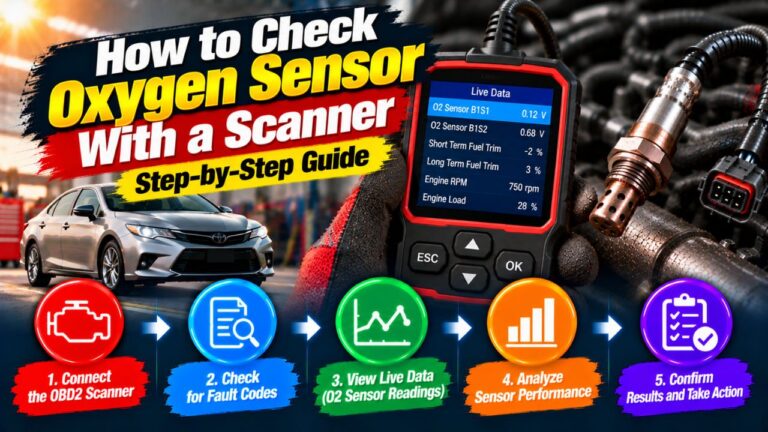
Short-term fuel trim (STFT) and long-term fuel trim (LTFT) show how much the ECM is adding or subtracting from its calculated fuel delivery.
Large positive corrections generally indicate that the computer is adding fuel.
Large negative corrections mean it is removing fuel.
Fuel trims can help reveal whether the engine is actually running outside its expected mixture range.
Inspect O2 or Air-Fuel Sensor Data
A scan tool can show how the upstream sensor responds while the engine runs.
The expected pattern depends on whether the vehicle uses:
- Narrowband O2 sensor
- Wideband air-fuel ratio sensor
Wideband and narrowband data should not be interpreted using the same rules.
Diagnose the Misfire Cylinder
If the code points to one cylinder, inspect that cylinder first.
A cylinder-specific problem makes a single upstream O2 sensor less likely to be the root cause.
Check the Spark Plugs First
Spark plugs are one of the most common causes of ignition-related misfires.
Inspect them for:
- Excessive wear
- Incorrect gap
- Carbon fouling
- Oil fouling
- Cracked insulator
- Physical damage
The condition of the plugs can also provide clues about whether the engine has been running rich or burning oil.
Check the Ignition Coils
Many modern gasoline engines use coil-on-plug ignition.
A weak ignition coil can cause intermittent or constant misfires.
On some vehicles, a technician can swap the suspected coil with a known-good cylinder and see whether the misfire moves.
If the trouble code follows the coil, the coil becomes a strong suspect.
Check for Vacuum Leaks
A vacuum leak introduces additional air that the engine computer did not expect.
That creates a lean condition and can cause rough idle and misfires.
Common leak areas include the intake manifold, PCV system, vacuum hoses, and brake booster connections.
A lean code associated with a misfire does not automatically mean the O2 sensor is bad.
Check Fuel Delivery
A cylinder needs the correct amount of fuel to burn properly.
Possible fuel-related causes include:
- Dirty injector
- Failed injector
- Low fuel pressure
- Weak fuel pump
- Restricted fuel supply
An O2 sensor may detect the resulting lean exhaust, but the sensor may not be the cause.
Check Engine Compression
If spark and fuel are normal, mechanical engine condition should be considered.
Low compression can result from problems such as:
- Burned valve
- Worn piston rings
- Head gasket damage
- Valve timing problem
No oxygen sensor replacement can correct a mechanical compression fault.
Should You Replace the O2 Sensor When You Have a Misfire Code?
Not automatically.
A misfire code by itself is not enough evidence to replace an oxygen sensor.
Replace the sensor when testing indicates that it is actually failing or when the sensor-specific diagnostic procedure confirms the fault.
Guessing can become expensive because a vehicle may have several oxygen sensors.
Replacing good sensors will not solve an ignition coil, injector, vacuum leak, or compression problem.
Can You Drive With a Misfire Caused by an O2 Sensor?
You should avoid prolonged driving with an active misfire regardless of the cause.
A mild intermittent misfire may still allow the vehicle to drive, but persistent misfires can overheat and damage the catalytic converter.
If the check engine light is flashing, the misfire is generally considered more serious.
Reduce driving and have the vehicle diagnosed as soon as practical.
Common Diagnostic Mistakes
One of the biggest mistakes is replacing an oxygen sensor simply because the computer reports an O2-related code.
The code identifies a circuit or operating condition the computer detected. It does not always identify the failed component.
Another common mistake is assuming a lean sensor reading proves the engine does not have enough fuel. An ignition misfire can leave unused oxygen in the exhaust and make the sensor report lean even though fuel delivery is not the original problem.
Proper diagnosis considers misfire counts, fuel trims, sensor data, ignition condition, fuel delivery, and engine mechanical health together.
FAQs About Can a Bad Oxygen Sensor Cause a Misfire
Can a bad O2 sensor cause a random misfire?
Yes. If an upstream O2 sensor causes the overall air-fuel mixture to become substantially too rich or too lean, multiple cylinders can misfire and potentially trigger P0300.
Can a bad O2 sensor cause one cylinder to misfire?
It is less likely.
A misfire affecting only one cylinder usually points more strongly toward that cylinder’s spark plug, ignition coil, injector, compression, or localized air leak.
Can a misfire make the O2 sensor look bad?
Yes.
A misfire can send unused oxygen into the exhaust and create abnormal oxygen sensor readings. The sensor may simply be reporting the exhaust condition accurately.
Can a bad oxygen sensor cause rough idle and misfire?
Yes, particularly if a faulty upstream sensor causes incorrect fuel adjustments.
However, rough idle and misfires have many other possible causes.
Will replacing the oxygen sensor fix a misfire?
Only if the sensor is actually responsible for the incorrect air-fuel mixture.
If the misfire comes from an ignition coil, spark plug, injector, vacuum leak, or mechanical problem, replacing the O2 sensor will not fix it.
Can a downstream O2 sensor cause a misfire?
Usually not.
The downstream sensor primarily monitors catalytic converter operation on most vehicles and normally has much less influence over primary fuel control than the upstream sensor.
Can a bad O2 sensor make spark plugs go bad?
Indirectly, yes.
If incorrect sensor feedback causes prolonged rich operation, carbon deposits may foul the spark plugs and eventually contribute to misfires.
Can an oxygen sensor cause a flashing check engine light?
A faulty oxygen sensor may contribute to conditions that cause severe misfires, but the flashing light is generally triggered because the engine is actively misfiring, not simply because an O2 sensor fault exists.
Conclusion
The overall verdict on can a bad oxygen sensor cause a misfire is yes, but usually indirectly. A faulty upstream oxygen or air-fuel ratio sensor can send incorrect information to the engine computer, causing fuel delivery to become excessively rich or lean. If the mixture becomes unstable enough, rough idle, hesitation, spark plug fouling, and random or multiple-cylinder misfires can follow.
However, a bad oxygen sensor should not be the first assumption when a vehicle has a misfire. Spark plugs, ignition coils, fuel injectors, vacuum leaks, fuel-pressure problems, and low compression are generally more direct causes, especially when only one cylinder is affected. An existing misfire can also create unusual O2 sensor readings and make a perfectly functional sensor appear suspicious.
The practical approach is to read the trouble codes, examine misfire data and fuel trims, inspect the ignition and fuel systems, and verify the oxygen sensor’s actual behavior before replacing it. If the sensor is truly causing incorrect fuel control, replacement can solve the problem. If it is only reporting a misfire created elsewhere, replacing the O2 sensor will not correct the underlying fault.