When Does EVAP Purge Valve Open? Timing and Normal Operation
If you are wondering when does EVAP purge valve open, the general answer is that the engine computer opens or pulses the valve after the engine is running and operating conditions are suitable for EVAP purging. On many vehicles, the purge valve is normally closed when it is not electrically commanded, and the PCM gradually opens it once conditions such as engine temperature, run time, load, and fuel-control status are appropriate.
The valve usually does not simply snap fully open and remain there. Modern vehicles commonly use pulse-width modulation (PWM) to cycle the purge solenoid rapidly, allowing the powertrain control module (PCM) to meter the amount of fuel vapor entering the engine.
During cranking and the earliest part of a cold start, purge is commonly disabled because uncontrolled fuel vapor could interfere with the air-fuel mixture. Once the engine has stabilized, the PCM can begin permitting purge according to its calibration.
It is also important not to confuse the purge valve with the EVAP vent valve. The purge valve controls vapor moving toward the engine, while the vent valve manages fresh-air flow on the charcoal-canister side of the system.
When Does EVAP Purge Valve Open?
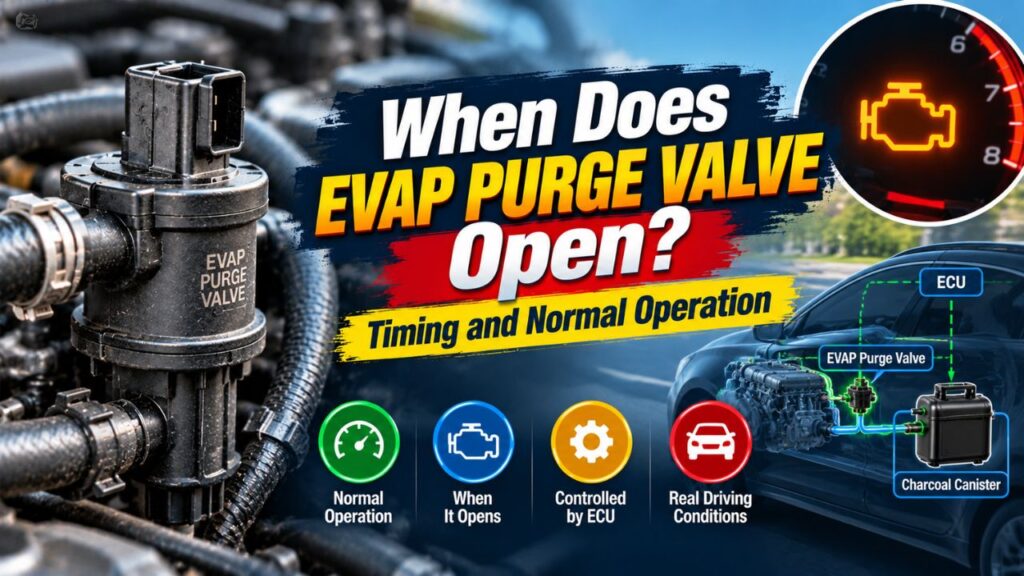
The EVAP purge valve opens when the PCM decides that the engine can safely burn fuel vapor stored in the charcoal canister.
There is no universal temperature, RPM, or number of seconds that applies to every vehicle. Manufacturers use different control strategies.
However, purge is commonly enabled only after some combination of these conditions has been met:
- Engine has been running for a certain amount of time
- Engine temperature has risen sufficiently
- Fuel control is operating normally
- Engine load is within an acceptable range
- Throttle conditions are appropriate
- EVAP diagnostics allow purging
- No relevant faults are preventing normal operation
On some older systems, purge may begin after roughly a minute of operation and once the engine reaches a specified coolant temperature. Newer systems can use far more complex strategies.
The key point is that the PCM controls when the purge valve opens. It does not normally remain open whenever the engine is running.
What Happens When the EVAP Purge Valve Opens?
The EVAP system captures gasoline vapor that would otherwise escape from the fuel tank.
The basic vapor path is:
Fuel tank → charcoal canister → purge valve → intake manifold → engine
The charcoal canister stores fuel vapor using activated carbon.
When the PCM opens the purge valve, intake vacuum helps pull vapor out of the canister and toward the engine.
The vapor mixes with incoming air and is burned during normal combustion.
At the same time, fresh air can enter through the vent side of the EVAP system, helping sweep stored hydrocarbons out of the charcoal canister.
This process allows the canister to continue accepting new fuel vapor later.
Does the EVAP Purge Valve Open Fully?
Not necessarily.
Modern purge valves are commonly controlled using pulse-width modulation.
Instead of simply being:
Open or closed
the PCM can rapidly switch the solenoid on and off.
For example, the computer may initially request a small amount of purge flow, then increase the purge duty cycle as engine conditions allow.
This gives the PCM much better control over the amount of vapor entering the engine.
The valve may therefore make a noticeable:
click-click-click
or
tick-tick-tick
sound while it operates.
That clicking can be completely normal.
What Determines When the Purge Valve Opens?
The PCM uses several inputs to decide when purging is appropriate.
The exact list varies by vehicle, but commonly considered factors include the following.
Engine Coolant Temperature
Many systems restrict purge when the engine is very cold.
Once the engine reaches an acceptable temperature range, the PCM may begin purge operation.
This helps prevent extra fuel vapor from interfering with cold-start fueling.
Time Since the Engine Started
Some systems require the engine to run for a certain amount of time before purge is enabled.
This gives the engine time to stabilize after startup.
Engine Load
The PCM may alter purge flow according to how much load is being placed on the engine.
An engine operating under moderate, stable conditions can often tolerate vapor flow more easily than one undergoing certain transient conditions.
Throttle Position
Throttle opening can affect intake vacuum and the amount of airflow entering the engine.
The PCM uses this information when calculating appropriate purge flow.
Fuel-Control Status
Many systems prefer normal closed-loop fuel control before significant purging begins.
In closed loop, oxygen-sensor feedback helps the PCM adjust fuel delivery as EVAP vapor enters the engine.
Fuel Tank Pressure
A fuel tank pressure sensor may provide information about pressure or vacuum inside the EVAP system.
This information is also important for EVAP diagnostic testing.
Does the EVAP Purge Valve Open During Crank?
Generally, the EVAP purge valve is not intentionally opened for normal purge flow during engine cranking.
During cranking, the PCM needs precise control over the mixture required to start the engine.
Introducing unpredictable fuel vapor from the charcoal canister could make starting more difficult.
Therefore, many systems keep the normally closed purge valve closed during:
- Engine cranking
- Initial startup
- Early cold operation
Once the engine starts and meets the required operating conditions, the PCM can begin purge operation.
However, vehicle calibrations differ, so an exact model-specific service procedure should be used if you are diagnosing purge commands during cranking.
Why Is Purging Usually Avoided During Cranking?
Gasoline vapor stored in the charcoal canister can vary greatly in concentration.
Sometimes it contains relatively little fuel.
After refueling, however, it may contain a much higher concentration of hydrocarbons.
Allowing that vapor into the engine during cranking could alter the starting mixture.
This is one reason a purge valve stuck open can cause hard starting, particularly immediately after filling the fuel tank.
Even though the PCM is not commanding purge, vapor can still enter through a mechanically leaking valve.
Is the EVAP Purge Valve Normally Open?
On many vehicles, no. The EVAP purge valve is normally closed.
“Normally closed” means that when the solenoid is not energized, the internal valve blocks the vapor passage.
The PCM must electrically command the solenoid to open the valve.
This design helps prevent uncontrolled fuel vapor or intake airflow from moving through the EVAP system.
A common operating pattern is:
| PCM Command | Typical Purge Valve Position |
| No purge command | Closed |
| Purge commanded | Open or pulsed |
| Engine off | Usually closed |
| During normal cranking | Usually closed |
| EVAP diagnostic test | May be commanded open or closed |
This describes a common design, but manufacturer-specific systems can vary.
Should an EVAP Purge Valve Normally Be Closed?
Yes, most conventional electronically controlled purge solenoids are designed to be closed when de-energized.
That means if the valve is disconnected electrically, many designs should return to their closed resting position.
This is important for diagnosis.
If a normally closed purge valve allows substantial airflow through its ports when unplugged and de-energized, the valve may be leaking or stuck partially open.
A leaking purge valve can create an uncontrolled path between the EVAP system and intake manifold.
Possible symptoms include:
- Hard starting after refueling
- Rough idle
- Long cranking
- Stalling
- Abnormal fuel trims
- Check Engine light
The exact test procedure should still be verified for the specific vehicle.
Should Air Pass Through a Disconnected EVAP Purge Valve?
For a typical normally closed purge valve, air should generally not flow freely through the valve when it is electrically disconnected and de-energized.
If you remove the valve and can easily blow air through it from one port to the other while no power is applied, that can indicate that the valve is not sealing.
However, there are several important qualifications.
Vehicle Design Matters
Not every purge valve uses exactly the same internal design.
Always compare your test results with the manufacturer’s specifications if available.
A Simple Blow Test Is Not Precise
Blowing through the valve can reveal a major internal leak, but it cannot accurately measure a small leak.
A valve may seem closed during a simple airflow check but still leak under engine vacuum.
Vacuum Testing Is More Reliable
A hand vacuum pump can provide a better indication of whether the valve holds vacuum when it should be closed.
If the valve cannot maintain the required seal, replacement may be necessary.
Clicking Does Not Prove the Valve Seals
A purge solenoid can click correctly when power is applied and still leak internally.
Electrical movement and proper sealing are two separate things that need to be considered.
What If Air Passes Through the Purge Valve When It Is Unplugged?
If your vehicle uses a normally closed valve and significant air passes through it while unplugged, the valve may be:
- Stuck open
- Partially stuck open
- Contaminated internally
- Mechanically worn
- Damaged at the valve seat
A stuck-open valve is particularly worth investigating if the vehicle also has hard starting after refueling.
The valve may allow concentrated fuel vapor into the intake during startup even though the PCM is not requesting purge.
Do not condemn the valve solely from a crude airflow test, though. Confirm its expected operating design and perform a proper sealing test where possible.
When Should an EVAP Purge Valve Be Venting?
The wording can be confusing because the purge valve itself is not normally the component that “vents” the EVAP system to the atmosphere.
The purge valve controls vapor flow toward the engine.
The EVAP canister vent valve controls the fresh-air or atmospheric side of the system.
During normal purge operation:
- The PCM commands purge flow.
- The purge valve opens or pulses.
- Engine vacuum draws vapor toward the intake.
- Fresh air enters through the EVAP vent path.
- Air moves through the charcoal canister.
- Stored fuel vapor is carried toward the engine.
So, if by “when should an EVAP purge valve be venting” you mean when should vapor be flowing through the purge valve, the answer is when the PCM has enabled purge during suitable engine-running conditions.
If you mean when should the EVAP system be open to atmospheric air, that function generally involves the canister vent valve rather than the purge valve.
Purge Valve vs. Vent Valve: Which One Is Normally Open?
This distinction is one of the easiest parts of the EVAP system to mix up.
On many common designs:
Purge valve: Normally closed.
Canister vent valve: Normally open.
The vent valve allows fresh air into the charcoal canister during normal purge operation.
During certain EVAP leak tests, the PCM may close the vent valve to seal the system.
It can then open the purge valve while the engine is running to create vacuum in the EVAP system.
Once the desired vacuum is reached, the PCM can close the purge valve and monitor how well the system holds that vacuum.
That is one way the vehicle detects vapor leaks.
Does the Purge Valve Open at Idle?
It can.
There is a common misconception that the purge valve should always remain closed at idle.
That is not universally true.
Some vehicles permit controlled purge at warm idle. Others limit purge under certain idle conditions.
If the PCM is commanding the purge valve at idle, rhythmic clicking can be normal.
What is not normal is uncontrolled purge flow caused by a valve that remains open even after the PCM commands it closed.
A scan tool can help distinguish commanded operation from an internal leak.
Does the Purge Valve Open When the Engine Is Cold?
Often, significant purge is delayed while the engine is cold.
The PCM may wait for:
- Minimum coolant temperature
- Minimum engine run time
- Stable fuel control
before enabling normal purging.
The exact thresholds vary substantially among vehicles.
This is why statements such as “the purge valve always opens after exactly 60 seconds” are not reliable for all cars.
One manufacturer or engine may use that strategy while another uses different criteria.
Does the Purge Valve Open Under Acceleration?
It can, depending on engine load and vehicle strategy.
The PCM continuously changes purge flow according to operating conditions.
During some higher-load conditions, purge may be reduced or suspended. Under other conditions, the engine may continue to accept controlled purge vapor.
The important point is that the valve does not operate on a simple fixed schedule.
It is integrated into the engine-management strategy.
Does the Purge Valve Open When the Engine Is Off?
For normal vapor purging, generally no.
The engine needs to be running to burn the stored hydrocarbons, so conventional purge flow toward the intake normally occurs during engine operation.
When the engine is switched off, a normally closed purge valve typically returns to its closed position.
Some vehicles perform engine-off EVAP diagnostic tests, but that does not mean the purge valve should remain freely open after shutdown.
The exact diagnostic strategy depends on the vehicle.
Why Does the Purge Valve Open During an EVAP Leak Test?
The PCM may use intake vacuum to test whether the EVAP system can hold pressure or vacuum.
A typical running leak-test strategy can involve:
- Engine is running.
- Vent valve closes.
- Purge valve opens.
- Engine vacuum is applied to the EVAP system.
- Fuel tank pressure sensor detects the increasing vacuum.
- Purge valve closes.
- PCM monitors how quickly vacuum decays.
If the vacuum disappears too quickly, the PCM may determine that the EVAP system has a leak.
This explains why purge operation is important for more than simply emptying the charcoal canister.
How Can You Tell When the Purge Valve Is Being Commanded Open?
The easiest professional method is a scan tool.
Depending on the vehicle and scan tool, data may show:
- EVAP purge command
- Purge duty cycle
- Purge percentage
- Fuel tank pressure
- EVAP system status
A bidirectional scan tool may also allow the purge solenoid to be manually commanded on and off during diagnosis.
You may also hear the valve clicking when it is being pulsed, although sound alone does not indicate the exact purge percentage.
Should the Purge Valve Click When It Opens?
Often, yes.
Because the valve contains an electromagnetic solenoid, each electrical activation can move an internal plunger and produce a click.
With PWM control, the valve can click repeatedly.
Normal clicking is usually:
- Rhythmic
- Relatively light
- Localized near the purge solenoid
A purge valve can still be defective even if it clicks, however.
The solenoid may move while the internal valve fails to seal.
What Happens If the Purge Valve Opens Too Early?
If fuel vapor enters the engine before the PCM expects it, the mixture can be disturbed.
This can be especially noticeable during:
- Cold starting
- Cranking
- Immediately after refueling
- Idle
Possible symptoms include:
- Hard starting
- Rough idle
- Stalling
- Rich or lean fuel-trim behavior
A mechanically stuck-open purge valve can create this condition even though the PCM itself is commanding the valve closed.
What Happens If the Purge Valve Never Opens?
If a purge valve remains closed when the PCM commands it open, the charcoal canister cannot purge normally.
Possible consequences include:
- Check Engine light
- Insufficient purge-flow codes
- EVAP monitor failure
- Charcoal canister becoming heavily loaded with vapor
- Increased evaporative-emissions problems
The engine may otherwise run normally because there is no uncontrolled airflow into the intake.
Normally Closed vs. Stuck Closed
These two terms should not be confused.
A normally closed purge valve is functioning correctly when it stays closed without an electrical command.
A stuck-closed purge valve is faulty because it remains closed even when the PCM commands it to open.
Similarly:
Normally closed = correct resting position
Stuck closed = failure to open when required
This distinction is important when testing the valve on a workbench.
Normally Open vs. Stuck Open
Most common purge solenoids are not designed to remain open with no electrical command.
A valve that passes substantial airflow while it should be de-energized and sealed may be stuck open or leaking internally.
This condition can be especially troublesome because engine vacuum may continuously draw vapor or air through the EVAP system.
Quick Purge Valve Operating Guide
| Operating Condition | Typical Purge Valve Behavior |
| Engine off | Closed |
| Key off | Closed |
| Engine cranking | Usually closed |
| Initial cold start | Usually closed or purge limited |
| Warm engine | Purge may begin |
| Normal cruise | Often pulsed as needed |
| Warm idle | May be pulsed on some vehicles |
| No electrical command | Usually closed |
| EVAP leak testing | May be commanded open or closed |
| Valve stuck open | Air/vapor may flow when it should not |
| Valve stuck closed | No purge flow when commanded |
These are general patterns. Exact behavior depends on vehicle calibration.
Can You Test the Purge Valve With the Electrical Connector Unplugged?
Yes, unplugging the connector can be useful during diagnosis, but the results must be interpreted correctly.
On a normally closed valve, disconnecting electrical power should leave the valve in its closed state.
A technician can then check whether it is leaking.
However, disconnecting the connector can set a circuit-related diagnostic trouble code, so this should be treated as a test rather than a permanent solution.
If the valve remains mechanically open even when unplugged, disconnecting it electrically will not fix the airflow problem.
What If the Purge Valve Is Open With No Power?
For a purge valve that is specified as normally closed, being open with no power generally indicates a mechanical problem.
Possible causes include:
- Internal contamination
- Worn sealing surface
- Stuck plunger
- Damaged return spring
- Internal mechanical failure
If proper testing confirms that the valve cannot seal, replacement is normally the appropriate repair.
FAQs About When Does EVAP Purge Valve Open
When does EVAP purge valve open after startup?
The exact timing varies, but the PCM commonly waits until the engine has been running and conditions such as engine temperature and fuel-control status are suitable. Purge may then be introduced gradually using pulse-width modulation.
Does the EVAP purge valve open during crank?
Usually not for normal purge operation. The valve is commonly kept closed during cranking so fuel vapor does not interfere with the carefully controlled starting mixture.
Is the EVAP purge valve normally open?
Usually no. Many EVAP purge solenoids are normally closed and open only when electrically commanded by the PCM.
Should an EVAP purge valve normally be closed?
Yes, on a typical normally closed design. When the solenoid is de-energized, it should block the purge passage.
Should air pass through a disconnected EVAP purge valve?
On most normally closed purge valves, air should not flow freely through the ports when the valve is electrically disconnected. Free airflow can indicate an internal leak or stuck-open valve, although model-specific specifications should be checked.
When should an EVAP purge valve be venting?
The purge valve should allow vapor flow toward the engine when the PCM commands purge. Atmospheric venting is generally handled by the separate EVAP canister vent valve.
Can the purge valve open at idle?
Yes. Some vehicles command controlled purge at warm idle. Hearing the purge solenoid pulse at idle does not automatically indicate a problem.
Does the purge valve stay open continuously while driving?
Usually not. Modern vehicles often pulse the valve and continually adjust its duty cycle according to engine and EVAP operating conditions.
Conclusion
So, when does EVAP purge valve open? Under normal operation, the PCM opens or pulses the purge valve after the engine is running and the conditions required for safe EVAP purging have been met. These conditions can include engine temperature, run time, load, throttle position, fuel-control status, and EVAP diagnostic requirements.
The purge valve is usually normally closed, including with the engine off and generally during cranking. Once purge is enabled, the PCM can rapidly cycle the solenoid to control exactly how much stored fuel vapor moves from the charcoal canister into the engine.
If a normally closed purge valve allows substantial airflow while electrically disconnected, it may be leaking or stuck open. And if you are trying to determine when an EVAP purge valve should be “venting,” remember that the purge valve controls vapor flow toward the engine; the separate EVAP vent valve normally manages atmospheric airflow through the canister.
Because control strategies vary by vehicle, scan-tool data and model-specific service information are the most reliable ways to determine exactly when a particular purge valve should open.