Which Way Should an EVAP Purge Valve Be Connected? Flow Guide
The short answer to which way should an EVAP purge valve be connected is that the valve normally routes fuel vapor from the charcoal canister toward the engine intake manifold when the ECU commands the valve open. On a directional purge valve, the canister hose connects to the canister or vapor-inlet side, while the other port connects to the engine vacuum or intake-manifold side.
However, you should not identify the ports by appearance alone. Some EVAP purge valves have an arrow, CAN/CANISTER marking, VAC/MAN marking, different connector shapes, or vehicle-specific hose fittings that indicate the correct orientation. Other designs may look nearly symmetrical.
Installing a directional purge valve backward can affect sealing, vapor flow, EVAP testing, idle quality, and diagnostic trouble codes. The safest method is to follow the markings on the valve or the hose-routing information for the exact vehicle.
Which Way Should an EVAP Purge Valve Be Connected?
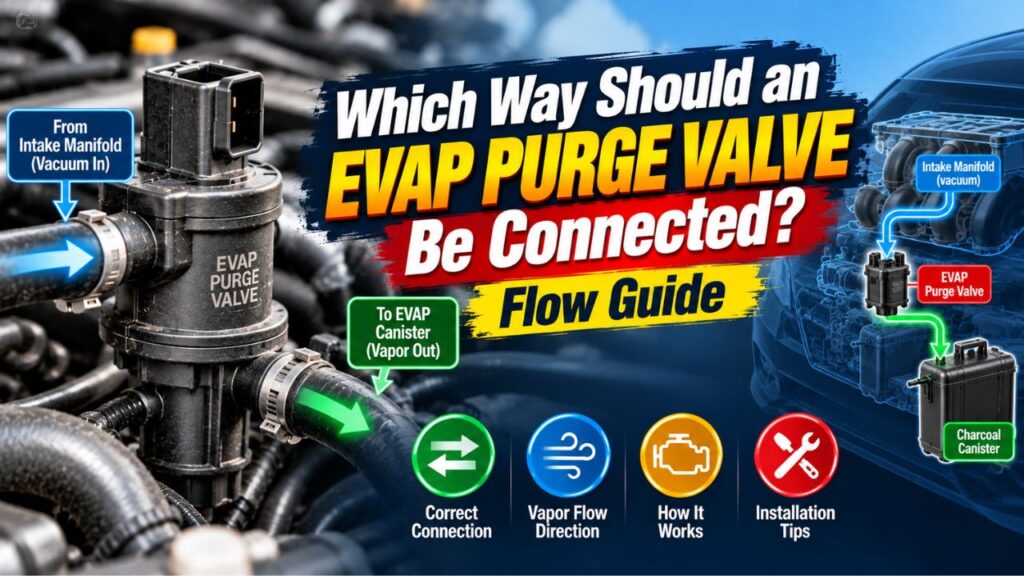
In a typical EVAP system, the normal purge-flow path is:
Fuel tank → charcoal canister → EVAP purge valve → intake manifold → engine
The charcoal canister stores gasoline vapor from the fuel tank. When operating conditions are correct, the engine computer opens the purge valve so intake vacuum can pull those vapors through the valve and into the engine.
Therefore, on a directional purge valve:
- The canister side connects to the hose coming from the charcoal canister.
- The intake side connects toward the intake manifold, throttle-body area, or another engine vacuum source specified by the manufacturer.
The exact port names can differ between vehicles, but the basic vapor movement during purge is generally from the canister toward the engine.
What Is EVAP Purge Valve Flow Direction?
EVAP purge valve flow direction describes the intended path of vapor through the purge solenoid when the valve is operating.
During normal purging, fuel vapor moves out of the charcoal canister, through the purge valve, and toward the engine intake.
Intake manifold vacuum helps create this movement.
The valve does not simply remain open whenever the engine is running. The engine control module, or ECM, controls purge flow according to conditions such as engine temperature, load, speed, and EVAP-system strategy.
On many modern vehicles, the purge solenoid is pulse-width controlled rather than simply switched fully open all the time.
The valve therefore needs to meter vapor accurately as well as seal when purge is not commanded.
Does Purge Valve Have a Direction?
Yes, many purge valves do have a preferred or required direction.
Some purge solenoids are designed internally so that vacuum pressure acts on the valve in a particular way. Reversing the ports can change how well the valve seals or how accurately it controls flow.
Other purge-valve designs may tolerate airflow in both directions mechanically, but that does not mean you should install them either way.
Manufacturers may use a specific orientation because of:
- Internal valve-seat design
- Solenoid construction
- Vacuum loading
- Flow calibration
- Leak-test requirements
- Hose routing
- Port shape
- Integrated check-valve functions
For this reason, assume the valve is directional unless the manufacturer specifically indicates otherwise.
Purge Valve Inlet and Outlet Explained
The words inlet and outlet can sometimes create confusion because different manuals describe the ports differently.
The easiest way to understand them is by following normal purge flow.
Canister Side
The canister-side port receives fuel vapor from the charcoal canister during normal purge operation.
This may be labeled:
CAN
CANISTER
TANK
or occasionally another vehicle-specific abbreviation.
This hose ultimately leads toward the charcoal canister and fuel-vapor storage system.
Intake-Manifold Side
The other side connects toward engine vacuum.
It may be labeled:
VAC
MAN
MANIFOLD
ENG
or with an arrow indicating flow toward the engine.
This side experiences intake vacuum when the engine is running under conditions that produce manifold vacuum.
How to Tell Which Side of Purge Valve Goes to Intake
The most reliable method is to look for markings on the valve body.
Inspect both ports closely.
You may find an arrow molded into the plastic or printed on the housing.
The arrow generally indicates the intended vapor-flow direction when the valve is open.
Since normal purge flow moves from the canister toward the engine, the arrow usually points toward the intake-manifold side.
You may also find labels such as CAN and VAC.
If the valve is marked:
CAN → connect that side to the charcoal-canister hose.
VAC or MAN → connect that side toward the engine intake.
Do not rely only on which port is larger.
Port diameter and hose-fitting design are often chosen for packaging and connection security, not necessarily to indicate flow direction.
Which Purge Valve Hose Goes to the Canister?
The hose that runs toward the charcoal canister connects to the canister-side port of the purge valve.
Depending on the vehicle, this hose may disappear toward the rear of the engine compartment and eventually run underneath the vehicle toward the canister.
The charcoal canister itself is often located near the fuel tank, although some vehicles place it elsewhere.
The opposite purge-valve hose usually travels only a relatively short distance to the intake manifold or another vacuum connection in the engine compartment.
If both hoses have been disconnected and you cannot tell which is which, trace them physically before reconnecting the valve.
Do not guess.
Which Side Goes to the Intake Manifold?
The engine-vacuum side of the purge valve connects to the intake manifold or another designated intake connection.
This hose provides the vacuum that pulls fuel vapor through the EVAP system when the valve is commanded open.
On many vehicles, the engine-side hose is relatively short because the purge valve is mounted close to the intake manifold.
However, location alone is not a guaranteed identification method.
Some manufacturers mount the purge valve farther away or integrate it into a hose assembly.
Use port markings or service information whenever possible.
Can You Install a Purge Valve Backwards?
Yes, physically installing some purge valves backward may be possible if the hose fittings fit.
But you should not install a directional purge valve backward.
A backward valve may:
- Fail to seal properly
- Flow incorrectly
- Create unexpected purge flow
- Cause a rough idle
- Cause hard starting
- Trigger EVAP diagnostic codes
- Interfere with leak testing
In some cases, the vehicle may initially appear to run normally.
That does not prove the installation is correct.
The EVAP system performs self-tests under specific conditions, so a backward valve may not cause a warning light immediately.
What Happens If a Purge Valve Is Installed Backwards?
The result depends on the internal design of the valve.
A purge solenoid is not simply an empty tube with an electrical switch. Internal pressure and vacuum can influence how its valve seat operates.
If installed backward, manifold vacuum may act against the wrong side of the internal mechanism.
That can cause the valve to leak when it is supposed to remain closed.
A leaking purge valve can act somewhat like an unintended vacuum path.
Possible symptoms include rough idle, fuel-trim changes, hesitation, and hard starting after refueling.
Another possibility is restricted purge flow. If the internal design does not flow properly in reverse, the engine computer may command purge but detect less vapor movement than expected.
That can result in an EVAP-related trouble code.
Can a Backward Purge Valve Cause Hard Starting After Refueling?
Yes, it is possible if the reversed installation prevents the valve from sealing correctly.
After refueling, the EVAP system may contain a large amount of fuel vapor.
If manifold vacuum can pull that vapor into the engine when the purge valve should be closed, the engine may receive an overly rich mixture during startup.
You may notice longer cranking, rough startup, or an engine that starts and then stalls.
A purge valve installed correctly can produce similar symptoms if it is internally stuck open, so orientation should be checked as part of diagnosis.
Can a Backward Purge Valve Cause a Check Engine Light?
Yes.
The ECM monitors how the EVAP system responds during purge and leak testing.
If the valve does not seal or flow as expected, the computer may detect:
- Incorrect purge flow
- Excessive purge flow
- Insufficient purge flow
- EVAP leak conditions
A trouble code does not specifically prove the valve was installed backward, but incorrect orientation should be checked if the problem started immediately after purge-valve replacement.
Can You Use the Arrow on the Purge Valve?
Yes, if the valve has a clear factory arrow.
The arrow is generally the best visual clue for flow orientation.
For normal EVAP purging, the arrow should correspond with vapor movement:
Charcoal canister → purge valve → engine intake
Do not confuse an arrow used for assembly, electrical orientation, or another marking with a flow arrow.
If the marking is unclear, verify it using the vehicle’s service information or the replacement-part documentation.
What If the Purge Valve Has No Arrow?
Some purge valves have no obvious flow-direction arrow.
In that case, look for other markings.
Common clues include:
- CAN
- VAC
- MAN
- IN
- OUT
- Different factory quick-connect fittings
- Different hose diameters
- Original hose position
If the old purge valve is still available, compare the new valve with it before removing hoses from the old one.
Taking a photo before disassembly is especially helpful.
If everything has already been disconnected and no markings are visible, identify the hoses by tracing them rather than using port shape alone.
Can Hose Size Tell You Purge Valve Direction?
Sometimes it provides a clue, but it should not be your primary method.
Manufacturers occasionally use differently sized vapor hoses or unique quick-connect fittings that make incorrect installation difficult.
However, a larger port does not universally mean canister side or manifold side.
A replacement aftermarket valve may also use adapters or slightly different port designs.
Use the markings and vehicle-specific routing information first.
Can You Tell Direction by Blowing Through the Purge Valve?
An airflow test can sometimes tell you whether a normally closed purge valve is leaking, but it is not the best method for determining installation direction.
Many normally closed purge valves should block airflow while unpowered.
That means you may not be able to tell the intended direction simply by attempting to pass air through the valve.
If the valve is properly activated during a vehicle-specific test, it may allow flow.
Even then, free airflow does not necessarily tell you which orientation the manufacturer requires.
The internal valve may flow in both directions when open but only seal correctly in one direction.
Use markings or service information for orientation.
Should Air Pass Through an Unplugged Purge Valve?
For many normally closed EVAP purge valves, air should not pass freely through the valve when the electrical connector is disconnected and no command is being applied.
If air flows easily through a normally closed purge valve while it is unpowered, the valve may be leaking or stuck open.
However, not every EVAP system uses an identical purge-valve design.
Always confirm the valve’s normal state for the particular vehicle before declaring it defective.
How to Identify the Purge Valve Hoses Before Removal
The easiest way to avoid connecting a new purge valve backward is to document the original setup before taking it apart.
Take a clear photo showing:
- Both hoses
- Electrical connector
- Valve position
- Any arrows
- Any molded port labels
You can also mark the canister-side hose with a small piece of removable tape.
Then transfer the hoses one at a time.
This simple approach is especially useful when the two ports look almost identical.
How to Trace the Canister Hose
If both hoses are already disconnected, start with the line that runs away from the intake system.
The canister-side hose typically joins the EVAP vapor plumbing that leads toward the charcoal canister.
On many vehicles, that line continues toward the rear of the vehicle and eventually reaches the fuel tank area.
The intake-side connection instead routes toward the intake manifold or throttle-body region.
If the routing disappears behind several components and cannot be followed visually, consult the vehicle’s vacuum or EVAP hose diagram.
How to Trace the Intake Hose
The intake-side purge hose eventually reaches an engine vacuum source.
Follow the hose away from the purge valve.
If it connects directly to the intake manifold or to a designated intake-vacuum passage, that is the engine side.
This line often sees significant vacuum while the engine is operating.
Do not remove hoses from a running engine simply to identify vacuum unless the correct diagnostic procedure calls for it.
A disconnected manifold-vacuum hose can create a large vacuum leak and cause the engine to run poorly.
Is the Purge Valve Normally Open or Closed?
Many EVAP purge valves are normally closed when they are not electrically commanded.
That prevents uncontrolled vapor flow into the intake.
The engine computer opens the valve only when operating conditions are appropriate for purging the charcoal canister.
This normally closed design is one reason valve orientation matters.
The internal pressure difference between the intake side and canister side can affect how well the valve seals.
Still, do not assume every purge valve uses exactly the same design. Vehicle-specific information always takes priority.
Why Does the Purge Valve Need Intake Vacuum?
The purge valve does not normally pump fuel vapor by itself.
Instead, it controls a passage.
When it opens, pressure differences—often including intake manifold vacuum—draw vapor from the charcoal canister toward the engine.
The engine computer controls how much purge is allowed so that the additional vapor does not significantly disturb the engine’s air-fuel ratio.
This is also why a valve that leaks when it should be closed can affect idle quality.
The intake manifold is capable of pulling flow through the EVAP circuit even when the computer did not request it.
Does the Fuel Vapor Flow From the Engine to the Canister?
Not during normal purge operation.
During normal EVAP purge, vapor flows from the charcoal canister toward the engine.
The fuel tank supplies vapor to the charcoal canister during storage and venting conditions.
Then, when purging is commanded, the stored vapor travels:
Canister → purge valve → intake manifold
A properly connected purge valve controls this second part of the path.
Is the Purge Valve the Same as the Vent Valve?
No.
The purge valve and EVAP vent valve perform different jobs.
The purge valve is normally located on the engine side of the EVAP system and controls vapor movement toward the intake.
The vent valve is generally associated with the charcoal-canister side and controls fresh-air movement and EVAP-system sealing.
Confusing the two can make hose routing much harder to understand.
If you are working near the intake manifold, you are more likely dealing with the purge solenoid.
If you are working near the charcoal canister or fuel tank, the component may be the vent valve instead.
How to Install an EVAP Purge Valve Correctly
Before installing the replacement, compare it closely with the original valve.
Confirm that the electrical connector, port layout, and mounting position match.
Look for any directional arrow or CAN/VAC labels.
Connect the canister hose to the correct canister port and the engine hose to the intake or vacuum port.
Push quick-connect fittings fully into place until their retainers lock.
Do not force a fitting that does not naturally fit.
A connection that feels wrong may indicate that the valve is reversed or that the replacement part is incorrect.
After installation, reconnect the electrical plug and make sure no vapor hose is kinked, pinched, or left disconnected.
What to Check After Replacing a Purge Valve
Start the engine and check that it idles normally.
Listen for obvious vacuum leaks around the repaired area.
If a scan tool is available, clear the old fault code after confirming the repair.
Keep in mind that clearing the code does not prove the EVAP problem has been solved.
The vehicle may need to complete its EVAP monitor under specific driving and temperature conditions.
If the same code returns after replacement, verify the valve orientation before replacing additional components.
How Do You Know If the New Purge Valve Is Backwards?
Suspect incorrect orientation if the problem begins immediately after replacement.
Possible clues include a new rough idle, hard starting after refueling, unexpected fuel-trim changes, or the same EVAP code returning.
First verify that the canister and intake hoses were not accidentally swapped.
Then check the flow arrow or port labels.
If orientation is correct, the replacement valve itself, electrical circuit, or another EVAP component may still be responsible.
Common Mistakes When Connecting an EVAP Purge Valve
One common mistake is assuming the two ports are interchangeable simply because they are similar in size.
Another is using hose diameter alone to determine direction.
A third mistake is copying a diagram from a different engine or model year.
EVAP routing can change even within the same vehicle model when a different engine is installed.
It is also easy to confuse the canister purge valve with the EVAP vent solenoid.
The safest approach is always to identify the exact part and follow the valve markings or vehicle-specific hose diagram.
Can a Wrong Purge Valve Cause the Same Problem as a Backward Valve?
Yes.
A purge valve that physically fits but has the wrong internal calibration or port configuration can cause problems even if the hoses are connected according to their apparent positions.
Replacement parts should be matched using the exact vehicle year, make, model, engine, and part number when possible.
This is particularly important with aftermarket valves that may look almost identical across several applications.
When Should You Ask a Mechanic to Check the Connection?
Professional diagnosis may be useful if the hose routing is unclear or if the EVAP fault remains after replacement.
A technician can use factory diagrams and a scan tool to identify the proper connections and verify actual purge operation.
Further testing may include:
- Purge-command testing
- Fuel tank pressure monitoring
- Electrical circuit testing
- EVAP smoke testing
This is usually more effective than repeatedly switching hoses or replacing EVAP parts by trial and error.
FAQs About Which Way Should an EVAP Purge Valve Be Connected
Which Way Should an EVAP Purge Valve Be Connected?
The normal purge path runs from the charcoal canister through the purge valve and toward the engine intake manifold.
On a directional valve, connect the canister hose to the CAN or canister side and the intake hose to the VAC, MAN, or engine side.
Does a Purge Valve Have a Direction?
Many purge valves do.
Even if a valve can physically pass air in either direction while open, its internal design may require a specific orientation to seal and meter vapor correctly.
What Is the EVAP Purge Valve Flow Direction?
During normal purge operation, vapor flows from the charcoal canister toward the intake manifold.
The engine then burns those fuel vapors during normal combustion.
Can You Install a Purge Valve Backwards?
You may be able to physically connect some valves backward, but you should not.
A backward directional purge valve may leak, flow incorrectly, cause drivability problems, or trigger EVAP trouble codes.
How Can I Tell Which Side of the Purge Valve Goes to the Intake?
Look for an arrow or a marking such as VAC, MAN, MANIFOLD, or ENG.
If there are no markings, trace the hose that leads to the intake manifold or use the vehicle’s EVAP routing diagram.
Which Purge Valve Hose Goes to the Canister?
The hose that ultimately runs toward the charcoal canister connects to the canister side of the purge valve.
That port may be marked CAN or CANISTER.
Should a Purge Valve Pass Air in Both Directions?
Not necessarily.
Many normally closed purge valves should block airflow while unpowered. When opened, some may physically pass air both ways, but that does not mean they can be installed in either direction.
What Happens If I Swap the Purge Valve Hoses?
Swapping the hoses on a directional valve can cause incorrect flow or poor sealing.
Possible results include a check engine light, rough idle, hard starting after refueling, and EVAP-system test failures.
Conclusion
The answer to which way should an EVAP purge valve be connected is that normal EVAP purge flow travels from the charcoal canister, through the purge valve, and toward the engine intake manifold.
If the valve has CAN and VAC markings, connect CAN to the charcoal-canister hose and VAC or MAN to the engine-vacuum side. If it has a flow arrow, the arrow normally follows vapor flow toward the engine during purge operation.
Do not assume the two ports are interchangeable. Many purge valves are directional because internal valve design, vacuum pressure, and EVAP calibration depend on the correct orientation. If markings are unclear, trace the hoses or use the vehicle-specific EVAP diagram rather than guessing.
Correctly identifying the purge valve inlet and outlet prevents backward installation, incorrect purge flow, hard starting, rough idle, and unnecessary EVAP trouble codes.